
Scores for all instruments: 16,000+ (active and growing), over 236,000 pages.
All genres and levels: Jazz & Blues, Rock & Pop, Classical & Contemporary, Film & Musicals;
books & biographies; methods, études, play-along tracks (MP3) for Jazz & Rock.
Access & benefits: US$15.99 one-time payment, valid for lifetime, full Library access.
Remembering Charles Aznavour, born on this day in 1924.
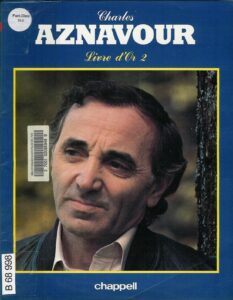
Charles Aznavour- La Bohème avec partition
Charles Aznavour - Short biography
Beloved French chanson entertainer Charles Aznavour, who wrote more than 800 songs, recorded more than 1,000 of them in French, English, German, and Spanish and sold over 100 million records in all, was born Shahnour Vaghinag Aznavourian on May 22, 1924, in Paris. He was the younger of two children born to Armenian immigrants who fled to France.
His mother was a seamstress as well as an actress and his father was a baritone who sang in restaurants. Both Charles and his elder sister waited on tables, and he performed, as well. He delivered his first poetic recital while just a toddler. Within a few years later he had developed such a passion for singing/dancing, that he sold newspapers to earn money for lessons.
He took his first theatrical bow in the play "Emil and the Detectives" at age 9 and within a few years was working as a movie extra. He eventually quit school and toured France and Belgium as a boy singer/dancer with a traveling theatrical troupe while living the Bohemian lifestyle. A popular performer at the Paris' Club de la Chanson, it was there that he was introduced in 1941 to the songwriter Pierre Roche.
Together they developed names for themselves as a singing/writing cabaret and concert duo ("Roche and Aznamour"). A Parisian favorite, they became developed successful tours outside of France, including Canada. In the post WWII years Charles began appearing in films again, one of them as a singing croupier in Adieu chérie (1946).
Eventually Aznavour earned a sturdy reputation composing street-styled songs for other established musicians and singers, notably Édith Piaf, for whom he wrote the French version of the American hit "Jezebel". Heavily encouraged by her, he toured with her as both an opening act and lighting man.
He lived with Piaf out of need for a time not as one of her many paramours. His mentor eventually persuaded him to perform solo (without Roche) and he made several successful tours while scoring breakaway hits with the somber chanson songs "Sur ma vie" and "Parce que" and the notable and controversial "Après l'amour." In 1950, he gave the bittersweet song "Je Hais Les Dimanches" ["I Hate Sundays"] to chanteuse Juliette Gréco, which became a huge hit for her.

In the late 50s, Aznavour began to infiltrate films with more relish. Short and stubby in stature and excessively brash and brooding in nature, he was hardly leading man material but embraced his shortcomings nevertheless. Unwilling to let these faults deter him, he made a strong impression with the comedy Une gosse 'sensass' (1957) and with Paris Music Hall (1957). He was also deeply affecting as the benevolent but despondent and ill-fated mental patient Heurtevent in La cabeza contra la pared (1959).
A year later, Aznavour starred as piano player Charlie Kohler/Edouard Saroyan in Francois Truffaut's adaptation of the David Goodis' novel Tirad sobre el pianista (1960) [Shoot the Piano Player], which earned box-office kudos both in France and the United States. This sudden notoriety sparked an extensive tour abroad in the 1960s.
Dubbed the "Frank Sinatra of France" and singing in many languages (French, English, Italian, Spanish, German, Russian, Armenian, Portuguese), his touring would include sold-out performances at Carnegie Hall (1964) and London's Albert Hall (1967).
Aznavour served as actor and composer/music arranger for many films, including Gosse de Paris (1961), which he also co-wrote with director Marcel Martin, and the dramas Las cuatro verdades (1962) [Three Fables of Love") and Caroline chérie (1968) [Dear Caroline]. The actor also embraced the title role in the TV series "Les Fables de la Fontaine" (1964), then starred in the popular musical "Monsieur Carnaval" (1965), in which he performed his hit song "La bohême".
His continental star continued to shine and Aznavour acted in films outside of France with more dubious results. While the satirical Candy (1968), with an international cast that included Marlon Brando, Richard Burton and Ringo Starr, and epic adventure Los libertinos (1970) were considered huge misfires upon release, it still showed Aznavour off as a world-wide attraction.
While he was also seen in La prueba del valor (1970) (1970), The Blockhouse (1973) (1973) and an umpteenth film version of Agatha Christie's Diez negritos (1974), it was his music that kept him in the international limelight. Later films included Yiddish Connection (1986), which he co-wrote and provided music; Il maestro (1990) with Malcolm McDowell; the Canadian-French production Ararat (2002) for which he received special kudos; cameos as himself in La verdad sobre Charlie (2002) and Emmenez-moi (2005); and his final feature film, Mon colonel (2006)
Films aside, his chart-busting single "She" (1972-1974) went platinum in Great Britain. He also received thirty-seven gold albums in all. His most popular song in America, "Yesterday When I Was Young" has had renditions covered by everyone from Shirley Bassey to Julio Iglesias.
In 1997, Aznavour received an honorary César Award. He has written three books, the memoirs "Aznavour By Aznavour" (1972), the song lyrics collection "Des mots à l'affiche" (1991) and a second memoir "Le temps des avants" (2003). A "Farewell Tour" was instigated in 2006 at age 82. He died Married at least three times (some claim five) to Micheline Rugel, Evelyne Plessis and Ulla Thorsell, he fathered six children (daughters Katia, Patricia and Seda Aznavour, and sons Misha, Nicholas, and Patrick Aznavour). He died on October 1, 2018, in France.
Browse in the Sheet Music Library:
Or browse in the categories menus & download the Library Catalog PDF:
Charles Aznavour Discography
In a career as a composer/singer/songwriter that spanned over 70 years, Charles Aznavour recorded more than 1,200 songs interpreted in nine languages. He has written or co-written over 1,000 songs for himself and others. With 180 million records sold, he is one of the best-selling artists of all time. Additionally, he appeared in more than 80 films. Furthermore, he released 51 studio albums in French, as well as 41 albums in other languages such as English, Italian, Spanish, and German. He also released 23 live albums.
In this article, you will find the complete discography of Charles Aznavour, including his French and international releases. It covers his earliest 78 RPM recordings made with Pierre Roche for the Polydor label, as well as his most recent CDs released on the EMI and Barclay Records labels.
Efforts are made to keep this article up to date, but the French version may have more recent information. Charles Aznavour's discography is constantly evolving with new releases, collaborations, and recordings. Regular updates are made, but it's advisable to check the French version for the latest information on his discography.