Scores for all instruments: 16,000+ (active and growing), over 236,000 pages.
All genres and levels: Jazz & Blues, Rock & Pop, Classical & Contemporary, Film & Musicals;
books & biographies; methods, études, play-along tracks (MP3) for Jazz & Rock.
Access & benefits: US$15.99 one-time payment, valid for lifetime, full Library access.
Table of Contents
Remembering Count Basie, born on this day in 1904
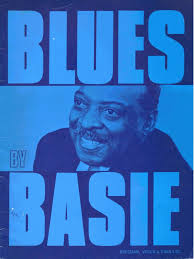
The best sheet music download from our Library.
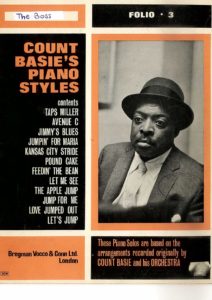
Please, subscribe to our Sheet Music Library.
Count Basie: The Architect of Swing
A Century of Swing
On August 21, 1904, William James Basie was born in Red Bank, New Jersey, beginning a life that would fundamentally reshape American music . Count Basie, as the world would come to know him, built a musical empire on a foundation of swing—a rhythmic propulsion so infectious and precise that it defined an era. His band didn't just play music; it embodied a feeling, a way of life. As a modest pianist who understood that his greatest instrument was the entire orchestra, Basie cultivated a sound that was simultaneously lean and powerful, bluesy and sophisticated . This article explores the extraordinary journey of the man who became jazz royalty, his revolutionary music, and the legacy that continues to swing.
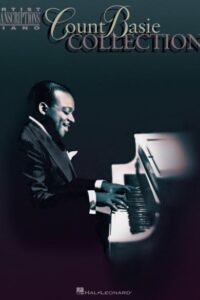
Biography
Early Life and Musical Beginnings
Born to working-class parents who were both amateur musicians—his father played the E-flat horn and his mother was a pianist who became his first teacher—Basie's musical foundation was laid early . As a young man, he moved to New York City, where he immersed himself in the vibrant Harlem jazz scene. There, he absorbed the styles of the great stride pianists of the day. He had the extraordinary fortune to study informally with two masters: James P. Johnson, from whom he learned the "stride" style of contrasting left-hand beat with right-hand melody, and Thomas "Fats" Waller, who taught him to play the organ .
Basie's early career included accompanying silent films in Harlem theaters, a job that came about when he was changing reels at a local movie theater and the house musician failed to appear . This period also saw him playing in vaudeville and various dance halls, honing his craft and learning the practical realities of show business.
The Kansas City Crucible and Rise to Fame
In 1927, a tour cancellation left Basie stranded in Kansas City, Missouri. This "gateway to the West" would become his musical proving ground . He joined first Walter Page's Blue Devils, a legendary band featuring vocalist Jimmy Rushing, and then the more polished Bennie Moten Orchestra . When Moten died unexpectedly in 1935, Basie inherited the core of that band and formed his own group, initially known as the Barons of Rhythm .
The Barons of Rhythm became a fixture at the Reno Club in Kansas City, performing nightly to enthusiastic crowds. Their broadcasts on local radio, often filling the late-night airwaves with bluesy, riff-based music, caught the attention of a wider audience. It was during this time that a radio announcer gave him the regal moniker "Count," positioning him alongside the already-titled Duke Ellington and Earl Hines.

A key moment came when the band, with time to fill at the end of a broadcast, began to improvise. Basie liked the results and named the piece "One O'Clock Jump." He recalled, "we hit it with the rhythm section and went into the riffs, and the riffs just stuck. We set the thing up front in D-flat, and then we just went on playing in F" . It would become his signature tune.
National Stardom and the Decca Years
The band's radio broadcasts reached the ears of the influential music producer and critic John Hammond, who traveled to Kansas City to see them . Impressed, Hammond arranged for the band to record in Chicago in 1936. These sessions, released under the name Jones-Smith Incorporated due to contractual issues, marked the recording debut of the brilliant tenor saxophonist Lester Young .
Soon after, Basie and the band, now known as the Count Basie Orchestra, moved to New York City. In 1937, they signed with Decca Records and began a string of recordings that would define the swing era.

The "All-American Rhythm Section"
The key to the Basie sound was its rhythm section, often referred to as the "All-American Rhythm Section" . It featured Basie himself on piano, Freddie Green on guitar, Walter Page on bass, and Jo Jones on drums . They created a model of tightly meshed, perfectly balanced ensemble playing that has never been surpassed . They provided a light, swinging, and propulsive foundation that allowed the horn soloists to soar.
The "Old Testament" and "New Testament" Bands
Jazz historians often divide Basie's career into two distinct periods. The first, from the late 1930s to about 1950, is known as the "Old Testament" band. It featured legendary soloists like Lester Young, Buck Clayton, Harry "Sweets" Edison, and the powerful blues shouter Jimmy Rushing . This band was the epitome of Kansas City swing—loose, bluesy, and full of "jump."
After 1950, due to economic pressures that had diminished the big band era, Basie was forced to pare down to a septet . In 1952, he organized a new big band that became known as the "New Testament" band . This group had a slightly more polished and modern sound but retained the essential Basie rhythm. It featured a new generation of soloists, including tenor saxophonists Frank Foster and Frank Wess, trumpeter Thad Jones, and the powerful baritone vocalist Joe Williams.

Later Career and Accolades
In the 1950s, Basie's career experienced a resurgence. Hits like Frank Foster's "Shiny Stockings" and Joe Williams' rendition of "Every Day I Have the Blues" brought a new wave of popularity . He also began a fruitful series of recording sessions with vocalists, backing such stars as Ella Fitzgerald, Frank Sinatra, Tony Bennett, and Sammy Davis, Jr. .
Basie's music was also making its way onto the silver screen. He made numerous film and television appearances, and his music appeared in soundtracks, with "April in Paris" becoming a signature piece for the band . In 1958, Basie became the first Black artist to win a Grammy Award, and his career would eventually accumulate nine Grammys, along with the Grammy Trustees Award in 1981 and the Lifetime Achievement Award . In 1983, he received an American Jazz Masters Award from the National Endowment for the Arts .
Count Basie continued to perform and record until his final years. He passed away on April 26, 1984, leaving behind a legacy that remains as vital as ever .
Music Style and Technical Innovations
The Essence of Swing
Count Basie's music is, first and foremost, about swing. The band exemplified the core quality in jazz called swing, a rhythmic feeling that is both relaxed and powerfully propulsive . This was achieved not through complexity but through precision and a deep, intuitive connection between the musicians.
The "All-American Rhythm Section"
The engine of the Basie sound was his rhythm section . Basie's own piano playing was famously sparse and economical. He had perfected a style of "comping," playing syncopated and highly precise chords that punctuated the beat and drove the band . He understood that his role as a leader was to cue the band, and his minimalist approach left plenty of sonic space for the other instruments.
- Freddie Green (guitar): His four-to-the-bar rhythmic strumming was the bedrock of the rhythm section, providing an unerring, swinging pulse.
- Walter Page (bass): He established a walking bass line style that was melodic and rhythmically solid.
- Jo Jones (drums): Known as "Papa Jo," he revolutionized jazz drumming, moving the time-keeping from the bass drum to the hi-hat cymbal. This created a much lighter, more buoyant feel that became a signature of the Basie sound .
The "Kansas City Sound" and the Blues
Basie's style was deeply rooted in the blues, a tradition of the American Southwest rather than the Deep South . The band frequently updated the blues songs of the 1920s, infusing them with a modern, swinging energy. The "Kansas City sound" was often described as being like "an old-time revival," with the band functioning as a call-and-response choir . As Basie himself said, he wanted "to be the social interpreter of blues music, the language of all Negroes" . This blues sensibility was the emotional core of his music, even in its most sophisticated moments.
Composition Characteristics and Major Works
The Riff and Call-and-Response
Basie's arrangements were often built around simple, catchy riffs—short, repeated musical phrases. This approach, rooted in the call-and-response patterns of African music, allowed for an incredible amount of energy and interplay. The band would trade riffs back and forth between the saxophone and brass sections, creating a thrilling, conversational sound .
Head Arrangements
In the early days, many of Basie's arrangements were "head arrangements," meaning they were worked out collectively in rehearsal and memorized rather than being written down . This gave the music a spontaneous, organic feel. Once they found a riff or a sequence that worked, they could repeat it through collective memory .
Notable Compositions
Basie's most famous pieces remain cornerstones of the big band repertoire :
- "One O'Clock Jump" (1937): The band's signature tune, a simple but infectious blues-based theme built on riffs. It became one of the most famous jazz compositions of all time and a standard for the swing era .
- "Jumpin' at the Woodside" (1938): Another classic jam-session piece that showcases the band's high-energy, riff-based style.
- "Swingin' the Blues" (1938): A definitive example of the band's bluesy, relaxed swing.
- "April in Paris" (1956): This hit from the "New Testament" era became an unexpected signature piece, famous for its false ending and triumphant reprise.
- "Shiny Stockings" (1956): A composition by Frank Foster for the "New Testament" band, it became one of their biggest hits .
- "Every Day I Have the Blues" (1955): Joe Williams' vocal performance on this track became the definitive version of the blues standard .
Encounters with Other Artists
Throughout his long career, Basie collaborated with a who's who of jazz and popular music:
- Lester Young: Their collaboration in the late 1930s and early 1940s was one of the most fruitful partnerships in jazz history. Young's light, airy tenor saxophone was the perfect foil for Basie's rhythm section, and his solos inspired a generation of musicians .
- Billie Holiday and Jimmy Rushing: Basie's bands featured two of the greatest blues and jazz singers of all time. Holiday's subtle phrasing and Rushing's powerful, optimistic blues delivery gave the band a unique vocal dimension .
- Frank Sinatra: Their recordings together, particularly for the album Sinatra at the Sands, captured the energy of a live performance with the Basie orchestra, a testament to their mutual respect .
- Ella Fitzgerald and Tony Bennett: Basie's arrangements provided a swinging, elegant backdrop for these iconic singers .
- Joe Williams: The baritone blues singer was the star vocalist of the "New Testament" band, and their collaboration on songs like "Every Day I Have the Blues" was legendary .
Legacy
The "Count Basie Theatre"
In 1984, an historic theater in his hometown of Red Bank, New Jersey, was renamed the "Count Basie Theatre" in his honor, a testament to his local roots and his lasting impact .
Enduring Influence
Count Basie's influence on jazz is immeasurable. The rhythmic model of his "All-American Rhythm Section" became a template for countless big bands and small groups. His emphasis on swing, precision, and blues feeling remains the gold standard. The "Count Basie Orchestra" continues to perform today, carrying on his legacy of swing and sophistication.
"Swing, You Mother!"
A note from Frank Sinatra to Count Basie, inscribed with the words "Count – Swing, you mother! Ol' Blue Eyes," perfectly captures the sentiment shared by musicians and fans alike . To "swing" was the highest compliment, and no one swung harder or more elegantly than Count Basie.
Selected Discography
Count Basie made most of his albums with his big band. See the Count Basie Orchestra Discography on Wikipedia.
This list provides a starting point for exploring Basie's extensive catalog, which spans over 55 years and includes more than 1,100 recordings :
- The Original American Decca Recordings (MCA, 1937-39): A collection of the "Old Testament" band's finest early work.
- April in Paris (Verve, 1956): A classic album from the "New Testament" era featuring the hit title track.
- The Complete Atomic Basie (Roulette, 1957): A landmark album from the late 1950s, featuring a dynamic, modern sound.
- Count Basie and the Kansas City 7 (Impulse!, 1962): A superb small-group recording.
- Sinatra at the Sands (Reprise, 1966): A live album with Frank Sinatra, capturing the energy and excitement of their collaboration.
- The Basie Big Band (Pablo, 1975): A late-career masterwork showcasing the band's enduring power.
Listen to Count Basie's music on Spotify
Browse in the Sheet Music Library:
Or browse in the categories menus & download the Library Catalog PDF: