Scores for all instruments: 16,000+ (active and growing), over 236,000 pages.
All genres and levels: Jazz & Blues, Rock & Pop, Classical & Contemporary, Film & Musicals;
books & biographies; methods, études, play-along tracks (MP3) for Jazz & Rock.
Access & benefits: US$15.99 one-time payment, valid for lifetime, full Library access.
Table of Contents
Who was Dave Brubeck (1920-2012)?
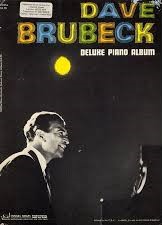

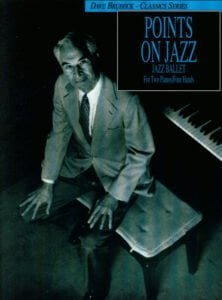
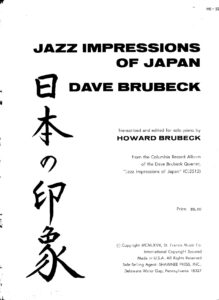
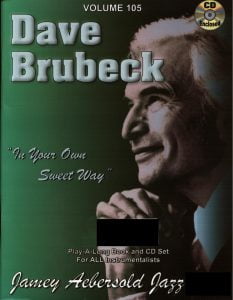


The best sheet music download from our Library.
Dave Brubeck: The Pianist Who Made the Unconventional Swing
Dave Brubeck was one of the most popular and influential jazz musicians of the twentieth century—a pianist and composer who brought elements of classical music into jazz and whose style epitomized the West Coast "cool" jazz movement. He helped ease jazz into the mainstream, married spontaneity with classical rigor, made unlikely time signatures irresistible, and made very serious music swing. His 1959 album Time Out became the first million-selling jazz LP, and its signature track "Take Five" remains one of the best-known jazz recordings of all time. Yet Brubeck was far more than a one-hit wonder: over a career spanning more than six decades, he produced a vast body of work that includes jazz standards, orchestral music, choral compositions, ballets, and even an oratorio.
Biography
Early Life and Formative Years
David Warren Brubeck was born on December 6, 1920, in Concord, California. He was the third son of Elizabeth Ivey Brubeck, a pianist and music teacher, and Howard "Pete" Brubeck, a cattle rancher and champion rodeo competitor. His mother began teaching him piano at the age of four—though for a period he deceived her by memorizing songs rather than learning to read music. By the age of fourteen, he was already playing local gigs on weekends.
Despite his musical inclinations, Brubeck's father groomed him to follow in his footsteps as a cattleman. He entered the College of the Pacific in Stockton, California (now the University of the Pacific) as a pre-med student with the ambition of becoming a veterinarian. However, early piano lessons from his mother, combined with encouragement from perceptive college professors, led him to change his major to music in the Conservatory of Music. It was at the College of the Pacific that he met his future wife, fellow student Iola Whitlock.
Please, subscribe to our Sheet Music Library. Sheet music should be accessible and affordable for all musicians, from professionals to absolute beginners.
War Service and Classical Training
After graduating in 1942, Brubeck enlisted and served under General George S. Patton in the European Theatre of Operations during World War II, where he conducted a service band. Following his discharge in 1946, he enrolled at Mills College in Oakland, California, to study composition with the renowned French composer Darius Milhaud. Milhaud, a jazz-loving composer and adopted Californian, encouraged Brubeck both to pursue a career in jazz and to incorporate jazz into his compositions. During this period, Brubeck also studied with Arnold Schoenberg, the inventor of the twelve-tone system of composition.
The Octet, Trio, and the Classic Quartet
In 1946, Brubeck formed the Dave Brubeck Octet, employing fellow Milhaud students as band members. The group made several recordings that reflected Brubeck's studies in polyrhythms and polytonality—respectively, two time signatures or two keys played simultaneously. The octet recordings sounded ahead of their time even by contemporary standards, but the highly experimental group disbanded after their radicalism failed to find an audience.
Brubeck next led a trio that proved popular in the San Francisco area. In 1949, with octet alumni Cal Tjader and Ron Crotty, Brubeck made the first of a string of award-winning Dave Brubeck Trio recordings. He was forced to disband the trio in 1951 after being incapacitated for many months by a back injury.
In late 1951, Brubeck reformed the trio, which soon became a quartet with the addition of alto saxophonist Paul Desmond, another octet alumnus. This marked the beginning of a collaboration that would influence jazz for an entire era. Within several months, they attained a measure of national fame, largely by word of mouth among West Coast critics who championed the group's innovations.
With Eugene Wright on bass and Joe Morello on drums, Brubeck and Desmond played college campuses and concert halls, introducing cool jazz to a post-war generation. Brubeck's portrait appeared on the cover of Time magazine in 1954, with a story about the rebirth of jazz and the Dave Brubeck Quartet. During the 1950s and 1960s, the quartet pioneered the concept of performing concerts on hundreds of college and university campuses while continuing to perform in more traditional jazz venues such as the Apollo in Harlem and the Howard Theatre in Washington, D.C.
In 1967, Brubeck disbanded the "classic quartet" to devote more time and energy to his interest in composing more extended works and larger forms. From then until his death, a wealth of original orchestral music, choral compositions, chamber music, ballet, and other musical genres followed from his pen.
Later Years and Death
Brubeck remained active in writing, recording, and performing up until his death. He continued to perform jazz throughout the world, while also integrating improvisation into his larger works. He was honored with the title of Jazz Master by the National Endowment for the Arts, and in 1995, during a White House ceremony, President Bill Clinton awarded him the Presidential Medal of the Arts. In 2009, he was awarded the Kennedy Center Honors.
Dave Brubeck died on December 5, 2012, in Norwalk, Connecticut, one day short of his 92nd birthday.
Musical Style
The West Coast Cool Jazz Aesthetic
Brubeck was a major exponent of West Coast or "cool" jazz—a style characterized by its more relaxed, linear, and classically influenced approach compared to the harder, more aggressive bebop of the East Coast. His style ranged from refined to bombastic, reflecting his mother's classical training and his own improvisational skills. The hallmarks of his performance and compositional styles include eccentric rhythms, polyrhythms, extended harmonic language, polytonality, emphasis upon improvisation and counterpoint, and the fusion of jazz and classical music.
Unusual Time Signatures
Brubeck is best known for his pioneering use of unconventional time signatures. Much of his music employs unusual time signatures, superimposing contrasting rhythms, meters, and tonalities. The Time Out album was the first to consciously explore time signatures outside of the standard 4/4 beat or 3/4 waltz time. "Take Five" is in 5/4 time, "Blue Rondo à la Turk" alternates between 9/8 and 4/4, and "Unsquare Dance" is in 7/4. These odd time signatures opened the door to more aggressive rhythms in jazz and beyond—when prog rockers proclaimed the influence of jazz, they were thinking Brubeck time.
Polytonality and Polyrhythms
Brubeck's studies with Milhaud and Schoenberg deeply influenced his harmonic approach. He frequently employed polytonality—the simultaneous use of two or more keys—and polyrhythms. The New York Times noted that his "polytonality and use of polyrhythms, combined with his uniquely American musical language, give his music an unmistakable and accessible sound".
The Brubeck Sound: Block Chords and Counterpoint
Brubeck's piano style was distinctive and immediately recognizable. He often employed ringing chords, dramatic crescendos, and two-fisted block chording. His playing was steeped in blues and had a palpable connection to stomp, boogie-woogie, and earlier jazz styles. At the same time, his semi-classical piano explorations were some of the coolest in town.
The interplay between Brubeck's piano and Paul Desmond's alto saxophone was central to the quartet's sound. Desmond's melodic, lyrical solos were in marked contrast to Brubeck's polytonal rhythms and block chords, but somehow they clicked and drove each other to greatness. This combination of classical rigor and jazz spontaneity, of intricate counterpoint and infectious swing, became the Brubeck signature.
Chord Progressions and Harmonic Language
The Simplicity Beneath the Complexity
One of the paradoxes of Brubeck's music is that beneath its surface complexity—the odd time signatures, the polytonality, the counterpoint—much of it rests on surprisingly simple harmonic foundations. "Take Five," for example, uses a chord progression that is remarkably straightforward. The head melody follows an ABA form; in the A section, the chord progression repeats | Cm – Gm7 | for eight measures, and during the improvised sections, this same two-chord vamp is repeated throughout. The genius lies not in harmonic complexity but in the rhythmic conception and the melodic interplay.
"In Your Own Sweet Way": A Harmonic Challenge
Brubeck's composition "In Your Own Sweet Way" presents a very different harmonic picture. The harmony is functional and made up primarily of II-V progressions. The A sections begin with iim7b5 - V7b9 - vi, and continue with ii - V - I - IV. What makes the tune particularly challenging for improvisers is that its thirty-two-bar form spans a wide range of keys, moving through G minor, B-flat, G-flat, D, C, and D-flat. This harmonic adventurousness reflects Brubeck's classical training and his willingness to push beyond the conventional boundaries of jazz harmony.
"The Duke": Polychords and Quartal Harmony
Brubeck's tribute to Duke Ellington, "The Duke," showcases his interest in extended harmonic structures. The composition features chords built from fourths—highly resonant voicings that Brubeck particularly recommended for writing for strings. The piece also employs polychords, such as an F triad superimposed over an E triad. This kind of harmonic thinking, rooted in the modern classical tradition of Milhaud and others, set Brubeck apart from many of his jazz contemporaries.
Harmonic Analysis and Legacy
Brubeck's harmonic language has been the subject of serious scholarly analysis. Analyses of his songs show sensitivity to form, harmony, and phrase structure, with written introductions explaining his reasoning—particularly useful when multiple interpretations are possible. His approach to harmony, like his approach to rhythm, was both intellectually rigorous and emotionally accessible, a combination that helps explain his enduring popularity among both jazz aficionados and the general public.
Relationships with Other Artists
Paul Desmond: The Creative Partnership
The relationship between Brubeck and Paul Desmond was one of the most significant creative partnerships in jazz history. They met in the late 1940s, with Desmond initially joining Brubeck's Octet. According to legend, Brubeck once fired Desmond during a tour so that Desmond would be able to gamble in Reno. Despite their personal differences—Brubeck was a sober, devoted family man while Desmond was a drinker and smoker who never married—their musical partnership flourished. Brubeck later reflected: "I knew I played better with him. It was mutual".
Desmond composed "Take Five," which became the quartet's biggest hit, and his melodic, lyrical solos provided the perfect foil to Brubeck's more aggressive, harmonically dense piano style. The quartet remained together until 1967, when Brubeck disbanded it to focus on composition.
Miles Davis
Brubeck's relationship with Miles Davis was complex. Davis recorded Brubeck's composition "In Your Own Sweet Way" in 1956, before Brubeck himself had released it. Davis's recording of the tune, with its tautly written mid-tempo structure, demonstrated that Brubeck could write standards that stood alongside the best of the jazz tradition. Despite their stylistic differences—Davis was at the forefront of hard bop and modal jazz on the East Coast while Brubeck represented West Coast cool—Davis took Brubeck seriously, and Brubeck was taken seriously by black musicians, including the famously uncompromising Davis.
Other Contemporaries
Brubeck's life criss-crossed with countless talented contemporaries. He toured with and performed alongside such giants as Ella Fitzgerald, Duke Ellington, Charlie Parker, Dizzy Gillespie, and Stan Getz. He recorded an entire album with Gerry Mulligan. He knew Cecil Taylor, Chet Baker, Shelly Manne, Art Blakey, Lee Konitz, Cal Tjader, Lennie Tristano, Jimmy Giuffre, and Max Roach.
A Defiant Stance on Racial Equality
Brubeck was also notable for his principled stance on racial equality. In 1960, he cancelled a promotional appearance on NBC's hugely popular Bell Telephone Hour because the producers insisted that black bass player Eugene Wright would have to remain off-camera. He refused to tour apartheid South Africa and collaborated with Louis Armstrong on a musical about race relations.
Influences
Classical Influences
Brubeck's classical training profoundly shaped his musical identity. His studies with Darius Milhaud and Arnold Schoenberg gave him a deep understanding of twentieth-century classical techniques—polytonality, twelve-tone composition, and complex rhythmic structures. Milhaud's influence was particularly significant; the French composer encouraged Brubeck to pursue jazz while incorporating the sophisticated techniques of modern classical music. Brubeck himself saw jazz as a direct extension of the classical tradition: "Bach improvised every Sunday. Classical music shouldn't abandon it".
Jazz Influences
Brubeck was deeply influenced by the jazz tradition. Throughout his life, he paid tribute to Duke Ellington, who was a forerunner in the school of courtly pianists and had a talent for quietly shaking compositional precedent. His piano playing was steeped in blues, stomp, and boogie-woogie. He also learned from the jazz greats he performed alongside, absorbing the innovations of Charlie Parker, Dizzy Gillespie, and others.
World Music
Brubeck had an uncanny ability to assimilate music of diverse cultures, allowing him to be fluent in integrating various ethnic musical characteristics into his performance and creative composition. This is evident in "Blue Rondo à la Turk," which was inspired by Turkish folk rhythms, and in his Jazz Impressions of Eurasia, which drew on his international tours.
Legacy
Popularizing Jazz
Alongside beloved figures like Ella Fitzgerald and Frank Sinatra, Brubeck achieved name recognition beyond jazz. He helped bring jazz to a wider audience, particularly through his college campus tours and his accessible yet sophisticated compositions. "Take Five," with its unprecedented million copies sold, reached much farther than bebop ever did.
Rhythm Innovation
Brubeck's exploration of unusual time signatures opened the door to more aggressive rhythms in jazz and beyond. His rhythmic innovations influenced not only jazz musicians but also rock and progressive musicians, including Ray Davies of The Kinks, Ray Manzarek of The Doors, and Deep Purple's Jon Lord.
A Complex Legacy
Finding a convincing fit for Brubeck's legacy—one that reconciles his mass popularity with his advanced musical technique—has proved elusive. Some critics have dismissed West Coast cool jazz as a "whitewashed" version of jazz. Yet Brubeck's technical sophistication, his principled stand on racial issues, and his influence on generations of musicians make him an enduring and significant figure in American music.
Honors and Recognition
Brubeck received numerous honors, including the National Endowment for the Arts Jazz Master title, the Presidential Medal of the Arts, and the Kennedy Center Honors. He was designated a "Living Legend" by the Library of Congress. His portrait appeared on the cover of Time magazine in 1954—the first jazz musician to receive that honor.
Works
Jazz Standards
Brubeck wrote a number of jazz standards, including "In Your Own Sweet Way" and "The Duke". Other notable compositions include "Blue Rondo à la Turk," "Unsquare Dance," "Strange Meadowlark," "Koto Song," and "Brandenburg Gate".
Extended Works and Classical Compositions
After disbanding the classic quartet in 1967, Brubeck devoted himself to composing larger forms. His first major "classical" composition was The Light in the Wilderness, an oratorio with music by Brubeck and texts from the Bible adapted by Dave and his wife Iola. It premiered at the University of North Carolina, Chapel Hill, in 1968.
He also composed an Easter oratorio, Beloved Son, as well as Pange Lingua Variations, Voice of the Holy Spirit: Tongues of Fire, and Regret for strings and solo piano. His Cannery Row Suite, a jazz opera created with his wife Iola, premiered at the 2006 Monterey Jazz Festival. He set to music the words of the Old Testament and of Martin Luther King Jr..
Film and Television Works
Brubeck also contributed to film and television. He created the sounds of Peanuts in the miniseries This Is America, Charlie Brown. His music has inspired choreography by Lar Lubovitch, Murray Louis, and other visionary dancers.
Discography
Brubeck's discography encompasses the extensive recorded output of the American jazz pianist and composer, spanning more than six decades from his debut in 1946 with the Dave Brubeck Octet to posthumous releases of his final studio sessions. Primarily featuring work with ensembles such as the Dave Brubeck Trio and the long-standing Dave Brubeck Quartet—most notably alongside saxophonist Paul Desmond—Brubeck's catalog includes dozens of studio and live albums across labels like Fantasy, Columbia, Atlantic, and Concord Jazz.
Key Studio Albums
- Jazz at Oberlin (1953) – A landmark live recording that captured the quartet's improvisational energy on college campuses
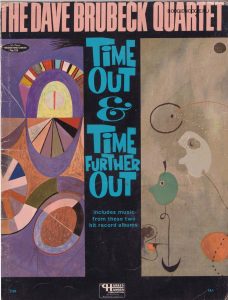
- Time Out (1959) – The defining masterpiece, the first million-selling jazz LP, featuring "Take Five" and "Blue Rondo à la Turk"
- Time Further Out (1961) – The first of several follow-up albums exploring unconventional meters
- Countdown: Time in Outer Space (1962) – Continued the rhythmic experimentation
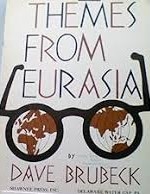
- Jazz Impressions of Eurasia (1958) – Inspired by international tours
- Brubeck & Rushing (1960) – A collaboration with vocalist Jimmy Rushing
- The Last Set at Newport (1971) – With Gerry Mulligan
- Indian Summer (2007) – A reflective solo piano album
Brubeck's partnership with Columbia Records from 1954 onward marked a commercial peak, yielding prolific output including up to four albums annually in the early 1960s.
Most Known Compositions and Performances
"Take Five"
"Take Five," composed by Paul Desmond, is the Dave Brubeck Quartet's signature piece. With its 5/4 time signature, syncopated piano riff, and Desmond's floating saxophone line, it became one of the best-known and best-loved jazz recordings of all time. It was a Top 10 hit all over the world and remains as familiar today as it was in 1959.
"Blue Rondo à la Turk"
Also from Time Out, "Blue Rondo à la Turk" alternates between 9/8 and 4/4 time, inspired by Turkish folk rhythms. It showcases Brubeck's ability to fuse world music influences with jazz.
"In Your Own Sweet Way"
This Brubeck composition has become a jazz standard, recorded by Miles Davis and many others. Its sophisticated harmonic structure—spanning multiple keys—makes it a favorite among jazz musicians.
"The Duke"
Brubeck's tribute to Duke Ellington demonstrates his command of complex harmony, including polychords and quartal harmony.
"Unsquare Dance"
A playful piece in 7/4 time that further demonstrates Brubeck's rhythmic inventiveness.
Documentaries
Dave Brubeck: In His Own Sweet Way (2010)
This Clint Eastwood co-produced documentary tells Brubeck's personal story, tracing his career from his first musical experiences to the overwhelming success of the Dave Brubeck Quartet. It features contemporary interviews, vintage performances, previously unseen archive, and additional performances filmed especially for the documentary. Contributors include Bill Cosby, Jamie Cullum, Yo-Yo Ma, George Lucas, and Eastwood himself. The documentary aired on Turner Classic Movies on Brubeck's birthday, December 6, 2010. It has an IMDb rating of 8.1.
Rediscovering Dave Brubeck (2001)
A one-hour documentary about the legendary jazz pianist, who was still going strong in his 80s, creating new music, constantly on tour, and writing classical as well as jazz tunes.
BBC Arena: Dave Brubeck - In His Own Sweet Way
The BBC's Arena series also profiled Brubeck as he approached his 90th birthday, examining how he, along with Miles Davis and John Coltrane, captured the public's imagination and determined the evolution of jazz.
Dave Brubeck was a musician of extraordinary range and influence—a pianist who brought classical sophistication to jazz, a composer who made odd time signatures accessible and swinging, and a bandleader who created some of the most beloved music of the twentieth century. His legacy is one of paradox: a popular artist who was also a serious innovator, a West Coast cool jazz icon who was taken seriously by East Coast hard bop musicians, and a traditionalist who was also a revolutionary. As he once said, "I am primarily a jazz composer. Most of us don't even like the word jazz. It really is an extension of what Bach and Mozart did every day: improvise". In that spirit, Brubeck's music continues to live on, inspiring new generations of musicians and listeners alike.
Bossa Nova U S A – Dave Brubeck (piano solo sheet music)
Browse in the Sheet Music Library:
Or browse in the categories menus & download the Library Catalog PDF:
Dave Brubeck - Full Concert [HD] | Live at North Sea Jazz Festival 2004
Setlist: 1 ‘On The Sunny Side Of The Street’ 2 ‘Yesterdays’ 3 -‘Elegy’ 4 ‘London Flat, London Sharp’ 5 ‘Travelin' Blues’ 6 ‘Sleep’ 7 ‘Take 5’
LINEUP Dave Brubeck (piano); Bobby Militello (alto sax, flute); Michael Moore (bass); Randy Jones, drums