Table of Contents
Scores for all instruments: 16,000+ (active and growing), over 236,000 pages.
All genres and levels: Jazz & Blues, Rock & Pop, Classical & Contemporary, Film & Musicals;
books & biographies; methods, études, play-along tracks (MP3) for Jazz & Rock.
Access & benefits: US$15.99 one-time payment, valid for lifetime, full Library access.
Remembering György Ligeti, born on this day in 1923.
György Ligeti, one of the most original and influential composers of the 20th century, would have turned 103 on May 28, 1923. A pioneering voice of musical modernism, his work journeyed from the folk-influenced sounds of his early years to the revolutionary sound masses of his middle period, and finally to the complex rhythmic structures of his late masterpieces. Famed for his innovative techniques like "micropolyphony" and his unique use of texture and timbre, Ligeti’s profound impact is felt not only in concert halls but also in popular culture through his iconic use in Stanley Kubrick’s film 2001: A Space Odyssey.
Biography: A Life Shaped by Turmoil
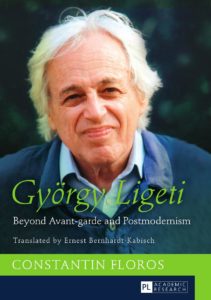
György Sándor Ligeti was born on May 28, 1923, in Dicsőszentmárton, Transylvania (present-day Târnăveni, Romania), to Hungarian-Jewish parents. Showing an early aptitude for music, he began composing at age 14. His studies were interrupted by the horrors of World War II. In 1944, he was sent to a forced labor camp, while his father and brother perished in concentration camps; only his mother survived the Holocaust.
After the war, Ligeti resumed his studies at the Franz Liszt Academy of Music in Budapest, graduating in 1949. He became a professor there, but his innovative ideas ran counter to the state-approved socialist realism, leading to limited performance opportunities for his work. Following the failed Hungarian Revolution in 1956, Ligeti and his wife fled to Vienna, seeking artistic freedom.
In the West, he plunged into the avant-garde circles of Cologne and Darmstadt. Though influenced by figures like Karlheinz Stockhausen and Pierre Boulez, he quickly forged his own path, rejecting the rigid systems of serialism. After a difficult period, his international breakthrough came in the early 1960s with orchestral works like Apparitions (1958–59) and Atmosphères (1961). He became an Austrian citizen in 1968 and taught composition at the Hochschule für Musik und Theater Hamburg from 1973 until his retirement in 1989. The celebrated pianist Pierre-Laurent Aimard was among his noted students. Ligeti died in Vienna on June 12, 2006.
Musical Style and Innovative Harmony
Ligeti’s music is known for its refusal to adhere to a single style. His work can be broadly divided into three distinct periods:
- Early Period (Hungary): Strongly influenced by folk music, with the polyphonic complexity of his idol, Béla Bartók, as a clear foundation.
- Middle Period (The "Sonorist" Years): His most revolutionary phase. He moved away from conventional melody and rhythm to create pure explorations of timbre and texture. Central to this is micropolyphony, a technique where dense, complex canons of many individual parts merge to create a single, shimmering sound mass.
- Late Period (Rhythmic Complexity): Marked by a new fascination with intricate polyrhythms, partly inspired by his studies of sub-Saharan African music and the player-piano studies of Conlon Nancarrow.
Essential Works: A Curated Playlist
Ligeti’s catalogue is filled with masterpieces. Here are some of his most significant compositions, a great starting point for any listener:
- Atmosphères (1961): The quintessential example of his micropolyphonic, "sonorist" style; a revolutionary sound mass that appears static but is in constant, microscopic motion.
- Requiem (1963–1965): A terrifying and monumental work for soprano, mezzo-soprano, choir, and orchestra. The second movement, Kyrie, is a churning, apocalyptic vision of texture and dense counterpoint.
- Lux Aeterna (1966): A breathtaking 16-voice a cappella work that creates an ethereal, otherworldly soundscape. It is entirely static, yet the harmony inside the texture is constantly shifting in a masterpiece of vocal micropolyphony.
- Lontano (1967): This work creates a tangible sense of musical perspective, as if individual melodic lines are gradually emerging from a distant fog, blending lyricism with his signature textural fog.
- Le Grand Macabre (1974–1977, revised 1996): His only full-length opera. An absurdist, apocalyptic comedy that parodies and pastiches everything from Offenbach to Beethoven, while also delving into sincere human drama.
- Piano Études (1985–2001): A monumental collection of 18 études. They are a testament to his late style, demanding breathtaking virtuosity while exploring rhythmic illusions, polyrhythms, and mesmerizing sonic landscapes.
Music for Films: From Kubrick to Mainstream
Ligeti’s journey into popular culture began in 1968 when Stanley Kubrick used his music in 2001: A Space Odyssey. Kubrick famously used four Ligeti pieces on the soundtrack without the composer's permission. However, the hauntingly alien soundscapes of Atmosphères, the Requiem, and Lux Aeterna became so integral to the film's cosmic horror and mystery that they cemented his legacy in popular culture. The Musica Ricercata also appeared decades later in Kubrick’s final film, Eyes Wide Shut (1999).
Legacy and Influence
His influence stretches far beyond classical music. The dense, creeping textures in his work directly inspired figures like Jonny Greenwood of the band Radiohead, who cites Ligeti as a constant reference in his work with the band and in his film scores.
Through his own genius and direct teaching, he influenced a generation of composers, including Unsuk Chin and Michael Daugherty. His legacy is one of restless, creative innovation; a constant striving to escape the "prison" of past conventions and forge new, unheard worlds of sound.
To learn more about György Ligeti, I recommend starting with the Pierre-Laurent Aimard recordings of his Piano Études and the comprehensive The Ligeti Project box set conducted by Jonathan Nott. You can also watch Kubrick’s 2001: A Space Odyssey to hear his music in its most famous cinematic context.
GYÖRGY LIGETI (1923-2006) - MUSICA RICERCATA (an analysis)
GYÖRGY LIGETI : Musica ricercata & 6 Bagatelles for wind quintet (1951-55) – The search for a language of his own in the shadow of Bartók.
György Ligeti comes from Transylvania, his birthplace has belonged to Romania since the post-war period, but he is Hungarian from a Jewish family. After the war, which he was lucky to survive (apart from his mother, his family died in a concentration camp), he began to study music to Budapest.
In the short phase before Hungary was subjugated by Stalinism, there was a culturally open climate in which the young composer must have absorbed all the latest trends like a sponge. However, after that (from 1946), just like in the USSR, the culture was regulated and suppressed. Musically, a simple, real-socialist style was required. Even by the acknowledged greatest Hungarian composer, Béla Bartók, only a few pieces were performed, mostly folk music arrangements.
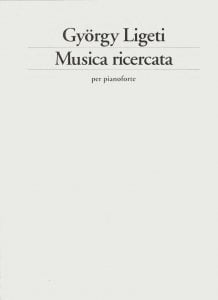
The young Ligeti outwardly followed these guidelines, but in reality he was looking for a new style in which harmony and the passage of time were largely eliminated. The pieces on this way could only be created for the drawer. For example the 'Musica ricercata' for piano. The title is a reference to the ricercar, the early baroque form of the fugue (e.g. in Girolamo Frescobaldi, to whom the 11th piece refers), but also aptly means “searching music” in German.
Hoping to have his music performed, Ligeti arranged 6 pieces from this 11-part cycle as the Bagatelles for wind quintet. But even then, the 6th Bagatelle was rejected on the grounds that there were too many small seconds - the judgments on new musical works were so superficial. Since the score was left behind when they fled to the West, Ligeti reconstructed the instrumentation for a Swedish wind quintet for the overall premiere in 1969.

In this version, the work became a classic hit of the 20th century: wind quintets are hungry for good pieces and – when have you ever seen such a catchy work by a notorious avant-gardist? It is often forgotten that there is an original work (the '10 pieces for wind quintet') from the 1960s (i.e. Ligeti's demanding micropolyphonic period), but it is never the same could achieve popularity.
But despite the relatively traditional, Bartók-like tonal language, Musica ricercata/ Bagatelles shows many aspects that are consistently typical of Ligeti's work.
- Form progression: Ligeti prefers processual to developing forms (in contrast to Bartók). That means: Form (and harmony) appear without contrasts or even statically (see also point 'Rules of the game'). Musical parameters flow in straight lines transitions into one another instead of developing into spin-offs or spin-offs. The simplest example: the first piece of the Musica ricercata on the one note A is in principle a process of speeding up, achieved through real accelerando and process-related shortening of the basic rhythmic motif up to the five-eighth-long figure from Prestissimo.
2. Rhythm: This technique already shows Ligeti's preferred relationship to rhythm and meter: bar lines stand for coordination, but not in the sense of a metric emphasis. Even in the Musica ricercata there are numerous passages where rhythmic processes are composed across bars. The successive quintuplets, sextuplets, septuplets, etc. are then composed as an accelerando. In later works, this can also be found as a micropolyphonic obfuscation in different values at the same time.
3. Intervals: In many pieces, the melodic line prefers a small ambitus (most frequently the minor third), which is filled out in small intervals. On the other hand, there are eruptions at large intervals. These sudden gestures also become typical of later works, where there are repeated crashes and breakouts – either as expressive interruptions in the process or as end or turning points. In the piano version there are already spoken, programmatic playing instructions such as 'ferocissimo (very wild)', 'minaccioso (threatening)', 'like in a panic', 'insisting, defiant', 'like crazy'. In the wind version, these are almost all reduced or transformed into relatively neutral Italian playing instructions (a sign of the sober avant-garde years?), but this does not soften the extreme expression.
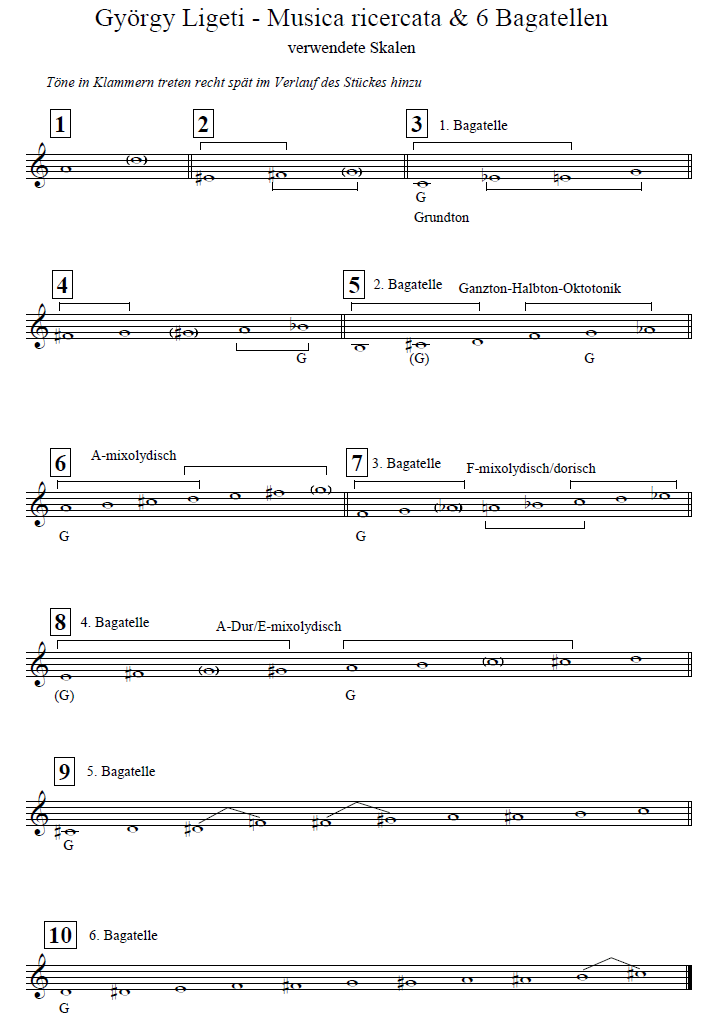
4. Rules of the game: This term does not quite belong in this series, but perhaps best describes Ligeti's approach to composing. In part, this attitude can already be found in Bartók (see my analysis of “Music for Stringed Instruments, Percussion and Celesta”): simple basic requirements create complex compositional connections. Let's think of simple board games: a few rules and clear game goals (e.g. mill and checkers) always create different and complex game processes. This is also the case in the Musica ricercata: the basic rules of the game are kept extremely simple. The eleven pieces each have an increasing range of notes: from two notes in the first to all twelve in the last (although the idea of introducing the new note towards the end of the piece is already abandoned from the 3rd piece). However, the selection of the tones already reveals a more complex way of thinking: the same tones are not always used, but successive pieces use a range of tones that are as contrasting as possible, e.g. with fundamental tones that are far away (see overview).
The scales mostly obey point or scale symmetries (except in the more Mixolydian pieces 7+8 and the pieces with an almost complete chromatic scale). The compositional tasks that result from the small number of tones are demanding, sometimes even amusing: How do you create an interesting piece from just one (two), three or four tones? Or which consonances result from parallel shifts in non-symmetrical scales (6th bagatelle)?
Other techniques typical of the later Ligeti are the extensive use of ostinato formations (which, however, are later permuted, i.e. altered in sequence) and canon. His cluster pieces of the 1960s and the polyrhythmic works of the 1970s and 1980s are predominantly constructed canonically.
Otherwise, however, Ligeti very often still follows Bartók's model here (above all, of course, in the 5th bagatelle, which is dedicated to the memory of the predecessor):
Developments are taken to a limit, which then creates a new form section, there are traditional ones highlights. In addition to his personal style of scale formation, which is very similar to Bartók's, he uses typical compositional techniques such as drone tones and transverse harmonies (Eastern European 'Bluenotes'), imitative sections as well as Hungarian and Bulgarian ones Rhythms (reversed dotting and compound time signatures in fast tempo).
The 5th Bagatelle uses a typical Bartók model of the 'Night Music', which the older composer had established in works such as 'Im Freien', 'Musik für Stringeninstrumente' and 'Divertimento für Stringorchester'. Minor motive formulas (the minor third in Hungarian rhythm) build up a development over a bell-like drone bass that aims for a plaintive climax. The harmony goes through several states of aggregation from unison to mild dissonance at T.10, screaming dissonance at T.18 to something mysterious
Cluster T.24.
The ending, with its turn from D minor to C sharp major, is a prime example of the extended tonality in the cycle of minor thirds that Ernö Lendvai began to demonstrate to Bartók and on which Hungarian theorist Albert Simon built a novel theory of extended romantic-modern harmonics: takes If you take the minor third axis C sharp-E-G-A sharp as the tonic level (with its major fifth tones G sharp-B-D-F), D minor fulfills the function of a dominant sphere, which allows the ending to be interpreted as a kind of authentic cadence.
Ligeti's sheet music download here.
György Ligeti - Musica ricercata (mit Noten, sheet music)
Track list:
I. Sostenuto- 0:00 II. Mesto, rigido e cerimoniale- 2:10 III. Allegro con spirito- 5:29 IV. Tempo di Valse- 6:37 V. Rubato, Lamentoso- 8:11 VI. Allegro molto capriccioso- 10:54 VII. Cantabile, molto legato- 11:39 VIII. Vivace, energico- 14:40 IX. Adagio, mesto, allegro maestoso- 15:41 X. Vivace, capriccioso- 17:38 XI. Andante misurato e tranquillo: Omaggio a Girolamo Frescobaldi- 18:54
Browse in the Sheet Music Library:
Or browse in the categories menus & download the Library Catalog PDF: