
Scores for all instruments: 16,000+ (active and growing), over 236,000 pages.
All genres and levels: Jazz & Blues, Rock & Pop, Classical & Contemporary, Film & Musicals;
books & biographies; methods, études, play-along tracks (MP3) for Jazz & Rock.
Access & benefits: US$15.99 one-time payment, valid for lifetime, full Library access.
Table of Contents
Johnny Cash: The Man in Black and the Soul of American Music
Please, subscribe to our Sheet Music Library. Sheet music should be accessible and affordable for all musicians, from professionals to absolute beginners.
Johnny Cash is not merely a country music singer. He is an American institution, a cultural monolith whose shadow falls across nearly every genre of popular music that emerged in the second half of the twentieth century. He was a pioneer of rock and roll, a foundational figure in country music, a gospel singer, a folk storyteller, a protest singer, and—in the final decade of his life—an unlikely alternative rock icon. He sold more than 90 million records worldwide, charted 137 singles between 1955 and 2003, and remains the only performer besides Elvis Presley to have been inducted into both the Country Music Hall of Fame and the Rock and Roll Hall of Fame.
To understand Johnny Cash is to understand a man of profound contradictions. He was a devout Christian who sang about murder and adultery. He was a patriot who campaigned for Native American rights and prison reform. He was a drug addict who wrote some of the most spiritually searching music of his era. He was, as the New York Times observed in its obituary, "country music's foremost poet of the working poor," whose "stripped-down songs described the lives of coal miners and sharecroppers, convicts and cowboys, railroad workers and laborers".
This post provides a comprehensive examination of Johnny Cash's life, music, and legacy. It traces his journey from a cotton farm in Depression-era Arkansas to the stages of Folsom Prison, Carnegie Hall, and the MTV Video Music Awards. It analyzes his distinctive "boom-chicka-boom" guitar technique, his unconventional harmonic language, and his finest compositions. It explores his collaborations across genres, his contributions to film music, his philanthropic and political activism, and the lasting impact he has had on both country music and rock and roll. In doing so, it seeks to answer a deceptively simple question: What made Johnny Cash the Man in Black?
The best sheet music download from our Library.
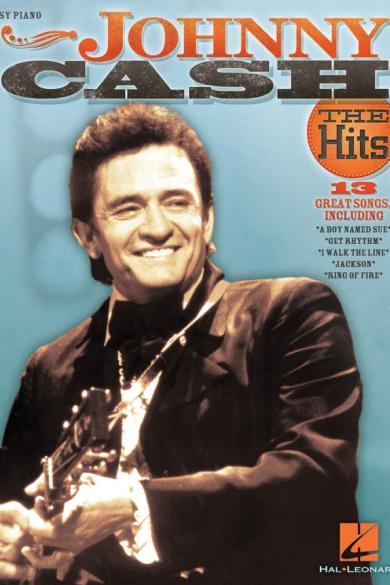


Biography: From the Cotton Fields to the World Stage
Please, subscribe to our Sheet Music Library. Sheet music should be accessible and affordable for all musicians, from professionals to absolute beginners.
John R. Cash was born on February 26, 1932, in Kingsland, Arkansas, the son of poor sharecroppers during the height of the Great Depression. He grew up in the nearby farming community of Dyess, where the Cash family worked a plot of land as part of a New Deal agricultural resettlement program. It was a hardscrabble existence, and Cash later recalled singing folk, spiritual, and country songs to himself while picking cotton in the fields.
The defining trauma of Cash's childhood was the death of his older brother Jack, who was killed in a gruesome accident with a table saw in 1944. Cash, who was twelve years old at the time, witnessed the aftermath of the accident and carried the guilt of his brother's death with him for the rest of his life. This loss, combined with the strict discipline of his father and the poverty of his upbringing, would inform the somber, guilt-ridden quality that permeates much of his music.
Cash's musical education began in the church, where he sang hymns and gospel songs, and on the radio, where he absorbed the country music of the Grand Ole Opry and the folk ballads of the American South. While in high school, he sang on an Arkansas radio station, a formative experience that planted the seed of a performing career.
In 1950, at the outbreak of the Korean War, Cash enlisted in the United States Air Force. He was stationed in West Germany, where he served as a radio interceptor, monitoring Soviet Morse code transmissions. It was during this period that Cash bought his first guitar and taught himself to play. He also began writing songs, including the first version of what would become "Folsom Prison Blues," a composition inspired by the 1951 film Inside the Walls of Folsom Prison. As Cash later explained, "I just wanted to write a song that would tell what I thought it would be like in prison".
Search your favorite sheet music in the Sheet Music Library Catalog
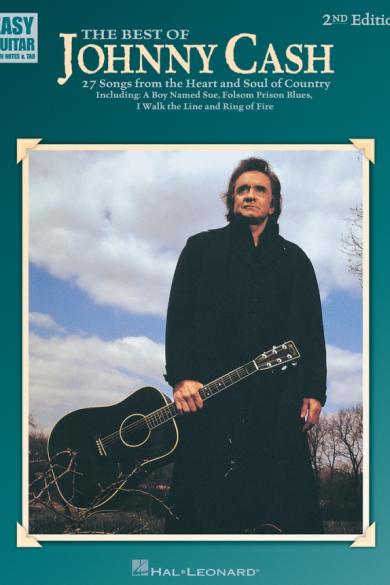

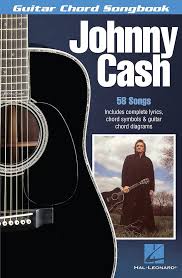


After his discharge from the Air Force in 1954, Cash married his first wife, Vivian Liberto, and moved to Memphis, Tennessee. He sold appliances door-to-door to support his family while playing music on the side with two auto mechanics, guitarist Luther Perkins and bassist Marshall Grant. The trio, initially known as the Tennessee Two, auditioned for Sun Records in 1955, hoping to secure a contract as a gospel act. Sam Phillips, the label's owner, was not interested in gospel, but he recognized something unique in Cash's cavernous baritone and the sparse, percussive accompaniment of Perkins and Grant.
Cash's first single for Sun, "Cry! Cry! Cry!" backed with "Hey Porter," was released in 1955 and became a Top 10 country hit. It established the template for much of his subsequent work: Cash's deep, resonant vocal, pushed by the "boom-chicka-boom" rhythm that would become his sonic signature. Over the next three years, Cash notched four No. 1 country singles at Sun, including the indelible "I Walk the Line," a song he wrote for his first wife while he was touring and struggling with temptation.
In 1958, clashes with Phillips over money and artistic direction led Cash to sign with Columbia Records. He made an immediate impact with "Don't Take Your Guns to Town," which topped the country chart in 1959. The Columbia years saw Cash at his most ambitious and eclectic. He recorded concept albums devoted to religious material (Hymns, 1959), train songs (Ride This Train, 1960), the struggles of Native Americans (Bitter Tears, 1964), and Western songs (Ballads of the True West, 1965). These albums demonstrated Cash's willingness to use his platform to address social and historical themes that were largely ignored by mainstream country music.
But as his fame soared, his personal life spiraled out of control. Cash became addicted to amphetamines and barbiturates, and his behavior became increasingly erratic. In one notorious incident, he kicked out the footlights of the Grand Ole Opry stage one by one. In 1965, he was arrested in El Paso, Texas, for attempting to smuggle hundreds of pills into the country in his guitar case. The following year, his wife filed for divorce.
Cash's salvation came in the form of June Carter, a member of the legendary Carter Family, whose radio broadcasts had inspired him during his youth. Carter had collaborated with Cash on the hit "Ring of Fire," a song she co-wrote with Merle Kilgore about her own tormented feelings for him. She helped him overcome his addictions, and in 1968, they married. As the New York Times noted, "The marriage established them as the unofficial First Family of country music".
The late 1960s were the peak of Cash's commercial and creative powers. In 1968, he released Johnny Cash at Folsom Prison, a live album recorded during a prison concert that became one of the most iconic live albums in music history. The following year, Johnny Cash at San Quentin contained one of his biggest hits, "A Boy Named Sue," a Shel Silverstein-penned story-song that showcased Cash's wry humor and his gift for narrative. From 1969 to 1971, he hosted The Johnny Cash Show on ABC Television, a prime-time variety program that featured guests as diverse as Bob Dylan, Stevie Wonder, Joni Mitchell, Neil Young, Eric Clapton, Ray Charles, and Louis Armstrong.
Cash's career experienced a commercial decline in the 1970s and 1980s, though he remained a respected live performer and a beloved cultural figure. In 1980, he became the youngest inductee to the Country Music Hall of Fame. In the mid-1980s, he formed the supergroup The Highwaymen with Waylon Jennings, Willie Nelson, and Kris Kristofferson, whose debut album and title track became a No. 1 country hit.
The final act of Cash's career was perhaps the most remarkable. In 1993, he was approached by Rick Rubin, a hip-hop and heavy metal producer known for his work with Run-DMC, the Beastie Boys, and the Red Hot Chili Peppers. Rubin proposed a radical reinvention: Cash would record solo acoustic performances of songs by contemporary artists, stripped of the slick production that had characterized his later Columbia records. The result was American Recordings (1994), an album that introduced Cash to a new generation of listeners and earned him his first Grammy in nearly a decade. The series continued with Unchained (1996), American III: Solitary Man (2000), American IV: The Man Comes Around (2002), and posthumously with American V: A Hundred Highways (2006) and American VI: Ain't No Grave (2010).
Cash's rendition of Nine Inch Nails' "Hurt," released on American IV, became one of the most acclaimed music videos of all time and earned six MTV Video Music Award nominations. The video, which intercut footage of a frail, aging Cash with images from his younger days, was a devastating meditation on mortality, regret, and the passage of time.
Johnny Cash died on September 12, 2003, in a Nashville hospital, of respiratory failure stemming from complications of diabetes. He was 71 years old. His wife June Carter Cash had died just four months earlier, on May 15, 2003.
Musical Style and Technique: The Boom-Chicka-Boom
Johnny Cash's musical style is one of the most distinctive and immediately recognizable in all of American popular music. At its core is his voice: a deep, gravelly bass-baritone that the New York Times described as "the vocal bedrock of American country music for more than four decades". Cash's voice was not a conventionally beautiful instrument. It was rough, weathered, and often seemed to be speaking as much as singing. But it possessed an authority and a gravity that made every word he sang feel like a truth.
The instrumental foundation of Cash's sound was the "boom-chicka-boom" rhythm, a technique developed by his guitarist Luther Perkins and bassist Marshall Grant. The style involves a bass note—usually the root of the chord—on the downbeat, followed by a chordal strum on the upbeat, creating a chugging, percussive pattern that mimics the sound of a freight train. As one instructional analysis explains, "This technique involves a bass note—usually on the downbeat—followed by a strum, which creates the characteristic chugging sound". The effect was achieved in part by Sam Phillips, who placed a piece of paper between the strings and the fretboard of Cash's guitar to reduce resonances and give the playing a more percussive quality.
Perkins' guitar playing was a crucial component of the Cash sound. He played a Fender Esquire through a Fender amplifier, and his style was characterized by its simplicity and economy. His solos on songs like "Folsom Prison Blues" and "I Walk the Line" are models of melodic restraint, using a handful of notes, bends, and vibrato to create emotional impact. As one analysis notes, "The solo is relatively simple, following a melodic line and relying on bends and vibrato for emotional impact". Perkins rarely played more than a few notes per measure, but every note counted.
Cash's own guitar playing was functional rather than virtuosic. He typically played rhythm, providing the boom-chicka-boom foundation while Perkins played lead. But his rhythmic sense was impeccable, and his ability to drive a song forward with a simple strumming pattern was a key element of his appeal. His acoustic guitar playing, particularly on the American Recordings albums, was spare and unadorned, allowing his voice and his lyrics to take center stage.
In terms of harmony, Cash's music was built on the straightforward chord progressions of country and folk music—primarily the I-IV-V progression that is the foundation of countless country songs. "Ring of Fire," for example, is built around a I-IV-V progression using the chords G, C, and D. "Folsom Prison Blues" is similarly built on a I-IV-V progression in E major, with a 12-bar blues form that Cash modified by staying on the V chord in measure 10 rather than going down to the IV.
But Cash's harmonic language was not entirely conventional. "I Walk the Line" is a case in point. The song is unusual for its era in that it moves through five different keys across its verses, a feat Cash achieved by humming to reset his pitch before each new section. As one analysis notes, "Its structure is unusual for the era, moving through five different keys across its verses". This harmonic restlessness reflects the song's lyrical theme of fidelity and temptation, with each key change representing a new resolve to stay on the straight and narrow.
Cash's later work with Rick Rubin was even more harmonically spare. The American Recordings albums stripped away the Nashville production that had characterized his later Columbia records, leaving only Cash's voice and his acoustic guitar, occasionally augmented by sparse accompaniment from musicians like Tom Petty and the Heartbreakers or members of the Red Hot Chili Peppers. The effect was to foreground the elemental quality of Cash's voice and the raw emotional power of his interpretations.
Best Songs and Compositions
Johnny Cash's catalog is vast—more than 70 albums over a 45-year career—and any list of his best songs is necessarily partial. What follows is a survey of some of his most significant compositions and recordings, with an emphasis on the songs that best illustrate his range as a writer and interpreter.
"I Walk the Line" (1956) is perhaps Cash's most enduring composition and, according to Taste of Country, the greatest song of his career. Cash wrote the song for his first wife, Vivian Liberto, while he was on tour and struggling with the temptations of life on the road. The song's famous opening—"I keep a close watch on this heart of mine"—is a vow of fidelity set to a melody that seems to promise more than it delivers. The unusual harmonic structure, with its five key changes, gives the song a restlessness that mirrors the singer's inner turmoil.
"Folsom Prison Blues" (1955) is the song that established Cash's outlaw persona. Written while he was serving in the Air Force in West Germany, the song was inspired by the film Inside the Walls of Folsom Prison and tells the story of a convict who "shot a man in Reno just to watch him die". The song's dark humor and its jaunty, train-like rhythm create a tension that is quintessentially Cash: the singer is condemned, but he is not repentant. The live version from At Folsom Prison (1968), recorded in front of an audience of actual inmates, is the definitive recording, capturing the electric connection between Cash and an audience that understood him all too well.
"Ring of Fire" (1963) is one of Cash's most recognizable songs, a mariachi-tinged ballad about the all-consuming nature of love. The song was written by June Carter and Merle Kilgore, and Carter later revealed that she wrote it while tormented by her feelings for Cash, who was then married to someone else. The song's famous trumpet riff and its descending bass line create a sense of inevitability, as if the singer is being drawn inexorably into the flames.
"A Boy Named Sue" (1969) is a departure from Cash's usual somber mode, a humorous story-song written by Shel Silverstein about a man who tracks down the father who gave him a girl's name. Recorded live at San Quentin, the song became Cash's biggest pop hit and won him a Grammy for Best Male Country Vocal Performance. It showcases Cash's abilities as a storyteller and his willingness to embrace the absurd.
"Hurt" (2002) is perhaps the most devastating recording of Cash's career. A cover of a Nine Inch Nails song about addiction and self-destruction, Cash's version transforms Trent Reznor's industrial lament into a meditation on mortality and regret. The accompanying music video, directed by Mark Romanek, is a masterpiece of visual storytelling, intercutting footage of a frail, aging Cash with images from his younger days. The line "What have I become, my sweetest friend?" takes on a new meaning when sung by a man near the end of his life.
"Man in Black" (1971) is Cash's statement of purpose, a song that explains the meaning behind his signature attire. "I wear the black for the poor and the beaten down," he sings, "living in the hopeless, hungry side of town." The song is a catalogue of the causes Cash championed throughout his life: prison reform, Native American rights, opposition to the Vietnam War, and solidarity with the marginalized. It is, in many ways, his most explicitly political song, and it remains a powerful statement of moral conviction.
Other notable songs in Cash's catalog include "Don't Take Your Guns to Town" (1959), a cautionary tale about a young man who goes to town looking for a fight and finds one; "Jackson" (1967), a Grammy-winning duet with June Carter Cash about a marriage gone sour; "Sunday Mornin' Comin' Down" (1970), a Kris Kristofferson song that Cash made his own; "One Piece at a Time" (1976), a humorous song about an auto worker who steals a Cadillac piece by piece; and "The Man Comes Around" (2002), the apocalyptic title track of his final album released during his lifetime.
Music in Films
Johnny Cash's music has appeared in countless films, and he contributed original music to several soundtracks. His most significant film music contribution came in 1970, when he and Carl Perkins wrote the theme song and incidental music for Little Fauss and Big Halsy, a Paramount Pictures comedy-drama directed by Sidney J. Furie and starring Robert Redford, Michael J. Pollard, and Lauren Hutton. The soundtrack album, released on Columbia Records, featured recordings by Cash and Perkins and has become a collector's item over the years.
Cash also wrote the music for a John Frankenheimer film originally titled September Country, though details of that project are less well-documented. His songs have been featured in numerous other films, from The Blues Brothers to Walk Hard: The Dewey Cox Story.
The most significant film associated with Johnny Cash is Walk the Line (2005), the biopic directed by James Mangold and starring Joaquin Phoenix as Cash and Reese Witherspoon as June Carter Cash. The film was based on Cash's two autobiographies and won an Academy Award for Best Actress for Witherspoon. The soundtrack, produced by T Bone Burnett, featured Phoenix and Witherspoon performing Cash's songs, including "Ring of Fire," "I Walk the Line," "Folsom Prison Blues," "Jackson," and "It Ain't Me Babe". The soundtrack album was a commercial success and won a Grammy Award, introducing Cash's music to yet another generation of listeners.
Cash's music has also been used extensively in documentaries, television shows, and commercials. His song "I Walk the Line" was famously used in a Levi's commercial in the 1990s, and "Ring of Fire" was used in a Sony advertisement featuring a blue alien. These licensing decisions helped to keep Cash's music in the public consciousness during the years when he was not actively recording.
Collaborations: A Musician's Musician
Johnny Cash was a collaborative artist by nature, and his career is marked by a remarkable series of partnerships with musicians across genres and generations. His earliest and most important collaboration was with the Tennessee Two—guitarist Luther Perkins and bassist Marshall Grant—whose sparse, rhythmic accompaniment defined the sound of his classic Sun and Columbia recordings.
Cash's most significant musical partnership was with June Carter Cash, whom he married in 1968. Their duets, including "Jackson," "It Ain't Me Babe," and "Long-Legged Guitar Pickin' Man," are among the most beloved recordings in country music history. Their chemistry, both on stage and in the studio, was palpable, and their relationship—tumultuous, loving, and ultimately redemptive—was the central narrative of Cash's life.
Cash's collaboration with Bob Dylan was another defining moment in his career. The two first met in the early 1960s, and Cash was an early champion of Dylan's songwriting. In 1969, Dylan invited Cash to record a duet on "Girl from the North Country" for his album Nashville Skyline. The song, with Dylan handling the higher register and Cash providing the lower harmony, is a beautiful example of two very different voices finding common ground. Cash also recorded several Dylan songs over the years, including "It Ain't Me Babe," "One Too Many Mornings," and "Don't Think Twice, It's All Right."
In the mid-1980s, Cash joined forces with Waylon Jennings, Willie Nelson, and Kris Kristofferson to form The Highwaymen, a country supergroup whose debut album and title track—Jimmy Webb's "Highwayman," about reincarnation across centuries—became a No. 1 country hit and won a Grammy for Best Country Song. The group recorded three albums together and toured sporadically, and their collaborations remain a high point of the outlaw country movement.
Cash's collaboration with Rick Rubin in the 1990s was a different kind of partnership, one in which the producer's role was to create a space for Cash to be himself. Rubin's minimalist production aesthetic—often just Cash's voice and acoustic guitar—allowed Cash's interpretative gifts to shine. The American Recordings series featured Cash covering songs by artists as diverse as Nine Inch Nails, Soundgarden, Depeche Mode, Nick Cave, Tom Petty, and Sting, as well as traditional folk and gospel songs. The series was a critical and commercial triumph and introduced Cash to a new generation of listeners.
Cash also collaborated with a wide range of other artists throughout his career, including Ray Charles ("Crazy Old Soldier"), Paul McCartney ("New Moon Over Jamaica"), Joe Strummer ("Redemption Song"), and the Muppets (a memorable appearance on The Muppet Show performing "Ghost Riders in the Sky"). His willingness to work with artists from different genres and generations was a testament to his curiosity and his lack of musical snobbery.
Influences and Legacy
Johnny Cash's influences were as diverse as his collaborations. He grew up listening to the country music of the Grand Ole Opry, the folk ballads of the American South, and the gospel music of the church. He was inspired by the train songs of Jimmie Rodgers, the storytelling of Hank Williams, and the spiritual conviction of the Carter Family. He was also influenced by the blues—he cited the Mississippi Sheiks as an early favorite—and by the folk revival of the 1950s and 1960s.
Cash's legacy, however, is not merely a matter of his influences. It is a matter of his influence on others. His impact on American music is difficult to overstate. As the New York Times noted, "His influence extended far beyond the sphere of country music; along with Elvis Presley, Jerry Lee Lewis and Carl Perkins, his peers on Sun Records in the mid-1950's, he is considered a pioneer of rock 'n' roll".
Cash's influence on songwriters is particularly profound. He shaped the careers of Bob Dylan, Kris Kristofferson, and Waylon Jennings, and his songwriting—direct, observational, unafraid of darkness—provided a template for generations of Americana and alt-country artists. As one tribute noted, "He was a core influence on U2, Queens of the Stone Age, Slipknot, Coldplay, The Strokes—in fact just about anyone who wanted their music to remain on the mean side".
His influence on rock music was recognized in 1992, when he was inducted into the Rock and Roll Hall of Fame, making him one of the few performers to be enshrined in both the Country Music Hall of Fame and the Rock and Roll Hall of Fame. His stripped-down aesthetic and his willingness to confront uncomfortable subjects—addiction, prison, murder, mortality—anticipated the raw confessionalism of punk, grunge, and alternative rock.
Cash's cultural legacy extends beyond music. He was a political activist who used his platform to advocate for prison reform, Native American rights, and racial equality. His album Bitter Tears: Ballads of the American Indian (1964) was a groundbreaking statement of solidarity with Native Americans; Dennis Banks, co-founder of the American Indian Movement, called it "the earliest and most significant statement on behalf of Native people and our issues". He opposed the Vietnam War and supported civil rights, making him a rare liberal voice in the conservative world of country music.
Cash's personal struggles with addiction and his eventual redemption have made him a symbol of resilience and grace. His late-career renaissance, driven by the American Recordings series, demonstrated that an artist could remain vital and relevant well into old age. The music video for "Hurt," released just months before his death, is a permanent record of his willingness to confront his own mortality with unflinching honesty.
In 2024, the state of Arkansas dedicated a statue of Cash in Statuary Hall of the United States Capitol in Washington, D.C., a fitting tribute to a man who had become, in the words of the Kennedy Center, "the name [that] means country music for millions of people around the world".
Additional Information: Awards, Discography, and Personal Life
Johnny Cash won 13 Grammy Awards and received 35 nominations over the course of his career. His first Grammy came in 1967 for Best Country & Western Performance, Duet, Trio, or Group for "Jackson," his duet with June Carter. He won Grammy Awards for "A Boy Named Sue" (1970), "Sunday Mornin' Comin' Down" (1971), and "Hurt" (2003), among others. In 1999, he was honored with a Recording Academy Lifetime Achievement Award, and in 1998, his songs "I Walk the Line" and "Ring of Fire" became his first recordings inducted into the Grammy Hall of Fame.
Cash was also a prolific recording artist, releasing over 70 albums in his lifetime. His discography includes classic albums such as Johnny Cash with His Hot and Blue Guitar! (1957), At Folsom Prison (1968), At San Quentin (1969), American Recordings (1994), and American IV: The Man Comes Around (2002). His posthumous releases include American V: A Hundred Highways (2006), American VI: Ain't No Grave (2010), and Out Among the Stars (2014), an album of lost recordings from the 1980s.
Cash's personal life was as dramatic as his music. He married his first wife, Vivian Liberto, in 1954, and they had four daughters together. Their marriage ended in divorce in 1966, largely due to Cash's drug addiction and infidelity. In 1968, he married June Carter Cash, with whom he had one son, John Carter Cash. June was his partner on stage and off for 35 years, and her death in May 2003, just four months before his own, was a blow from which he never recovered.
Cash was a deeply religious man, and his faith informed much of his music, particularly his gospel recordings. He was also a man of profound contradictions—a sinner who sang about redemption, a rebel who loved his country, a drug addict who preached sobriety. As he once said, "I'm a Christian, but I'm not a good one. I'm a Christian who falls down and gets back up."
Johnny Cash was not just a country singer. He was a force of nature, a man whose voice seemed to emerge from the very soil of America. He sang about the poor, the imprisoned, the addicted, and the lost, and in doing so, he gave voice to people who are too often ignored by popular culture. He was a pioneer of rock and roll, a foundational figure in country music, and an unlikely alternative rock icon. He was the Man in Black, and he wore that black "for the poor and the beaten down, living in the hopeless, hungry side of town."
What makes Johnny Cash matter is not just his music—though the music is extraordinary—but the way he lived his life. He was honest about his flaws, unafraid to confront his demons, and willing to change his mind. He was a man who walked the line, and sometimes fell off it, but always got back up. In an era when so much popular music is designed to be disposable, Cash's music endures because it is built on something permanent: the truth of human experience.
As the New York Times observed in its obituary, Cash "outlasted trends to become a mythical figure rediscovered by each new generation". That is his legacy. He is not just a part of American music history; he is a living presence in it, a voice that continues to speak to anyone who has ever felt like an outsider, anyone who has ever struggled with guilt or addiction or loss, anyone who has ever tried—and failed—to walk the line.
Discography
Main articles on Wikipedia: Johnny Cash albums discography, Johnny Cash singles discography, and Johnny Cash Sun Records discography
See also: List of songs recorded by Johnny Cash
- Johnny Cash with His Hot and Blue Guitar! (1957)
- The Fabulous Johnny Cash (1958)
- Hymns by Johnny Cash (1959)
- Songs of Our Soil (1959)
- Now, There Was a Song! (1960)
- Ride This Train (1960)
- Hymns from the Heart (1962)
- The Sound of Johnny Cash (1962)
- Blood, Sweat and Tears (1963)
- The Christmas Spirit (1963)
- Keep on the Sunny Side (with the Carter Family) (1964)
- I Walk the Line (1964)
- Bitter Tears: Ballads of the American Indian (1964)
- Orange Blossom Special (1965)
- Johnny Cash Sings the Ballads of the True West (1965)
- Everybody Loves a Nut (1966)
- Happiness Is You (1966)
- Carryin' On with Johnny Cash & June Carter (with June Carter) (1967)
- From Sea to Shining Sea (1968)
- The Holy Land (1969)
- Hello, I'm Johnny Cash (1970)
- Man in Black (1971)
- A Thing Called Love (1972)
- America: A 200-Year Salute in Story and Song (1972)
- The Johnny Cash Family Christmas (1972)
- Any Old Wind That Blows (1973)
- Johnny Cash and His Woman (with June Carter Cash) (1973)
- Ragged Old Flag (1974)
- The Junkie and the Juicehead Minus Me (1974)
- The Johnny Cash Children's Album (1975)
- Johnny Cash Sings Precious Memories (1975)
- John R. Cash (1975)
- Look at Them Beans (1975)
- One Piece at a Time (1976)
- The Last Gunfighter Ballad (1977)
- The Rambler (1977)
- I Would Like to See You Again (1978)
- Gone Girl (1978)
- Silver (1979)
- A Believer Sings the Truth (1979)
- Johnny Cash Sings with the BC Goodpasture Christian School (1979)
- Rockabilly Blues (1980)
- Classic Christmas (1980)
- The Baron (1981)
- The Adventures of Johnny Cash (1982)
- Johnny 99 (1983)
- Highwayman (with Waylon Jennings, Willie Nelson & Kris Kristofferson) (1985)
- Rainbow (1985)
- Heroes (with Waylon Jennings) (1986)
- Class of '55 (with Roy Orbison, Jerry Lee Lewis & Carl Perkins) (1986)
- Believe in Him (1986)
- Johnny Cash Is Coming to Town (1987)
- Classic Cash: Hall of Fame Series (1988)
- Water from the Wells of Home (1988)
- Boom Chicka Boom (1990)
- Highwayman 2 (with Waylon Jennings, Willie Nelson & Kris Kristofferson) (1990)
- The Mystery of Life (1991)
- Country Christmas (1991)
- American Recordings (1994)
- The Road Goes on Forever (with Waylon Jennings, Willie Nelson & Kris Kristofferson) (1995)
- American II: Unchained (1996)
- American III: Solitary Man (2000)
- American IV: The Man Comes Around (2002)
- My Mother's Hymn Book (2004)
- American V: A Hundred Highways (2006)
- American VI: Ain't No Grave (2010)
- Out Among the Stars (2014)
- Songwriter (2024)
Browse in the Sheet Music Library:
Or browse in the categories menus & download the Library Catalog PDF: