Scores for all instruments: 16,000+ (active and growing), over 236,000 pages.
All genres and levels: Jazz & Blues, Rock & Pop, Classical & Contemporary, Film & Musicals;
books & biographies; methods, études, play-along tracks (MP3) for Jazz & Rock.
Access & benefits: US$15.99 one-time payment, valid for lifetime, full Library access.
Table of Contents
Who is Ludovico Einaudi (b.1955)?
Who is Ludovico Einaudi?
Search your favorite sheet music in the Sheet Music Library Catalog


Ludovico Einaudi: The Minimalist Maestro Who Redefined Contemporary Classical Music
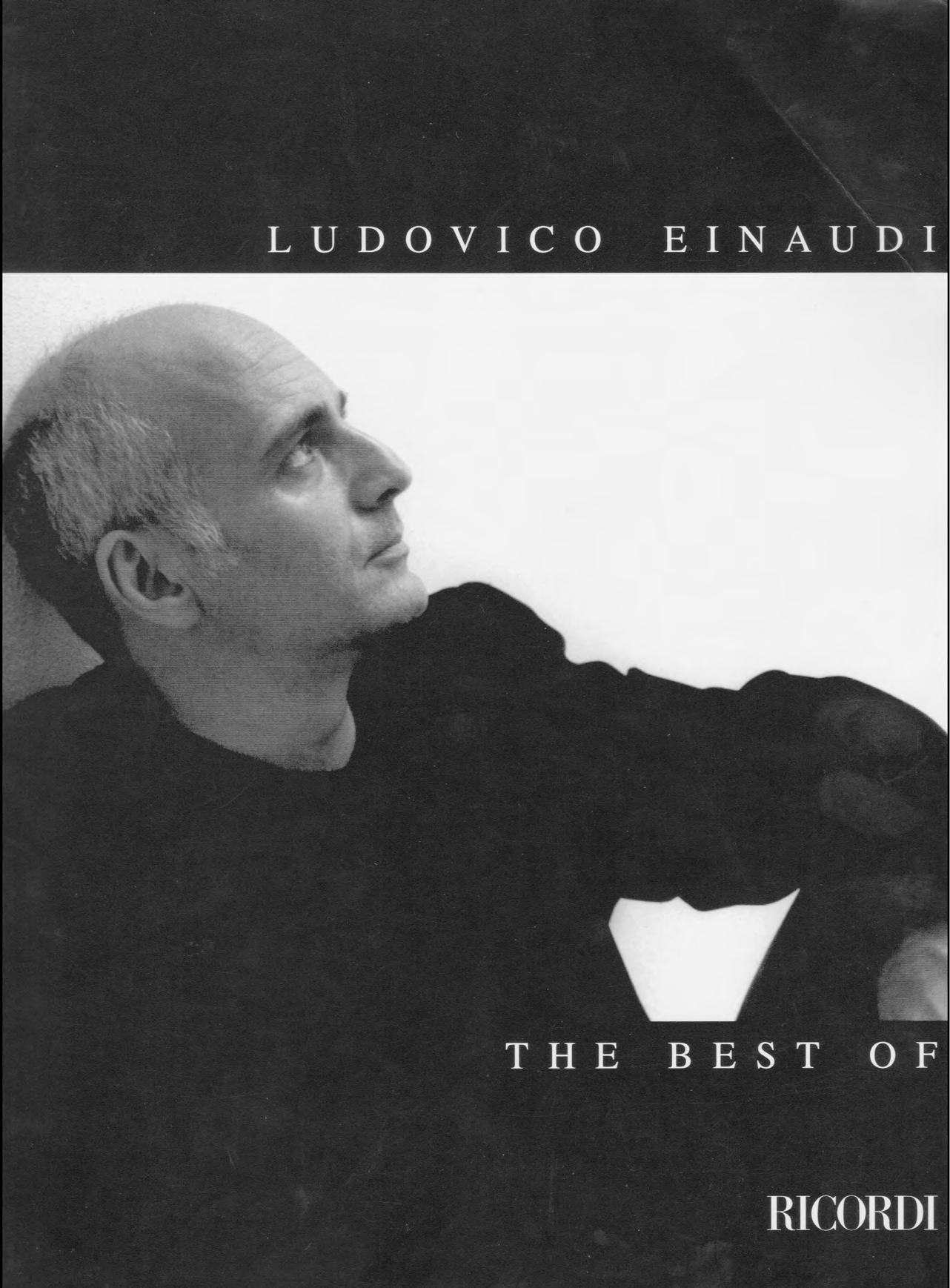
Ludovico Maria Enrico Einaudi OMRI, born on 23 November 1955 in Turin, Italy, stands as one of the most paradoxical figures in contemporary music. A classically trained composer who studied under the avant-garde titan Luciano Berio, Einaudi has nonetheless become the world's most-streamed classical artist, surpassing Mozart, Bach, and Beethoven in the digital era. His delicate piano melodies, characterised by repetitive arpeggios and hauntingly simple melodic motifs, have infiltrated every corner of modern culture—from Oscar-winning films to TikTok videos, from Apple advertisements to Arctic protest performances. With over 39 billion global streams and a track, "Experience," that has amassed more than 16 billion views on TikTok alone, Einaudi has achieved something remarkable: he has made instrumental piano music a mass-market phenomenon without compromising his artistic vision.
Yet his journey to this pinnacle of cultural ubiquity has been anything but conventional. Born into one of Italy's most prestigious intellectual families, trained in the rigorous traditions of the Milan Conservatory, and mentored by a composer whose work embodied the very avant-garde ethos that Einaudi would later seem to reject, he has charted a course that defies easy categorisation. This article explores the life, music, and legacy of a composer who has fundamentally altered the relationship between classical music and popular culture.
Please, subscribe to our Sheet Music Library.

Early Life and Education: A Childhood Steeped in Culture and Contradiction
Ludovico Einaudi was born into a family of extraordinary intellectual and political significance. His father, Giulio Einaudi, was a legendary publisher who founded the eponymous publishing house Giulio Einaudi Editore, working with some of the most important Italian writers of the twentieth century, including Italo Calvino and Primo Levi. His paternal grandfather, Luigi Einaudi, served as the President of Italy from 1948 to 1955, a period that overlapped with Ludovico's earliest years. On his mother's side, his grandfather Waldo Aldrovandi was a pianist, opera conductor, and composer who had emigrated to Australia after World War II.
It was his mother, Renata Aldrovandi, who provided the earliest and most profound musical influence. A skilled pianist herself, she filled the family home with the sounds of Bach, Chopin, and Schumann. Einaudi later recalled: "The sound of the piano music she was playing — Bach, Chopin — was around me and it was like a constant fire in the house. It kept my emotions awake in a special way". This early exposure to the classical canon would form the bedrock of his musical language, even as he later sought to transcend its boundaries.
The Einaudi household was also a meeting place for some of Italy's finest literary minds. Italo Calvino, a close family friend, made a particular impression on the young Ludovico. "He was a very special person whom I remember very well," Einaudi recalled. "He was focused on science, philosophy, literature — he was a very interesting man". The fantastic fictions of Calvino, particularly Invisible Cities, resonated deeply with the adolescent Einaudi, and their influence can be detected in the melancholy playfulness of his music.
Paradoxically, the young Einaudi initially turned to music as an escape from the overwhelming literary culture of his home. "You walk around the house and you see only books, so in a way music was my escape," he explained. "I felt more free in the world of music, where I could dream and imagine myself in a different environment".
Einaudi began composing as a teenager, initially writing on a folk guitar before turning to the piano. He enrolled at the Conservatorio Verdi in Milan, one of Italy's most prestigious musical institutions, where he obtained a diploma in composition in 1982. That same year, he took an orchestration class taught by Luciano Berio, one of the most important composers of the twentieth-century avant-garde, and was awarded a scholarship to the Tanglewood Music Festival.
Berio's influence on Einaudi was profound and multifaceted. "Luciano Berio did some interesting work with African vocal music and did some arrangements of Beatles songs, and he taught me that there is a sort of dignity inside music," Einaudi recalled. "I learnt orchestration from him and a very open way of thinking about music". This openness—the willingness to draw from diverse musical traditions without prejudice—would become a defining characteristic of Einaudi's own artistic practice.
The Classical Years and a Fateful Departure
Following his studies, Einaudi spent several years composing in traditional classical forms, including chamber and orchestral works. His compositions were performed at prestigious venues including Teatro alla Scala in Milan, the Tanglewood Music Festival, Lincoln Center, and the UCLA Center for Performing Arts. He also collaborated with musicians from diverse traditions, including Ballaké Sissoko from Mali and Djivan Gasparyan from Armenia, experiences that would later inform his engagement with world music.
Yet by the mid-1980s, Einaudi began to feel constrained by the conventions of the classical avant-garde. He turned toward more personal expression through works for dance and multimedia, and eventually for piano. This shift marked a decisive break from the trajectory that his training had prepared him for. As the Steinway artist biography notes, "he turned away from what seemed a glittering classical career to forge his own musical path, giving him the freedom to reconcile his wider-ranging influences".
The breakthrough came with Stanze (1997), a suite for electric harp that was first played on BBC Radio 3. The response was extraordinary: the switchboard jammed with listeners eager to know what they had just heard. It was a similar story with Le Onde (1998), a solo piano cycle that Einaudi performed himself. This album not only ignited his recording career but also opened the door to film and television music.
Musical Style and Technique: The Architecture of Simplicity
Einaudi's musical language is immediately recognisable yet notoriously difficult to categorise. He has been described as a minimalist, a post-minimalist, a neoclassical composer, and a purveyor of "mood-painterly pastiche". In truth, his style synthesises elements from classical music, rock, pop, folk, and world music into something that is uniquely his own.
The fundamental building block of Einaudi's piano writing is the arpeggio. His left hand typically provides a continuous, flowing accompaniment of broken chords, often omitting the third and relying on the root, fifth, and octave. This technique, which appears throughout his oeuvre from Le Onde to Experience, creates a sense of harmonic openness—the absence of the third leaves the chord ambiguous, neither definitively major nor minor, suspending the listener in a state of emotional indeterminacy.
Over this harmonic foundation, the right hand delivers simple, memorable melodic motifs. These are not melodies in the traditional sense of long, developed lines; rather, they are fragments—short, repeating phrases that gradually evolve through subtle variation. As one critic observed, Einaudi "ladles out simple melodic fragments with the right hand over arpeggios and gently tolling chords by the left".
Einaudi's preference for minor modes is a defining feature of his emotional palette. He writes primarily in natural minor scales, and his chord progressions often revolve around the VI-VII-i cadence in A minor, a progression that carries strong associations with folk music and film scores. His music is often described as melancholic, wistful, and elegiac—qualities that arise not from complex harmonic manipulation but from the interplay of repetitive patterns and modal colouring.
The role of repetition in Einaudi's music cannot be overstated. His compositions are built on the principle of gradual transformation—a phrase is stated, repeated, slightly altered, repeated again, and so on, accumulating emotional weight through persistence rather than development. This technique, which has roots in both minimalist composition and popular music's loop-based structures, is central to the hypnotic quality of his work.
Harmony: The Tension Between Simplicity and Expression
Einaudi's harmonic language has been a subject of considerable debate. Classical music critics have often been harsh, accusing him of poor voice-leading, weak bass lines, and a lack of long-term harmonic planning. One critic on The Guardian's comment pages wrote that "the way he gets from chord to chord is often badly managed... the harmony is not well calculated to build expectations and then either satisfy or delay/evade gratification".
These criticisms, however valid from the perspective of traditional classical compositional technique, miss the point of Einaudi's aesthetic. His music is not concerned with the teleological harmonic development that characterises the Western classical tradition from Palestrina through Wagner to Schoenberg. Instead, it operates in a static, immersive mode, where harmony serves not to create tension and resolution but to establish and sustain a particular emotional atmosphere.
Einaudi's harmonic vocabulary is deliberately limited. He favours simple triads, often in root position or first inversion, and avoids the chromatic complexity that characterises much contemporary classical music. His progressions are often modal rather than tonal, drawing on the natural minor scale and its associated chords. The effect is a kind of harmonic transparency—the listener is never lost in a thicket of chromaticism but can always perceive the underlying tonal centre.
This simplicity is not, however, mere naivety. Einaudi's harmonic choices are carefully calibrated to serve his expressive purposes. The repetitive VI-VII-i progression that recurs throughout his work creates a sense of inevitable return, a musical analogue to the cyclical patterns of nature and memory that so often inspire his compositions.
Notable Compositions: The Essential Einaudi
Einaudi's catalogue spans over three decades and includes more than twenty studio albums, several film scores, and numerous collaborations. Below are some of his most significant and beloved works.
Le Onde (1996)
The title track from Einaudi's breakthrough album is a solo piano piece that exemplifies his approach to melody and accompaniment. The left hand maintains a steady stream of arpeggios while the right hand unfolds a lyrical, folk-inflected melody. The piece is inspired by the movement of waves, a recurring theme in Einaudi's work, and its repetitive structure creates a hypnotic, almost meditative effect.
I Giorni (2001)
The title track from Einaudi's second solo piano album is one of his most enduringly popular compositions. I Giorni ("The Days") weaves folk-influenced lyricism into his signature minimalist style, drawing on the composer's engagement with world music. The piece is built on a simple, repeating melodic figure that gradually accumulates emotional intensity through subtle changes in dynamics and texture.
Nuvole Bianche (2003)
Perhaps Einaudi's most famous solo piano composition, Nuvole Bianche ("White Clouds") was composed upon seeing white clouds floating "like majestic ships in the sky" outside the windows of his flat in Milan. The piece is a masterclass in Einaudi's technique: a simple, repeating chord progression over which a poignant melody unfolds. Its use in the TV drama This Is England and the film Insidious brought it to a vast international audience.
Una Mattina (2004)
The title track from Einaudi's most "classical" album to date, Una Mattina ("One Morning") is a contemplative solo piano piece that became widely known through its inclusion in the film The Intouchables (2011). The piece is characterised by its gentle, rocking left-hand accompaniment and its wistful, almost nostalgic melody.
Experience (2013)
Einaudi's highest-streamed track of all time, Experience is a solo piano piece that has become a viral phenomenon, particularly on TikTok, where it has amassed over 16 billion views. The piece builds gradually from a simple, repeated figure, adding layers of harmonic and rhythmic complexity as it progresses. Its emotional crescendo and cinematic sweep have made it a favourite for film trailers, advertisements, and social media content.
Elegy for the Arctic (2016)
Composed and performed for Greenpeace, Elegy for the Arctic is one of Einaudi's most politically significant works. He performed the piece on a floating platform in the Arctic Ocean, surrounded by melting glaciers, to raise awareness of climate change. The performance, which was filmed and widely shared on social media, brought Einaudi's music to an audience far beyond the traditional classical music world.
Seven Days Walking (2019)
Einaudi's most ambitious project to date, Seven Days Walking comprises seven volumes of music released over seven consecutive months. The project was inspired by Einaudi's walks in the Alps during the winter of 2018, where he followed "more or less the same trail" each day, observing how the landscape changed with the weather and his own mood. Each volume explores variations on the same musical themes, creating what Einaudi described as a "musical labyrinth".
Underwater (2022)
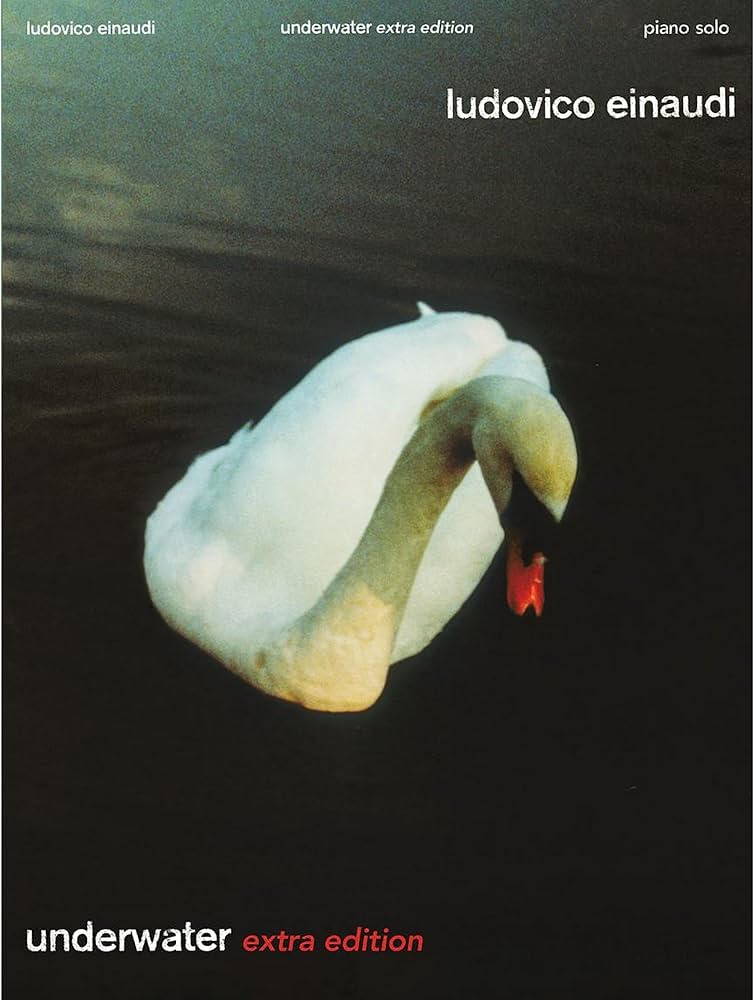
Einaudi's first full solo piano album in twenty years, Underwater was written during the COVID-19 lockdown, when the composer was isolated at his home in Italy. "I felt a sense of freedom to abandon myself and to let the music flow in a different way," he explained. "I didn't have a filter between me and what came out of the piano, it felt very pure". The album's twelve tracks, including "Luminous," "Rolling Like a Ball," and "Natural Light," are among his most intimate and unadorned recordings.
Film and Television Music: The Soundtrack of Contemporary Cinema
Einaudi's music has become an integral part of contemporary film and television, used both in scores he composed specifically for films and in licensed tracks that directors have chosen to accompany their scenes. His distinctive sound—melancholic, introspective, and emotionally direct—has made him a natural choice for filmmakers seeking to evoke mood and atmosphere.
Einaudi began composing film soundtracks in the mid-1990s, starting with two films by Michele Sordillo: Da qualche parte in città (1994) and Acquario (1996), for which he won the Grolla d'oro award. His soundtrack for Luce dei miei occhi (2002) was named best soundtrack at the Italian Music Awards. In 2004, his score for Sotto falso nome received the prize for best film music at the Avignon Film Festival.
His television work includes the score for the 2002 miniseries Doctor Zhivago, which AllMusic praised as comparable in skill to Maurice Jarre's score for the earlier film adaptation. More recently, his music has been featured extensively in Shane Meadows's This Is England franchise, including the original film (2006) and the television sequels This Is England '86 (2010) and This Is England '88.
Einaudi's music has also been used in some of the most acclaimed films of recent years. His tracks "Fly," "Writing Poems," "L'origine nascosta," "Cache-cache," "Una Mattina," and "Primavera" were featured in The Intouchables (2011), the biggest box-office success in French cinema history. His music was used as the score for Chloé Zhao's Nomadland (2020), which won the Academy Award for Best Picture, and Florian Zeller's The Father (2020), for which he composed the original piece "My Journey".
Other films that have featured Einaudi's music include Insidious (2010), Samba (2014), The Water Diviner (2014), and The Third Murder (2017). His music has also appeared in numerous television advertisements, including campaigns for British Airways, Apple, and Dior.
Collaborations: A Dialogue Across Musical Traditions
Throughout his career, Einaudi has sought out collaborations with musicians from diverse traditions, reflecting his belief that music can and should draw from multiple sources. These collaborations have enriched his own musical language while introducing his audience to artists from beyond the Western classical tradition.
Ballaké Sissoko
One of Einaudi's most significant collaborations is with Malian kora virtuoso Ballaké Sissoko. Their album Diario Mali (2003) is a dialogue between Einaudi's minimalist piano and Sissoko's traditional West African kora music. The album, which was re-released on vinyl for its twentieth anniversary in 2023, remains a landmark of cross-cultural musical exchange. Sissoko's hypnotic, almost spellbinding playing hovers "between tradition and experimentation," creating a perfect foil for Einaudi's meditative piano.
Djivan Gasparyan
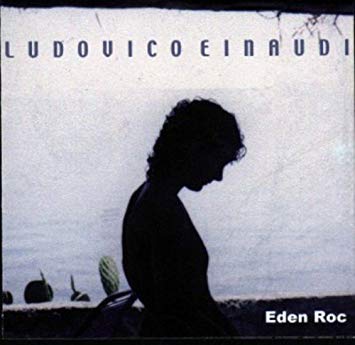
Einaudi collaborated with Armenian duduk player Djivan Gasparyan on the album Eden Roc (1999), which featured an array of guest musicians and instruments ranging from electric guitar to the Armenian duduk. The collaboration introduced Einaudi's audience to the haunting sound of the duduk, an ancient woodwind instrument that would become a recurring colour in his later work.
Daniel Hope
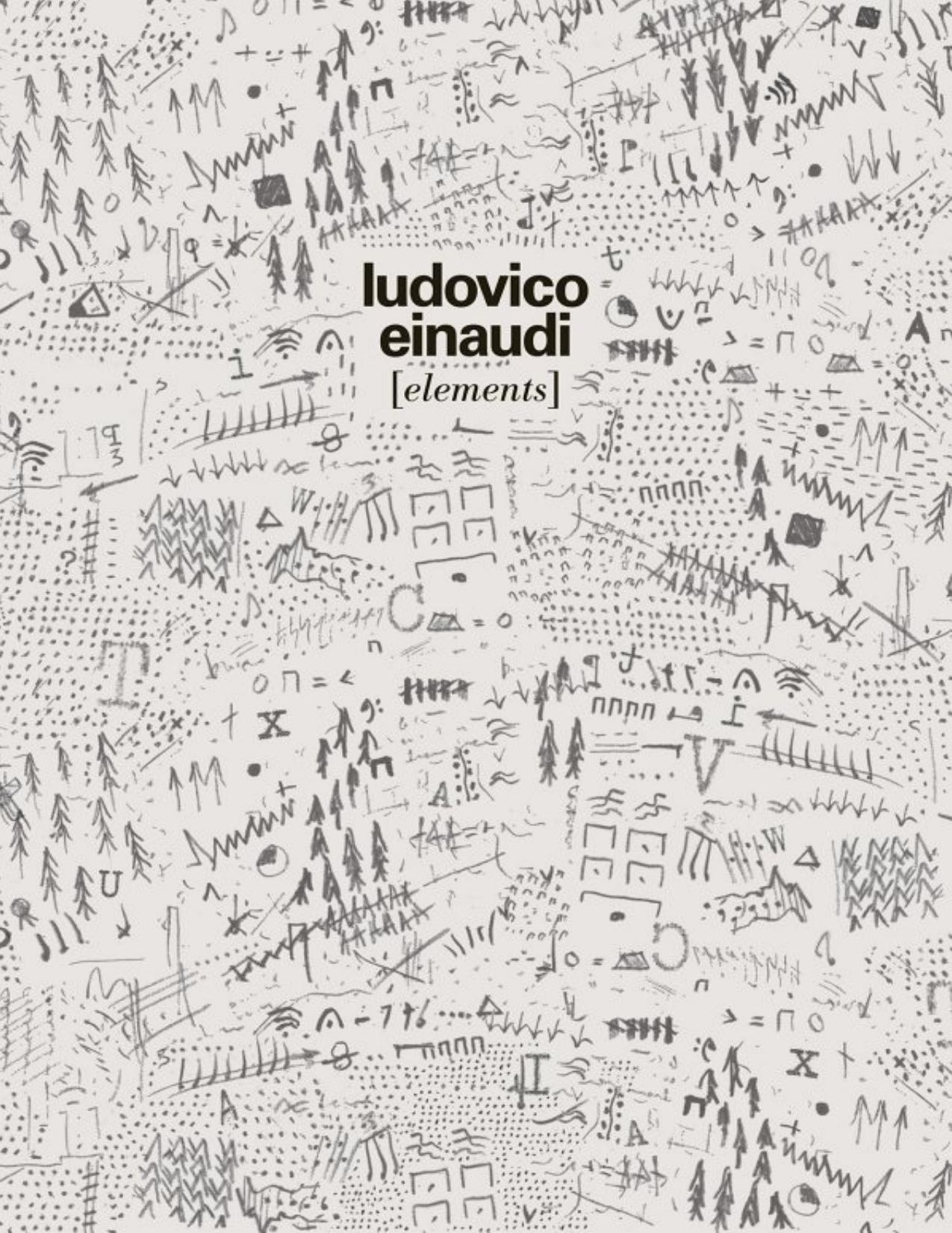
Violinist Daniel Hope has been a frequent collaborator, performing on several of Einaudi's albums including Elements (2015). Hope's expressive playing brings a different dimension to Einaudi's music, adding a lyrical, almost vocal quality to the instrumental textures.
Robert Lippok
Einaudi's collaboration with Robert Lippok of the post-rock band To Rococo Rot brought an electronic dimension to his music. Lippok contributed electronic textures and programming to several tracks, helping Einaudi explore the intersection of acoustic piano and digital sound.
Federico Mecozzi and Redi Hasa
Two musicians have become particularly associated with Einaudi's recent work: violinist and violist Federico Mecozzi and cellist Redi Hasa. Both have recorded on almost all the tracks of Einaudi's recent albums, including Seven Days Walking and The Summer Portraits. Their string playing adds warmth and depth to Einaudi's piano, creating a chamber-music intimacy that translates effectively to large concert halls.
Leo Einaudi
In recent years, Einaudi has collaborated with his son, multi-instrumentalist, singer, songwriter, producer, and arranger Leo Einaudi, on a rework of his chart-topping album The Summer Portraits. This collaboration represents both a familial bond and an artistic dialogue across generations.
Influences: From Bach to Eminem
Einaudi's musical influences are remarkably diverse, reflecting his belief that "every box is a narrow box" and that an artist should remain open to all forms of music. His early exposure to Chopin, Bach, and Schumann, thanks to his pianist mother, laid the foundation for his classical sensibility. He also explored European folk music, the Beatles, and other 1960s rock during his formative years.
Over time, his influences expanded to include Vivaldi, Stravinsky, and Bartók, as well as more unexpected sources such as Billie Eilish, Eminem, and Radiohead. Einaudi has spoken admiringly of Eminem's skill as a wordsmith, and his own rhythmic sensibility sometimes betrays the influence of hip-hop's flow and phrasing.
Among classical composers, Einaudi has cited Philip Glass as an important inspiration. Like Glass, Einaudi has been associated with minimalism, though his music is more accurately described as post-minimalist, incorporating elements of popular music and world music that are absent from the work of the first-generation minimalists.
The influence of non-Western music is also significant. Einaudi's collaborations with Ballaké Sissoko and Djivan Gasparyan introduced him to the melodic and rhythmic traditions of Mali and Armenia, while his study with Berio exposed him to African vocal music and other non-European forms. This openness to world music has become a defining feature of his sound.
Legacy: The Democratisation of Classical Music
Ludovico Einaudi's legacy is still being written, but its contours are already clear. He has achieved something that few artists in any genre can claim: he has fundamentally altered the relationship between classical music and popular culture. His compositions, which could sit alongside those of classical minimalists such as Max Richter and Michael Nyman, are also touched with an understanding of popular music that has allowed them to reach audiences far beyond the traditional classical music world.
Einaudi's commercial success is staggering. He is the world's most-streamed classical artist, with more than 10 million monthly listeners on Spotify and over 39 billion global streams. His track "Experience" has amassed more than 16 billion views on TikTok, making him Gen Z's classical artist of choice. He has sold out arenas across Europe and enjoyed the longest continuous headline run by a pianist in the history of London's Royal Albert Hall, with six consecutive nights.
Yet Einaudi's legacy is not merely commercial. He has demonstrated that instrumental piano music can be emotionally direct, accessible, and popular without sacrificing artistic integrity. He has shown that classical music need not be confined to concert halls and that it can speak to audiences in their everyday lives—through films, advertisements, and social media. And he has proven that an artist can be both deeply serious and widely loved, both a composer of substance and a popular phenomenon.
Einaudi's influence can be heard in the work of a generation of younger composers and pianists who have followed in his wake, including Max Richter, Ólafur Arnalds, and Nils Frahm. These artists have built on Einaudi's model of accessible, emotionally resonant instrumental music, creating a new genre—sometimes called neoclassical or post-classical—that has become one of the most vital streams in contemporary music.
Awards and Recognition
Einaudi's contributions to music have been recognised with numerous awards and honours. In 2005, he was made an Officer of the Order of Merit of the Italian Republic (OMRI). He has won the Echo Klassik award in Germany (2002), the Italian Music Award for Best Film Score for Luce dei miei occhi (2002), and the prize for best film music at the Avignon Film Festival for Sotto falso nome (2004).
More recently, he received the Lifetime Achievement Edison Klassiek in 2026, a recognition of his extraordinary career and his status as the world's most-streamed pianist. In the same year, he was awarded the McKim Medal, which honours personalities who embody the cultural dialogue between Italy and the United States.
Ludovico Einaudi: A Composer for the Twenty-First Century
Ludovico Einaudi occupies a unique position in contemporary music. He is a composer who belongs to no single tradition but draws from all of them; a pianist whose technique is rooted in the classical canon but whose sensibility is thoroughly modern; an artist who has achieved commercial success on a scale rarely seen in instrumental music while remaining true to a personal vision of simplicity, beauty, and emotional honesty.
His music has been criticised by some classical purists for its harmonic simplicity and lack of structural complexity. Yet these very qualities are central to its power. In an age of information overload, Einaudi offers something rare and precious: music that invites the listener to slow down, to breathe, to feel. His arpeggios, which might seem repetitive on first hearing, reveal themselves on closer listening to be endlessly subtle, shifting and evolving with each repetition. His melodies, which might seem simple, carry an emotional weight that belies their apparent artlessness.
Einaudi has said that he sees creating an album as similar to writing a book, with each album telling a different story. His body of work, now spanning more than three decades, constitutes a kind of library of the soul—a collection of musical narratives that explore memory, nature, love, loss, and hope. In a world that often seems to value complexity and sophistication over directness and sincerity, Ludovico Einaudi has reminded us that simplicity, when pursued with integrity and craft, can be the most profound form of expression.
Browse in the Sheet Music Library:
Or browse in the categories menus & download the Library Catalog PDF:
Ludovico Einaudi Discography
Studio albums
- Time Out (various instruments; experimental) (1988)
- Stanze (harp) (1992)
- Salgari (various instruments; ballet) (1995)
- Le Onde (piano) (1996)
- Eden Roc (piano and strings) (1999)
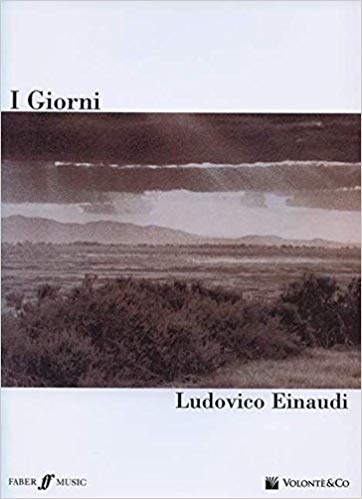
- I Giorni (piano) (2001)
- Diario Mali (piano, kora) (2003)
- Una Mattina (piano, cello) (2004)
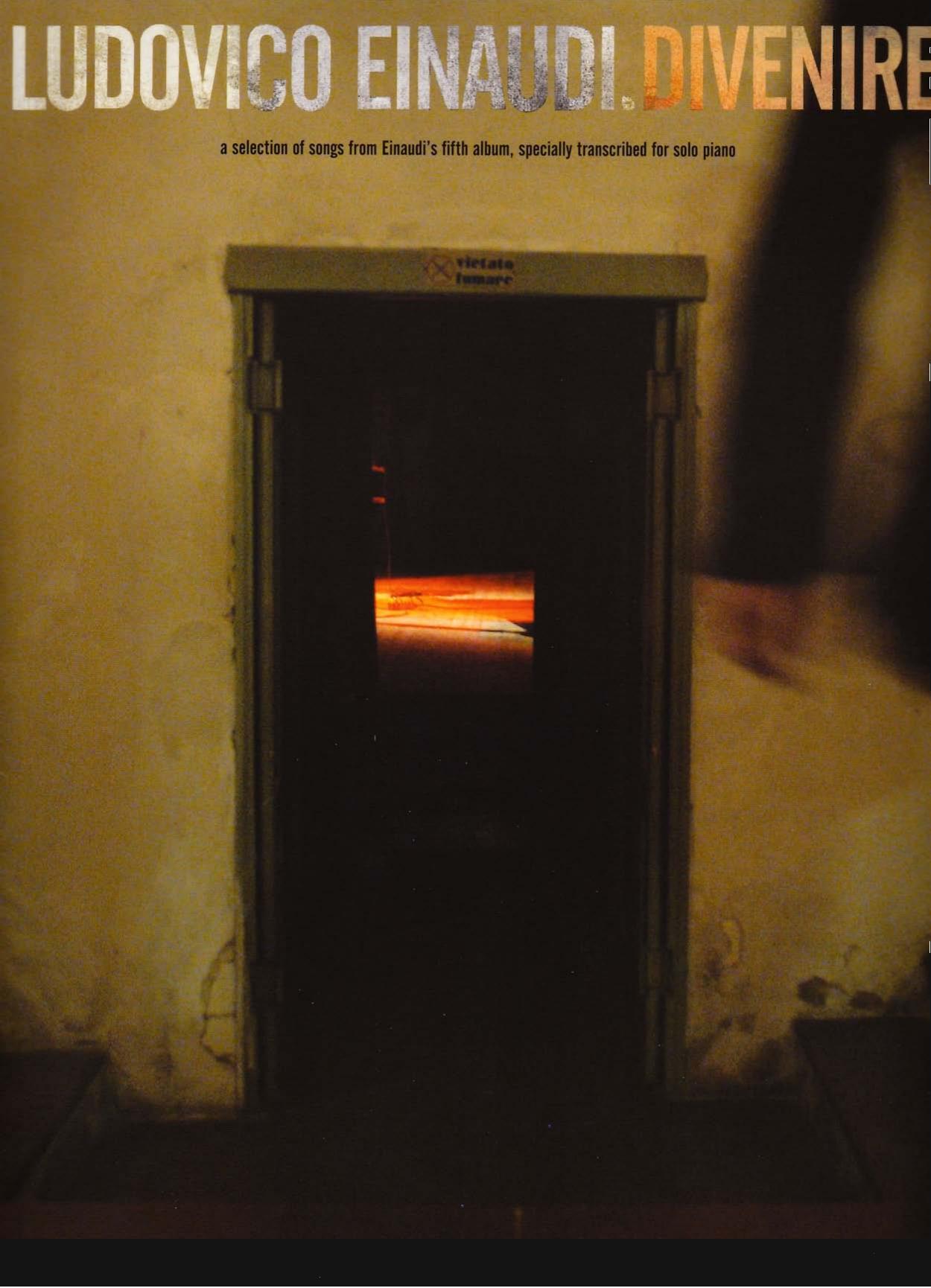
- Divenire (piano, string orchestra, electronic) (2006)
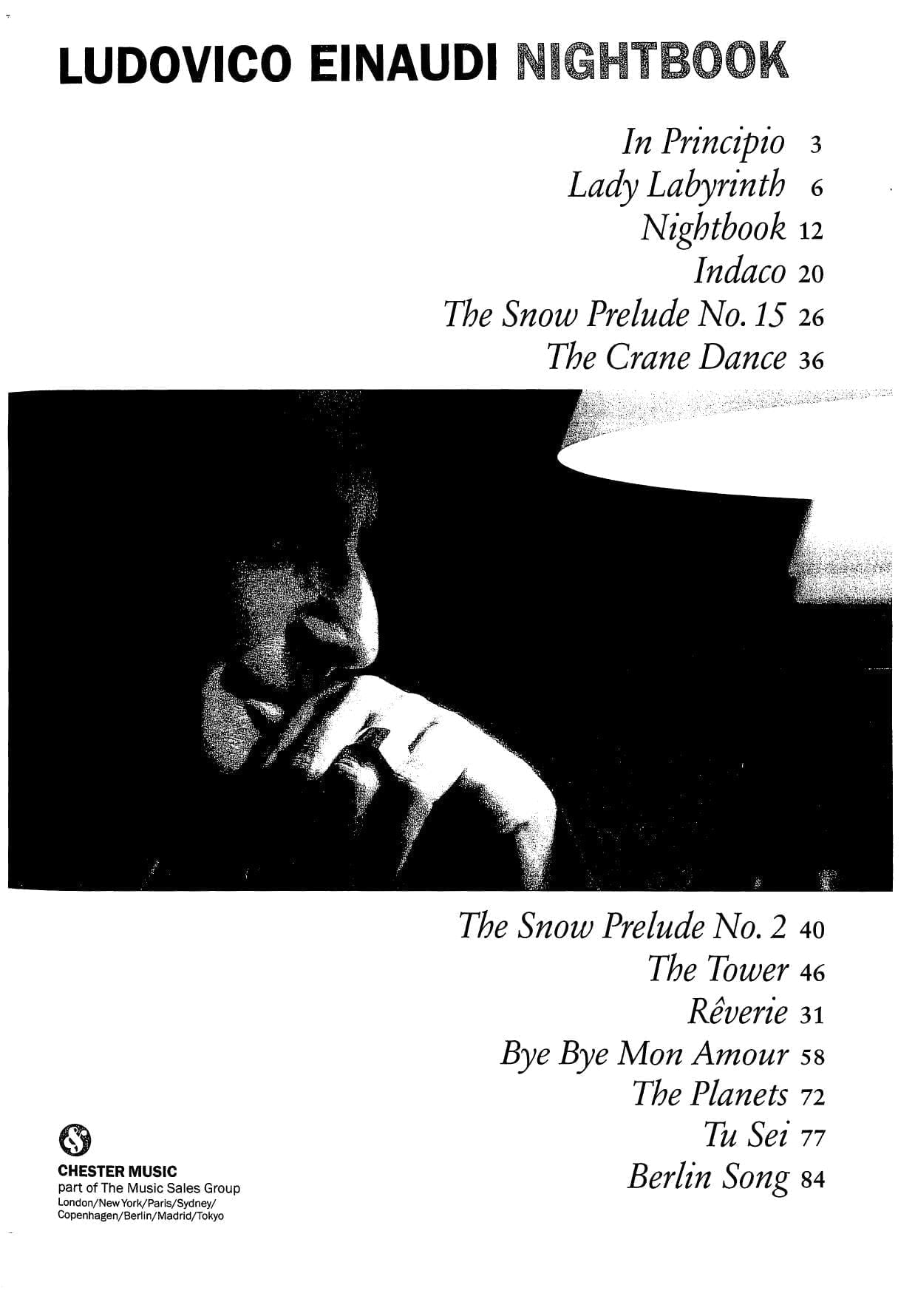
- Nightbook (piano, electronic) (2009)
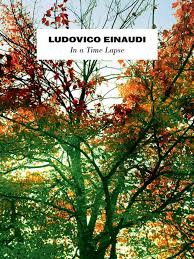
- In a Time Lapse[33][34] (piano, electronic) (2013)
- Taranta Project (piano, electronic, orchestra, cello, kora) (2015)
- Elements (piano, electronic, orchestra) (2015)
- Seven Days Walking (piano, violin, viola, cello) (2019)
- 12 Songs from Home (piano) (2020)
- Underwater (piano) (2022)
- The Summer Portraits (piano, string orchestra) (2025)
- Solo Piano (2026)
Live albums
- La Scala Concert 03.03.03 (2003)
- Live in Berlin (2007)
- iTunes Festival: London 2007 (2007)
- Live in Prague (2009)
- The Royal Albert Hall Concert (2010)
- La notte della Taranta 2010 (2011)
- iTunes Festival: London 2013 (2013)
- In a Time Lapse Tour (2014)
- Elements, Special Tour Edition (2016)
Compilations
- Echoes: The Einaudi Collection (2003)
- I primi capolavori (2010)
- Islands: Essential Einaudi (2011)
- Einaudi Essentiel (2012)
- Undiscovered (2020)
- Cinema (2021)
- Moments of Peace (2023)
- Music of Care (2023)
- Undiscovered II (2023)
Remixes
- Table Vs Ludovico Einaudi (2002)
- Elements, Remixes (2016)
Singles
- "Ultimi Fuochi" (1998)
- "Blusound" (2001)
- "Night" (2015)
- "Elements" (2015)
- "Drop" (2015)
- "Elegy for the Arctic" (2016)
- "Luminous" (2021)
- "Rose Bay" (2024)
With Whitetree
- Cloudland (2009)
Film and television scores
- Treno di panna (Director: Andrea De Carlo) (1988)
- Da qualche parte in città (Director: Michele Sordillo) (1994)
- Acquario (Director: Michele Sordillo) (1996)
- Aprile (Director: Nanni Moretti) (1998)
- Giorni dispari (Director: Dominick Tambasco) (1998)
- Fuori dal mondo (Director: Giuseppe Piccioni) (1999)
- La vita altrui (Director: Michele Sordillo) (2000)
- Un delitto impossibile (Director: Antonio Luigi Grimaldi) (2000)
- Le parole di mio padre (Director: Francesca Comencini) (2001)
- Alexandreia (Director: Maria Iliou) (2001)
- Luce dei miei occhi (Director: Giuseppe Piccioni) – Italian music award for best film score (2002)
- Doctor Zhivago (TV mini-series, Director: Giacomo Campiotti) (2002)
- Sotto falso nome (Director: Roberto Andò) – Prize for the best film music at Avignon Film Festival 2004 (2004)
- Mission: Saturn (2004)
- This Is England (Director: Shane Meadows) (2006)
- This Is England '86 (Director: Shane Meadows) (2010)
- Stargate Universe – Pathogen (2010)
- Sangandaan – Landas ng Buhay (2010)
- I'm Still Here (Director: Casey Affleck) (2010)
- Das Ende ist mein Anfang – German film (2010)
- Black Swan trailer (Director: Darren Aronofsky) (2010)
- This Is England '88 (Director: Shane Meadows) (2011)
- Intouchables – (Director: Olivier Nakache & Eric Toledano) (2011)
- Primavera – (Gary Speed RIP Documentary: Sport Wales) (2011)
- J. Edgar – (Director: Clint Eastwood) (2012)
- Derek (pilot episode) – (Director: Ricky Gervais) (2012)
- The Water Diviner – (Director: Russell Crowe) (2014)
- Mommy – (Director: Xavier Dolan) (2014)
- This Is England '90 – (Director: Shane Meadows) (2015)
- The Third Murder – (Director: Hirokazu Koreeda) (2017)
- The Father – (Director: Florian Zeller) (2020)
- Nomadland – (Director: Chloé Zhao) (2020)
- Cosmos: Possible Worlds – (TV series, director: Ann Druyan; episode: "The Sacrifice of Cassini", score by Alan Silvestri) (2020)
- The Braid – (Director: Laetitia Colombani) (2023)
Commercials, other
- BBC – background music to minute of silence for recent racing deaths before Formula 1 Airtel Grand Prix of India (30 October). (2011)
- Airtel India TV commercial Endless Goodbye on YouTube – excerpt from "I Giorni". (2011)
- Procter & Gamble TV commercial "The Best Job" for the Olympics 2012 (excerpt from "Divenire" on YouTube). (2012)
- Numerous episodes of the BBC's Top Gear including the 2009 Bolivia Special.
- Year of creation unknown: National Basketball Association (NBA) of America, Where Will Amazing Happen This Year (Magic Johnson Sky Hook) on YouTube.
- James May's Toy Stories Christmas Special, excerpt from "Divenire". (2012)
- "The Snow Prelude N. 03 in C Major" background music to the Nationwide Building Society's adverts. (2012)
- Vodafone RED, excerpt from "Walk". (2013)
- BBC – The Apprentice – Episode 7: Caravans (Lady Labyrinth & The Crane Dance).[45] (2013)
- British Airways Advert: Today, Tomorrow on YouTube, "Experience (Starkey Remix)" for commercial (2013)
- Één 'BIRTHDAY', Belgian documentary by photographer Lieve Blancquaert (nl.wikipedia) – 9 episodes.[46] – "Life" as intro and outro track
- "The Book Thief" international trailer – "Life" – The Book Thief: Official Trailer #1 HD (2014), 20centuryfox on YouTube.
- "Moving Art" Louie Schwartzberg, Netflix series. (2013)
- "Valiant Hearts: The Great War" first-look trailer – "Fly" Valiant Hearts: The Great War official trailer (UK) on YouTube. (2013)
- Procter & Gamble TV commercial for the Sochi 2014 Olympics – "Primavera". (2014)
- Alan Watts spiritual guide, Choices – "Experience" Video on YouTube. (2014)
- Nike Golf ad, Rory Mcilroy tribute to Tiger Woods – "Nuvole Bianche". (2015)
- ANZ Australia: Welcome to Your World, Your Way on YouTube, "Experience" for commercial. (2015)
- UFC 193 Promo Video: UFC 193: Rousey vs. Holly Holm – Revolution on YouTube, "Experience". (2015)
- BBC: "Fly" used as the theme music to TV series Doctor Foster. (2015)
- RTVE: "Nuvole Bianche" used as the theme music of 2015 Spanish Lottery commercial. (2015)
- BBC MasterChef: The Professionals, "Life" was used when a winner was announced. (2015)
- SKY Sports, "Experience" music for commercial and other features for the 2016 Golf Open. (2016)
- Procter & Gamble TV commercial Strong on YouTube for the Rio 2016 Olympics, "Experience" music for commercial. (2016)
- Amazon Prime – A Priest and Imam meet for a cup of tea. Excerpt from "I Giorni". (2016)
- Sense8 series finale "Amor Vincit Omnia", "Experience" was played during the closing scene. (2018)
Search your favorite sheet music in the Sheet Music Library Catalog
10 Pieces by Ludovico Einaudi
The best sheet music download from our Library.
Track list and live video playing: 0:00 - 6:10 Experience:  • Experience - Ludovico Einaudi (Piano Solo) 6:11 - 12:27 Nuvole Bianche: • Nuvole Bianche - Ludovico Einaudi - Piano ... 12:28 - 15:46 Una Mattina: • Una Mattina - Ludovico Einaudi (HD Piano S... 15:47 - 20:11 Fly: • Ludovico Einaudi - Fly (The Intouchables) 20:12 - 26:12 I Giorni: • I Giorni - Ludovico Einaudi (HD Piano Solo) 26:13 - 43:58 Divenire: • Divenire - Ludovico Einaudi | Extended Ver... 43:59 - 48:04 Life: • Life - Ludovico Einaudi - Piano Solo HD 48:05 - 53:01 Burning: • Burning - Ludovico Einaudi - HD Piano 53:02 - 58:06 In Un'altra vita: • Ludovico Einaudi - In un'altra vita | Pian... 58:07 - 1:04:10 Waterways: • Waterways - Ludovico Einaudi - Cello/Guita...