
Scores for all instruments: 16,000+ (active and growing), over 236,000 pages.
All genres and levels: Jazz & Blues, Rock & Pop, Classical & Contemporary, Film & Musicals;
books & biographies; methods, études, play-along tracks (MP3) for Jazz & Rock.
Access & benefits: US$15.99 one-time payment, valid for lifetime, full Library access.
Table of Contents
Who is Max Richter (b. 1966)?
The best sheet music download from our Library.
Please, subscribe to our Sheet Music Library. Sheet music should be accessible and affordable for all musicians, from professionals to absolute beginners.
Max Richter: The Composer Who Rebuilt Classical Music for the Modern Mind
Few contemporary composers have reshaped the boundaries of classical music as decisively as Max Richter. A German-born British composer, pianist, and producer, Richter has spent nearly three decades constructing a musical language that is at once profoundly accessible and quietly radical—a language he himself christened “post-classical”. His music has streamed over a billion times, soundtracked some of the most emotionally charged moments in modern cinema and television, and invited listeners to sleep through an eight-and-a-half-hour lullaby. Yet beneath the surface of this extraordinary commercial and cultural success lies a rigorously trained composer whose work is deeply rooted in the minimalist tradition, filtered through a humanist sensibility that refuses to separate intellectual ambition from emotional directness.
Search your favorite sheet music in the Sheet Music Library Catalog

Biography and Early Life
Max Richter was born on 22 March 1966 in Hamelin, Lower Saxony, West Germany. His family moved to Bedford, England, while he was still a young child, and it was in this adopted country that his musical identity began to take shape. Richter has described his childhood self as “very shy and quite solitary,” a bookish and musically inclined outsider in a sporty school where he felt like a foreigner. Music, he has said, affected him more physically than it did others; he was hypersensitive to sound from an early age.
His formal training was impeccable. He studied composition and piano at the University of Edinburgh, then at the Royal Academy of Music in London, before travelling to Florence to study with the Italian composer Luciano Berio, a pioneer of electroacoustic music and a central figure in the postwar avant-garde. Berio’s influence was profound. Richter has recalled that when he showed Berio a score, “it felt as though he was reading my mind… he could read the intention behind all of my scribbles”. This encounter with a mind that could see through the notation to the musical intention behind it left a lasting mark on Richter’s approach to composition.
After completing his studies, Richter co-founded the contemporary classical ensemble Piano Circus, a group of six pianists dedicated to performing and commissioning works by minimalist and post-minimalist composers. He remained with the ensemble for a decade, during which time they commissioned and performed works by Arvo Pärt, Brian Eno, Philip Glass, Julia Wolfe, and Steve Reich, producing five albums for Decca/Argo. This immersion in the minimalist canon—not merely as a listener but as a performer and curator—would become the foundation upon which his own compositional voice was built.
The late 1990s saw Richter branching out into electronic and popular music. In 1996 he collaborated with the Future Sound of London on the album Dead Cities, initially as a pianist but eventually co-writing the track “Max”. He worked with the band for two years and also contributed to Roni Size’s Mercury Prize-winning In the Møde in 2000. These experiences in the electronic and dance music worlds were not diversions from his classical training but extensions of it—part of a lifelong project of breaking down the barriers between musical traditions.
Musical Style and Technique: Post-Classical Minimalism
Max Richter’s music is often described as minimalist, but the label requires qualification. As musicologist Samuel M. Rothermel argues in his analysis of The Blue Notebooks, Richter “borrows from multiple minimalist traditions, particularly layering, use of predominantly inverted triadic harmony, and basic motivic repetition throughout a piece,” yet he adds “extra-musical elements, such as heavy use of reverb and environmental recording samples, to create an intensely atmospheric sensation”. Richter himself prefers the term “post-classical,” a designation that acknowledges his roots in the classical tradition while signalling his openness to electronic textures, found sounds, and popular music idioms.
The core of Richter’s technique lies in his approach to repetition and variation. His compositions frequently begin with a simple, often stepwise melodic phrase—what one critic describes as “unsteady steps”—and build entire movements through the gradual layering of new material, the subtle modification of existing motifs, and the addition of basslines that shift beneath the surface. This is minimalism in the tradition of Steve Reich and Philip Glass, but softened and humanised. Where the New York minimalists of the 1960s pursued impersonality and process, Richter pursues intimacy and emotional resonance. His pieces are performed with rubato and sensitivity; the repetition is never stringent but rather “repetitive but never stringent,” as the BBC’s review of The Blue Notebooks put it.
A defining feature of Richter’s sound is his use of texture and timbre. He writes prominently for strings, exploiting their capacity for wide register and liberal vibrato to create what Rothermel calls “a somewhat intangible tenderness”. Piano, organ, harp, and electronics are woven into the fabric of his arrangements, and the boundary between acoustic and electronic sound is deliberately blurred. The BBC review of The Blue Notebooks notes his “equal fascination for acoustic instrumentation and electronic sounds, particularly beats,” and highlights a particularly ingenious technique: the use of extracted reverberation from the harp as an eerie synthesizer patch in its own right. This attention to the sonic residue of acoustic instruments—the space around the notes—is characteristic of Richter’s production aesthetic.
Harmony and Compositional Approach
Harmonically, Richter’s music is deceptively simple. He works predominantly within tonal frameworks, often relying on triadic harmony, but with a distinctive preference for inverted triads and clustered pitches that generate “vibrant extensions that color the underlying functional harmony”. The harmonic progressions are frequently cyclical, built around the alternation of two or three chords that repeat with subtle variations in voicing and orchestration. “On the Nature of Daylight,” for instance, is in B-flat minor and uses a simple, cyclical chord progression that provides the foundation for its accumulating emotional weight.
This harmonic economy is not a limitation but a deliberate compositional strategy. Richter has spoken of his desire to “make room for the listener,” to use “simple and direct language” without sacrificing depth. “At the conservatory, we grow up with the idea that good music is complex music,” he has said. “So I try to make room for the listener… Which does not mean that it is simple music: it means that I have worked hard to make it seem simple”. This is the paradox at the heart of Richter’s art: the appearance of simplicity achieved through rigorous refinement.
His formal structures often rely on the repetition of a single motive to generate longer forms, with variation achieved through changes in instrumentation, texture, and harmonic colour rather than through melodic development in the traditional sense. The result is music that unfolds gradually, almost ritualistically, inviting the listener into a state of contemplative attention. It is this quality that has made his work so attractive to filmmakers, for whom Richter’s music provides an emotional through-line that can be edited and shaped without losing its internal logic.
Key Works and Compositions
Richter’s solo discography is a catalogue of increasingly ambitious explorations of the post-classical aesthetic. His debut album, Memoryhouse (2002), was reviewed by Andy Gill as “a landmark work of contemporary classical music”. An experimental album of what Richter called “documentary music,” it was recorded with the BBC Philharmonic Orchestra and explores real and imagined histories, with tracks dealing with the aftermath of the Kosovo conflict and childhood memories. The album combines ambient sounds, voices—including that of John Cage—and poetry readings from the work of Marina Tsvetaeva. Although it received little press attention at the time, Memoryhouse has since been recognised as a foundational text of the neoclassical movement; Pitchfork, reviewing the 2014 reissue, noted that Richter’s ability to weave subtle electronics against the grand BBC Philharmonic Orchestra “helped suggest new possibilities and locate fresh audiences” for a generation of composers.
It was The Blue Notebooks (2004), however, that cemented Richter’s reputation. Named by The Guardian as one of the best classical works of the century, the album features Tilda Swinton reading from Kafka’s The Blue Octavo Notebooks and the poetry of Czesław Miłosz. Richter has described it as a protest album about the Iraq War and a meditation on his own troubled childhood. The album’s second track, “On the Nature of Daylight,” has become Richter’s signature composition—a piece for string orchestra of extraordinary emotional power that has been used in Martin Scorsese’s Shutter Island, Denis Villeneuve’s Arrival, and the HBO series The Last of Us. Other highlights from the album include “Vladimir’s Blues,” a minimalist piano work of deceptive emotional complexity, and “Shadow Journal,” which weaves harp arpeggios, ambient sounds, a typewriter, speech, and an electronic beat into a hypnotic whole.
Songs from Before (2006) featured Robert Wyatt reading texts by Haruki Murakami, continuing Richter’s practice of integrating spoken word into his musical landscapes. 24 Postcards in Full Colour (2008) was a collection of twenty-four classically composed miniatures originally conceived for mobile phone ringtones—a characteristically conceptual project that saw Richter treating the billions of small speakers traversing the planet as a space for creative music.
Infra (2010) took as its central theme the 2005 London terrorist bombings and extended Richter’s 25-minute score for a Wayne McGregor ballet of the same name. Pitchfork called it “achingly gorgeous,” and The Independent described it as “a journey in 13 episodes, emerging from a blur of static and finding its way in a repeated phrase that grows in loveliness”.
Richter’s most audacious project to date is undoubtedly Sleep (2015), an eight-and-a-half-hour composition designed to be experienced overnight. Created in collaboration with visual artist and creative partner Yulia Mahr, Sleep consists of thirty-one compositions, most between twenty and thirty minutes in length, all based on variations of four or five themes. Scored for piano, cello, two violas, two violins, organ, soprano vocals, synthesisers, and electronics, it was performed by the American Contemporary Music Ensemble with vocals by Grace Davidson. Richter has called it “an eight-hour-long lullaby” and “a manifesto for a slower pace of existence”. A one-hour distillation, From Sleep, was released alongside the full work, and the project has been performed in venues from the Concertgebouw in Amsterdam to the Sydney Opera House, with audiences given beds instead of seats. Sleep was named one of the fifty best ambient albums of all time by Pitchfork and chosen by Jarvis Cocker as BBC Radio 6’s album of the year.
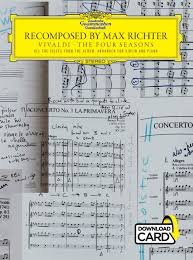
Recomposed by Max Richter: Vivaldi – The Four Seasons (2012) is another landmark. Richter retained roughly twenty-five percent of Vivaldi’s original material, phrasing and looping it to emphasise his grounding in postmodern and minimalist music. The project, released as part of Deutsche Grammophon’s series of masterwork “remixes,” topped the iTunes classical charts in the UK, Germany, and the US and won the prestigious ECHO Classic Award. It remains one of the most successful classical recordings of the twenty-first century and is still regularly performed by orchestras today.
More recent albums include Voices (2020), a major recording project inspired by the Universal Declaration of Human Rights, and Voices 2 (2021), which Richter described as “a piece of music as a place to think”. Exiles (2021) saw Richter team up with the Baltic Sea Orchestra for orchestral versions of older works and new material, including a reflection on travel and transformation that resonated with the migrant crisis.
Richter’s music has become ubiquitous in cinema and television, but his work as a film composer is distinct from his solo work. He approaches scoring as “solving a puzzle,” a “technical discipline” fundamentally different from writing autonomous music. In cinema, he says, “If you did that… you wouldn’t have a film. It would be as though you’ve gone to a cinema just to hear a record playing”. His scores are therefore more restrained, more willing to leave space for dialogue and image, while still bearing the unmistakable imprint of his harmonic and textural language.
His breakthrough in film came with Ari Folman’s animated documentary Waltz with Bashir (2008), a searing meditation on war, memory, and trauma. Richter’s score was described as “provocative and powerfully intense,” matching the film’s confrontation with “lasting lessons in recent history and the psychology of trauma”. It won the European Film Award for Best Composer. He followed this with scores for Shutter Island (2010), which made extensive use of “On the Nature of Daylight”; The Leftovers (2014–2017), Damon Lindelof’s HBO series about a post-apocalyptic global event, for which Richter’s “emotive and minimal score” was widely praised as essential to the show’s tone; and Ad Astra (2019), James Gray’s sci-fi thriller starring Brad Pitt. For Ad Astra, Richter incorporated plasma wave data from the Voyager probes into the score, embodying the film’s themes of cosmic isolation and existential journeying. The score earned him a Grammy nomination.
Other notable film and television scores include Mary Queen of Scots (2018), My Brilliant Friend (2018–), Taboo (2017), Hostiles (2017), White Boy Rick (2018), Miss Sloane (2016), Testament of Youth (2014), Black Mirror (“Nosedive,” 2016), and Spaceman (2024). His most recent score, for Chloé Zhao’s Hamnet (2025), earned him nominations for the Academy Award, Golden Globe, and BAFTA, and the soundtrack includes an orchestral version of “On the Nature of Daylight”. The Berlinale honoured Richter with its Camera award in 2026, recognising his lasting mark on contemporary film music.
Collaborations
Collaboration has been a constant thread throughout Richter’s career, spanning electronic music, ballet, fashion, and visual art. His early work with the Future Sound of London and Roni Size introduced him to the possibilities of electronic production, and he has continued to move fluidly between the classical and popular music worlds. He produced Vashti Bunyan’s 2005 album Lookaftering and Kelli Ali’s 2008 album Rocking Horse.
His most significant and sustained creative partnership is with the choreographer Wayne McGregor. Their collaborations include Infra (2008), Woolf Works (2015), and MaddAddam (2026), the latter inspired by Margaret Atwood’s trilogy and resulting in the album While The Flood Rages. Richter has also scored music for Dior catwalk shows, collaborated with Maison Margiela, and worked with artists including Anna Lapwood, Anne-Sophie Mutter, and Gautier Capuçon.
His personal and professional partnership with Yulia Mahr has been equally formative. The two met at the Edinburgh Festival in 1988, and Mahr, a filmmaker and visual artist, gave Richter his first musical commission. She has been his creative partner on projects including Sleep, Voices, and Free and Equal, and together they founded Studio Richter Mahr in Oxfordshire in 2022—a recording studio and creative retreat powered by solar and heat-pump technology, set in thirty-one acres of woodland. The couple have also released Free and Equal Vol. 2 in support of Doctors Without Borders, featuring compositions reimagined by contemporary artists.
Influences and Legacy
Richter’s musical influences are a strikingly eclectic constellation. He has cited Bach and the Beatles as his “twin stars,” and he describes hearing Bach’s Double Violin Concerto as a revelatory experience. Kraftwerk’s “Autobahn” was, in his words, “like being struck by lightning,” opening the door to electronic music. He was drawn to the minimalist disruptors—Brian Eno, Philip Glass, Julia Wolfe, Steve Reich, and Arvo Pärt—whose work he championed with Piano Circus, and he has spoken of his admiration for the poetry of Wordsworth, Keats, Anne Carson, and Redgrove. The literature of Kafka and Miłosz, the films of Andrei Tarkovsky, and the political activism of the human rights tradition have all left their mark on his artistic vision.
Richter’s legacy is already substantial. He is widely credited with helping to popularise the post-classical genre and with blazing a trail for a generation of musicians who move fluidly between classical, electronic, and popular music. Pitchfork has noted that “as you listen to new work by Julianna Barwick or Jóhann Jóhannsson, thank Richter; just as Sigur Rós did with its widescreen rock, Richter showed that crossover wasn’t necessarily an artistic curse”. His music has been performed in the world’s most prestigious concert halls, from the Barbican to the Concertgebouw, and his recordings have amassed over a billion streams.
His awards and honours reflect this influence. He has won two BAFTAs, been nominated for three Grammy Awards (including Best Composer of the Year in 2021), and received the European Film Award for Waltz with Bashir. In 2026 he was awarded a CBE in the New Year’s Honours List for his contribution to British culture, and he received the Ivor Novello Award for Innovation, with The Ivors Academy praising him as “one of the defining voices in contemporary classical music”.
Additional Information: Activism, Sleep Science, and the Art of Listening
Beyond his compositional work, Richter is a committed activist and humanist. From his earliest albums, humanitarian issues and political activism have been a long-running thread through his work. The Blue Notebooks was explicitly a protest against the Iraq War; Infra responded to the London bombings; Voices was inspired by the Universal Declaration of Human Rights; and Exiles addressed the migrant crisis. He thinks of music as “an ever-more crucial place to reflect” on the pressing issues of the time.
His approach to Sleep was informed by consultations with a neuroscientist specialising in sleep, and the work was designed to interact with the sleeping mind, exploring the effects of subsonics and repetition to enhance slow-wave sleep. This scientific curiosity extends to his use of technology in composition, from his early experiments with analogue synthesizers to his incorporation of NASA’s Voyager plasma wave data into the Ad Astra score.
Richter has also been active as a mentor. In 2014 he launched an ongoing mentorship programme for aspiring young composers, and Studio Richter Mahr serves as a creative retreat for young artists, filmmakers, and musicians. His commitment to nurturing the next generation is consistent with his broader belief in music as a form of public good—a space for reflection, consolation, and collective experience.
Max Richter:
Max Richter occupies a unique position in contemporary music. He is a classically trained composer who has written for the concert hall, the ballet stage, the cinema screen, and the streaming playlist; a minimalist whose music is beloved by listeners who would never describe themselves as classical music fans; a political artist whose protests are made not with slogans but with slow, repeating chords and the space between them. His music does not demand attention so much as it creates the conditions for attention to arise. It is, in his own words, “a place for the listener to walk around in and find their own way around”. In an age of acceleration and distraction, that invitation—to pause, to breathe, to listen—may be his most enduring legacy.
Max Richter Solo Piano Music played by Jeroen van Veen