
Scores for all instruments: 16,000+ (active and growing), over 236,000 pages.
All genres and levels: Jazz & Blues, Rock & Pop, Classical & Contemporary, Film & Musicals;
books & biographies; methods, études, play-along tracks (MP3) for Jazz & Rock.
Access & benefits: US$15.99 one-time payment, valid for lifetime, full Library access.
Table of Contents
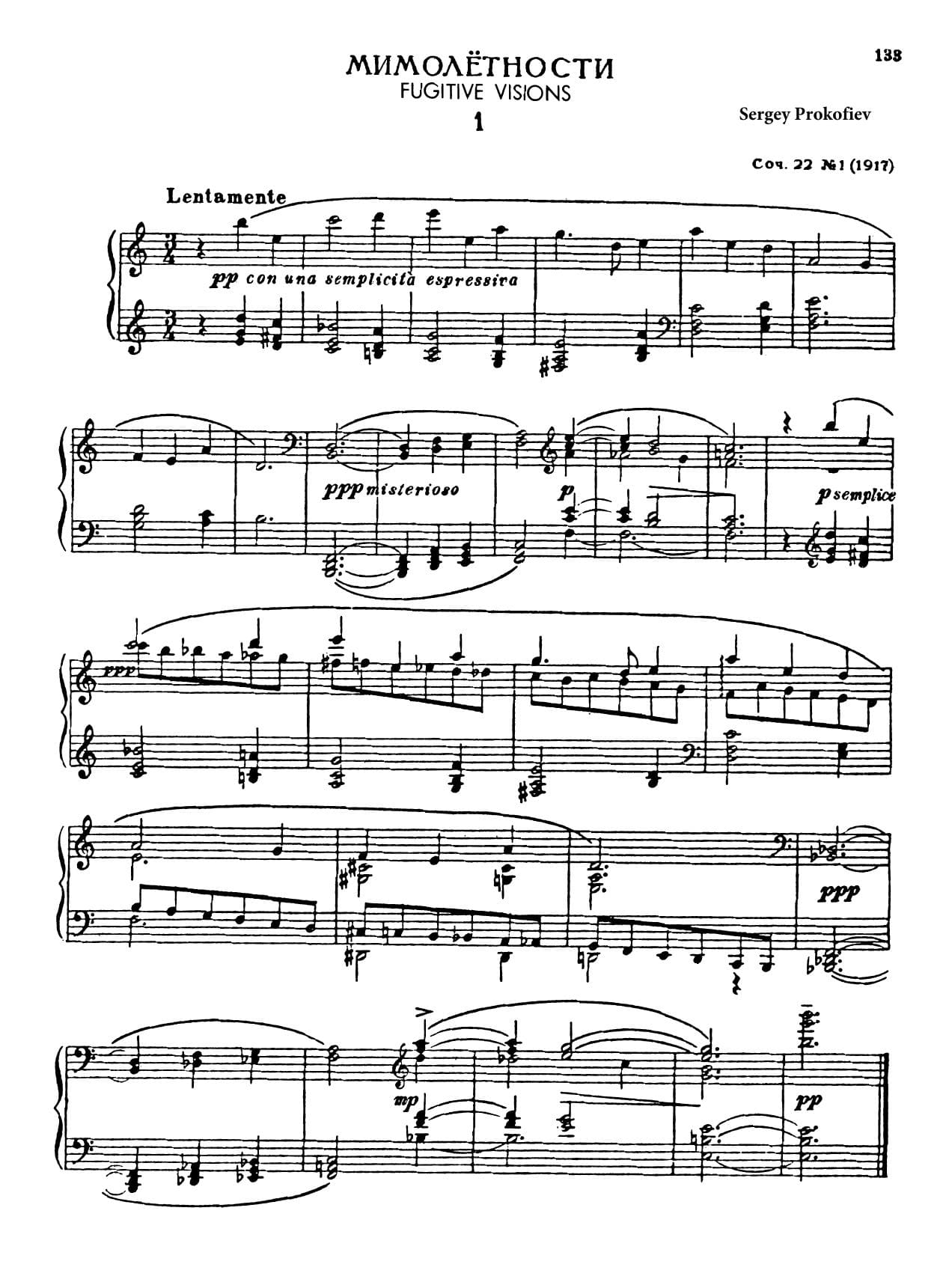
Prokofiev Vision Fugitives, Op. 22 (Boris Berman) piano sheet music, Noten
Please, subscribe to our Sheet Music Library.
Track List:
0:00 - No. 1: Lentamente 1:02 - No. 2: Andante 2:39 - No. 3: Allegretto 3:30 - No. 4: Animato 4:35 - No. 5: Molto giocoso 4:58 - No. 6: Con eleganza 5:24 - No. 7: Pittoresco (Arpa) 7:27 - No. 8: Comodo 8:45 - No. 9: Allegro tranquillo 9:53 - No. 10: Ridicolosamente 11:01 - No. 11: Con vivacita 12:07 - No. 12: Assai moderato 13:05 - No. 13: Allegretto 13:54 - No. 14: Feroce 14:59 - No. 15: Inquieto 15:48 - No. 16: Dolente 17:30 - No. 17: Poetico 18:28 - No. 18: Con una dolce lentezza 19:57 - No. 19: Presto agitatissimo e molto accentuato 20:38 - No. 20: Lento irrealmente
Koroliov: 22:08 - No. 10: Ridicolosamente
The best sheet music download from our Library.
Who was Prokofiev?
Sergei Sergeyevich Prokofiev (27 April [O.S. 15 April] 1891 – 5 March 1953) was a Russian composer, pianist, and conductor who later worked in the Soviet Union.
As the creator of acknowledged masterpieces across numerous music genres, he is regarded as one of the major composers of the 20th century. His works include such widely heard pieces as the March from The Love for Three Oranges, the suite Lieutenant Kijé, the ballet Romeo and Juliet—from which "Dance of the Knights" is taken—and Peter and the Wolf. Of the established forms and genres in which he worked, he created—excluding juvenilia—seven completed operas, seven symphonies, eight ballets, five piano concertos, two violin concertos, a cello concerto, a symphony-concerto for cello and orchestra, and nine completed piano sonatas.
A graduate of the Saint Petersburg Conservatory, Prokofiev initially made his name as an iconoclastic composer-pianist, achieving notoriety with a series of ferociously dissonant and virtuosic works for his instrument, including his first two piano concertos.
In 1915, Prokofiev made a decisive break from the standard composer-pianist category with his orchestral Scythian Suite, compiled from music originally composed for a ballet commissioned by Sergei Diaghilev of the Ballets Russes. Diaghilev commissioned three further ballets from Prokofiev—Chout, Le pas d'acier and The Prodigal Son—which, at the time of their original production, all caused a sensation among both critics and colleagues. But Prokofiev's greatest interest was opera, and he composed several works in that genre, including The Gambler and The Fiery Angel. Prokofiev's one operatic success during his lifetime was The Love for Three Oranges, composed for the Chicago Opera and performed over the following decade in Europe and Russia.
After the Revolution of 1917, Prokofiev left Russia with the approval of Soviet People's Commissar Anatoly Lunacharsky, and resided in the United States, then Germany, then Paris, making his living as a composer, pianist, and conductor.
In 1923, he married a Spanish singer, Carolina (Lina) Codina, with whom he had two sons; they divorced in 1947. In the early 1930s, the Great Depression diminished opportunities for Prokofiev's ballets and operas to be staged in America and Western Europe. Prokofiev, who regarded himself as a composer foremost, resented the time taken by touring as a pianist, and increasingly turned to the Soviet Union for commissions of new music; in 1936, he finally returned to his homeland with his family. His greatest Soviet successes included Lieutenant Kijé, Peter and the Wolf, Romeo and Juliet, Cinderella, Alexander Nevsky, the Fifth and Sixth Symphonies, On Guard for Peace, and the Piano Sonatas Nos. 6–8.
The Nazi invasion of the USSR spurred Prokofiev to compose his most ambitious work, an operatic version of Leo Tolstoy's War and Peace; he co-wrote the libretto with Mira Mendelson, his longtime companion and later second wife. In 1948, Prokofiev was attacked for producing “anti-democratic formalism”. Nevertheless, he enjoyed personal and artistic support from a new generation of Russian performers, notably Sviatoslav Richter and Mstislav Rostropovich: he wrote his Ninth Piano Sonata for the former and his Symphony-Concerto for the latter.
Search your favorite sheet music in the Sheet Music Library Catalog
Works
Main article: List of compositions by Sergei Prokofiev
Important works include (in chronological order):
- Piano Concerto No. 1 in D♭ major, Op. 10
- Toccata in D minor, Op. 11, for piano
- Piano Sonata No. 2 in D minor, Op. 14
- Piano Concerto No. 2 in G minor, Op. 16
- Sarcasms, Op. 17, for piano
- Violin Concerto No. 1 in D major, Op. 19
- Scythian Suite, Op. 20, suite for orchestra
- Chout, Op. 21, ballet in six scenes
- Visions fugitives, Op. 22, set of twenty piano pieces
- The Gambler, Op. 24, opera in four acts
- Symphony No. 1 in D major "Classical", Op. 25
- Piano Concerto No. 3 in C major, Op. 26
- Tales of an Old Grandmother, Op. 31, four piano pieces
- The Love for Three Oranges, Op. 33, opera in four acts
- Overture on Hebrew Themes, Op. 34, for clarinet and piano quintet
- Quintet, Op. 39, for oboe, clarinet, violin, viola, and double-bass
- The Fiery Angel, Op. 37, opera in five acts
- Symphony No. 2 in D minor, Op. 40
- Le pas d'acier, Op. 41, ballet in two scenes
- Divertissement, Op. 43
- Symphony No. 3 in C minor, Op. 44
- The Prodigal Son, Op. 46, ballet in three scenes
- Symphony No. 4 in C major, Op. 47 (revised as Op. 112)
- Sinfonietta, Op. 5/48
- Four Portraits from The Gambler, Op. 49
- String Quartet No. 1 in B minor, Op. 50
- Symphonic Song, Op. 57
- Lieutenant Kije, Op. 60, suite for orchestra, includes the famous Troika
- Violin Concerto No. 2 in G minor, Op. 63
- Romeo and Juliet, Op. 64, ballet in four acts
- Suite No. 1 from Romeo and Juliet, Op. 64bis
- Suite No. 2 from Romeo and Juliet, Op. 64ter
- Suite No. 3 from Romeo and Juliet, Op. 101
- Ten Pieces for Piano from Romeo and Juliet, Op. 75
- Peter and the Wolf, Op. 67, a children's tale for narrator and orchestra
- Alexander Nevsky, Op. 78, cantata for mezzo-soprano, chorus, and orchestra
- Violin Sonata No. 1 in F minor, Op. 80
- The "War Sonatas":
- Piano Sonata No. 6 in A major, Op. 82
- Piano Sonata No. 7 in B♭ major, Op. 83
- Piano Sonata No. 8 in B♭ major, Op. 84
- Zdravitsa, Op. 85
- Betrothal in a Monastery, Op. 86, opera
- Cinderella, Op. 87, ballet in three acts
- War and Peace, Op. 91, opera in thirteen scenes
- String Quartet No. 2 in F major, Op. 92
- Flute Sonata in D, Op. 94 (later arranged as Violin Sonata No. 2, Op. 94a)
- Symphony No. 5 in B♭ major, Op. 100
- Piano Sonata No. 9 in C major, Op. 103
- Symphony No. 6 in E♭ minor, Op. 111
- Ivan the Terrible, Op. 116, music for Eisenstein's film
- The Tale of the Stone Flower, Op. 118, ballet in two acts
- On Guard for Peace, Op. 124
- Symphony-Concerto for Cello and Orchestra in E minor, Op. 125
- Symphony No. 7 in C♯ minor, Op. 131
Browse in the Sheet Music Library:
Or browse in the categories menus & download the Library Catalog PDF: