Table of Contents
Czerny – Piano Masterpieces
Tracklist: Der Pianist Im Klassischen Style, Op. 856 00:00:00 I. Prelude in C Major. Allegretto 00:02:31 II. Fugue in C Major. Allegro Moderato E Maestoso 00:05:30 III. Prelude in A Minor. Allegro Animato 00:06:47 IV. Fugue in A Minor. Allegro Moderato 00:11:07 V. Prelude in F Major. Andante Cantabile 00:13:31 VI. Fugue in F Major. Allegro 00:16:32 VII. Prelude in D Minor. Allegro Agitato 00:18:40 VIII. Fugue in D Minor. Andante Con Moto 00:22:10 IX. Prelude in B-Flat Major. Andante Tranquillo 00:24:42 X. Fugue in B-Flat Major. Allegro Con Spirito 00:28:31 XI. Prelude in G Minor. Allegro Serioso 00:30:32 XII. Fugue in G Minor. Moderato
00:35:05 XIII. Prelude in E-Flat Major. Andante Moderato 00:37:19 XIV. Fugue in E-Flat Major. Allegro 00:40:11 XV. Prelude in C Minor. Vivace Affettuoso 00:41:44 XVI. Fugue in C Minor. Andante Serioso, Ma Con Moto 00:46:10 XVII. Prelude in A-Flat Major. Allegretto Espressivo E Cantabile 00:48:06 XVIII. Fugue in A-Flat Major. Allegro Risoluto 00:50:40 XIX. Prelude in F Minor. Molto Allegro E Agitato 00:52:31 XX. Fugue in F Minor. Lento Moderato Ed Espressivo 00:57:13 XXI. Prelude in D-Flat Major. Allegro Moderato E Tranquillo 00:59:31 XXII. Fugue in D-Flat Major. Allegro Commodo 01:02:07 XXIII. Prelude in B-Flat Minor. Andante Sostenuto Con Espressione 01:04:59 XXIV. Fugue in B-Flat Minor. Andante Cantabile, Mesto Ed Espressivo 01:09:48 XXV. Prelude in G-Flat Major. Allegro Con Fuoco
Search the best Czerny’s sheet music, books, and arrangements in the Library.
Search your favorite sheet music in the Sheet Music Library Catalog
Scores for all instruments: 16,000+ (active and growing), over 236,000 pages.
All genres and levels: Jazz & Blues, Rock & Pop, Classical & Contemporary, Film & Musicals;
books & biographies; methods, études, play-along tracks (MP3) for Jazz & Rock.
Access & benefits: US$15.99 one-time payment, valid for lifetime, full Library access.
Please, subscribe to our Sheet Music Library. Sheet music should be accessible and affordable for all musicians, from professionals to absolute beginners.
Who was Czerny (1791-1857)?
The best sheet music download from our Library.
Please, subscribe to our Sheet Music Library. Sheet music should be accessible and affordable for all musicians, from professionals to absolute beginners.
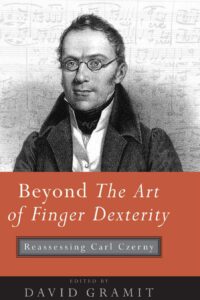
Carl Czerny is one of those paradoxical figures in music history: a name known by every pianist who has ever sat on a bench, yet a personality and musician whose full significance is frequently reduced to a set of finger exercises. “Czerny” evokes images of dry, mechanical études, the daily bread of finger drills and velocity studies that countless students have both loved to hate and needed to endure. But to leave the story there is to miss an extraordinary, multifaceted life that bridges the Classical and Romantic eras, links Beethoven to Liszt, and fundamentally shapes the way the piano is taught, played, and understood right into the present day. Carl Czerny was a prodigious pianist, an obsessive pedagogue, a prolific composer, a pioneering editor, and a generous spirit whose influence on the art of piano playing is arguably unmatched by any other single individual.
Search your favorite sheet music in the Sheet Music Library Catalog
Biography: The Boy Who Met Beethoven
Carl Czerny was born in Vienna on 21 February 1791, into a family steeped in music. His father, Wenzel Czerny, was a pianist, organist, oboist, and singer who had migrated from Bohemia (today’s Czech Republic) and earned a living as a teacher and performer. Recognising his son’s extraordinary gifts almost immediately, Wenzel began teaching Carl the piano at the age of three. The child was composing by age seven, and at nine he made a public impression performing Mozart’s D minor Piano Concerto, K. 466.

The defining moment of Czerny’s early life came when he was ten years old. The violin virtuoso Wenzel Krumpholz, a family friend and an admirer of the boy’s playing, arranged for him to visit Ludwig van Beethoven. Czerny was taken to Beethoven’s lodgings, where, quaking with nervousness, he played the master’s own “Pathétique” Sonata, the Adelaide, and other works. Beethoven, visibly moved, reportedly said to Krumpholz, “The boy has talent. I will teach him myself.” For the next several years, Czerny received free, irregular but immensely influential lessons from Beethoven. These lessons focused on interpretation, legato playing, and technical precision, and Czerny absorbed Beethoven’s aesthetic ideals at their source. He also studied composition with Johann Georg Albrechtsberger and Antonio Salieri, both respected luminaries of Viennese musical life.

As a young man, Czerny seemed poised for a brilliant career as a touring virtuoso. He gave a number of successful concerts in Vienna, including the Viennese premiere of Beethoven’s “Emperor” Concerto in 1812, at the home of Prince Lobkowitz. The performance earned the composer’s praise. Yet Czerny never became a travelling virtuoso in the mould that his most famous pupil would later invent. Several reasons contributed to this. The Napoleonic Wars had drained Vienna’s economy and disrupted aristocratic patronage. Czerny himself was reportedly a shy, modest, and homebound man, who later admitted to a “nervous timidity” regarding performing. He also cared for his ageing parents and simply preferred the stability and creative satisfaction of teaching and composing. And so, instead of pursuing the concert stage, Czerny retreated into his music room, where he would teach, compose, and codify piano technique for the rest of his life.

He never married, and lived the quiet, industrious existence of a confirmed bachelor, teaching up to twelve hours a day, often seeing ten or twelve pupils daily. His Viennese apartment became a kind of piano laboratory, a place where the leading pedagogical ideas of the time were tested, systematised, and disseminated across the globe through his printed works. When he died on 15 July 1857, he left behind a staggering catalogue of compositions and a pedagogical empire that had already begun to define the future of piano playing.
The Teacher: Studio of Genius
Czerny’s genius as a teacher lay not only in his analytical mind but also in his open heart. His most legendary act of pedagogical generosity involved the young Franz Liszt. In 1819, the nine-year-old Liszt, a raw but sensational talent from Hungary, was brought to Vienna by his father, Adam. Several prominent teachers, including Hummel, were too expensive or unavailable. Czerny, upon hearing the boy play in an impromptu audition, immediately recognised his potential and agreed to take him on as a pupil—free of charge. For eighteen months, he gave the young Liszt rigorous daily lessons, insisting on the discipline of scales, études, and clean finger technique. He corrected the boy’s wild, slapdash habits, made him sight-read, and instilled a sense of order that would later serve as the bedrock for Liszt’s transcendental virtuosity. The bond between teacher and pupil remained lifelong; Liszt dedicated his groundbreaking Transcendental Études to Czerny, calling him his “beloved master.”

But Liszt was only the most luminous of a galaxy of Czerny pupils who would go on to teach, and through their teaching effectively populate the entire modern school of pianism. Among them were Theodor Leschetizky, who later became one of the most celebrated teachers in history (mentor to Paderewski, Schnabel, Moiseiwitsch, and many others); Theodor Kullak, court pianist and founder of the Neue Akademie der Tonkunst in Berlin; Sigismond Thalberg, Liszt’s great rival, who studied with Czerny in the 1820s and learned from him the seamless legato that became his trademark; and Anna Caroline Oury (née de Belleville), a brilliant concert pianist much admired by Schumann. Through these figures and their own pupils, Czerny’s pedagogical DNA was passed down, generation after generation. A vast family tree of pianism—from Leschetizky to Schnabel, from Liszt to a legion of his own students—can be traced back to the quiet, bespectacled man in Vienna.

The Pedagogue: A Complete System for the Piano
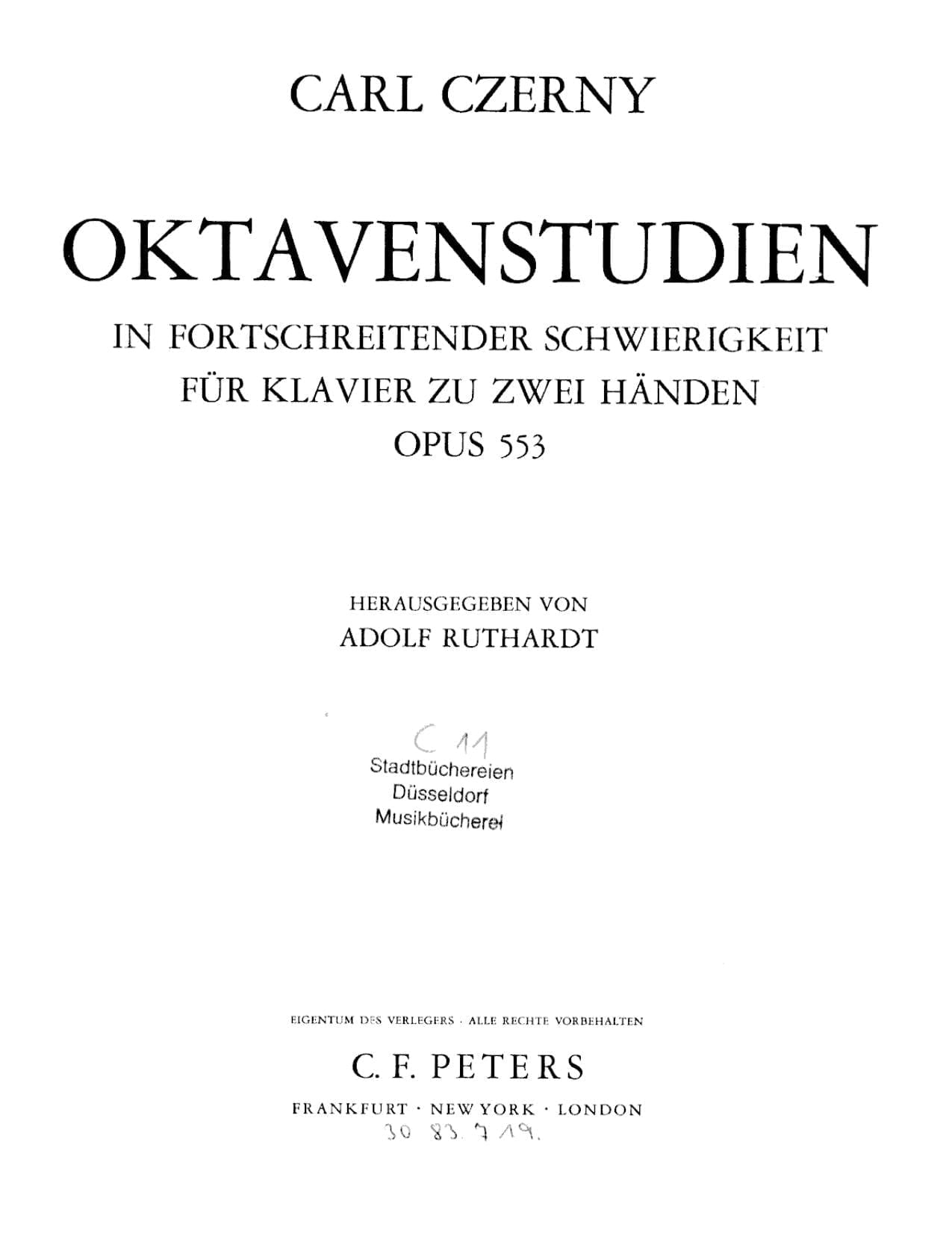
Czerny’s pedagogical output is, quite simply, monumental. He wrote over a thousand works, and the vast majority of them are studies, exercises, methods, and teaching pieces. These were not composed haphazardly; they are part of a carefully graded, comprehensive system designed to take a student from the first steps to the summit of virtuosity. At a time when the piano was rapidly evolving mechanically (growing heavier, louder, and more resonant) and the demand for technically dazzling playing was exploding, Czerny provided the machinery to equip players for the new age.
His most ambitious treatise is the Vollständige theoretisch-praktische Pianoforte-Schule, Op. 500 (Complete Theoretical and Practical Piano School), published in 1839. This encyclopaedic, multi-volume work covers everything: posture, hand position, fingering, articulation, sight-reading, extemporisation, performance practice, and the stylistic traits of different composers. It is not merely a collection of exercises but a map of the entire pianistic universe as understood in the early nineteenth century, influenced by Beethoven’s playing, Hummel’s legato, and Clementi’s finger school. The Pianoforte-Schule includes discussions on the use of the metronome (Czerny was a close friend of its inventor, Johann Nepomuk Maelzel), analysis of ornamentation, and even advice on tuning and caring for the instrument. It remains an invaluable source for historians of performance practice.
Intersecting with the Pianoforte-Schule are the études that every piano student encounters. Czerny’s study collections are graded with a care that reflects his practical teaching experience, and they remain central to modern pedagogy.
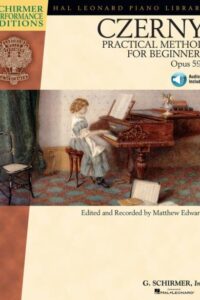
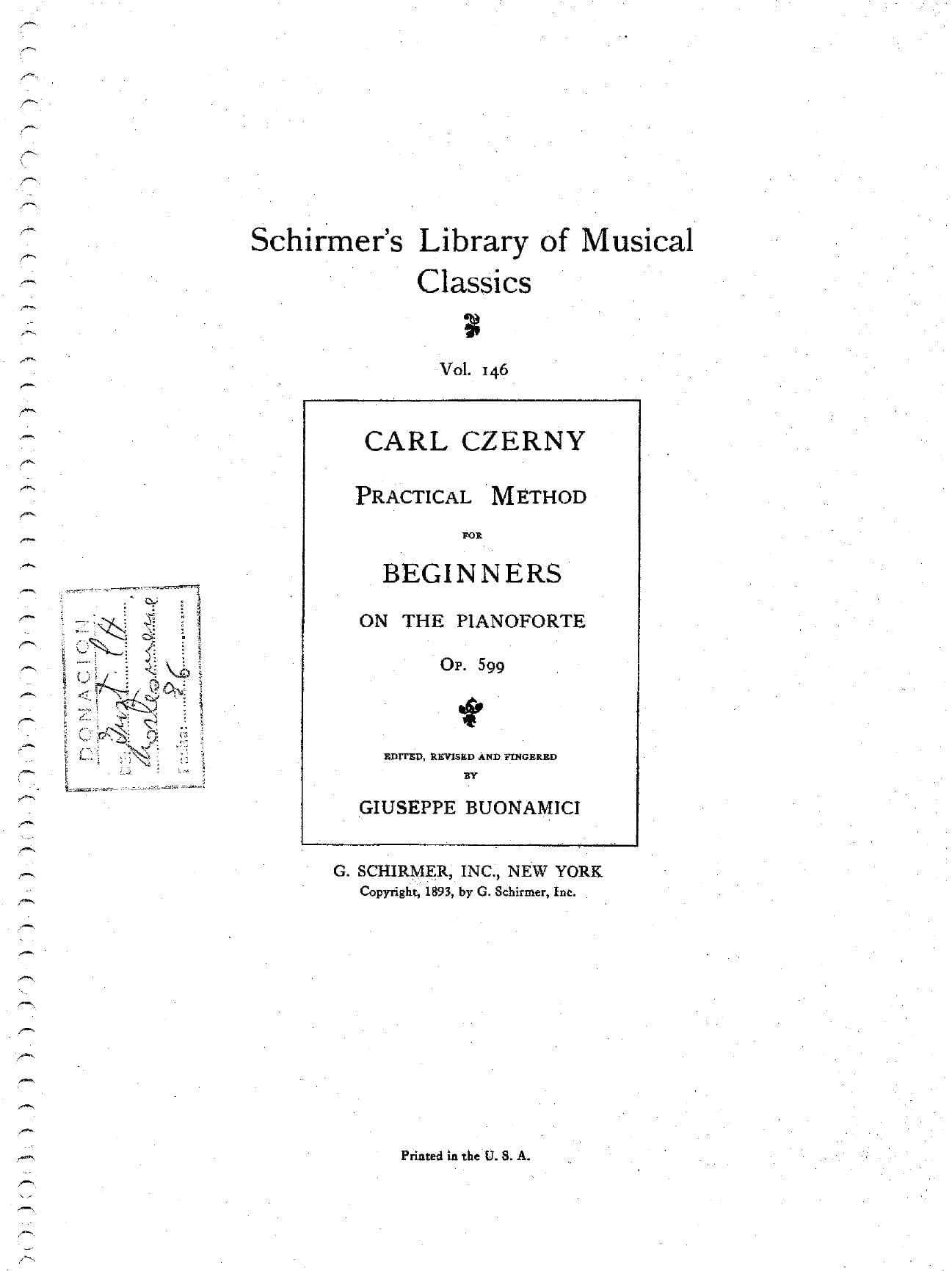
- Practical Method for Beginners, Op. 599: The starting point for countless millions. These little pieces introduce basic note-reading, simple finger combinations, and elementary musical expression within very modest technical demands.
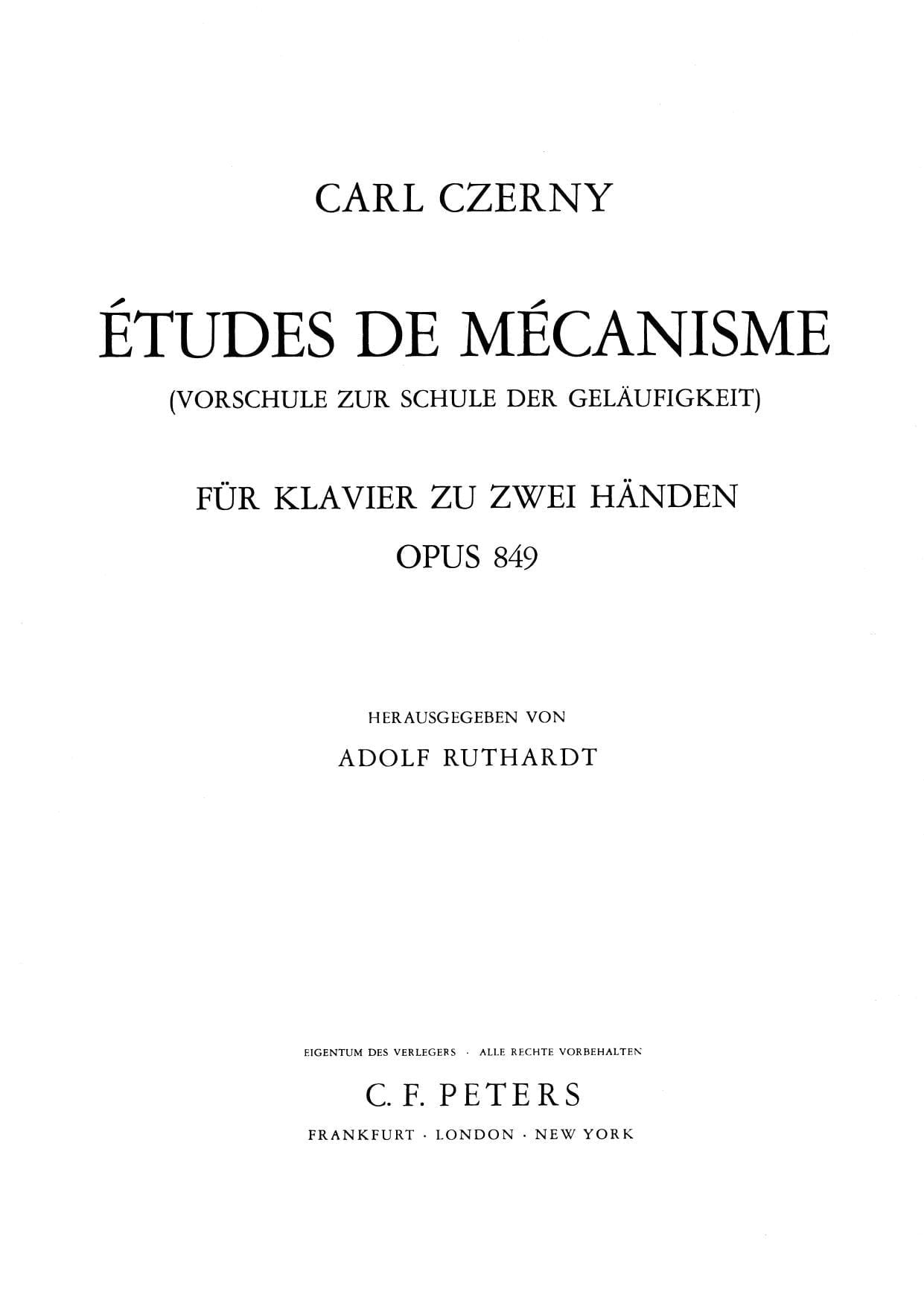
- 30 New Studies in Technique, Op. 849: Subtitled “Prelude to the School of Velocity,” these bridge elementary work and more fluid playing, focusing on evenness, light passagework, and preparation for rapid scales.
- The School of Velocity, Op. 299: Perhaps his most famous opus. These forty studies systematically develop speed, agility, and endurance without sacrificing clarity. They are deceptively musical and demand a light, pearly touch.
- The Art of Finger Dexterity, Op. 740: A collection of fifty studies for advanced players. Here the challenges multiply: double notes, octaves, repeated chords, intricate syncopations, and independent voice-leading. It is a finishing school for the concert virtuoso.
- School of the Virtuoso, Op. 365: Designed to follow Op. 740, these studies require a high degree of finger independence and stamina; they explore the furthest reaches of bravura technique.
- The School of Legato and Staccato, Op. 335: As the title suggests, a focused exploration of articulation, which Czerny considered fundamental to expressive, orchestral playing at the keyboard.
- School of the Left Hand, Op. 399: A prescient collection, given the later development of left-hand repertoire, systematically strengthening and freeing the weaker hand.
There are dozens more collections—studies for brilliant effect, for the cultivation of soft playing, exercises in thirds and sixths, preludes and cadenzas, and even a method for playing the organ with pedals. Czerny’s publications taught the world how to play scales, how to rotate the hand, how to use arm weight (a concept often incorrectly thought to be a late-nineteenth-century discovery), and how to shape a phrase. Despite their reputation for dryness, many of the études contain genuine musical charm and a clear harmonic shape. When played with imagination, they are far more than mere “finger exercises.”
Technique and Philosophy: Beyond the Mechanical
For over a century, a caricature of Czerny has persisted: that of a mechanistic drillmaster who reduced piano playing to a kind of digital gymnastics. This picture is woefully incomplete. Reading his written instructions reveals a musician deeply concerned with beauty of tone, singing legato, and expressive nuance. In the Pianoforte-Schule, Czerny is adamant that every technical exercise must be executed with a beautiful sound, a relaxed hand, and a musical intention. He prescribes a low wrist, curved fingers, and no wasted motion—a technique based on the lightly weighted Viennese actions of his day, but adaptable to the heavier English and French actions he also knew.
Crucially, Czerny inherited and codified Beethoven’s concept of the legato—the seamless connection of tone that makes the piano “sing.” He also absorbed Johann Nepomuk Hummel’s refinement of passagework, and Muzio Clementi’s school of firm finger independence. From these ingredients he forged a synthesis: a technique that served the music’s expression, not the other way round. His teaching emphasised sight-reading (Liszt became an unrivalled reader), extemporisation, and the ability to realise thoroughbass, all practical musicianship skills that are often neglected today.
He was one of the first important musicians to adopt Maelzel’s metronome wholeheartedly, and his tempo markings for Beethoven’s works (which he knew at first hand) remain a subject of fascinated debate—some scholars considering them invaluable, others questioning their accuracy due to possible mechanical errors in his metronome or his recollection. Still, his advocacy of the metronome was never an advocacy of soullessness. He advised its use as a checking device to guard against rushing and dragging, not as a substitute for musical pulse and flexible phrasing.
The Editor and Transcriber: Preserving and Transmitting
In an age before recordings, printed editions and transcriptions were the primary means by which musical masterworks circulated. Czerny undertook this labour on a massive scale. His edition of Bach’s Well-Tempered Clavier, with fingering, articulation marks, and metronome indications, helped reintroduce Bach’s music to the mainstream during the 1830s, a time when the works were still largely unknown outside scholarly circles. While his interpretative additions are heavily romanticised by modern standards, they were crucial in making Bach accessible and playable to a new generation.
His work on Beethoven’s piano sonatas, and his notes on performance of the concertos and chamber music, are an irreplaceable document of early nineteenth-century performance practice. He prepared editions of the complete sonatas and wrote a memoir describing the tempi, style, and character that Beethoven himself intended. Though not without errors of memory or editing, these testimonies remain a primary source for anyone seeking to understand how Beethoven’s circle heard the music.
Czerny also fed the immense market for piano transcriptions. He arranged Beethoven’s symphonies for piano solo and for piano four-hands, turning orchestral works into domestic literature. He made two-hand and four-hand versions of operas by Mozart, Rossini, Bellini, Donizetti, and others, and composed countless variations on popular themes. These arrangements, today often dismissed as potboilers, were the YouTube videos of the 1820s: the way people everywhere got to know the great repertory.
The Composer: A World of Music Beyond the Études
Czerny’s compositional catalogue is staggering—over a thousand opus numbers, with many unnumbered works besides. The sheer volume has inevitably led to the criticism that he was a hack, grinding out music by the yard. The reality is more nuanced. Much of his output consists of functional pedagogical works, yes, but there exists a substantial body of “serious” music that reveals a composer of talent, craft, and genuine inventiveness, who was capable of writing in a style that bridges Beethovenian intensity and early Romantic lyricism.
His piano sonatas are especially noteworthy. The Sonata No. 1 in A-flat major, Op. 7, written when he was only nineteen, shows Beethoven’s influence in its dramatic scope and harmonic adventurousness, alongside a Schubertian warmth. The Sonata No. 11 in D flat major, Op. 730, is a mature work of real grandeur. His chamber music includes string quartets, piano trios, and violin sonatas. His sacred music—masses, offertories, and graduals—was widely performed in Austria, and he also wrote several symphonies, including a Symphony in C minor, No. 1 (which was recorded in the 1990s), and programmatic orchestral works.
Despite moments of beauty and ingenuity, Czerny’s non-pedagogical music fell into almost total neglect after his death. It was eclipsed by the Romantic generation of Schumann, Chopin, Liszt, and Mendelssohn, whose expressive palettes and formal innovations Czerny, an essentially conservative Classical-Romantic transition figure, did not fully adopt. The recent recording renaissance—led by pianists such as Martin Jones, Anton Kuerti, and others—is gradually inviting a reassessment, but his concert works are likely to remain a niche interest.
Pupils, Legacy, and the Pianistic Family Tree
To speak of Czerny’s legacy is to speak of the history of piano playing itself. The pedagogical lineage is almost mythical. Czerny taught Liszt, and Liszt taught a galaxy of students (Hans von Bülow, Carl Tausig, Emil von Sauer, Arthur Friedheim, and dozens of others) who spread his—and indirectly Czerny’s—principles across Europe and America. Czerny taught Leschetizky, who taught Paderewski, Schnabel, Moiseiwitsch, Gabrilowitsch, and a host of other legendary figures. Through these two rivers, and also through Kullak and Thalberg, Czerny’s technical system flows into the playing of virtually every pianist trained in the Western tradition, regardless of national style.
The very fabric of standard piano pedagogy—the emphasis on daily scales and arpeggios, the systematic use of graded études, the separation of technical issues into discrete exercises—owes more to Czerny than to any other figure. Even critics who lament an overemphasis on mechanical drill are responding to his pervasive influence. Modern teaching has softened some of his more doctrinaire finger exercises in light of later insights into anatomy, relaxation, and whole-body technique, but the foundation he laid remains intact.
Czerny also influenced the way we hear tempo. His metronome marks for Beethoven ignited a debate that still rages: did Beethoven really intend the frantic speeds Czerny indicated? Should we take them literally? The controversy has stimulated a vast scholarly literature and led many performers to a deeper engagement with historical performance practice.
His role in preserving and transmitting the Viennese classical tradition cannot be overstated. Without his tireless work as an editor, memorialist, and teacher, much detailed knowledge of Beethoven’s wishes and of early nineteenth-century keyboard style might have been lost. He was a bridge across an epoch, carrying the classical ideals of clarity, proportion, and legato into the age of Romantic virtuosity.
Character and Anecdotes
By all accounts, Czerny was a man of remarkable modesty, patience, and devotion. Despite his proximity to genius and the early prophecy of his own gifts, he displayed no trace of the egomania that afflicted many lesser talents. The story of his free lessons to the young Liszt is emblematic; he once remarked that he taught Liszt “without remuneration, out of sheer joy in his talent.” He lived simply, investing his earnings in a substantial music library, and was a valued friend and colleague to the leading Viennese musicians of his day. The poet Grillparzer and the publisher Diabelli were among his correspondents. His letters to a young pupil, later published as Letters to a Young Lady on the Art of Playing the Pianoforte, are a charming mixture of technical advice, aesthetic wisdom, and kindly encouragement.
Czerny: A Quiet Giant
Carl Czerny is easy to caricature and impossible to ignore. The études he composed two centuries ago are still, every day, opening the fingers and training the minds of young pianists from Shanghai to São Paulo. His pedagogical principles, whether recognised or not, underpin the technical formation of the modern keyboard player. The line from Beethoven’s improvisations at the Broadwood to the thunder of a modern Steinway concert grand runs straight through his music room.
Perhaps his most profound epitaph is that he saw himself as a servant: a servant of Beethoven’s art, a servant of his pupils’ talent, and a servant of music itself. He did not chase immortality on the stage, but built it quietly in the teaching studio, one étude at a time. And for that, every pianist who can play a clean scale, every student who has ever felt fingers fly in a cascade of notes, and every listener who thrills to the feats of a great virtuoso, owes Carl Czerny a debt of gratitude.
Browse in the Sheet Music Library:
Or browse in the categories menus & download the Library Catalog PDF: