Scores for all instruments: 16,000+ (active and growing), over 236,000 pages.
All genres and levels: Jazz & Blues, Rock & Pop, Classical & Contemporary, Film & Musicals;
books & biographies; methods, études, play-along tracks (MP3) for Jazz & Rock.
Access & benefits: US$15.99 one-time payment, valid for lifetime, full Library access.
Table of Contents
When I Look In Your Eyes · Diana Krall
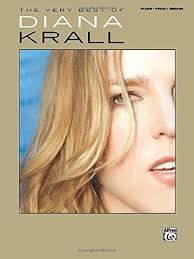

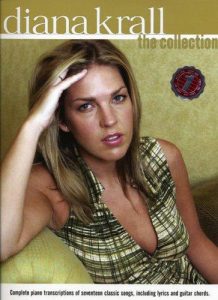



Please, subscribe to our Sheet Music Library.
The best sheet music download from our Library.
Who is Diana Krall?
Diana Krall: The Contemporary Diva Who Redefined Jazz
In the contemporary jazz landscape, few artists have achieved the perfect balance between artistic depth and commercial success that Diana Krall commands. With her sultry contralto voice and elegant piano touch, she has captivated over 15 million listeners worldwide, becoming the only jazz singer in history to have eight albums debut at number one on the Billboard Jazz Albums chart. Billboard magazine named her the second-greatest jazz artist of the 2000–2009 decade. She has won three Grammy Awards, ten Canadian Juno Awards, and has been appointed to both the Order of Canada and the Order of British Columbia.
Yet these impressive statistics and honours barely scratch the surface of Diana Krall's artistic significance. She is not merely a singer but a supremely accomplished pianist—a rare figure in jazz history who has earned widespread recognition equally for both her instrumental mastery and vocal artistry. From Nat King Cole to Shirley Horn, the lineage of "singer-pianists" finds its contemporary apotheosis in Krall. Her music blends jazz, bossa nova, and pop elements, deeply rooted in tradition yet transcending genre boundaries through a voice unmistakably her own.
Search your favorite sheet music in the Sheet Music Library Catalog
Biography – From Nanaimo to the World Stage
Early Years and Musical Awakening
Diana Jean Krall was born on November 16, 1964, in Nanaimo, British Columbia, a harbour city on Vancouver Island. She was the daughter of Adella A. (née Wende), an elementary school teacher, and Stephen James "Jim" Krall, an accountant. Krall has one sibling, Michelle, a former member of the Royal Canadian Mounted Police.
Music ran in Krall's blood. Her father was an avid jazz enthusiast who played piano at home, while her mother sang in a community choir. Her father's extensive record collection—particularly his 78s of 1920s and 1930s piano masters like Fats Waller, James P. Johnson, and Earl Hines—became Krall's earliest musical textbook. Encouraged by her father, a stride pianist himself, Krall developed a deep affinity for jazz from childhood.
Krall began studying piano at the age of four and took examinations through The Royal Conservatory of Music. Simultaneously, she sang in a church choir and learned to play and sing the Fats Waller songs from her father's collection. By high school, she was a member of a student jazz group; at just fifteen, she was already performing professionally in local restaurants and even a hockey bar.
The Path of Study
Krall's talent earned her a scholarship to the prestigious Berklee College of Music in Boston, where she studied from 1981 to 1983. Seeking to deepen her artistry, she then moved to Los Angeles to study privately with veteran jazz pianist Jimmy Rowles. Rowles—renowned for his delicate harmonic sensibilities and elegant accompaniment style—left an indelible mark on Krall's musical development. She also crossed paths with legendary bassist Ray Brown in the early 1980s; impressed by her piano playing, Brown became an important mentor and introduced her to key figures in the jazz world.
Career Breakthrough
Krall returned to Canada to record her first album, Stepping Out, released in 1993 on Justin Time Records. The album featured bassist John Clayton and drummer Jeff Hamilton and caught the attention of producer Tommy LiPuma, who would become her longtime collaborator. LiPuma produced her second album, Only Trust Your Heart (1995).
The true breakthrough came with All for You: A Dedication to the Nat King Cole Trio (1996). This tribute to one of her greatest influences spent 70 weeks on the Billboard jazz charts and earned Krall her first Grammy nomination. Love Scenes (1997), recorded with guitarist Russell Malone and bassist Christian McBride, quickly became a hit.
Global Stardom
In 1999, Krall signed with Verve Records and released When I Look in Your Eyes, an album that would make history. Featuring orchestral arrangements by Johnny Mandel, the album spent 52 consecutive weeks at number one on the Billboard Jazz Albums chart and won Krall her first Grammy Award for Best Jazz Vocal Performance.
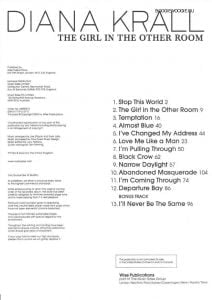
The Look of Love (2001), with lush arrangements by Claus Ogerman, achieved platinum status and reached the Top 10 of the Billboard 200. The live album Live in Paris (2002) won another Grammy. With The Girl in the Other Room (2004), Krall included her own compositions for the first time—many co-written with her husband, British singer-songwriter Elvis Costello, whom she married in 2003.
Krall continued to evolve: Christmas Songs (2005), From This Moment On (2006), the bossa nova experiment Quiet Nights (2009), the exploration of lesser-known jazz tunes Glad Rag Doll (2012), the light rock covers collection Wallflower (2015), a return to standards with Turn Up the Quiet (2017), and the Gershwin duets album with Tony Bennett, Love Is Here to Stay (2018). Her most recent album, This Dream of You (2020), was partly a tribute to her late longtime producer Tommy LiPuma.
Musical Style – Elegance, Restraint, and Depth
The Signature Sound
Diana Krall's musical style can be distilled into three keywords: elegance, restraint, and depth.
Her voice—a contralto with a husky, warm texture—is neither showy nor overwhelming, yet possesses remarkable penetrative power. Critics have described her singing as evoking "the feeling of sitting alone in a nearly empty bar at one or two in the morning, where only her slightly melancholic voice seems to understand your mood." Her voice has been likened to "whiskey with honey"—rich, warm, and intoxicating.
On the piano, Krall's touch is delicate and precise. Her instrument is not merely accompaniment but a second voice in dialogue with her singing. This dual identity as singer-pianist grants her unique control over the rhythm and dynamics of her music.
Stylistic Evolution
Krall's musical journey can be understood in two broad phases.
The first phase was rooted in traditional old-school jazz, with relatively sparse arrangements typically featuring guitar, bass, and piano, swinging with a cool, relaxed feel. Representative works include All for You and Love Scenes.
The second phase is more diverse and mature. Krall began incorporating bossa nova, pop, and even soft rock elements, with richer arrangements and string sections adding cinematic texture. Representative works include The Look of Love, Quiet Nights, and Wallflower.
Throughout this evolution, one core quality remains constant: Krall never flaunts technique; she lets the music speak for itself. Her interpretations are restrained yet deeply felt, every phrase carefully considered yet imbued with improvisational spontaneity.
Stylistic Hallmarks in Signature Works
On All for You, Krall interpreted 1940s lyrics with a modern sensibility—playful, swinging, and full of musical warmth.
On When I Look in Your Eyes, she balanced improvisation with lyrical expression through collaborations with guitarist Russell Malone, drummer Jeff Hamilton, and others. The lyrics explored themes of love, philosophy, and the passage of time, with her low-register voice and piano演绎 forming a signature style.
On Wallflower, Krall reimagined classic songs with jazz piano and her signature contralto, employing string arrangements and minimalist production. Her take on California Dreamin' evoked a cinematic, almost visual atmosphere.
Chord Progressions and Musical Harmony
Harmonic Heritage and Innovation
Diana Krall's harmonic language is deeply rooted in the jazz tradition, yet filtered through her personal sensibilities. Her harmonic style draws primarily from Nat King Cole, Jimmy Rowles, and Carmen McRae—all artists celebrated for their nuanced harmonic treatment.
Krall's piano accompaniment often employs rich chord voicings that create full harmonic colours while keeping the melody清晰. Her harmonic techniques include:
Extended and Substitute Chords: Krall frequently uses 9ths, 11ths, 13ths, and tritone substitutions, breathing fresh life into standard repertoire.
Alberti Bass: In some passages, Krall's piano employs broken-chord accompaniment patterns—a classical technique deftly integrated into her jazz vocabulary.
Colouristic Harmony: Krall makes effective use of chromatic harmony and modal interchange, introducing unexpected harmonic colours while maintaining tonal centres, creating listening experiences that feel both familiar and novel.
Harmonic Practice in Specific Works
On Love Letters, Krall employs chord progressions including C, C/B, C7/E, F, Cdim, C/G, C/E, C, G, C7M, Cdim, Dm7, G7, C7M—a classic jazz standard harmonic framework, yet one she imbues with renewed vitality.
On I'll See You in My Dreams, prominent chords include G, Baug, Ebdim, E, F#, B—the use of augmented and diminished chords adding tension and colour.
On Little Girl Blue, featured chords include Ab, Bb, Bbm, Eb, Cbdim, Cm—the alternation between major and minor modes and the use of chromatic harmony showcasing Krall's sensitive grasp of harmonic colour.
Improvisational Harmonic Thinking
As a distinguished jazz pianist, Krall's improvisation is built upon a profound understanding of harmonic structure. Her improvised lines are simultaneously melodic and tightly connected to the underlying chord progressions. Her piano solos never aim for virtuosic display; rather, they centre on narrative and emotional expression, every note earning its place.
Relationships with Other Artists
Mentors and Influences
Several key figures decisively shaped Krall's musical path.
Jimmy Rowles: As her private teacher, Rowles initiated Krall into the deeper realms of jazz piano. His refined, restrained accompaniment style found its way into Krall's own playing.
Nat King Cole: Krall has repeatedly cited Carmen McRae and Nat King Cole as her greatest influences. Cole's dual identity as singer-pianist provided a perfect model; her second album was a direct tribute to him.
Carmen McRae: Another profound influence. McRae's distinctive phrasing and deep lyrical interpretation are clearly audible in Krall's singing.
Other influences include Dinah Washington, Roberta Flack, Shirley Horn, Andy Bey, Aretha Franklin, Sarah Vaughan, Frank Sinatra, Ella Fitzgerald, Astrud Gilberto, and Bill Evans.
Collaborators
Krall has collaborated with numerous elite musicians throughout her career.
Guitarist Russell Malone and drummer Jeff Hamilton: Long-term collaborators who formed the core of Krall's trio, with Malone's细腻 fingerstyle guitar and Hamilton's solid drumming providing perfect complements to Krall's piano.
Tony Bennett: In 2018, Krall and Bennett released Love Is Here to Stay, a duet album celebrating the music of George and Ira Gershwin. This collaboration represented a meeting of two generations of jazz vocal royalty.
Elvis Costello: As Krall's husband, Costello not only influenced her personal life but also her musical direction. Their co-written songs on The Girl in the Other Room—six tracks in total—demonstrated a creative fusion of pop and jazz. Krall described this period as "a pretty deep creative time for me".
Producer Tommy LiPuma: As Krall's producer for many years, LiPuma played an essential role in shaping her sound. This Dream of You (2020) was a tribute to him following his passing.
Other collaborators include Paul McCartney, Barbra Streisand, Michael Bublé, Rosemary Clooney, Geoff Keezer, and arranger/conductor Claus Ogerman (Frank Sinatra, Antonio Carlos Jobim, Stan Getz). She also worked with director Clint Eastwood, who directed her with the attention he would give an actress.
Influence and Legacy
Impact on Subsequent Generations
Diana Krall is not merely a successful artist but a role model for a generation of jazz musicians. Her success proved that a jazz artist could achieve commercial success while maintaining artistic integrity. She has influenced a new generation of musicians including Michael Bublé, Norah Jones, and Jamie Cullum.
Norah Jones's emergence is closely connected to Krall's success. The soft, intimate jazz-pop style of Jones's debut album Come Away with Me owed much to the commercial space Krall had opened.
Crossing Boundaries
Krall is the first artist to consistently dominate the jazz album charts while simultaneously conquering crossover audiences worldwide. She broke the stereotype of jazz as "elitist" and "cold," bringing the music to a vastly expanded audience. Her success demonstrates that jazz need not sacrifice artistic depth for popular appeal.
Criticism and Debate
Krall's success has not been without critics. Some jazz purists consider her music too "safe" and "polished," lacking improvisational冒险精神. However, as one commentator observed: "Snobs may see Krall's discs as a kind of musical fossil fuel, but she knows better. Her choices mirror her style: cool, calculating, and filled with a clear, upscale notion of good taste". Krall's courage lies not in artistic radicalism but in finding her personal voice within tradition.
Scholarly Attention
Krall's artistry has attracted serious academic interest. Scholars have examined the "reception of Diana Krall," tracing the development of her piano and vocal interpretation from early to advanced stages and comparing her music to major jazz pianists and vocalists. Researchers have analyzed her European roots combined with North American influence in a multicultural context. This scholarship signals that Krall has transcended mere pop culture phenomenon to enter the canonization process of jazz history.
Major Works
Studio Albums
Krall's discography is rich and diverse. Her most important studio albums include:
- Stepping Out (1993) – Debut
- Only Trust Your Heart (1995)
- All for You: A Dedication to the Nat King Cole Trio (1996) – Breakthrough, Grammy-nominated
- Love Scenes (1997)
- When I Look in Your Eyes (1999) – Grammy winner, 52 weeks at #1
- The Look of Love (2001) – Platinum, Top 10 Billboard 200
- The Girl in the Other Room (2004) – First album with original compositions
- Christmas Songs (2005)
- From This Moment On (2006) – Standards collection
- Quiet Nights (2009) – Bossa nova experiment
- Glad Rag Doll (2012) – Exploration of lesser-known jazz tunes
- Wallflower (2015) – Light rock covers
- Turn Up the Quiet (2017) – Return to standards
- Love Is Here to Stay (2018) – Duets with Tony Bennett
- This Dream of You (2020)
Krall has released 15 studio albums, one live album, one compilation, one EP, three video albums, and seven music videos.
Live Albums
- Live in Paris (2002) – Grammy winner
- Live at the Montreal Jazz Festival (2004)
Compilations
- The Very Best of Diana Krall (2007)
- The Collection (2014)
Film and Television Work
Film Soundtracks
Diana Krall's songs have been featured in numerous film soundtracks:
- Midnight in the Garden of Good and Evil (1997) – Krall contributed to this soundtrack
- At First Sight (1999) – Krall both sang on the soundtrack and appeared as "Singer"
- True Crime (1999) – Krall's recording of the pop standard "Why Should I Care" was featured
- Dance With Me – Soundtrack appearance
- The Guru – Featured Krall's recording of "Just the Way You Are"
- Anything Else (2003) – Featured Krall's music
- Public Enemies (2009) – Krall appeared as a "Torch Singer" and performed
Acting Appearances
Krall has made occasional film and television appearances:
- De-Lovely (2004) – A biopic about Cole Porter's life, in which Krall sang "Just One of Those Things" and appeared as a musical performer
- Public Enemies (2009) – Appeared as a torch singer
- Pete the Cat – Voiced Pete's mother
Concert Films
Krall has released several concert films:
- Diana Krall: Live in Paris (2001) – Filmed at the historic Olympia Theatre in Paris
- Diana Krall: Live at the Montreal Jazz Festival (2004)
- Diana Krall: Live in Rio (2009)
Television Appearances
Krall has appeared on numerous television programs and documentaries, including Spectacle: Elvis Costello with… and Tony Bennett Celebrates 90: The Best Is Yet to Come.
Documentaries
While there is no single feature-length biographical documentary dedicated exclusively to Diana Krall, several concert films serve a documentary function—capturing not only performances but also offering behind-the-scenes glimpses and interviews that illuminate her artistic philosophy and personal魅力.
Diana Krall: Live in Paris (2001), filmed at the legendary Olympia Theatre, is a landmark concert film showcasing her elegant musical stylings. It includes bonus features such as exclusive rehearsal footage.
Diana Krall: Live at the Montreal Jazz Festival (2004) captures another iconic performance.
Additionally, a documentary episode featuring Krall was produced, covering her appearance at the Montreux stage following the release of Glad Rag Doll. Behind-the-scenes documentaries and interviews have also been released for albums including Glad Rag Doll and Turn Up the Quiet.
As one of the most important contemporary jazz artists, Krall also appears in numerous documentaries about jazz, her contemporaries, and the music industry at large.
Most Famous Compositions and Performances
Most Famous Recordings
When I Look in Your Eyes (1999) stands as Krall's most representative work. Its commercial success (52 weeks at #1) and artistic achievement (Grammy recognition) set a benchmark for contemporary jazz vocals.
All for You (1996), as her breakthrough album, holds similar landmark status. The tribute to Nat King Cole not only brought Krall widespread attention but also established her unique artistic identity as "singer-pianist."
Live in Paris (2002) demonstrates Krall's power as a live performer. On the stage of the Olympia Theatre—a venue that has witnessed countless jazz legends—Krall proved herself an artist of the same calibre.
Most Famous Performances
Krall's live performances are renowned for their intimacy and musicality. As critics have observed: "Live performance is the best way to judge a jazz singer's true ability. Live in Paris and Live in Rio bear witness to Diana Krall's迷人魅力 as the jazz diva of her generation, her emotional flow between piano keys and microphone, and her musical dialogue with the band."
Each Krall performance is a unique musical experience. Her upcoming performances at the Montreal Jazz Festival (June 26, 2026) and two concerts at London's Royal Albert Hall (September 2026) will undoubtedly add new highlights to her long touring career.
Diana Krall
Diana Krall is a singular phenomenon in contemporary jazz. She has built a career on elegance without superficiality, depth without pretension. Her voice is at once intimate and commanding, her piano playing both technically assured and emotionally resonant. She has brought jazz to audiences who might never have discovered it, while earning the respect of connoisseurs who recognize the sophistication beneath her accessible surface.
From her early days playing in a Nanaimo hockey bar to sold-out concerts at the world's most prestigious venues, Krall has remained true to her artistic vision. She has expanded the boundaries of what a jazz singer-pianist can be, creating a body of work that spans traditional standards, bossa nova, pop, and original compositions. She has collaborated with legends and mentored the next generation. She has won Grammys and Junos, topped charts and broken records.
But beyond the accolades and the statistics, Diana Krall's true legacy lies in the music itself—in the hushed intimacy of a late-night ballad, the swinging joy of a uptempo standard, the cinematic atmosphere of a bossa nova. Her music invites us to listen more closely, to feel more deeply, and to appreciate the timeless beauty of a song well sung and a melody well played.
As she once said of her creative process: "This album is very cathartic and also really fun, because I don't think it's all about just personal experience—it's also about creativity and imagination". That blend of personal truth and creative imagination, of tradition and innovation, of restraint and passion—that is the essence of Diana Krall. And it is why, more than three decades into her career, she remains one of the most beloved and respected figures in contemporary music.
Listen to Diana Krall music on Spotify
Browse in the Sheet Music Library:
Or browse in the categories menus & download the Library Catalog PDF: