Scores for all instruments: 16,000+ (active and growing), over 236,000 pages.
All genres and levels: Jazz & Blues, Rock & Pop, Classical & Contemporary, Film & Musicals;
books & biographies; methods, études, play-along tracks (MP3) for Jazz & Rock.
Access & benefits: US$15.99 one-time payment, valid for lifetime, full Library access.
Table of Contents
Who was George Shearing?
George Shearing - Lullaby of Birdland (Full Concert)
Please, subscribe to our Sheet Music Library. Sheet music should be accessible and affordable for all musicians, from professionals to absolute beginners.
Concert Setlist: 00:00 - Intro 00:07 - Artist's Reflection: George's childhood 01:08 - Artist's Reflection: jazz and classical music influences 01:53 - George Shearing greets the audience 02:24 - Freedom Jazz Dance 07:14 - Why Did I Choose You? 12:40 - Artist's Reflection: when George started playing jazz 13:16 - Isn't It Romantic? 19:52 - Estate 25:17 - Artist's Reflection: meeting with his teacher 56 years later 26:28 - George presents Neil Swainson 27:04 - Donna Lee 31:24 - Artist's Reflection: a funny story about Rachmaninov 31:48 - George funny jokes 33:33 - Memphis in June 40:20 - Artist's Reflection: when George wrote Lullaby Of Birdland 40:48 - Lullaby of Birdland 46:29 - Moose the Mooch 51:51 - Ending
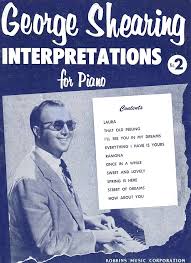
The best sheet music download from our Library.
George Shearing: The Sound of Elegance
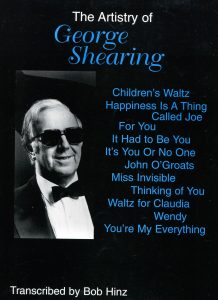
Please, subscribe to our Sheet Music Library. Sheet music should be accessible and affordable for all musicians, from professionals to absolute beginners.
A Legacy in Sound
Sir George Albert Shearing (1919–2011) stands as one of the most distinctive and beloved figures in jazz history. His instantly recognizable "Shearing sound"—a shimmering, block-chord style featuring vibraphone and guitar in close harmony—defined sophisticated jazz for millions of listeners. As a blind pianist who rose from working-class London to international stardom, Shearing's journey embodies triumph over adversity. His composition "Lullaby of Birdland" became a jazz standard, recorded by everyone from Ella Fitzgerald to Miles Davis . This article explores Shearing's life, music, and enduring legacy.
Biography

Search your favorite sheet music in the Sheet Music Library Catalog
Early Life and Education in London
George Albert Shearing was born on August 13, 1919, in Battersea, London, the youngest of nine children . His father, James Phillip Shearing, worked delivering coal, while his mother, Ellen Amelia Brightner, cleaned trains in the evening to supplement the family's modest income .
Born blind, Shearing's musical journey began remarkably early. At age three, he started learning piano, displaying exceptional aptitude despite his visual impairment . His formal training came at the Linden Lodge School for the Blind, where he spent four years developing his technique . There, he was influenced by the recordings of Teddy Wilson and Fats Waller, whose sophisticated piano styles shaped his early musical sensibilities .
Though offered several scholarships for further study, Shearing chose a different path. He began performing professionally at a local pub, the Mason's Arms in Lambeth, earning "25 bob a week" playing piano and accordion . He also joined an all-blind band during this period, gaining valuable ensemble experience.
Rise in British Jazz
Shearing's career gained momentum in the late 1930s. He made his first BBC radio appearance after befriending the influential jazz promoter Leonard Feather, with whom he began recording in 1937 . In 1940, Shearing joined Harry Parry's popular band, contributing to the comeback of the legendary violinist Stéphane Grappelli . This period established Shearing as a major figure in British jazz, and he won seven consecutive Melody Maker polls .
American Years
In 1947, encouraged by Leonard Feather, Shearing emigrated to the United States . His harmonically complex style—mixing swing, bebop, and modern classical influences—quickly gained attention . One of his first performances in the U.S. was at the Hickory House in New York, where he played with the Oscar Pettiford Trio . He also led a quartet with clarinetist Buddy DeFranco, though contractual issues arose due to Shearing's MGM contract and DeFranco's Capitol affiliation.
The turning point came in 1949 when Shearing formed the first George Shearing Quintet, featuring Margie Hyams on vibraphone, Chuck Wayne on guitar (later replaced by Toots Thielemans, billed as John Tillman), John Levy on bass, and Denzil Best on drums . This group would define his career. Their recording of "September in the Rain" became an international hit, selling over 900,000 copies . Shearing himself described the success as "as accidental as it could be" .
In 1956, Shearing became a naturalized U.S. citizen . He continued leading various configurations of the quintet, recording prolifically for Capitol Records until 1969 . He also founded his own short-lived label, Sheba, during this period.
Later Career and Duo Work
By the 1970s, Shearing grew weary of the quintet format that had made him famous. He phased out the group, finally disbanding it in 1978 . "I had an identity. I held on to it for 29 years. Eventually I held on like grim death. The last five years I played on automatic pilot. I could do the whole show in my sleep," he later recalled.
He shifted focus to smaller configurations: trios, solo performances, and especially duos. Notable collaborations included work with the Montgomery Brothers, Marian McPartland, Brian Q. Torff, Jim Hall, Hank Jones, and Kenny Davern . In 1979, Shearing signed with Concord Records, beginning a fruitful partnership with singer Mel Tormé that earned two Grammy Awards .
Personal Life and Honors
Shearing married twice: first to Trixie Bayes (1941–1973), then to singer Ellie Geffert in 1975, who survived him . In 1962, he received a golden retriever guide dog named Leland from Guide Dogs for the Blind, with whom he traveled extensively .
His honors were numerous: performances for U.S. Presidents and a Royal Command Performance for Queen Elizabeth II; an honorary doctorate from Westminster College (1975); the Horatio Alger Award (1978); the Ivor Novello Award for Lifetime Achievement (1993); an OBE (1996); and a knighthood in 2007 . He suffered a serious fall in 2004 but continued performing into his 80s . George Shearing died on February 14, 2011, in Manhattan, of congestive heart failure at age 91 .
Music Style and Technical Innovations
The "Shearing Sound"
Shearing's signature contribution to jazz is the "Shearing sound," characterized by a distinctive locked hands or block chord technique. This involves playing the melody in harmonized parallel chords, with the vibraphone doubling the right-hand melody an octave higher and the guitar doubling the left hand an octave lower . The result is a five-part, organ-like texture that sounded "like the Glenn Miller sound" for a small jazz combo . Shearing described this approach: "a full block sound, which, if it was scored for saxophones, would sound like the Glenn Miller sound. And coming at the end of the frenetic bebop era, the timing seemed to be right" .
This technique—sometimes called "Shearing's voicing"—involves a double melody block chord with an additional fifth part that doubles the melody an octave lower . While jazz organist Milt Buckner is generally credited with inventing the locked-hands style, Shearing refined and popularized it in a small group context .
Influences
Shearing's style synthesized various influences. From Milt Buckner and the Lionel Hampton band he drew the locked-hands concept . The Glenn Miller saxophone section inspired his block sound . The Nat King Cole Trio influenced his small-group approach . He also absorbed lessons from boogie-woogie pianists and jazz masters such as Fats Waller, Earl Hines, Teddy Wilson, Erroll Garner, Art Tatum, and Bud Powell .
Equally significant was his love of classical music. His solos frequently drew inspiration from Satie, Delius, and Debussy, and he performed with concert orchestras in the 1950s and 1960s .
Harmony and Tonality
Shearing's harmonic language blended bebop complexity with accessible melodic charm. He was a pioneer in incorporating Afro-Cuban styles into small-group jazz, featuring congueros like Mongo Santamaría, Willie Bobo, and Armando Peraza in his groups . This Afro-Cuban influence was part of his broader exploration of Latin jazz, and vibraphonist Cal Tjader began his Latin jazz career while playing with Shearing .
Composition Characteristics and Major Works
Compositions
By his own estimate, Shearing wrote about 300 tunes, joking that 295 were completely unknown . Nevertheless, he contributed several standards to the jazz repertory:
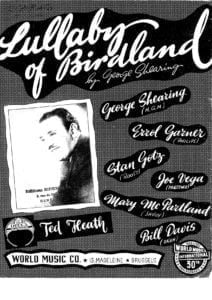
- "Lullaby of Birdland" (1952) – His most famous composition, written as the theme for the legendary New York nightclub where he frequently performed . With lyrics by George David Weiss, it became a jazz standard recorded by Ella Fitzgerald, Sarah Vaughan, Miles Davis, and even Bill Haley and His Comets .
- "Conception" – Another widely recorded Shearing original .
- "Consternation" – A bebop-influenced piece .
- "She" – A less-known but significant composition .
Melodic and Formal Style
Shearing's improvisations were known for their melodic elegance and refined sense of taste. He built a reputation for accessible improvisations that never sacrificed sophistication . His style was often described as "cool jazz" in temperament—complex harmonically but never ferocious in energy .
Encounter with Other Artists
Shearing collaborated with a vast roll-call of jazz luminaries:
- Stéphane Grappelli – Their collaboration began in the 1940s in England and continued decades later on The Reunion (1976) .
- Mel Tormé – The Grammy-winning partnership on Concord Records was highly acclaimed .
- Ella Fitzgerald, Peggy Lee, Joe Williams, Nancy Wilson, Carmen McRae – Shearing served as an exceptional accompanist for vocalists .
- The Montgomery Brothers – He recorded with Wes Montgomery and his siblings in 1961 .
- Jim Hall – The duo album with this celebrated guitarist was critically praised .
- Marian McPartland, Hank Jones – He recorded with these fellow pianists in duo settings .
- Toots Thielemans – Thielemans replaced Chuck Wayne in the early quintet, playing guitar (billed as John Tillman) .
Discography and Notable Recordings
Shearing left an expansive catalogue of over 100 albums . Key recordings include:
With the Quintet (1949–1970s)
- "September in the Rain" (1949, MGM) – The breakthrough hit .
- "Lullaby of Birdland" (1952) – The standard .
- Shearing in Hi Fi (1955) – A classic quintet album .
- The Shearing Spell (1955) – Another quintet classic .
- Nat King Cole Sings, George Shearing Plays (1963) – A celebrated collaboration .
With Vocalists (Concord Era)
- Albums with Mel Tormé – Grammy winners in 1983 and 1984 .
- "On a Clear Day" (1980) .
- "Alone Together" (1981) – with Marian McPartland .
Trio and Solo Work
- The Reunion (1976) – with Stéphane Grappelli, Andy Simpkins, Rusty Jones .
- Live at the Cafe Carlyle (1984) – solo piano .
- Grand Piano (1985) – solo interpretations .
Later Albums
- That Shearing Sound (1994, Telarc) .
- Paper Moon: Music of Nat King Cole (1995, Telarc) .
- Back to Birdland (2001, Telarc) .
Search your favorite sheet music in the Sheet Music Library Catalog
George Shearing in Film, Television, and Popular Culture
Television Appearances
Shearing appeared on numerous television programs, including ABC's The Pat Boone Chevy Showroom alongside many musical stars of his day . He also performed on the BBC repeatedly throughout his career .
Documentaries and Autobiography
Shearing co-wrote his autobiography, "Lullaby of Birdland," with Alyn Shipton (2004), offering candid reminiscences of his career . Though no major documentary is widely known, his life story has been featured in various jazz retrospectives.
In Literature
Jack Kerouac's novel "On the Road" (1957) contains a scene describing a Shearing concert, immortalizing his presence in Beat Generation culture .
His Music in Films and Modern Media
Shearing's recordings have appeared in numerous film soundtracks, though specific titles are less well-documented. Covers of "Lullaby of Birdland" have been featured in films and television shows, often evoking a sophisticated 1950s jazz atmosphere.
Legacy and Influence
Famous Performers of His Music
Shearing's compositions have been recorded by:
- Ella Fitzgerald and Sarah Vaughan ("Lullaby of Birdland") .
- Miles Davis ("Conception") .
- Bill Haley and His Comets ("Lullaby of Birdland Twist") – an improbable cover .
- Countless jazz vocalists and instrumentalists who interpret his works.
Influence on Other Musicians
Many musicians credited Shearing with "opening up their ears to the beauties of tone" . His locked-hands technique influenced generations of pianists, and his accessible cool jazz aesthetic provided a counterbalance to the intensity of bebop .
Recognition
In 2003, Shearing received a Lifetime Achievement Award at the BBC Jazz Awards, recognizing his profound impact . The title "Sir George Shearing" from his 2007 knighthood cemented his status as a national treasure in both Britain and the United States .
George Shearing's life and music represent a remarkable journey from a working-class London home to global jazz stardom. His signature "Shearing sound"—elegant, harmonically rich, and instantly recognizable—defined a generation's taste in sophisticated jazz. With over 100 albums, 300 compositions, and a legacy that includes one of jazz's most enduring standards ("Lullaby of Birdland"), Shearing's influence remains profound. His ability to blend bebop complexity with melodic accessibility, and his pioneering work in Latin jazz, ensure his place among the greats. Sir George Shearing proved that artistry and innovation can flourish, regardless of physical limitation, and his music continues to captivate listeners worldwide.
Browse in the Sheet Music Library:
Or browse in the categories menus & download the Library Catalog PDF: