Scores for all instruments: 16,000+ (active and growing), over 236,000 pages.
All genres and levels: Jazz & Blues, Rock & Pop, Classical & Contemporary, Film & Musicals;
books & biographies; methods, études, play-along tracks (MP3) for Jazz & Rock.
Access & benefits: US$15.99 one-time payment, valid for lifetime, full Library access.
Table of Contents
Who was Handel?
The Best of Handel
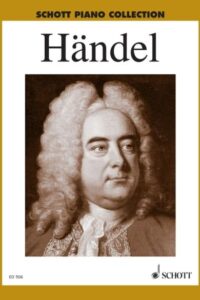
The best sheet music download from our Library.
George Frideric Handel: The Colossus of Baroque Music
George Frideric Handel (German: Georg Friedrich Händel; 23 February 1685 – 14 April 1759) stands as one of the supreme figures in Western music history. A German-born Baroque composer who became a naturalized British subject, Handel's prodigious output—spanning operas, oratorios, anthems, concerti grossi, and organ concertos—has secured his place alongside Johann Sebastian Bach as the towering genius of his era. Born in the same year as Bach and Domenico Scarlatti, Handel's life and career traversed the major musical centers of Europe, ultimately finding its greatest expression in London, where he created works that have never lost their power to move audiences.
His most famous work, the oratorio Messiah (1741), has become a cultural phenomenon transcending the concert hall, while his instrumental masterpieces—Water Music (1717) and Music for the Royal Fireworks (1749)—remain synonymous with royal pageantry and ceremonial grandeur. Yet these celebrated works represent merely the visible peak of an immense creative iceberg that includes 42 operas, 29 oratorios, more than 120 cantatas, and countless instrumental compositions.
Biography
Early Years in Halle (1685–1702)
Handel was born in Halle, in the Duchy of Magdeburg (then part of Brandenburg-Prussia), to Georg Händel, an eminent barber-surgeon of 63, and his second wife, Dorothea Taust. The family's social standing was respectable, and Handel's father, a man of practical ambitions, intended his son for the study of civil law rather than music.
According to Handel's first biographer, John Mainwaring, the young Handel "had discovered such a strong propensity to music that his father, who always intended him for the study of civil law, had reason to be alarmed. He strictly forbade him to meddle with any musical instrument". Undeterred, the boy "found means to get a little clavichord privately conveyed to a room at the top of the house. To this room he constantly stole when the family was asleep". By an early age, Handel had become a skillful performer on both harpsichord and pipe organ.
A fortuitous journey to Weissenfels proved decisive. The young Handel's organ playing at the court chapel so impressed Duke Johann Adolf I that the Duke persuaded Handel's father to allow musical lessons. From 1692 onward, Handel studied with Friedrich Wilhelm Zachow, organist of the Lutheran Marienkirche in Halle, learning harmony, counterpoint, fugue composition, and the analysis of scores. Zachow's teaching provided a thorough grounding in the North German polyphonic tradition that would remain a foundation of Handel's style.
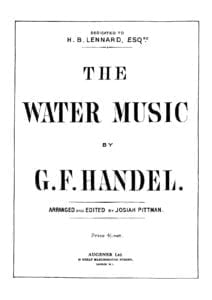
Please, subscribe to our Sheet Music Library. Sheet music should be accessible and affordable for all musicians, from professionals to absolute beginners.
Hamburg and Early Operas (1703–1706)
Following his father's wishes, Handel enrolled as a law student at the University of Halle in 1702 and briefly served as organist at the Reformed Cathedral. But after a year, his true vocation proved irresistible. In 1703, he accepted a position as violinist and harpsichordist in the orchestra of the Hamburg opera house.
Hamburg was Germany's operatic capital, and Handel immersed himself in its vibrant musical life, meeting Johann Mattheson, Christoph Graupner, and Reinhard Keiser. His first two operas, Almira and Nero, were produced in 1705, followed by Daphne and Florindo in 1708. The young composer also engaged in a famously dramatic duel with Mattheson—a quarrel that nearly proved fatal but was subsequently resolved.

Search your favorite sheet music in the Sheet Music Library Catalog
The Italian Sojourn (1706–1710)
In 1706, Handel traveled to Italy at the invitation of Gian Gastone de' Medici, whom he had met in Hamburg. The next four years proved transformative. In Florence, Rome, Naples, and Venice, Handel encountered the latest Italian musical styles at their source.
In Rome, he met the two towering figures of Italian Baroque music: Arcangelo Corelli and Alessandro Scarlatti. He also engaged in friendly musical competitions with Domenico Scarlatti. Handel's Italian works from this period include two operas (Rodrigo and Agrippina), numerous solo cantatas, the oratorio Il trionfo del tempo e del disinganno (1707), and the serenata Aci, Galatea e Polifemo (1708). His years in Italy permanently overlaid his North German training with the Italian style that would characterize his mature music.
Hanover and London (1710–1712)
Handel returned to Germany in 1710, accepting the position of Kapellmeister to the Elector of Hanover, the future King George I of Great Britain. Almost immediately, he requested leave to visit London—a city that would become his permanent home.
His first London opera, Rinaldo (1711), was a sensational success. Composed in just two weeks, it established Handel as the preeminent composer of Italian opera in England. After a second visit, Handel settled permanently in London in 1712, receiving a royal pension of £200 per year from Queen Anne.
The London Years (1712–1759)
Handel's London career unfolded over nearly five decades of extraordinary productivity and occasional adversity. In 1717, he composed Water Music for a royal river procession on the Thames—a work that reportedly reconciled him with King George I, who had not forgiven his former employee for his extended London absence.
From 1719 to 1728, Handel served as musical director of the Royal Academy of Music, producing a succession of masterful Italian operas, including Radamisto (1720), Giulio Cesare (1724), Tamerlano (1724), and Rodelinda (1725). These works represented the summit of the opera seria tradition.
However, changing public tastes and the rise of satirical works like The Beggar's Opera (1728) undermined the popularity of Italian opera. Handel's financial situation grew precarious. In response, he gradually developed a new genre: the English oratorio—a form that combined the dramatic power of opera with the grandeur of choral music and biblical themes.
The 1730s and 1740s saw the creation of his greatest oratorios: Esther, Deborah, Athalia, Saul, Israel in Egypt (1739), and—most famously—Messiah (1741). Premiered in Dublin in 1742, Messiah achieved immediate acclaim. Other masterpieces followed: Samson (1743), Judas Maccabaeus (1747), Solomon (1749), and Jephtha (1752).
In 1749, Handel composed Music for the Royal Fireworks to celebrate the Treaty of Aix-la-Chapelle. His instrumental output also included the magnificent twelve Concerti Grossi, Op. 6 (1739)—widely regarded, alongside Bach's Brandenburg Concertos, as the crowning achievement of the Baroque concerto.
Final Years and Death
In 1751, Handel began to lose his sight, eventually becoming almost totally blind. Despite this affliction, he continued to compose and perform, with his final work being the oratorio Jephtha (1752). He died on 14 April 1759 in London, a wealthy and respected man. He was accorded a state funeral and buried in Westminster Abbey—an honour rarely granted to a musician.
Musical Style
Stylistic Synthesis
Handel's musical style represents one of the great syntheses in Western music history. The first basis of his style was the North German music of his childhood—the rigorous contrapuntal tradition of composers like Zachow and the middle-German polyphonic choral tradition. This foundation was soon completely overlaid by the Italian style he acquired during his travels in Italy—the melodious vocal writing, the clear harmonic structures, and the dramatic sensibility of Italian opera.
To these influences he added elements of the French style of Jean-Baptiste Lully and, later, the English tradition of Henry Purcell. The result was a uniquely cosmopolitan idiom that nevertheless developed a distinctly English robustness in his later music.

Vocal Writing
Handel's music is preeminently vocal. His writing for the solo voice displays outstanding suitability for the medium and an unerring melodic line. He possessed a striking ability to depict human character musically in a single scene or aria—a gift deployed with great dramatic power in both his operas and oratorios.
His choruses, however, represent perhaps his greatest achievement. The power and effectiveness of his choral writing have never been surpassed. He interweaves massive but simple harmonic passages with contrapuntal sections of great ingenuity, the whole most effectively illustrating the text. His choral writing—particularly in works like Messiah, Israel in Egypt, and Judas Maccabaeus—established a model that profoundly influenced later composers, including Haydn and Mozart.
Instrumental Music
Though the bulk of his music was vocal, Handel was nevertheless one of the great instrumental composers of the late Baroque era. His overtures (mostly in the French style), his orchestral concertos (Op. 3 and Op. 6), his large-scale concert music for strings and winds (such as Water Music and Music for the Royal Fireworks), and his organ concertos all demonstrate complete mastery of the orchestral means at his command.
His keyboard music is characterized by complete clarity, usually resulting from a precise design monumentally conceived. It is decorative rather than profound, meant to be enjoyed for its vitality and rhythmic frankness.
Theatrical Sensibility
Handel had a lifelong attachment to the theater—even his oratorios were usually performed on the stage rather than in church. Until almost the end of his life, he loved Italian opera, and only after it involved him in ever-increasing financial losses did he abandon it for English oratorio. Like other composers of his time, he accepted the conventions of Italian opera, with its employment of male sopranos and contraltos and the formalized sequences of stylized recitatives and arias upon which opera seria was constructed. Using these conventions, he produced many masterpieces, including Giulio Cesare (1724), Sosarme (1732), and Alcina (1735).
Relationships with Other Artists
Fellow Composers
Handel's relationships with his contemporaries were complex and varied. He met Johann Sebastian Bach only indirectly—they shared the same eye doctor, who may have inadvertently contributed to the blindness of both composers. Bach greatly admired Handel's music, but the two never met face-to-face.
With Georg Philipp Telemann, however, Handel had a more direct connection. The young Telemann visited Halle in 1701 specifically to hear the promising teenager. In Hamburg, Handel worked alongside Johann Mattheson, Reinhard Keiser, and Christoph Graupner.
His Italian years brought him into contact with the greatest musicians of the day. He met Arcangelo Corelli and Alessandro Scarlatti in Rome, and engaged in friendly musical competitions with Domenico Scarlatti. These encounters left permanent marks on his musical style.
Patrons and Collaborators
In London, Handel's social circle extended beyond musicians. He reserved his friendship for members of other arts and professions—doctors, painters, intellectuals, lawyers, clergymen, and politicians. His most important librettist was Charles Jennens, who provided the text for Messiah and other works.
Later Influence
Handel's influence on later composers was profound, particularly in Vienna, where he was revered by both Mozart and Beethoven. Mozart made celebrated arrangements of Handel's works, including a re-orchestration of Messiah. Beethoven considered Handel the greatest composer who ever lived and drew inspiration from his choral writing. Haydn, too, was deeply influenced by Handel's oratorios. In London, however, Handel exerted surprisingly little influence on his immediate successor, Johann Christian Bach.
Chord Progressions and Harmonic Language
Harmonic Foundations
Handel was very conscious of harmonic relationships. His harmonic language, while rooted in the common practice of the Baroque era, displays distinctive characteristics that set it apart.
Individual da capo arias follow regular harmonic patterns, and clear patterns govern the relationship between recitative and the following aria. However, Handel's operas do not regularly exhibit stable harmonic patterns in a single key or even in a group of related keys. The large-scale harmonic patterns of his operas illustrate chronological changes in his conception of musical-dramatic structure.
Simple Yet Effective Progressions
Handel's simple harmonic progression is a main focus of his style, making his music accessible to society at large. His writing technique of intermingling polyphony and major keys was called the model of classical choral writing.
In his choruses, Handel frequently combines massive but simple harmonic passages with contrapuntal sections of great ingenuity. His diatonic progressions and harmonies based on common chords, while sometimes characterized as colorless, serve a dramatic purpose: they create a sense of clarity and directness that powerfully communicates the text.
Dramatic Harmony
Handel deployed harmony for dramatic effect. He would often maintain continuity between movements by using dominant relationships, and in some cases, strong dramatic conflict is indicated by placing consecutive arias in keys a half-step apart. His operas contain many compelling harmonic elements that impart information and contribute to the richness of his dramatic acts.
Handel's harmonic language represents a practical, theatrical approach to harmony—less intellectually rigorous than Bach's, but no less effective in its emotional impact.
Influences
Early Influences
The primary influences on Handel's early style were the north German polyphonic tradition of his childhood and the Italian style he acquired in Italy. His teacher Friedrich Wilhelm Zachow provided a thorough grounding in German contrapuntal techniques.
Italian Masters
The influences of Arcangelo Corelli and Alessandro Scarlatti can be detected in his work to the end of his long life. Corelli's influence is particularly evident in Handel's concerto writing, while Scarlatti's influence shaped his approach to vocal melody and opera seria.
French and English Traditions
The French style of Jean-Baptiste Lully influenced Handel's overtures and dance movements. The English composer Henry Purcell also left a mark, particularly in Handel's later music.
Literary Influences
Some of the greatest names of English literature are connected with Handel's compositions—Milton (L'Allegro and Il Penseroso), Dryden (Alexander's Feast), and Pope (St. Cecilia's Day). The spirit of English poetry had an important influence on Handel's approach to text setting.
Borrowing and Adaptation
Handel has been both celebrated and reviled as a borrower. He took much material from other composers—including Habermann, Kerl, and Clari—but transformed it in ways that made it distinctly his own. This practice of borrowing was common in the Baroque era and was not considered unethical; rather, it reflected a view of composition as a craft of adaptation and improvement.
Legacy
The Creator of English Oratorio
English oratorio was to all intents and purposes created by Handel, and his creation had a tremendous influence on the musical history of his chosen country of residence long after his death. In the 1730s and 1740s, Handel gradually developed an entirely unique English variant of the oratorio that combined Italian operatic conventions with English choral traditions and biblical narratives.
Influence on Later Composers
Handel's music was well known to composers including Haydn, Mozart, and Beethoven. In Vienna, he was revered by both Mozart and Beethoven. Beethoven, in particular, considered Handel the greatest composer who ever lived, and his influence extended beyond Beethoven's choral works.
In Germany, a revival of interest in Handel's works occurred in the nineteenth century, with complete editions of his works published by the Händel-Gesellschaft.
Cultural Icon
Messiah became the embodiment of the deep religious feeling pervading the English people. Handel's works have for later generations become a source of joy and delight to a very different social class—they are the musical equivalents of those palaces and gardens of Handel's day which are now national monuments and open to all.
Modern Scholarship
A large body of publications—books, articles, poems—was devoted to Handel both in his lifetime and for decades after his death. The opening of previously restricted archives and the recovery of lost documents have provided a much clearer understanding of the influences on Handel's output and its context within European Baroque musical culture.
Works
Main articles on Wikipedia: List of compositions by George Frideric Handel and List of operas by George Frideric Handel
Overview
Handel's compositions include 42 operas, 24 oratorios, more than 120 cantatas, trios and duets, numerous arias, odes and serenatas, solo and trio sonatas, 18 concerti grossi, and 12 organ concertos. His works are cataloged using the Händel-Werke-Verzeichnis (HWV) numbering system.
Operas
Handel's operas span his entire career. His first opera, Almira, premiered in Hamburg in 1705. His Italian operas include Rodrigo (1707), Agrippina (1709), and the London successes Rinaldo (1711), Giulio Cesare (1724), Tamerlano (1724), Rodelinda (1725), Alcina (1735), and Serse (1738). His last opera, Deidamia, premiered in 1741.
Oratorios
Handel's oratorios represent his most enduring contribution. The most famous is Messiah (HWV 56, 1741), but he also composed Esther (1718, rev. 1732), Deborah (1733), Athalia (1733), Saul (1738), Israel in Egypt (1739), Samson (1743), Judas Maccabaeus (1747), Solomon (1749), and Jephtha (1752).
Instrumental Works
Concerti Grossi
Handel published two sets of concerti grossi: the six Concerti Grossi, Op. 3 (c. 1734), and the twelve Concerti Grossi, Op. 6 (1739). The Op. 6 set, in particular, is regarded as one of the supreme achievements of the Baroque concerto.
Orchestral Suites
Water Music (1717) consists of three suites in F major, D major, and G major, featuring French overtures and dance movements including minuets, bourrées, and hornpipes. Music for the Royal Fireworks (1749) was composed for outdoor performance.
Organ Concertos
Handel composed 12 organ concertos, published as Op. 4 and Op. 7. These works were often performed as interludes during his oratorio performances.
Keyboard Music
His keyboard works include suites, fugues, and variations, including the celebrated Harmonious Blacksmith variations.
Church Music
Handel composed numerous anthems, including the Chandos Anthems and the Coronation Anthems, of which Zadok the Priest (1727) has been performed at every British coronation since.
Works in Films
Handel's music has been extensively featured in cinema, often lending grandeur and emotional depth to dramatic scenes.
The Great Mr. Handel (1942)
This British Technicolor biographical film, directed by Norman Walker and starring Wilfrid Lawson, dramatizes Handel's later life and the composition of Messiah. The film incorporates musical excerpts arranged by Ernest Irving, including "Comfort Ye," "For Unto Us a Child is Born," and the "Hallelujah Chorus" from Messiah, alongside selections from Music for the Royal Fireworks and Water Music. Released during World War II, it functioned as cultural propaganda, portraying Handel as a champion of British democratic values.
Barry Lyndon (1975)
Stanley Kubrick's masterpiece famously uses the Sarabande from Handel's keyboard suite in D minor as its main theme. The soundtrack is a remarkably effective mix of classical music and traditional Irish music.
The Madness of King George (1994)
This film features music by Handel adapted and arranged by George Fenton. Extracts are taken from Saul, Samson, Julius Caesar, Music for the Royal Fireworks, Water Music, Zadok the Priest, and various concerti grossi. Zadok the Priest is used to particularly great effect.
God Rot Tunbridge Wells! (1985)
This British musical, marking the 300th anniversary of Handel's birth, features the composer reflecting on his life and career.
Discography
Handel's complete works have been recorded multiple times. The most significant recordings include:
Complete Oratorios
- Messiah has been recorded by countless conductors, including Sir Thomas Beecham, Sir Georg Solti, John Eliot Gardiner, and Trevor Pinnock.
- The complete oratorios have been recorded by conductors including John Eliot Gardiner, Christopher Hogwood, and Nicholas McGegan.
Complete Operas
- Many of Handel's operas have been recorded by conductors including Alan Curtis, René Jacobs, William Christie, and John Eliot Gardiner.
- Notable recordings include Giulio Cesare, Rinaldo, Alcina, and Serse.
Instrumental Works
- The Concerti Grossi, Op. 6, have been recorded by ensembles including the Academy of St Martin in the Fields (Neville Marriner), the English Concert (Trevor Pinnock), and the Freiburger Barockorchester.
- Water Music and Music for the Royal Fireworks have been recorded numerous times, with period-instrument performances by ensembles like the English Baroque Soloists.
Complete Editions
The Händel-Gesellschaft (HG) and Hallische Händel-Ausgabe (HHA) provide scholarly editions of his complete works.
Most Known Compositions and Performances
Messiah (HWV 56, 1741)
Messiah is Handel's most famous work—indeed, one of the most famous works in all of Western music. Premiered in Dublin on 13 April 1742, it consists of three parts and 56 pieces. The first part concerns the birth and prophecy of Christ; the second, passion and redemption; and the third, resurrection and eternal life.
The "Hallelujah Chorus" is perhaps the most famous single piece of choral music ever written. Tradition holds that King George II rose to his feet during its first London performance—a gesture that audiences have repeated ever since.
Water Music (1717)
Composed for a royal river party on the Thames, Water Music belongs to an essentially French tradition of outdoor music. Deliberately popular in style, it relies on the appeal of sturdy dance tunes and military-style orchestration. It breaks down into three suites in F major, D major, and G major. The famous hornpipe movements have been seen as a nod to the water on which the piece was first premiered.
Music for the Royal Fireworks (1749)
Composed to celebrate the Treaty of Aix-la-Chapelle, this work was originally scored for a massive wind band of 24 oboes, 12 bassoons, and nine trumpets, along with horns and drums. It represents Handel at his most public and celebratory.
Giulio Cesare (HWV 17, 1724)
This opera, with a libretto by Nicola Francesco Haym, is widely considered one of Handel's finest operatic achievements. Its arias, including the famous "Va tacito e nascosto," demonstrate Handel's mastery of vocal writing and dramatic characterisation.
Zadok the Priest (1727)
One of the Coronation Anthems composed for the coronation of King George II, Zadok the Priest has been performed at every British coronation since. Its soaring choral entry remains one of the most thrilling moments in ceremonial music.
Concerti Grossi, Op. 6 (1739)
These twelve concertos represent the summit of the Baroque concerto grosso tradition. Each concerto is unique in structure, ranging from the expansive No. 1 in G major to the tragic No. 3 in E minor.
Documentaries
Water Music – Recreating a Royal Spectacular (Naxos)
This documentary, narrated by renowned London biographer Peter Ackroyd, follows a team of historical experts as they attempt to discover the remarkable story behind the 1717 premiere of Handel's Water Music on the Thames.
Handel: The Entertainer (dir. Reiner E. Moritz)
This film explores Handel's operas, focusing on a production of Rinaldo directed by David Alden, setting his work in the context of the composer's overall operatic output and achievement.
Händel – Der Film (2009)
A German documentary film starring Matthias Wiebalck as Handel and featuring Joyce DiDonato as the singer Francesca Cuzzoni.
Barockstar: George Frideric Handel
This documentary tells the story of Handel's life as he journeyed through Baroque Europe, leaving Germany for Italy and experiencing Florence, Rome, and Venice before arriving in London.
Handel's Messiah (BYUTV)
This documentary tells the story of Handel's collaboration with librettist Charles Jennens and how the pair struggled to create a masterpiece that has stood the test of centuries.
Handel and His Music (Coronet Instructional Films, 1957)
An educational film presenting Handel's life story and musical works, exploring the social and political conditions of the period and explaining the musical forms Handel used and developed—the oratorio, masque opera, suite, and Baroque style.
George Frideric Handel stands as one of the great colossi of Western music. His ability to synthesize the diverse musical traditions of Germany, Italy, France, and England into a uniquely powerful and accessible idiom remains unparalleled. His oratorios, particularly Messiah, have become cultural touchstones that transcend the boundaries of concert music; his operas are experiencing a glorious revival; and his instrumental works continue to delight audiences worldwide.
From his clandestine childhood practice on a hidden clavichord in Halle to his state funeral in Westminster Abbey, Handel's life was a testament to artistic vision, commercial acumen, and unshakeable creative drive. As Paul Henry Lang wrote in his definitive biography, Handel was "possessed of a central calm" but his "driving force was incalculable". That force produced music of such power and humanity that it continues to speak to listeners across the centuries—a legacy that, more than 250 years after his death, shows no sign of diminishing.
Browse in the Sheet Music Library:
Or browse in the categories menus & download the Library Catalog PDF: