
Table of Contents
Scores for all instruments: 16,000+ (active and growing), over 236,000 pages.
All genres and levels: Jazz & Blues, Rock & Pop, Classical & Contemporary, Film & Musicals;
books & biographies; methods, études, play-along tracks (MP3) for Jazz & Rock.
Access & benefits: US$15.99 one-time payment, valid for lifetime, full Library access.
Gustav Mahler: The Architect of the Symphony and the Prophet of Modernity
Gustav Mahler stands as one of the most monumental and emotionally resonant figures in the history of Western music. A conductor of legendary intensity and a composer of sprawling, all-encompassing symphonies, Mahler’s life and work bridged the twilight of the Austro-Hungarian Empire and the dawn of a fractured modern world. Though during his lifetime he was celebrated primarily as an opera conductor of uncompromising standards, his true legacy lies in a body of work that transformed the symphony into a vehicle for personal confession, metaphysical inquiry, and sonic world-building. His music, initially dismissed by some critics as ephemeral, now occupies a central place in the concert repertoire, admired for its profound emotional depth, innovative harmonic language, and visionary scope. “My time will come,” Mahler reportedly declared, and indeed, the twentieth and twenty-first centuries have proven him remarkably prescient.
Search your favorite sheet music in the Sheet Music Library Catalog



I. Biography: The Wanderer and the Tyrant
Please, subscribe to our Sheet Music Library. Sheet music should be accessible and affordable for all musicians, from professionals to absolute beginners.
Gustav Mahler was born on July 7, 1860, in the Bohemian village of Kaliště (then part of the Austrian Empire, now the Czech Republic), into a German-speaking Jewish family. His childhood was marked by a sense of alienation and trauma. As a German-speaking Austrian minority in a Czech region, and as a Jew among that minority, Mahler felt like an outsider from the very beginning. His family life was also troubled; his father was a self-educated, forceful man, while his mother was delicate and often ill, and the household was shadowed by the deaths of several of his thirteen siblings. This early exposure to mortality, anxiety, and social marginalization would become a defining, thematic wellspring for his entire artistic output. Paradoxically, it was also his father’s world that provided the raw sonic material for his future compositions: the military band music from a nearby barracks and the folk songs of the Czech people were absorbed by the young Mahler and would reappear, transformed and ironized, throughout his symphonies.
The best sheet music download from our Library.
Recognized as a prodigy, Mahler entered the Vienna Conservatory at age fifteen, where he studied piano, harmony, and composition. He later attended Vienna University, developing a deep interest in literature, philosophy, and art history. However, it was as a conductor that he first achieved professional renown. Beginning with modest posts in provincial theaters, he rapidly ascended the ranks of European opera houses, including engagements in Kassel, Prague, Leipzig, Budapest, and Hamburg. In 1897, he converted from Judaism to Catholicism—a pragmatic move necessary to secure the prestigious post of director of the Vienna Court Opera, a position he would hold until 1907. His tenure in Vienna was transformative. He imposed rigorous rehearsal standards, introduced innovations in staging and lighting, and brought the opera house to unprecedented heights of interpretive quality. Yet, his tyrannical manner and relentless pursuit of perfection also made him powerful enemies, and the antisemitism he faced constantly simmered beneath the surface of Viennese musical life.
In 1902, he married Alma Schindler, a young, intellectually vibrant woman who became a central figure in his life and a muse for several of his works. The marriage was passionate but troubled, and Alma’s eventual infidelities have been the subject of much biographical scrutiny. The year 1907 was a watershed of catastrophe, a triad of blows that Mahler saw as a premonition realized from his own “Tragic” Sixth Symphony: he was forced to resign from the Vienna Opera; his eldest daughter, Maria, died of scarlet fever; and he was diagnosed with a fatal heart condition. Seeking a fresh start, he took up conducting posts in the United States, leading both the Metropolitan Opera and the New York Philharmonic. He returned to Vienna, gravely ill, in 1911, and died on May 18 of that year, leaving his Tenth Symphony as an unfinished sketch.
II. Musical Style, Harmony, and Technique
Mahler’s compositional output is almost exclusively confined to two genres: the symphony and the orchestral song (Lied). He believed these two forms were uniquely suited to expressing his “personal view of the world,” finding opera’s dramatic conventions too limiting for the subjective, metaphysical narratives he wished to convey. For Mahler, “a symphony must be like the world,” and his music is characterized by its attempt to embrace everything—nature, folk life, military marches, vulgar street songs, sublime spirituality, and nihilistic despair. This aesthetic is realized through a style that is at once deeply personal and historically Janus-faced, looking back to the Romantic tradition of Beethoven, Schubert, Wagner, and Bruckner, while simultaneously pointing toward the modernist experiments of the twentieth century.
Harmony and Tonality. Mahler’s harmonic language is a crucial bridge between Romantic expressiveness and twentieth-century dissonance. While tonality remained the structural foundation of his music, he stretched its limits through pervasive chromaticism, sudden and unprepared modulations, and unresolved dissonances. His most significant contribution to harmonic structure is the concept of progressive tonality. Instead of a traditional symphonic narrative that departs from a tonic key and ultimately returns to it, Mahler often composed works that begin in one key and end in another, creating a tonal journey that mirrors a psychological or philosophical transformation. For instance, his Second Symphony progresses from C minor to E-flat major, and the Seventh moves from a shadowy E minor to a radiant C major. This technique infuses the entire symphonic structure with a sense of dramatic striving and evolution. Furthermore, his frequent use of irony—quoting popular tunes, waltzes, and marches only to distort or subvert them—was a radical departure from the earnestness of earlier Romanticism, prefiguring the ironic and cynical modes of twentieth-century art.
Orchestration and Texture. Mahler was a virtuoso orchestrator, and his scores are famed for their vast and colorful sonic landscapes. He vastly expanded the standard orchestra, calling for huge forces, including quadruple woodwinds, massive brass sections, and an extensive array of percussion, often adding instruments like cowbells, the hammer, the rute, and the mandolin to achieve specific timbral effects. Yet, his orchestration is not merely about volume. It is characterized by a “chamber music technique” applied to the full orchestra, where individual lines are given to solo instruments within the massive ensemble, creating a remarkable transparency and contrapuntal clarity. He often used instruments in extreme registers or in unusual combinations to create grotesque, ironic, or otherworldly effects, famously commenting that he made “the basses and bassoon squeak on the highest notes, while my flute huffs and puffs down below”. This approach to texture, favoring interwoven soloistic lines over a homophonic mass, is a key element of his modernist foreshadowing.
Song and Symphony. The relationship between Mahler’s songs and symphonies is symbiotic. His early symphonies, particularly the First through Fourth, incorporate entire songs or song melodies as movements or thematic material, often drawn from his settings of the folk poetry collection Des Knaben Wunderhorn. In his middle-period symphonies (Nos. 5–7), he ceased quoting whole songs but continued to use their motives and moods as subtle allusions. Finally, in his late works like Das Lied von der Erde, the two genres fuse completely into a “song-cycle symphony,” a form that dissolves the boundaries between the intimate lyricism of song and the architectural grandeur of the symphony.
III. The Best Songs and Compositions
For a complete listing of Mahler's works, see List of compositions by Gustav Mahler.
Mahler’s catalog is compact but immensely consequential. His ten symphonies (nine completed, plus the Das Lied von der Erde, which he considered a symphony, and the unfinished Tenth) form the core of his legacy. Alongside them are several monumental song cycles for voice and orchestra.
The Symphonies. The First Symphony (1888) is a brilliant, often autobiographical dawn-of-life epic, full of nature sounds and fanfares. The Second (“Resurrection,” 1894) and Third (1896) are vast, metaphysical works that incorporate soloists and choruses to explore themes of death, nature, and spiritual rebirth. The Fourth (1900) offers a smaller-scale, faux-naïf vision of a child’s heaven. The purely orchestral triptych of the Fifth (1902), Sixth (1904), and Seventh (1905) marks a turn toward a more “hard-edged, contrapuntal clarity”. The Fifth is celebrated for its funereal first movement and its achingly beautiful Adagietto for strings and harp. The Sixth, the “Tragic,” is Mahler’s most harrowing statement, a work of unrelenting darkness that culminates in a final movement punctuated by hammer blows of fate. The monumental Eighth (“Symphony of a Thousand,” 1907) is a two-part choral symphony setting the Latin hymn “Veni Creator Spiritus” and the final scene of Goethe’s Faust, a colossal affirmation of human striving. The final works—Das Lied von der Erde (1908), the Ninth Symphony (1910), and the unfinished Tenth—are profound meditations on mortality and farewell, their endings often dissolving into an exquisite, quiet disintegration of sound.
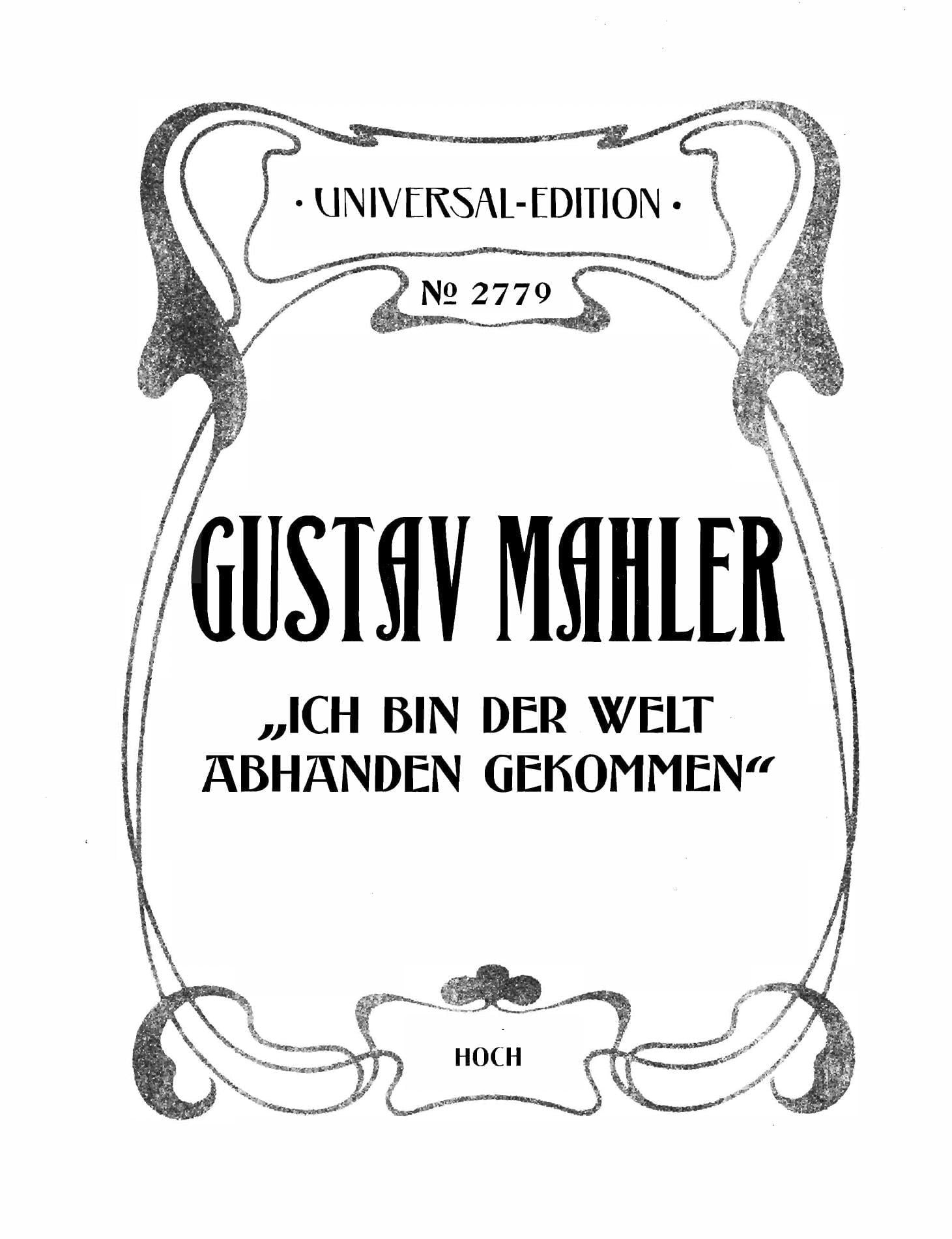
The Song Cycles. Among his songs, Lieder eines fahrenden Gesellen (Songs of a Wayfarer, 1883–85) is a poignant, autobiographical cycle of unrequited love and wandering, with melodies that would later populate the First Symphony. Kindertotenlieder (Songs on the Deaths of Children, 1901–04), settings of poems by Friedrich Rückert, is a work of devastating intimacy and grief, its orchestration a model of restrained, chamber-like poignancy. The Rückert-Lieder (1901–02) include some of his most sublime and spiritually searching songs, notably “Ich bin der Welt abhanden gekommen” (“I am lost to the world”). Together, these works represent a fusion of poetry, vocal expression, and orchestral color that is uniquely Mahlerian.
IV. Mahler in Film
Mahler’s music, with its overwhelming emotional directness and cinematic sweep, has proven irresistible to filmmakers. Its use in cinema has played a significant role in the broader popularization and “Mahler Renaissance” of the latter half of the twentieth century.
The most famous and influential example is Luchino Visconti’s 1971 masterpiece, Death in Venice. Visconti used Mahler’s Adagietto from the Fifth Symphony as the film’s principal musical theme, a choice that perfectly captured the protagonist’s repressed longing, intellectual yearning, and fatal obsession with beauty. The slow, string-led movement became indelibly associated with the film, and its haunting strains are now inextricably linked to images of Venice and the film’s tragic narrative. The score also incorporated music from the Third Symphony, further emphasizing the composer’s role as the film’s emotional and spiritual guide.
More recently, Martin Scorsese used Mahler’s early Piano Quartet in A Minor to unsettling effect in the psychological thriller Shutter Island (2010), its fragmentary and dissonant qualities contributing to the film’s atmosphere of instability and dread. In Tár (2022), Todd Field utilized Mahler’s Fifth Symphony, specifically its Adagietto and other movements, as a crucial element in the narrative about a brilliant but problematic conductor, exploring themes of artistic genius, power, and personal downfall. The Adagietto also formed the emotional core of Park Chan-wook’s Decision to Leave (2022), demonstrating the continuing cinematic power of Mahler’s most famous slow movement. Beyond these feature films, Mahler’s music has been used in numerous documentaries, and his life has been the subject of biopics, such as Ken Russell’s Mahler (1974) and Percy and Felix Adlon’s Mahler on the Couch (2010).
V. Collaborations and Relationships
Mahler’s career was defined by a network of intense, often complicated professional and personal relationships. His most significant peer relationship was with Richard Strauss. The two met as young conductors in Leipzig in 1887 and remained correspondents and mutual champions for the rest of Mahler’s life, even though their musical aesthetics were profoundly different. Mahler conducted Strauss’s Symphonia Domestica, and Strauss fiercely advocated for Mahler’s music, seeing him as a kindred spirit in the late-Romantic struggle for artistic renewal.
Among the younger generation, Mahler was a revered mentor and father figure to the composers of the Second Viennese School—Arnold Schoenberg, Alban Berg, and Anton Webern. Although Mahler never fully embraced their atonal and twelve-tone methods, he recognized their genius and championed their early works, providing crucial support and validation. His conducting protégés formed another devoted circle. Bruno Walter, who became Mahler’s assistant in Vienna, was perhaps the most faithful interpreter of his music, and after Mahler’s death, he conducted the premieres of Das Lied von der Erde and the Ninth Symphony. Other important conductors in his orbit included Otto Klemperer and Willem Mengelberg, who helped spread his music across Europe.
Personally, Mahler’s marriage to Alma Mahler was the central relationship of his adult life. Intelligent, artistic, and fiercely independent, Alma was a composer herself before their marriage, and her subsequent creative suppression has become a significant topic of discussion. Her memoirs and letters have shaped much of the biographical understanding of Mahler, though they are often subjective and self-serving.
VI. Awards and Honors
During his lifetime, Mahler’s honors were primarily as a conductor. As a student at the Vienna Conservatory, he won several composition prizes, but his mature works were not widely awarded. The true honors came posthumously, as his music ascended to the canon. The International Gustav Mahler Society was founded in Vienna in 1955, initiated by Bruno Walter and others, to promote the study and performance of his music. Since 1958, the Society has awarded the Golden Mahler Medal to individuals and institutions for outstanding achievements in Mahler research and interpretation. Recipients include Leonard Bernstein, Dietrich Fischer-Dieskau, Rafael Kubelík, Christa Ludwig, and Thomas Hampson.
The most significant “award,” however, has been the enduring place his music holds in the global repertoire. The “Mahler Renaissance” of the 1960s and 1970s, spearheaded by Leonard Bernstein’s passionate advocacy, cemented his status as a central figure of the concert hall. Today, his symphonies are among the most frequently performed and recorded works in the orchestral canon, a testament to their universal and continuing relevance.
VII. Influence and Legacy
Mahler’s influence on the course of twentieth-century music is profound and multifaceted. He was, in many ways, the last great symphonist of the Austro-German tradition and simultaneously one of the first truly modern voices. His music prefigured many of the radical developments of the coming century.
His influence can be traced along several distinct lines. The most direct was his impact on the Second Viennese School. Schoenberg, Berg, and Webern saw in Mahler’s music—its emotional extremity, its formal innovations, and its dissolution of traditional tonality—a path toward their own revolutionary breakthroughs. Echoes of Mahler’s Seventh Symphony can be heard in Berg’s Three Pieces for Orchestra and Webern’s Six Pieces. Beyond Vienna, his influence spread across cultures and generations. Dmitri Shostakovich admired Mahler’s ability to balance immense symphonic structures with ironic and grotesque elements, a quality that permeates his own fifteen symphonies. Benjamin Britten was a lifelong admirer, and traces of Mahler’s orchestral imagination and his exploration of innocence and experience can be felt in works like Peter Grimes and the War Requiem.
More broadly, Mahler’s legacy is his redefinition of the symphony as a form of personal confession and philosophical statement. He demonstrated that a symphony could be a “world,” embracing the banal and the sublime, the ironic and the sincere, the terror of death and the hope of transcendence. This concept of the symphony as a vast, inclusive, and psychologically complex narrative has influenced countless composers and continues to resonate with audiences today. His music, once seen as a dead end, is now understood as a crucial bridge between the nineteenth and twentieth centuries, a body of work that speaks with unparalleled directness to the anxieties, hopes, and contradictions of the modern human condition.
VIII. Memorials and museums
In Hamburg, the Gustav Mahler Museum is dedicated to Gustav Mahler's life and work. It is situated in the Composers Quarter. In Altschluderbach, near Toblach in South Tyrol, Italy, there remains a little museum and memorial in the former composer's hut of Mahler. It is situated in the animal park next to the Gustav Mahler Stube. The Stube formerly had a museum on the first floor. There, Mahler and his wife Alma resided from 1907 to 1910. Two of the other composer's huts used by Mahler still exist; both are equipped as little museums. There is one composing hut at the Attersee, Upper Austria, and one at the Wörthersee in Carinthia. Mount Mahler in the Rocky Mountains of Colorado is named in honour of the composer.
IX. Memorials and museums
In Hamburg, the Gustav Mahler Museum is dedicated to Gustav Mahler's life and work. It is situated in the Composers Quarter. In Altschluderbach, near Toblach in South Tyrol, Italy, there remains a little museum and memorial in the former composer's hut of Mahler. It is situated in the animal park next to the Gustav Mahler Stube. The Stube formerly had a museum on the first floor. There, Mahler and his wife Alma resided from 1907 to 1910. Two of the other composer's huts used by Mahler still exist; both are equipped as little museums. There is one composing hut at the Attersee, Upper Austria, and one at the Wörthersee in Carinthia. Mount Mahler in the Rocky Mountains of Colorado is named in honour of the composer.
Browse in the Sheet Music Library:
Or browse in the categories menus & download the Library Catalog PDF:
Best of Mahler
00:00:26 Mahler - Symphony No. 10 in F-Sharp Major: Adagio (excerpt) 00:04:07 Mahler - Symphony No. 2: IV. Urlicht 00:09:13 Mahler - Symphony No. 2: II. Andante moderato 00:21:12 Mahler - Symphony No. 2: III. In ruhig fliessender Bewegung 00:33:05 Mahler - Symphony No. 10 in F-Sharp Major (Original version) 01:00:00 Mahler - Symphony No. 9, GMW 50: 2. Im Tempo eines gemächlichen Ländlers. Etwas täppisch und sehr derb 01:16:05 Mahler - Symphony No. 9, GMW 50: 4. Adagio. Sehr langsam und noch zurückhaltend (D♭ Major) 01:41:26 Mahler - Symphony No. 9, GMW 50: 3. Rondo-Burleske: Allegro assai. Sehr trotzig 01:54:28 Mahler - Symphony No. 9, GMW 50: 1. Andante comodo (D Major) 02:24:15 Mahler - Symphony No. 2: I. Allegro maestoso 02:48:08 Mahler - Symphony No. 2: V. In Tempo des Scherzos