
Scores for all instruments: 16,000+ (active and growing), over 236,000 pages.
All genres and levels: Jazz & Blues, Rock & Pop, Classical & Contemporary, Film & Musicals;
books & biographies; methods, études, play-along tracks (MP3) for Jazz & Rock.
Access & benefits: US$15.99 one-time payment, valid for lifetime, full Library access.
Table of Contents
Mary Lou Williams: The First Lady of the Jazz Keyboard—A Life in American Music
Mary Lou Williams occupies a singular place in the history of American music. She was a pianist, composer, arranger, educator, and spiritual seeker whose career stretched across more than half a century, from the ragtime and boogie-woogie of the 1920s to the free jazz and sacred music of the 1970s. Duke Ellington observed that “her writing and performing have always been just a little ahead throughout her career,” and the historical record bears him out. She was the only major jazz figure to be a creative force in every era of the music’s evolution—ragtime, Kansas City swing, bebop, post-bop, and spiritual jazz—and she did so while battling the twin barriers of racism and sexism in a male-dominated profession. As the pianist and scholar Helen Sung has written, Williams’s “artistic integrity and persevering courage paved the way so that someone like me could be a part of jazz music today”.
The best sheet music download from our Library.


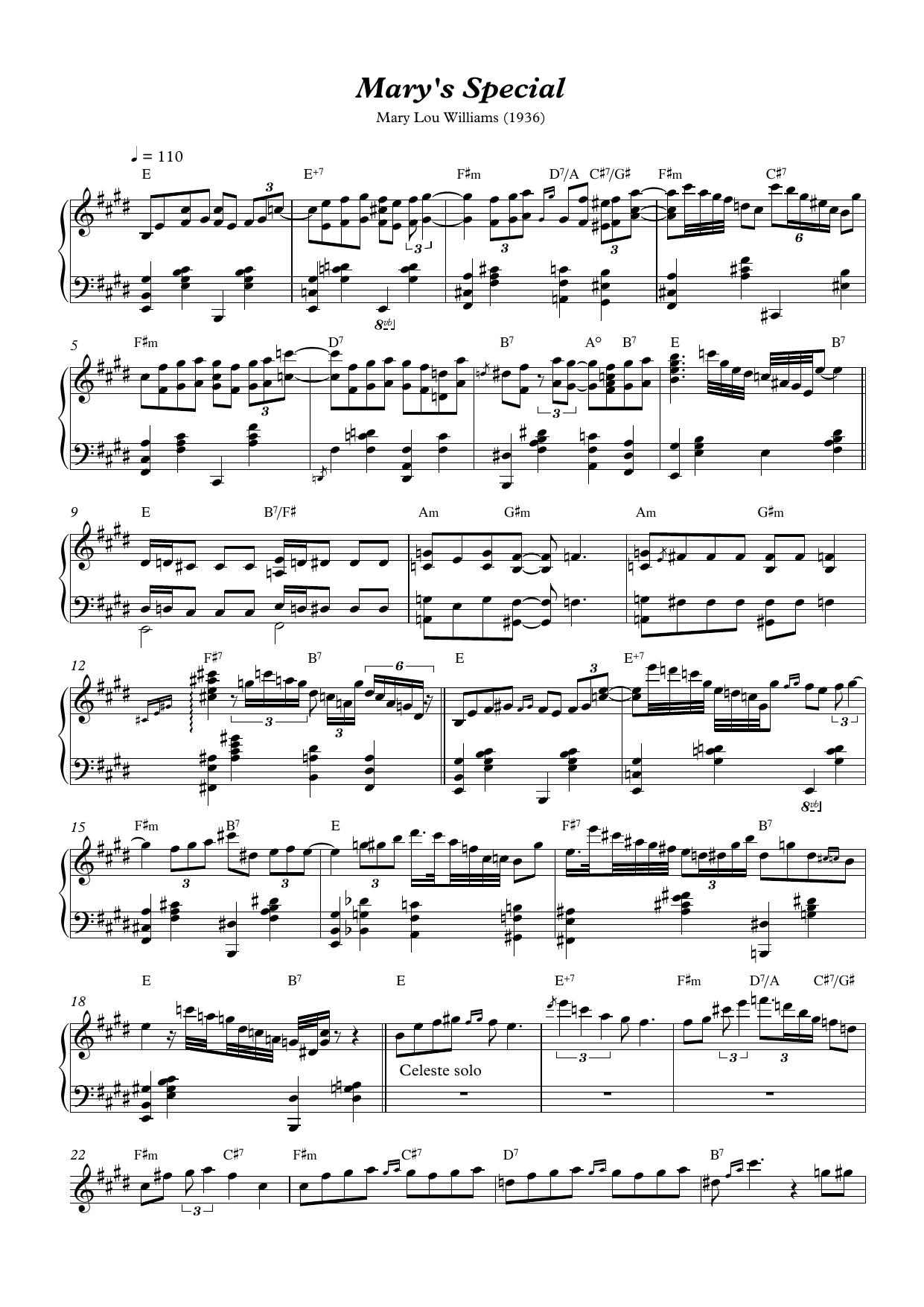
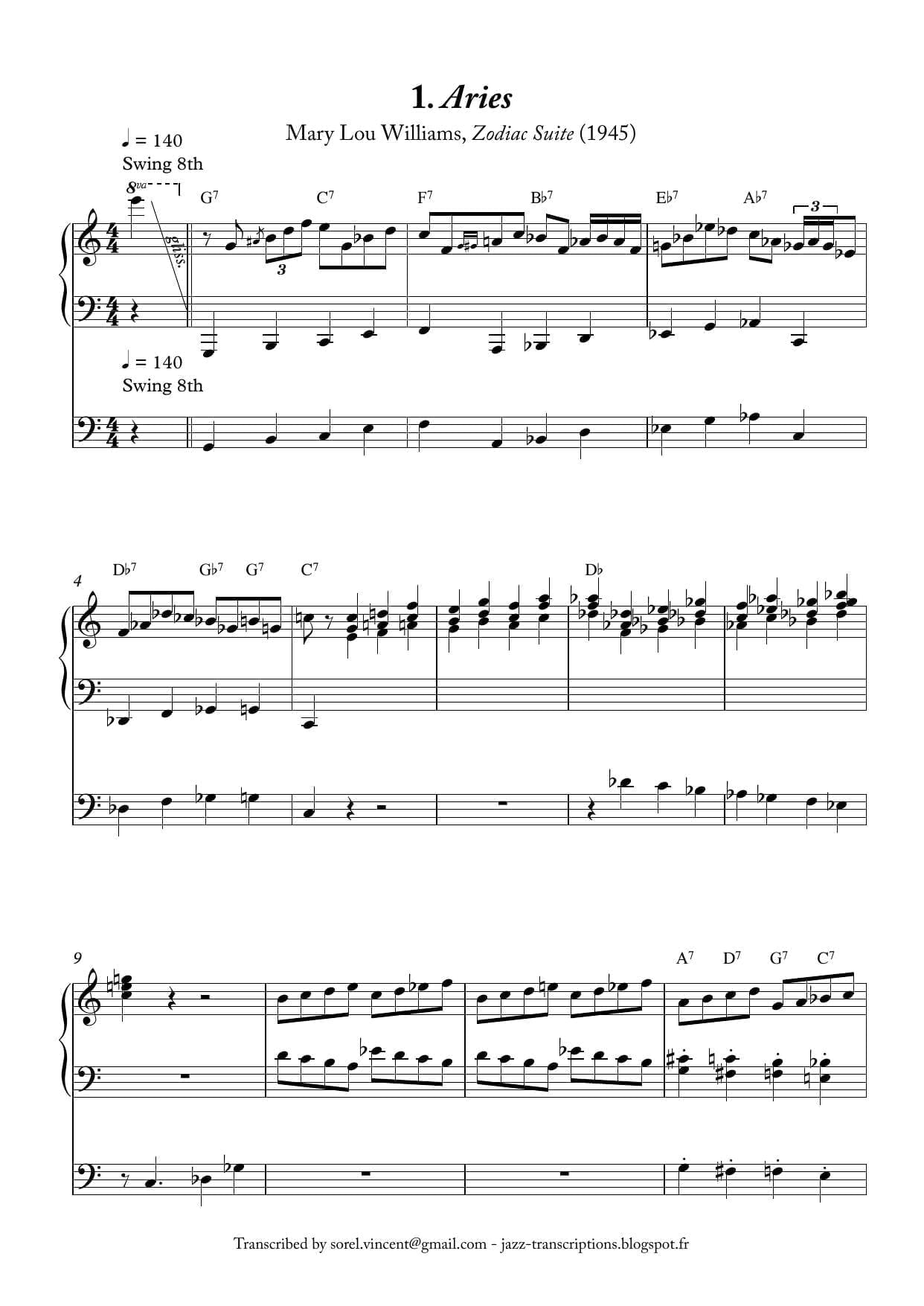
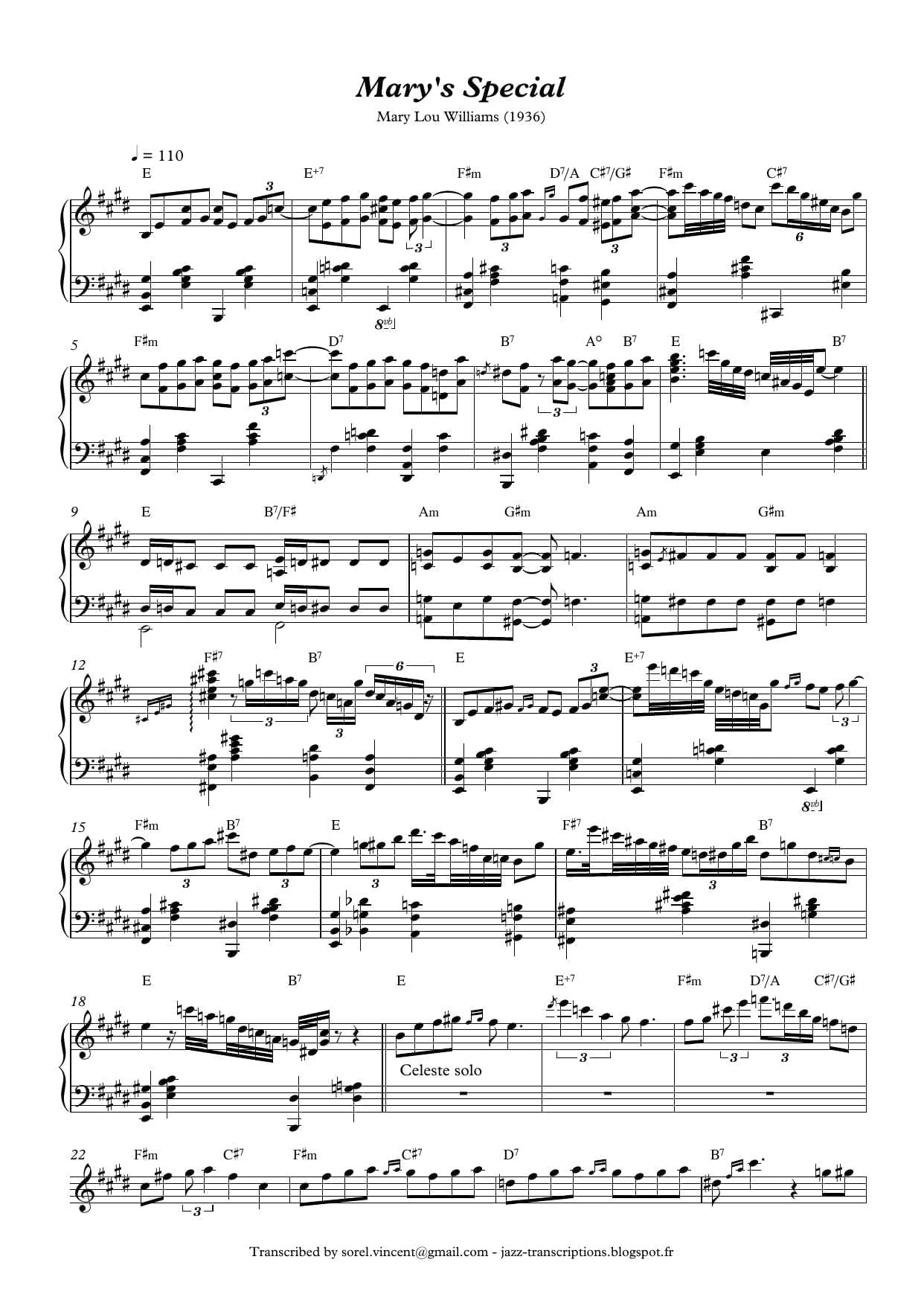

Please, subscribe to our Sheet Music Library. Sheet music should be accessible and affordable for all musicians, from professionals to absolute beginners.
Biography: From “the Little Piano Girl” to Jazz Matriarch
Mary Elfrieda Scruggs was born on May 8, 1910, in Atlanta, Georgia, the second of eleven children. Her mother was impoverished and unmarried, and the family soon moved to Pittsburgh’s East Liberty neighborhood, where Mary grew up. She was a prodigy of astonishing precocity: she picked out tunes on the piano at two, received formal lessons from her classically trained mother, and possessed perfect pitch and a formidable musical memory by the age of four. By six she was performing publicly, and by seven she was known throughout Pittsburgh as “the little piano girl of East Liberty,” playing for wealthy families at bridge teas one day and in gambling dens the next. Music was not merely a talent but a survival strategy. When racist neighbors terrorized the Williams family by throwing bricks at their home, the young Mary offered to play the piano for them—and the attacks stopped.
Her professional career began in earnest in her early teens. At twelve she substituted for a pianist in the traveling Buzz and Harris Revue, billed as Mary Lou Burley, and she soon passed through New York, where she encountered Jelly Roll Morton, Fats Waller, Willie “the Lion” Smith, and Duke Ellington. In 1927 she married saxophonist and bandleader John Williams, and when he moved to Oklahoma to join Andy Kirk and the Twelve Clouds of Joy, she briefly took over leadership of his band before joining Kirk herself in 1929. It was with Kirk’s Twelve Clouds of Joy that Williams became a central architect of the Kansas City sound. Her arrangements and compositions—including “Froggy Bottom,” “Walkin’ and Swingin’,” “Little Joe from Chicago,” “Roll ’Em,” and “Mary’s Idea”—gave the band its identity, and her piano playing, by turns earthy and sophisticated, set a new standard for what a woman in jazz could be.
By the late 1930s Williams was freelancing as an arranger for the biggest names in the music: Duke Ellington, Louis Armstrong, Benny Goodman, Tommy Dorsey, Cab Calloway, and Earl Hines, among others. Her marriage to John Williams ended, and she had a brief, turbulent marriage to trumpeter Harold “Shorty” Baker, with whom she co-led a band. In the early 1940s she settled in New York, where her Harlem apartment became a legendary gathering place for the young architects of bebop. Thelonious Monk, Bud Powell, Charlie Parker, and Dizzy Gillespie were not merely acquaintances but protégés; Williams mentored them, fed them, and wrote music that bridged the gap between swing and the harmonic innovations they were pioneering. Her 1945 Zodiac Suite, a twelve-movement work that was performed by the New York Philharmonic Chamber Orchestra, was a landmark of extended jazz composition, and it remains her most celebrated concert work.
Search your favorite sheet music in the Sheet Music Library Catalog



The 1950s brought a profound personal and artistic crisis. In 1954, while living in Paris, Williams walked off the bandstand mid-performance and withdrew from music altogether. She converted to Roman Catholicism, spent three years in spiritual retreat, and when she returned to music in 1957—at Dizzy Gillespie’s invitation to the Newport Jazz Festival—she did so with a renewed sense of purpose. The final two decades of her life were devoted to sacred jazz, education, and humanitarian work. She composed Black Christ of the Andes (1962/1964) and Mary Lou’s Mass (1964/1970), founded the Bel Canto Foundation to rehabilitate addicted musicians, and joined the faculties of the University of Massachusetts Amherst (1975) and Duke University (1977). She received two Guggenheim Fellowships, in 1972 and 1977, and dedicated the final decade of her life to what she called “saving jazz”. She died of bladder cancer in Durham, North Carolina, on May 28, 1981, at the age of seventy-one.
Musical Style, Harmony, and Technique
Williams’s pianism was as distinctive as it was historically encompassing. Marian McPartland, herself a formidable pianist, described Williams’s playing as “real. Earthy. Running through all the emotions,” possessing “an infallible time sense—an original harmonic concept, a way of voicing chords that is only hers”. That originality was rooted in a deep foundation of blues, boogie-woogie, and stride. Williams grew up absorbing the “power-packed” barrelhouse style derived from boogie-woogie and stride, and her left hand could generate a steam-engine momentum while her right hand danced through melodies borrowed from classical music or slammed down chromatic crashes. But she never remained fixed in any one idiom. As Tammy Kernodle has argued, Williams “helped facilitate the progression of ragtime, blues and stride bass piano styles,” treating those elements as “the undercurrent of her style” while constantly pushing forward.
Harmonically, Williams was a quiet revolutionary. Even in the 1930s, her arrangements were engaging with the blues in ways that few of her contemporaries were, foreshadowing “the advanced harmonic language that we hear in bebop in the late 1940s and ’50s”. She was, in her own phrase, playing “zombie music”—a style consisting of “mainly ‘outré’ chords and ‘out’ harmonies based on ‘off’ sounds”. By the time of the Zodiac Suite, she was pioneering what would later be called quartal comping, building chords in fourths rather than the traditional thirds, a technique that became a staple of modal jazz in the hands of McCoy Tyner and others. Analysis of the suite reveals a sophisticated harmonic language built on static harmony, anchor notes, cyclical structures, tritone-symmetric chords, and dual-function harmonies that unify the twelve movements despite their diverse keys and moods. In pieces like “Walkin’ and Swingin’,” she takes the melody through multiple key signatures, alternating thin and thick textures and deploying rhythmic accents, triplets, and pointed harmonic dissonances.
Rhythmically, Williams was a master of swing and syncopation. Her “Night Life” is a “blistering three-minute dance” in which she “pressurizes the syncopation between her perfect hands,” generating drama through sheer rhythmic control. She could be delicate and brooding in the lower register, then shift to the treble “launching into a series of light, pulsating, chordal figures,” always weaving a pattern that emerged gradually “like a rubbed drawing” before breaking “into a kaleidoscope of color”. Her style was never merely virtuosic display; it was, as McPartland noted, inseparable from her interior life—“Anything you are shows up in your music,” Williams said. “Jazz is whatever you are playing yourself, being yourself, letting your thoughts come through”.
Essential Compositions and Recordings
Williams’s catalogue is vast—she recorded more than a hundred discs, many of them now scarce 78s—but a core of works defines her legacy.
The Zodiac Suite (1945) is her masterpiece. A twelve-part cycle, each movement named for a zodiac sign and dedicated to musicians born under that sign, it was first performed in 1945 and later presented in chamber and full-orchestra versions. “Taurus” was dedicated to Duke Ellington, Joe Louis, and Bing Crosby, and it encapsulates Williams’s method: a solo piano opening alternating major and minor with whole-tone figures, a trio section swinging through chromatic and bluesy themes, and a return to the opening material to signify a personality that “only changes when it is forced to do so”. The suite remains “utterly modern” and has been reinterpreted by Geri Allen, Chris Pattishall, and symphonic ensembles.
“Walkin’ and Swingin’,” “Froggy Bottom,” “Mary’s Idea,” “Little Joe from Chicago,” and “Roll ’Em” are the Kirk-era compositions that made her name. “Roll ’Em” became a hit for Benny Goodman, and “What’s Your Story, Morning Glory?” was a hit for Jimmie Lunceford and became virtually synonymous with Williams. “Night Life” (1930) is a piano showcase of blistering syncopation and dramatic control. “In the Land of Oo-Bla-Dee” was written for Dizzy Gillespie’s big band and captures her ease with bebop.
A Keyboard History (1955) is a solo and trio survey that dips into everything from stride to bop, capturing “the mix of the sprightly and serious that so enlivened the pianist’s approach”. Black Christ of the Andes (1964) is a landmark of sacred jazz, opening with a choral piece for St. Martin de Porres that is “part chant and part hymn” but “rife with a reverence that reveals Williams’s expansive bebop and blues harmonic ingenuity,” culminating in a piano solo that erupts with a glissando and a habanera rhythm. Mary Lou’s Mass (1964/1970) encompasses gospel, spirituals, blues, soul, rock, and funk, and it remains one of the most important works of spiritual jazz. Free Spirits (1976) finds her in a top-notch trio with Buster Williams and Mickey Roker, entirely at home in the modern idiom. The History of Jazz (1978) is both a memoir and a musical education, a tour through the music’s evolution with Williams as its “strongly opinionated guide”. Zoning (1975) has been called “a seminal recording” and shows her embracing the sharp edges of 1970s post-bop.
Film and Multimedia
Williams’s music has had a modest but meaningful presence in film. She is credited as a soundtrack performer on the 1947 film Boy! What a Girl! and her compositions have been used in later films, including Night Teeth (2021) and Head in the Clouds (2004). Her piece “Cloudy” was used in the 2014 film The Mend, and “Walkin’ & Swingin’” appeared in the 2009 film Glorious 39. More significantly, her life and music have been the subject of documentary treatment. Mary Lou Williams: The Lady Who Swings the Band, directed by Carol Bash, is a biographical documentary with original music by Sumi Tonooka and musical direction by Wycliffe Gordon, featuring commentary from Tammy Kernodle, Farah Griffin, Stanley Crouch, Gary Giddins, and Robert O’Meally. Williams also appeared as herself in performance footage, including a 1978 film documenting a live set that included “The Lord is Heavy,” “Fandangle,” “N.G. Blues,” “Roll ’Em,” and “Over the Rainbow”.
Collaborations and Mentorship
Williams’s collaborative reach was extraordinary. As an arranger she wrote for Duke Ellington, Benny Goodman, Louis Armstrong, Tommy Dorsey, Cab Calloway, Earl Hines, Count Basie, and Jimmie Lunceford. For Goodman she wrote “Camel Hop” and “Roll ’Em”; for Lunceford, “What’s Your Story, Morning Glory?”; for Gillespie, “In the Land of Oo-Bla-Dee”. In the 1940s her Harlem apartment was a de facto conservatory for bebop, with Monk, Powell, Parker, and Gillespie as regular visitors and students. She mentored Monk from 1934, when he was sixteen and she was in her twenties in Kansas City, and the relationship endured for decades. Later in life she collaborated with Alvin Ailey on Mary Lou’s Mass, and her work was recorded by Marian McPartland, Dizzy Gillespie, Nat “King” Cole, Sarah Vaughan, Ella Fitzgerald, Geri Allen, Dave Douglas, and many others. Her 1951 trio recordings with Don Byas, and her 1968 big-band arrangements for the Danish Radio Jazz Orchestra with Ben Webster as guest soloist, are among her most sophisticated late-career collaborations.
Awards and Recognition
Williams’s official honors, though belated, were substantial. She was nominated for a Grammy Award in 1971 for Giants, her album with Dizzy Gillespie and Bobby Hackett. She received Guggenheim Fellowships in Music Composition in both 1972 and 1977, a rare distinction for a jazz musician and especially for a woman of her generation. She was awarded honorary doctorates from Fordham University (1973), Boston College, and others, and received the “Top Hat” award from the Pittsburgh Courier. In 1981 she received Duke University’s Trinity Award. After her death, the Kennedy Center established the Mary Lou Williams Festival of Jazz, and Duke University created the Mary Lou Williams Center for Black Culture in her honor.
Influence and Legacy
The measure of Williams’s influence is difficult to overstate. She was, as the Library Journal observed, “the only person to have been a creative force in every era of jazz, from ragtime through modern”. Her compositional style ranged from boogie-woogie to bebop, and she inspired pivotal pianists including Billy Taylor and Thelonious Monk. Cecil Taylor told the Washington Post in 1977 that “if we’d compared that to European music, she has the understanding to write Beethoven’s ‘Fifth Symphony’ as well as Stravinsky’s ‘Rite of Spring’”. She pioneered spiritual jazz after her conversion to Catholicism, opening a path that Alice Coltrane would later traverse, and her Zodiac Suite anticipated the extended compositional ambitions of later jazz suites. The New York Times has called her “a Mount Rushmore figure in jazz, possibly the greatest multiplier of openness and mastery the music has yet known”.
Yet her legacy has been complicated by the very forces she fought throughout her life. As Linda Dahl, her biographer, has noted, Williams’s music has often been harder to find than that of her male peers, and the question of why she remains marginalized—whether because she was “fluid stylistically,” or “female and Black,” or both—has never been fully answered. In recent years a tidal wave of reappraisal has begun. The Umlaut Big Band’s Mary’s Ideas, Deanna Witkowski’s Force of Nature, Dave Douglas’s Soul on Soul, and recordings by Geri Allen, Aaron Diehl, Chris Pattishall, and Helen Sung have all brought her music back into circulation. Her Zodiac Suite has been recorded complete by Aaron Diehl with the Boston Symphony Orchestra, and her sacred works continue to be performed.
Mary Lou Williams: Spirituality, Education, and Humanitarian Work
Two aspects of Williams’s life are inseparable from her music. The first is her spirituality. After her 1954 withdrawal from music, she converted to Roman Catholicism and devoted herself to sacred composition. Her apartment in the 1950s was, at times, “virtually a rehab,” as she took in down-and-out and addicted musicians and tried to help them rebuild their lives. She founded the Bel Canto Foundation for this purpose, and her later music—Black Christ of the Andes, Mary Lou’s Mass, Praise the Lord, Hymn to St. Martin de Porres—is saturated with a sense of reverence that never eclipsed her blues roots or her modernist harmonic sensibility. The second is her work as an educator. In 1970 she recorded The History of Jazz, a performance-lecture that remains a model of jazz pedagogy; she taught at the University of Massachusetts Amherst and Duke University; and she conceived of jazz history as a tree whose roots were “Suffering,” “Spirituals,” “Ragtime,” “K.C. Swing,” and “Bop,” with the leaves representing the individual artists who grew from those roots. “The blues is a matter of feeling, and the blues is basic,” she said in 1953. “All other styles telescope out of it”.
Mary Lou Williams was, in the fullest sense, a musician’s musician—respected by her peers, revered by the generations she mentored, and increasingly recognized by the public she never fully conquered. She was a woman who learned to play by ear, who never stopped listening, and who changed with every era of the music without ever losing the blues foundation beneath her feet. Her story is not only a jazz story but an American story: a story of prodigious gifts, relentless self-invention, spiritual seeking, and the refusal to be confined by the categories others assign. As Helen Sung put it, “all hail Mary Lou”.
Awards and honors
Guggenheim Fellowships, 1972 and 1977. Nominee 1971 Grammy Awards, Best Jazz Performance – Group, for the album Giants, Dizzy Gillespie, Bobby Hackett, Mary Lou Williams Honorary degree from Fordham University in New York in 1973 Honorary degree from Rockhurst College in Kansas City in 1980. Received the 1981 Duke University's Trinity Award for service to the university, an award voted on by Duke University students.