
Scores for all instruments: 16,000+ (active and growing), over 236,000 pages.
All genres and levels: Jazz & Blues, Rock & Pop, Classical & Contemporary, Film & Musicals;
books & biographies; methods, études, play-along tracks (MP3) for Jazz & Rock.
Access & benefits: US$15.99 one-time payment, valid for lifetime, full Library access.
Table of Contents
The best sheet music download from our Library.
Please, subscribe to our Sheet Music Library. Sheet music should be accessible and affordable for all musicians, from professionals to absolute beginners.
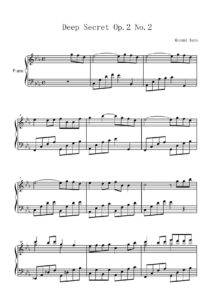
Mayumi Kato "Deep Secret" Op.2 No.2 - Paul Barton, FEURICH 218 piano
Mayumi Kato: The Poet of the Contemporary Piano
Mayumi Kato is a Japanese composer who has quietly but decisively carved out a singular space in the landscape of contemporary classical piano music. Born in 1990, she has distinguished herself through a distinctive and innovative style that prioritises melodic expressiveness, atmospheric evocation, and a deeply personal synthesis of Eastern and Western musical sensibilities. Although her name may not yet command the same widespread recognition as some of her contemporaries in the concert hall, her work has found a devoted international audience through the advocacy of the British pianist Paul Barton, whose recordings and YouTube performances have brought her music to millions of listeners. This article explores Kato’s biography, her musical language, her most significant compositions, her work in film, her collaborations and awards, and the influences that shape her evolving legacy.
Biography and Background
Mayumi Kato was born in Japan and currently lives in Nagoya, a major modern city and shipping port situated roughly in the middle of the island of Japan on the Pacific coast. Her connection to the city is not merely geographical; it is ancestral. In a personal note shared with Paul Barton, she revealed that her ancestors were samurai at Nagoya Castle. This heritage became the explicit subject of one of her compositions, “Samurai Father,” which she dedicated to Barton and which, in her own words, “tells the story about my background”. This intertwining of personal history with compositional output is characteristic of Kato’s approach: her music is rarely abstract for its own sake but often carries a narrative or emotional subtext rooted in memory, nature, or imagination.
Her academic background is in piano studies, which served as the foundation from which she embarked on her journey of composition. Rather than pursuing a conventional path through formal composition conservatoires, Kato developed her craft from the keyboard outwards, a trajectory that helps explain the idiomatic pianism of her writing and its deep understanding of the instrument’s expressive possibilities. She has consistently demonstrated a remarkable capacity for crafting evocative melodies that embody her unique artistic identity, and her compositions draw inspiration from the natural world, intricately interwoven with human emotions and the ethereal essence of dreams.
Musical Style and Aesthetic
Kato’s music is often described as occupying the borderlands between contemporary classical, new age, and neo-romantic piano traditions. Her oeuvre is notably informed by the rich traditions of Romanticism and Impressionism, manifested through a harmonious and melodious expression. Listeners will detect echoes of Chopin’s lyricism, Debussy’s harmonic colour, and Satie’s economy of means, yet these influences are filtered through a sensibility that is unmistakably personal and often inflected with an “oriental flavour,” as Barton has described it—a quality that emerges not through quotation of folk melodies but through scale choices, modal ambiguity, and a certain spaciousness of phrasing.
One of the most striking features of Kato’s style is its apparent simplicity. A close observer of her scores has noted that she “even does not indicate dynamics,” leaving that aspect to the performer and creating a kind of indeterminate music in which the interpreter becomes a co-creator of the emotional shape. This is not simplicity born of naivety but of confidence and economy: she knows exactly what she is doing, and with a certain economy of resources she achieves music that is highly evocative and stylistically varied. The result is a body of work that is accessible to intermediate pianists yet capable of sustaining sophisticated interpretive decisions, which partly explains its popularity on platforms such as MyMusicSheet, where her scores are widely downloaded and studied.
Harmony and Technique
Kato’s harmonic language is a crucial component of her expressive identity. She frequently works with modal scales, particularly the Dorian and Aeolian modes, and her music thrives on the subtle friction between them. A detailed analysis of her piece “Orange Moon” reveals how she moves between F Dorian and F Aeolian, exploiting the difference of a single note—the natural D versus the flat D—to create shifting shades of light and darkness within the same tonal centre. This technique of modal mixture is not deployed as a theoretical exercise but as a means of emotional nuance: the Dorian sixth lends a bittersweet openness, while the Aeolian sixth darkens the mood without abandoning the tonal centre.
Her harmonic progressions often avoid conventional functional cadences in favour of colouristic motion. In “Orange Moon,” a C major chord at the end of the A section acts as a “premonitory” gesture, preparing a sudden modulation to A Dorian/Aeolian in the B section. The return to F minor is accomplished abruptly from a D major chord, and the coda reintroduces a Picardy-third-like F major, insisting on the natural A for two bars to make clear that it is no error but a deliberate brightening of the mode. This kind of harmonic playfulness—where a single chromatic alteration reconfigures the emotional temperature of an entire passage—is a hallmark of her compositional technique.
Texturally, Kato favours a transparent, often two- or three-voice fabric. She alternates between melodic, cantabile phrases and chordal, homophonic passages, creating a sense of dialogue between horizontal line and vertical sonority. Her piano writing is deeply pianistic, lying well under the hands, and she frequently exploits the instrument’s upper register for bell-like effects and its lower register for grounding pedal points. The influence of Impressionist piano writing is evident in her use of parallel chords, extended tertian sonorities, and a fluid approach to dissonance treatment, but she rarely indulges in the dense textures of Ravel or the harmonic complexity of late Scriabin. Instead, she cultivates a lean, aerated sound world in which every note carries weight.
Best Songs and Compositions
Kato’s catalogue is extensive, with over ninety pieces recorded by Paul Barton for his YouTube playlist alone, and many more available as sheet music. Her output is anchored by the tetralogy of albums entitled “Mayumi Kato Piano Works,” which showcases her exceptional musical talent across four volumes. The first two volumes were released on CD in June 2016, the third in December 2017, and the fourth, “Secret Garden,” arrived on streaming platforms in January 2024.
Among her most celebrated pieces is “Oriental Wind,” the work that first brought her to Paul Barton’s attention. Barton recalls searching YouTube for oriental piano music in the early days of the platform and being captivated from the very first bars of “Oriental Wind”; he immediately wanted to play it, and this encounter initiated a twelve-year collaboration and friendship. The piece exemplifies her ability to evoke a sense of place and atmosphere through modal melody and delicate accompanimental figuration.
“The Bamboo Princess” is another signature work, released as a single featuring Paul Barton and drawn from the third volume of her Piano Works. Its title suggests a narrative or fairy-tale dimension, and the music reflects Kato’s fascination with Japanese folklore and natural imagery. “Language of Flowers” exists in versions for piano solo and for violin and piano, the latter performed by Lidia Baich and Paul Barton, and it demonstrates her gift for lyrical, long-breathed melody that can be shared between instruments. The duo version has become a favourite among her followers and is available as a play-along for violinists.
Other notable compositions include “Silver Moon,” which also serves as the title of her score for the 2020 feature film; “Samurai Father,” the personal tribute to her ancestral heritage; “KOTO for OLYA,” a miniature inspired by the sound of the traditional Japanese koto and recommended by Barton as an ideal entry point into her musical world; and “Khwan,” a piece written for Barton’s daughter Emilie, described as being “about a mother’s love”. Her catalogue also includes sets such as “10 Short Pieces for a Fast World,” the “Romance” series (Nos. 1–3), “Three Etudes,” “Little Princess Op. 4,” “Op. 1 – Kite in the Wind,” and evocative titles such as “Ukiyo-e,” “Liar,” “Alone in Running Waters,” “Guilty,” “Forbidden Fruit,” “Snow Land,” “Moonlit Bamboo Grove,” “Entering Arashiyama,” and “Velvet Rose Waltz” . The breadth of titles reflects her literary and visual imagination, as well as her engagement with Japanese cultural motifs alongside more universal emotional themes.
Music for Films
Mayumi Kato’s work as a film composer represents a significant and still-unfolding dimension of her career. Her first feature-film score was for “Silver Moon” (2020), directed by Joao Castelo. The film went on to win first place at the Slovenian International Film Festival in 2020, bringing Kato’s music to a broader cinematic audience. The title piece, “Silver Moon,” is a piano miniature that captures the nocturnal, reflective mood suggested by its name, and it has since become one of her most streamed compositions.
Her most award-laden film project to date is “In Your Blood: Hoki Naiden,” a fantasy feature directed by Julien Uzan, released in 2025. The film’s synopsis follows Takahiro Ashiya, a young man gifted with a strong sixth sense and psychic powers, who is compelled by his mother’s dying wish to recite a spell from an ancient book, the Hoki Naiden, thereby awakening his dormant abilities. Kato’s score for this film has been honoured with an extraordinary run of first-place awards: Best Soundtrack at the World Film Festival in Cannes (July 2024), Best Film Score at the 2024 Las Vegas International Film & Screenwriting Festival, Best Original Score at the 2024 New York City International Reel Film Festival, and Best Original Score at the 2025 Touchstone Independent Film Festival. These accolades confirm that her melodic and atmospheric gifts translate powerfully to the moving image, where her sensitivity to mood and her ability to sustain tension through harmonic colour are invaluable.
Collaborations
Kato’s most important and enduring collaboration is with the British pianist Paul Barton, who has been the primary interpreter and champion of her piano music for over a decade. Their partnership began around 2012 when Barton, then living in Thailand, discovered “Oriental Wind” on YouTube and messaged Kato directly. At the time, Kato did not even have music notation software; she worked from handwritten scores. But she was determined to have Barton play her music, so she downloaded notation software and taught herself to use it from scratch, eventually sending him a PDF of “Oriental Wind” and launching a collaboration that has since produced over ninety recorded pieces. Barton has described the experience of receiving a new score from Kato—an email from “mayu❤️” with a PDF attachment—as a highlight of his musical life. Their work together has resulted in the four “Mayumi Kato Piano Works” albums, numerous YouTube videos, and a friendship that transcends the usual composer-performer relationship.
Beyond Barton, Kato has collaborated with the violinist Utako Miyahara on the single “Beautiful Asia,” a trio version of which also features Barton, released in February 2024. The violinist Lidia Baich has performed “Language of Flowers” with Barton, and other instrumentalists have taken up her duo and trio arrangements. Kato has also written works for specific performers and occasions, such as “Khwan” for Barton’s daughter, demonstrating a personal, almost artisanal approach to collaboration in which pieces are tailored to the people who will bring them to life.
Awards and Recognition
In addition to her film-score awards, Kato’s music has received recognition through its inclusion in the repertoires of accomplished pianists and its widespread dissemination via streaming platforms and sheet-music services. The four-volume “Mayumi Kato Piano Works” project is itself a significant achievement, representing a sustained effort to document and share her compositional output with a global audience. While she may not have sought the traditional prizes of the classical music world, the enthusiastic response of performers, listeners, and film-festival juries attests to the impact of her work. Her presence on platforms such as Spotify, Apple Music, Amazon, and Deezer, as well as on MyMusicSheet, has made her music accessible to a generation of pianists who might never encounter it through conventional concert programming.
Influences and Legacy
Kato’s musical influences are rooted in the Romantic and Impressionist traditions, but she wears them lightly. The lyrical impulse of Romantic piano music—its song-like melodies, its emotional directness—is tempered by an Impressionist sensitivity to harmonic colour and atmosphere. At the same time, her Japanese heritage informs her modal language, her episodic structures, and her frequent evocation of nature and folklore. The result is a style that is neither derivative nor self-consciously “fusion”; it is simply her own.
Her legacy is already taking shape in several ways. First, she has built a substantial body of piano music that is playable by a wide range of performers, from intermediate students to seasoned professionals, and that rewards repeated listening and study. Second, her collaboration with Paul Barton has demonstrated the power of digital platforms to create alternative pathways for contemporary composers, bypassing traditional gatekeepers and reaching audiences directly. Third, her film work has shown that her musical language can function dramatically as well as lyrically, opening possibilities for further cinematic projects. Finally, her willingness to share her scores—often freely or at modest cost—has created a community of pianists who engage with her music as interpreters and advocates.
Mayumi Kato
Kato’s scores are available through MyMusicSheet and mymusic5, where her catalogue numbers well over one hundred items, including solo piano works, duos, trios, and pedagogical pieces. She maintains a presence on social media, including Facebook and Instagram, where she engages directly with listeners and performers. Her music has been described as “new age” in some retail classifications, but this label understates its grounding in classical technique and its compositional ambition. She is a member of the generation of composers whose careers have been shaped by the internet, and her story illustrates how talent, determination, and a willingness to learn new tools—such as notation software, acquired specifically to share her work—can overcome the barriers of geography and institutional access.
In sum, Mayumi Kato is a composer of quiet originality and growing significance. Her music, at once simple and sophisticated, intimate and cinematic, has found its way into the hands and hearts of pianists around the world. As her film scores garner international awards and her piano works continue to be recorded and performed, her legacy as a distinctive voice in contemporary classical music seems assured.
Browse in the Sheet Music Library:
Or browse in the categories menus & download the Library Catalog PDF: