Scores for all instruments: 16,000+ (active and growing), over 236,000 pages.
All genres and levels: Jazz & Blues, Rock & Pop, Classical & Contemporary, Film & Musicals;
books & biographies; methods, études, play-along tracks (MP3) for Jazz & Rock.
Access & benefits: US$15.99 one-time payment, valid for lifetime, full Library access.
Table of Contents
The best sheet music download from our Library.

Please, subscribe to our Sheet Music Library.
Michel Legrand: "What Are You Doing the Rest of Your Life?" (The Happy Ending film)
Flagey Studio 4 Concert Hall, Brussels.
Search your favorite sheet music in the Sheet Music Library Catalog
Michel Legrand: The Composer Who Made the Whole World Sing
Few musicians in the history of the twentieth century have straddled the worlds of jazz, classical music, popular song and cinema with such effortless grace as Michel Legrand.
Search your favorite sheet music in the Sheet Music Library Catalog
A three-time Academy Award winner, a five-time Grammy winner, and a composer of more than 250 film and television scores, Michel Legrand was that rare artist whose music was both sophisticated and immediately accessible, both intellectually rigorous and emotionally direct. He was, as the British Film Institute observed in its obituary, a man who “could craft a standard”—not just one, but a clutch of songs that would outlast their creator just as surely as they have outlasted the memory of the films for which they were written. From “I Will Wait for You” to “The Windmills of Your Mind,” from the sun-drenched melancholy of Summer of ’42 to the intricate jazz tapestries of Legrand Jazz, his music has become part of the collective cultural memory of the modern world.
The best sheet music download from our Library.
Early Life and Musical Formation
Michel Legrand was born on February 24, 1932, in Bécon-les-Bruyères, a suburb of Paris, into a family steeped in musical tradition. His father, Raymond Legrand, was a French composer and actor, and his mother, Marcelle der Mikaelian, was descended from the Armenian bourgeoisie. His sister, Christiane Legrand, would go on to become a celebrated singer, most notably with the vocal group Les Double Six. This environment of professional musicianship provided young Michel with an extraordinary foundation. From 1942 to 1949, he studied piano at the Paris Conservatoire, where his teachers included Nadia Boulanger and Henri Challan, among other renowned musicians. He received numerous awards for his skills in composition and piano and mastered a dozen other instruments.
The Conservatoire years were formative not only for his technique but for his artistic sensibility. Legrand would later say of Boulanger: “I hated her sometimes because she was so demanding, but she was extraordinary. She made me”. He studied conducting with her and harmony with Henri Challan, graduating as a first-prize winner in composition. The rigorous training he received—counterpoint, harmony, orchestration, the art of development—would underpin everything he did for the rest of his career. As one French radio analysis observed, his ability to turn his hand authentically to a wide range of musical styles grew from “a phenomenal and hard-earned musicianship”.
Yet the decisive moment in Legrand’s artistic development came not in the hallowed halls of the Conservatoire but in a concert hall in Paris in 1947. At the age of sixteen, he attended a Dizzy Gillespie concert that, in his own words, was “un électrochoc, un séisme, une césure”—an electric shock, an earthquake, a rupture. The revelation of modern jazz would upend his convictions and, more profoundly, his very identity as a musician. “Bebop,” he analysed, “is another voice, another air, an alternative to the teaching of the Conservatoire. Bach, Mozart or Ravel were my mother tongue; jazz was my first living language”. This existential question—symphonist or bopper?—would haunt and inspire him for the rest of his life. As he put it: “Why choose? Was there another way to combine, to amalgamate all these cultures? This existential question, which I asked myself from the age of sixteen, underpinned my life as a composer”.



The Rise to Stardom: From I Love Paris to Legrand Jazz
Legrand’s first professional steps were as an orchestrator and pianist for major French singers. He began working as a pianist for figures such as Edith Piaf and Yves Montand, and in 1954 he became the bandleader and conductor for Maurice Chevalier, travelling with him to New York. That same year, he recorded the album I Love Paris, a set of jazz standards that became an overnight sensation, selling over eight million copies. This was followed by such albums as Holiday in Rome (1955) and Michel Legrand Plays Cole Porter (1957), establishing him as a popular bandleader and arranger.
But it was the 1958 album Legrand Jazz that cemented his reputation among jazz musicians and aficionados. Recorded in New York, the album featured an extraordinary all-star lineup: Miles Davis, John Coltrane, Bill Evans, Ben Webster, Art Farmer, Hank Jones, and others. Legrand arranged jazz standards by Duke Ellington, Thelonious Monk, and others for these giants, demonstrating an arranger’s ear and a composer’s imagination that transcended the conventional boundaries of the genre. For many jazz fans, this album remains a landmark—a Frenchman’s love letter to American music, executed with both reverence and audacity.
The 1950s also saw Legrand writing and conducting ballets for Roland Petit, and beginning his career in film music. His first important collaborations were with some of the masters of French cinema, notably Marcel Carné. But it was his association with the young filmmakers of the French New Wave that would define his early cinematic identity.
The French New Wave and the Demy Partnership
The late 1950s and 1960s found Legrand at the centre of the French New Wave, scoring seven films for Jean-Luc Godard, six for Agnès Varda, and ten for Jacques Demy. He appeared and performed in Varda’s Cléo de 5 à 7 (1962), and his scores for Godard’s Une femme est une femme (1961) and Vivre sa vie (1962) brought a new sophistication to the emerging cinematic movement. But it was his collaboration with Jacques Demy that produced his most enduring and revolutionary work.
Les Parapluies de Cherbourg (1964) was a musical unlike anything that had come before. The director’s vision was to make a musical film in a completely different vein from the Hollywood tradition—a “mixture of poetry, color, and music”. The film was entirely sung, in free verse, with lyrics written by Demy. The direction was regulated by the music, and all aspects of the production were subordinate to the musical rhythm. Legrand’s score contained a wide range of styles, from haunting ballads such as “I Will Wait for You” to more playful numbers, all woven together with a thematic unity that was both rigorous and emotionally resonant.
The film won the Palme d’Or at the 1964 Cannes Film Festival and brought worldwide recognition to both Demy and Legrand. It earned five Oscar nominations, three of them for the score. “I Will Wait for You” became the biggest song hit to emerge from the film and quickly became a standard, recorded by artists as diverse as Louis Armstrong and Connie Francis. The critic Neil Brand noted that Legrand’s songs “would do justice to any Tin Pan Alley songsmith,” and that they “will outlast their creator just as surely as many of them have outlasted the memory of the films for which they were written”.
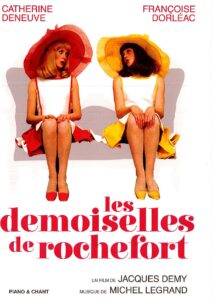
Legrand and Demy reunited for Les Demoiselles de Rochefort (1967), a splashy, colourful musical that added Americans Gene Kelly and George Chakiris to the usual French cast. The tuneful score continued their exploration of the musical form, blending French chanson, American jazz, and classical orchestration into something entirely new. Their partnership would continue through Peau d’âne (1970) and other projects, creating what Demy called “le cinéma enchanté”—a cinema of enchantment where music was not merely accompaniment but the very substance of the film.
Hollywood and International Success
In 1966, Legrand decided to take his chances in Hollywood, moving to Los Angeles with his wife and three children. His friendships with Quincy Jones and Henry Mancini helped him greatly, especially in meeting the lyricists Alan and Marilyn Bergman, with whom he would form one of the most productive songwriting partnerships of his career. In 1968, he had his biggest American success with the score for Norman Jewison’s The Thomas Crown Affair, which included the hit song “The Windmills of Your Mind”.
“The Windmills of Your Mind” won Legrand his first Academy Award for Best Original Song in 1969. The song, with its swirling, circular melody and its lyrics by Alan and Marilyn Bergman about the relentless turning of the mind, became an instant standard, recorded by Noel Harrison for the film and subsequently by Dusty Springfield, Sting, and countless others. Its harmonic structure is a marvel of Legrand’s art: the song works its way through all seven root notes tonally within a prevailing minor tonality, creating a sense of inevitable motion that mirrors the song’s lyrical imagery.
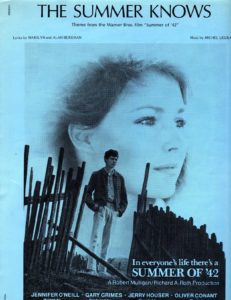
Legrand’s Hollywood career continued to flourish. He received twelve nominations for Academy Awards in total, winning two more Oscars: for the score of Summer of ’42 (1971) and for Yentl (1983). Summer of ’42, directed by Robert Mulligan, tells the story of a teenage boy’s infatuation with a young war widow. Legrand composed the score in an astonishingly short time—he was called by Warner Bros. on a Friday to attend a screening and had to compose the music by the following Wednesday. “A priori, it was mission impossible,” he recalled. “Yet nothing was simpler: I went back to my hotel room and started writing. The images, the photogénie of Jennifer O’Neill, transmitted a formidable emotion to me that I immediately set down on my staves”. The resulting theme, built from two four-note phrases (mi, la, si, sol; mi, la, si, do), is a masterclass in motivic development—the constant modification of the final interval, the change of direction, the transposition and modulation of the motif, all underpinned by a descending bass line that inspires increasingly rich chords. As the analysis notes, “Michel Legrand shows that he has done his classes and mastered the art of development, that he has retained the lessons of Haydn and Beethoven”.
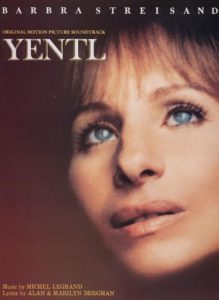
Yentl, starring and directed by Barbra Streisand, was a musical adaptation of Isaac Bashevis Singer’s story about a young Jewish woman who disguises herself as a man to pursue religious studies. Legrand’s score, with lyrics by Alan and Marilyn Bergman, won him his third Oscar—the film’s only nomination. Songs such as “Papa, Can You Hear Me?” and “The Way He Makes Me Feel” demonstrated his ability to write music of great emotional depth and dramatic power, tailored to Streisand’s extraordinary vocal range and interpretive gifts.
Musical Style and Technique
Michel Legrand’s musical style was a unique synthesis of the classical training he received at the Paris Conservatoire and the jazz idiom he fell in love with as a teenager. He described his approach as an amalgamation of cultures, a refusal to choose between the symphonic and the bopper. This synthesis is evident in every aspect of his music: in his melodies, which combine the long-breathed lyricism of French classical music with the syncopated freedom of jazz; in his harmonies, which move with a chromatic sophistication that owes as much to Ravel and Debussy as to Bill Evans and Gil Evans; and in his orchestrations, which deploy the resources of the symphony orchestra with the flexibility and spontaneity of a jazz big band.
Legrand’s melodic gift was perhaps his most immediately recognisable quality. He had what the BFI called “an innate ability to turn a tune into an earworm on first listen”. His melodies often have a yearning, wistful quality—a sense of longing that is never quite resolved. This is particularly evident in his ballads, such as “I Will Wait for You,” “What Are You Doing the Rest of Your Life?,” and “The Summer Knows.” These songs are characterised by long, arching phrases that seem to suspend time, supported by harmonies that shift and colour the melodic line in ways that are both surprising and inevitable.
His harmonic language is one of the most distinctive features of his music. A study of his compositional techniques for film songs identified several recurring elements: the intense use of harmonic sequences that form the basis for the melody of an entire song; the dominance of minor keys; the use of foreign notes (notes outside the prevailing key); strong chromatic movements; and diminished chords. These elements combine to create what the study calls a “romantic element” in his music—a quality of heightened emotion that is both sophisticated and accessible. In Les Parapluies de Cherbourg, key harmonic progressions such as ii-V-I and I-vi-ii-V, along with chromaticism and modal interchange, contribute to the score’s unique sound.
Legrand’s technique of thematic development was central to his art. He often built entire scores from small motivic cells, developing them through transposition, inversion, rhythmic variation, and harmonic transformation. In Summer of ’42, for example, the entire score is built from a four-note motif that is subjected to constant modification—the last interval is changed, the direction is altered, the motif is transposed and modulated. This technique, which he learned from his classical training, allowed him to create scores of great structural integrity while maintaining the melodic immediacy that his popular songs required. He also made use of polyphonic development, the principle of a core motif and its unfolding, and, for the recreation of baroque music, various intonational formulas such as the exclamatio figure.
Another characteristic feature of Legrand’s style was his use of jazz harmony within a popular song context. He was deeply influenced by the vocal harmonies of jazz groups such as the Four Freshmen and, in France, Les Double Six, with which his sister Christiane sang. He was also sensitive to soul, funk, Brazilian bossa nova, and even a certain psychedelic strangeness—all influences that can be found in his international popular music. Unlike many of his contemporaries, however, he never abandoned his classical technique. As the French radio analysis noted, he found rock ‘n’ roll’s binary rhythm, simple cadences, and summary harmonies “risible, even grotesque,” and in 1956 he orchestrated parodies of the style such as “Rock’n’Roll Mops” by Henri Salvador and Boris Vian.
The Art of the Film Score
Legrand composed more than 220 film and television scores over his career, and his work in cinema is arguably his most enduring legacy. His approach to film scoring was distinctive in several ways. First, he often worked closely with directors from the earliest stages of production, sometimes even before shooting began, allowing the music to shape the film’s rhythm and structure. In Les Parapluies de Cherbourg, the entire film was conceived as a musical, with the direction regulated by the music and all aspects of production subordinate to the musical rhythm. This was a radical departure from the Hollywood practice of adding music in post-production.
Second, Legrand’s scores often contained a central popular theme that would become the film’s musical signature, while the rest of the score developed that theme in ways that were dramatically and psychologically complex. As the Grove Music entry notes, “he often emphasised thematic unity, although many scores are overshadowed by a central popular theme”. This approach allowed him to satisfy both the commercial demands of the film industry and his own artistic ambitions.
Third, Legrand was remarkably versatile in his use of styles. His scores alternated between contemporary subjects and period pieces, and he used many different musical idioms—jazz, classical, French chanson, rock, bossa nova—depending on the needs of the film. His score for Lady Sings the Blues (1972), the biographical film of Billie Holiday, was a jazz score of great sensitivity and authenticity. His work on Joseph Losey’s The Go-Between (1971) used a four-note motif that “sounds like a menace, an unsettling strangeness of redundancy, of rhythmic variations in an aristocratic house to which a young boy of modest condition…”. The score won the Palme d’Or at Cannes for Losey, and Legrand made four films with the director.
Some of Legrand’s most memorable film music moments include the haunting “I Will Wait for You” from The Umbrellas of Cherbourg; the swirling, obsessive “The Windmills of Your Mind” from The Thomas Crown Affair; the nostalgic, sun-drenched theme from Summer of ’42; the melancholy “Brian’s Song” from the 1971 television film of the same name; and the deeply emotional songs from Yentl, including “Papa, Can You Hear Me?” and “The Way He Makes Me Feel”. In 2018, still active in his late eighties, Legrand composed the score for Orson Welles’s posthumously released film The Other Side of the Wind—a fitting final testament to a career that had begun with the French New Wave and would end with one of its most legendary figures.
Collaborations: Jazz, Pop, and Classical
One of the most remarkable aspects of Legrand’s career was the sheer breadth of his collaborations. He worked with jazz giants, pop stars, classical musicians, and filmmakers across multiple generations and continents. Among the jazz artists he collaborated with were Miles Davis, John Coltrane, Bill Evans, Stan Getz, Sarah Vaughan, Toots Thielemans, Stéphane Grappelli, Ray Brown, Shelly Manne, Chucho Valdés, and Arturo Sandoval. His 1958 album Legrand Jazz brought together Miles Davis, John Coltrane, Bill Evans, and Ben Webster, among others, in a meeting of minds that remains one of the great cross-cultural jazz recordings.
In the world of popular music, Legrand collaborated with Barbra Streisand, Ray Charles, Diana Ross, Björk, Kiri Te Kanawa, and Natalie Dessay, among many others. His partnership with the lyricists Alan and Marilyn Bergman produced a string of modern standards, including “The Windmills of Your Mind,” “What Are You Doing the Rest of Your Life?,” “The Summer Knows,” and the songs from Yentl. He also worked with French singers such as Edith Piaf, Yves Montand, and Maurice Chevalier early in his career.
In the realm of film, Legrand’s collaborators included directors as diverse as Jean-Luc Godard, Agnès Varda, Jacques Demy, Norman Jewison, Robert Mulligan, Joseph Losey, and Orson Welles. His ability to adapt to the stylistic demands of each director—Godard’s improvisatory spontaneity, Demy’s lyrical romanticism, Losey’s psychological complexity—is a testament to both his musical range and his collaborative generosity.
Awards and Recognition
Michel Legrand received an extraordinary array of awards and honours throughout his career. He won three Academy Awards: Best Original Song for “The Windmills of Your Mind” (1969), Best Original Dramatic Score for Summer of ’42 (1972), and Best Original Song Score for Yentl (1984). He was nominated for thirteen Oscars in total and for twenty-seven Grammys, winning five, including Best Instrumental Composition, Best Arrangement, and Best Jazz Performance by a Big Band. He also won a BAFTA, a Golden Globe, and received two Emmy nominations. In 1990, he was inducted into the Songwriters Hall of Fame.
Influences and Legacy
Michel Legrand’s influences were as diverse as his output. He was formed by the classical tradition of Bach, Mozart, Ravel, and Debussy, which he called his “mother tongue,” and by jazz, which he called his “first living language”. He was inspired by the big band arrangements of Duke Ellington and Count Basie, the bebop innovations of Dizzy Gillespie and Charlie Parker, and the harmonic sophistication of Bill Evans and Gil Evans. He was also influenced by French chanson, the vocal harmonies of groups like the Four Freshmen, and the bossa nova of Antônio Carlos Jobim.
Legrand’s own influence on subsequent generations of musicians is difficult to overstate. His music has become a staple of the jazz repertoire, recorded by artists as diverse as Bill Evans (whose version of “Je vivrai sans toi” / “I Will Say Goodbye” Legrand himself admired greatly) and Stan Getz. His songs have been interpreted by pop, jazz, and classical singers around the world. His film scores have inspired countless composers working in cinema today. As the jazz journalist Ian Shaw wrote, Legrand’s “unique ear for a memorable tune and his towering skills as a jazz pianist and composer… became a tribute to his everlasting impact on 20th century music—unforgettable melodies imprinted on the history of jazz, song, and film music”.
Beyond his musical achievements, Legrand’s legacy is one of artistic courage—the courage to refuse the false choice between classical and jazz, between high art and popular entertainment, between French and American musical traditions. He showed that a composer could be both rigorous and accessible, both sophisticated and heartfelt, both a master craftsman and a popular entertainer. In an era of increasing musical specialisation, he remained a generalist in the best sense of the word—a musician who could move freely between worlds because he had mastered them all.
Additional Information and Personal Life
Legrand was married three times and had several children. In 1958, while playing at the Moscow Festival of Students and Youth, he met his future wife, a young French model with whom he would have three children. He later married again, and his family life was complicated by the demands of his international career, which required him to divide his time between France and the United States for much of his life.
Legrand was known for his prodigious work ethic and his ability to compose under pressure. The story of Summer of ’42—composing the score in five days—is one of many examples of his ability to produce extraordinary work under tight deadlines. He attributed this ability to the discipline instilled in him by Nadia Boulanger: “She also transmitted to me a luminous, obvious idea: the more a creator is subject to constraints, the more free he is. Finally, it was from Nadia that I learned the importance of adrenaline”. He also said that after leaving the Conservatoire, he continued to live daily with the five years he had spent with Boulanger, learning fundamental notions starting with extreme rigour and discipline.
In his later years, Legrand continued to give live concerts with his own jazz trio and led his big band on international tours, accompanying such stars as Ray Charles, Diana Ross, Björk, and Stéphane Grappelli. He remained active as a composer until his death, demonstrating a creative vitality that belied his age. Michel Legrand died on January 26, 2019, in Paris, at the age of 86. His passing prompted an outpouring of tributes from around the world, from fellow musicians, filmmakers, and fans who had been touched by his music.
Michel Legrand: The Music That Keeps Playing
Michel Legrand was one of the great musical polymaths of the twentieth century. He was a jazz pianist of formidable technique, a classical composer of impeccable training, a songwriter of extraordinary melodic gift, and a film composer of profound dramatic instinct. His music transcended the boundaries that usually separate these disciplines, creating a body of work that is as unified as it is diverse. The French radio tribute captured this quality well: his work “was a challenge to the spirit of classification and of system”.
His songs have become part of the standard repertoire, sung by generations of artists in dozens of languages. His film scores have enhanced some of the most beloved movies of the past sixty years. His jazz arrangements and compositions have enriched the language of jazz itself. And his example—of a musician who refused to choose between the concert hall and the jazz club, between the cinema and the songbook, between France and America—remains an inspiration to anyone who believes that music is, at its best, a universal language.
As he himself might have said, the music keeps playing. The windmills of his mind continue to turn, and the melodies he created continue to enchant, to move, and to endure. In a career that spanned more than half a century and produced more than 250 film scores and over 100 albums of jazz, popular, and classical music, Michel Legrand left behind a legacy that is as rich as it is enduring. He was, in every sense, a musician for the world.
Search your favorite sheet music in the Sheet Music Library Catalog
Michel Legrand Discography
Main article on Wikipedia: Michel Legrand discography
This is a list of albums by Michel Legrand.
Selected discography
Albums
- 1954 I Love Paris
- 1955 Holiday in Rome
- 1956 Castles in Spain
- 1957 Bonjour Paris
- 1957 C'est magnifique
- 1958 Legrand in Rio
- 1958 The Columbia Album of Cole Porter
- 1959 Paris Jazz Piano
- 1959 The New I Love Paris
- 1959 Legrand Jazz
- 1960 Legrand Piano
- 1962 Strings On Fire (Philips Records)
- 1963 Michel Legrand Big Band Plays Richard Rodgers (Philips Records)
- 1964 Archi-Cordes
- 1964 Plays for Dancers (US release of Archi-Cordes)
- 1967 Violent Violins (UK release of Archi-Cordes)
- 1967 Cinema Legrand (MGM Records)
- 1968 At Shelly's Manne-Hole
- 1968 Si C'est Ça La Musique À Papa
- 1968 Je M'appelle Barbra (Columbia)
- 1974 Twenty Songs of the Century
- 1980 Atlantic City
- 1983 After the Rain
- 1993 Michel Plays Legrand
- 1995 Michel Legrand Big Band
- 2002 Michel Legrand by Michel Legrand
- 2013 Entre elle et lui (with Natalie Dessay)
With Miles Davis, Bill Evans, Paul Chambers, John Coltrane
With Stan Getz
- Communications '72 (Verve, 1972)
With Lena Horne
- Lena & Michel (RCA, 1975)
With Bud Shank
- Windmills of Your Mind (World Pacific, 1969)
With Sarah Vaughan
With Frankie Laine
- Foreign Affair (Philips -Europe / Columbia -US, 1958)
- Reunion in Rhythm (Columbia, 1959)
With Melissa Errico
- Legrand Affair, (Ghostlight Records, 2019)
With Stephane Grapelli
- legrand grappeli, (Verve Records, 1992)
Filmography
- Lovers Net (Les amants du Tage) (1954)
- Continente perduto (orchestrated) (1955)
- Charmants garçons (1958)
- Le Triporteur (1958)
- L'Amérique insolite (1958)
- L'Americain se détend (1958)
- Terrain vague (co-composer) (1960)
- A Woman Is a Woman (Une femme est une femme) (1960)
- The French Game (Le cœur battant) (1960)
- Les Portes claquent (1960)
- Lola (1961)
- Cléo from 5 to 7 (Cléo de 5 à 7) (1961)
- The Seven Deadly Sins (Les Sept péchés capitaux) (co-composer) (1961)
- The Winner (Un cœur gros comme ça) (1961)
- Retour a New York (1962)
- Comme un poisson dans l'eau (1962)
- Eva (1962)
- Une grosse tete (1962)
- My Life to Live (Vivre sa Vie: Film en Douze Tableaux) (1962)
- Bay of Angels (La baie des anges) (1962)
- L'Amerique lunaire (1962)
- Histoire d'un petit garcon devenu grand (1962)
- Le Joli Mai (1962)
- Illuminations (1963)
- Le grand escroc (1963)
- L'Empire de la nuit (1963)
- Love Is a Ball (1963)
- The Umbrellas of Cherbourg (Les Parapluies de Cherbourg) (1964)
- A Ravishing Idiot (Une ravissante idiote) (1964)
- Band of Outsiders (Bande à part) (1964)
- Fascinante amazonie (1964)
- Les amoureux du France (1964)
- La Douceur du village (1964)
- A Matter of Resistance (La vie de château) (1965)
- Quand passent les faisans (1965)
- Tender Scoundrel [fr] (Tendre voyou) (1965)
- Monnaie de singe (1965)
- Who Are You, Polly Maggoo? (Qui êtes-vous, Polly Maggoo?) (1966)
- The Plastic Dome of Norma Jean (1966)
- L'an 2000 (1966)
- Gold and Lead (L'or et le plomb) (1966)
- The Young Girls of Rochefort (Les Demoiselles de Rochefort) (1967)
- A Matter of Innocence (also known as Pretty Polly) (1967)
- L'homme à la Buick (1967)
- How to Save a Marriage and Ruin Your Life (1967)
- Sweet November (1968)
- The Thomas Crown Affair (1968)
- Play Dirty (1968)
- The Appointment (rejected) (1968)
- Ice Station Zebra (1968)
- Michel's Mixed Up Musical Bird (1968)
- The Swimming Pool (La Piscine) (1968)
- Castle Keep (1969)
- The Happy Ending (1969)
- The Picasso Summer (1969)
- Pieces of Dreams (1969)
- The Magic Garden of Stanley Sweetheart (1970)
- Wuthering Heights (1970)
- Donkey Skin (Peau d'Âne) (1970)
- The Lady in the Car with Glasses and a Gun (La Dame dans l'auto avec des lunettes et un fusil) (1970)
- The Go-Between (1971)
- The Married Couple of the Year Two (Les mariés de l'an II) (1971)
- Summer of '42 (1971)
- Le Mans (1971)
- Touch and Go [fr] (La Poudre d'escampette) (1971)
- A Few Hours of Sunlight (Un peu de soleil dans l'eau froide) (1971)
- A Time for Loving (Also: Paris Was Made for Lovers) (1972)
- La vieille Fille (The Old Maid) (1972)
- Lady Sings the Blues (1972)
- Not Dumb, The Bird (1972)
- Portnoy's Complaint (1972)
- Hearth Fires (Les feux de la Chandeleur) (1972)
- One Is a Lonely Number (1972)
- The Outside Man (Un homme est mort) (1972)
- A Doll's House (1973)
- The Nelson Affair (Also: Bequest to the Nation) (1973)
- Story of a Love Story (1973)
- The Hostages (Le gang des otages) (1973)
- 40 Carats (1973)
- Cops and Robbers (1973)
- Breezy (1973)
- The Man Who Loved Cat Dancing (rejected) (1973)
- The Three Musketeers (1973)
- A Slightly Pregnant Man (L'Evenement le plus important depuis que l'homme marche sur la lune) (1973)
- Our Time (1974)
- F for Fake (1974)
- Section spéciale (Special Section) (1975)
- The Savage (Le Sauvage) (1975)
- Sheila Levine Is Dead and Living in New York (1975)
- Gable and Lombard (1976)
- Ode to Billy Joe (1976)
- Le voyage de noces (1976)
- The Smurfs and the Magic Flute (La flute à six schtroumpfs) (1976)
- Gulliver's Travels (1977)
- The Other Side of Midnight (1977)
- Routes to the South (Les routes du sud) (1978)
- Mon premier amour (1978)
- The Phoenix (1978)
- Lady Oscar (1979)
- Je Vous Ferai Aimer La Vie (1979)
- The Fabulous Adventures of The Legendare Baron Munchhausen (Les fabuleuses aventures du légendaire Baron de Munchausen) (1979)
- Atlantic City (1980)
- The Hunter (1980)
- The Mountain Men (1980)
- Les Uns et les Autres (also known as Bolero) (1980)
- Hinotori (co-composer) (1980)
- Falling in Love Again (1980)
- What Makes David Run? (Qu'est-ce qui fait courir David?) (1981)
- Le Cadeau (1981)
- Chu Chu and the Philly Flash (1981)
- Your Ticket Is No Longer Valid (1982)
- Slapstick of Another Kind (1982) (1982 cut)
- La revanche des humanoides (1982)
- Best Friends (1982)
- The Gift (1982)
- Yentl (1983)
- Never Say Never Again (1983)
- A Love in Germany (Un amour en Allemagne) (1983)
- Secret Places (1984)
- Love Songs (Paroles et musique) (1984)
- Palace (1985)
- Partir, revenir (1985)
- Operation Double Cross (1985)
- Parking (1985)
- Crossings (1986)
- Sins (1986)
- Casanova (1987)
- Social Club (Club de rencontres) (1987)
- Spirale (1987)
- Switching Channels (1988)
- Three Seats for the 26th (Trois places pour le 26) (1988)
- Five Days in June (Cinq jours en juin) (1989)
- Flight from Paradise (Fuga dal Paradiso) (1990)
- Dingo with Miles Davis (1991)
- Gaspard et Robinson (1991)
- The Burning Shore (1991)
- The Pickle (1993)
- Ready to Wear (Prêt-à-Porter) (1994)
- Angels in the Outfield (1994)
- Les Misérables (1995)
- Les Enfants de Lumière (1995)
- Aaron's Magic Village (1997)
- Madeline (1998)
- Doggy Bag (1999)
- Season's Beatings (La Bûche) (1999)
- The Blue Bicycle (La Bicyclette Bleue) (2000)
- And Now... Ladies and Gentlemen (2002)
- Cavalcade (2005)
- Disco (2008)
- Oscar and the Lady In Pink (Oscar Et Le Dame En Rose) (2009)
- La rançon de la gloire (2014)
- The Guardians (2017)
- The Other Side of the Wind (2018)
- J'ai perdu Albert (2018)
- May December (2023) (posthumous, reorchestrated by Marcelo Zarvos)
Computer games
- Torin's Passage (1994)
Browse in the Sheet Music Library:
Or browse in the categories menus & download the Library Catalog PDF: