
Scores for all instruments: 16,000+ (active and growing), over 236,000 pages.
All genres and levels: Jazz & Blues, Rock & Pop, Classical & Contemporary, Film & Musicals;
books & biographies; methods, études, play-along tracks (MP3) for Jazz & Rock.
Access & benefits: US$15.99 one-time payment, valid for lifetime, full Library access.
Table of Contents
The best sheet music download from our Library.
Please, subscribe to our Sheet Music Library. Sheet music should be accessible and affordable for all musicians, from professionals to absolute beginners.
Frederic Mompou: The Poet of the Intimate and the Silent
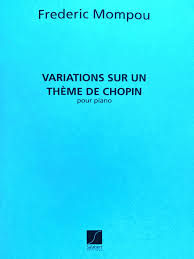
Mompou - Variations on a Theme by Chopin (X Évocation) Partition, partitura, sheet music, Noten
In the landscape of twentieth-century music, Frederic Mompou occupies a singular and quietly profound place. A Catalan composer and pianist of immense sensitivity, he chose not the path of the large-scale symphonic statement but that of the miniature—the fleeting, the intimate, and the essential. His music, which he himself termed música callada (silent music), is a world of whispered melodies, bell-like resonances, and a rarefied atmosphere that seems to exist just beyond the edge of sound. Often described as the successor to Debussy and a kindred spirit to Satie, Mompou forged a deeply personal language from a synthesis of French Impressionism, Catalan folk memory, and a profound mystical spirituality.

Biography: A Life in the Shadow of the Greats
Frederic Mompou Dencausse was born in Barcelona on April 16, 1893, into a cultured family of lawyer-landowners. His mother, Josefina Dencausse, was of French origin, and her family owned a bell foundry—a detail that would prove profoundly influential on his musical imagination. His brother, Josep Mompou, became a noted painter, and a sketch of a simple farmhouse by Josep would adorn the covers of all of Frederic's published music. Mompou displayed an innate musical talent early on, studying piano at the Conservatori Superior de Música del Liceu in Barcelona and giving his first public recital at the age of fifteen.

Search your favorite sheet music in the Sheet Music Library Catalog
A pivotal moment occurred when he was just nine years old: he heard Gabriel Fauré perform in Barcelona, and the experience left an indelible mark on him. In 1911, he traveled to Paris to study, armed with a letter of introduction to Fauré from Enrique Granados—a letter that, characteristically, never reached its intended recipient. He nonetheless entered the Paris Conservatoire, studying piano with Isidor Philipp and taking private lessons in harmony and composition with Marcel Samuel-Rousseau. His extreme shyness and introspection made a solo career impossible; he retreated from the stage to devote himself entirely to composition.
Mompou's life was one of quiet peregrination between Barcelona and Paris, driven by the cataclysms of the century. He returned to Barcelona in 1917 to flee the First World War, and then went back to Paris in 1921, where his music began to attract attention. In 1921, a performance of his Scènes d'enfants by his former teacher Ferdinand Motte-Lacroix inspired the critic Émile Vuillermoz to proclaim him "the only disciple and successor" to Claude Debussy. Despite this acclaim, the 1930s were a difficult period. He published no music between 1931 and 1941, a silence caused by personal tragedy—the death of his father and his brother's serious illness—and the turmoil of the Spanish Civil War. His financial situation became so dire that he was forced to consider business ventures, including an attempt to revive the family bell foundry.

In 1941, he fled the German occupation of Paris and returned permanently to Catalonia. His later life was characterized by a quiet stability. In 1957, at the age of 64, he married the pianist Carmen Bravo, a woman thirty years his junior. It was the first marriage for both of them. He lived quietly in Barcelona, a member of the Royal Academy of San Jorge, until his death from respiratory failure on June 30, 1987, at the age of 94. After the death of his widow in 2007, some eighty unpublished works were discovered in his home, a final, posthumous gift of silent music to the world.
Musical Style and Technique: The Art of the Miniature
Mompou is universally recognized as a miniaturist. His entire aesthetic is built upon the concentration of expression into the smallest possible form. His pieces are typically short, often lasting only a few minutes, and possess an improvisatory, almost fragmentary quality. He minimized traditional musical development in favor of a static, meditative intensity where a single chord, a melodic turn, or a subtle shift in harmony becomes the entire event of the piece. This approach places him closer to the world of the Symbolist poets or the painter Joan Miró—a fellow Barcelona native born the same year—than to the architects of Austro-German musical logic.
His technique is one of apparent simplicity masking immense sophistication. Melodies are often childlike, even naive, but are tinged with a profound melancholy and nostalgia. He was fond of ostinato figures that create a hypnotic, incantatory pulse, and his music is saturated with bell imitations—a direct inheritance from his family's foundry. Mompou frequently dispensed with bar lines and key signatures, allowing the music to float free from the constraints of regular meter and fixed tonality. The performer is granted a remarkable degree of freedom; Mompou believed the interpreter should feel unconstrained by excessive notation, even leaving the use of the sustaining pedal to the pianist's discretion to allow for the full resonance of the notes to bloom.
Harmony: The "Barri de Platja" Chord and the World of Resonance
At the heart of Mompou's harmonic language lies a deeply personal and instantly recognizable sound-world. His music is neither conventionally consonant nor aggressively dissonant; it occupies a liminal space of "blurred pedals" and rare modes, where the overtones themselves become a fundamental part of the musical material. This creates a sensual and spiritual atmosphere, a hallmark of his style.
The most famous element of his harmonic vocabulary is a specific chord he called the Barri de platja (Beach Quarter). This chord—consisting of the notes G♭, C, E♭, A♭, and D—was described by Mompou as "truly my chord". It is a complex, resonant sonority built from two tritones separated by a whole step, creating an ambiguity that is both static and shimmering. Crucially, Mompou did not use this chord functionally; it does not lead anywhere in a traditional harmonic sense. It is chosen for its pure acoustic beauty, its ability to evoke a specific atmosphere, and its power to conjure the bells and the sea of his childhood Barcelona. This use of harmony as color and atmosphere rather than as a vehicle for progression is the essence of his Impressionist inheritance, but his systematization of it into a personal, almost talismanic chord is entirely his own.
The Best Compositions: A Treasury of Miniatures
Mompou's output is modest in quantity but remarkably consistent in quality. His most celebrated works are almost all for solo piano, though his songs are also a vital part of his legacy.
For Piano Solo:
- Cançons i danses (Songs and Dances, 1921–1979): This is the central pillar of his piano output, a collection of fifteen pieces composed over nearly sixty years. Each piece pairs a lyrical, often folk-inspired "song" with a rhythmic "dance," creating a perfect microcosm of his art. They are among his best-known works, celebrated for their instantly memorable material and wide range of moods.
- Música callada (Silent Music, 1959–1967): Considered by many to be his masterpiece, this vast cycle of twenty-eight aphoristic pieces is the ultimate expression of his aesthetic. Inspired by the mystical poetry of Saint John of the Cross, it is music of extreme concision, asceticism, and meditative depth. Each piece is a haiku-like distillation of thought, a "music of the almost-nothing" that represents a career-long search for essential expression.
- Scènes d'enfants (Scenes of Children, 1915–1918): These evocative miniatures capture the innocent and imaginative world of childhood and were the works that first earned him the title of Debussy's successor.
- Cants màgics (Magic Songs, 1920): His first published work, these pieces established his mature style, characterized by incantatory melodies and bell-like resonances.
- Variations on a Theme of Chopin (1938–1957): A set of variations based on Chopin's Prelude No. 7 in A major, demonstrating his deep affinity with the Romantic piano tradition, filtered through his own unique harmonic lens.
- Paisajes (Landscapes, 1942–1960): A suite of evocative pieces, including the famous "La fuente y la campana" (The Fountain and the Bell), which paints vivid sonic pictures of the Catalan landscape.
For Voice and Piano:
- Combat del somni (Dream Battle, 1942–1951): A song cycle that is one of his most ambitious and significant vocal works.
- Damunt de tu només les flors: One of his most famous creations, this beautiful song was premiered by the legendary soprano Victoria de los Angeles in 1944 and remains a favorite in the recital repertoire.
- Cinq mélodies sur des textes de Paul Valéry (1973): Often cited as his greatest vocal work, this sombre and profound cycle showcases his mastery of French prosody and his deep connection to Symbolist poetry.
Other Notable Works:
- Suite Compostelana for Guitar (1962): Composed for the legendary guitarist Andrés Segovia, this suite is a staple of the guitar repertoire and demonstrates Mompou's ability to transfer his intimate style to another instrument.
- Los Improperios (1964): A choral work for chorus and orchestra, written in memory of his friend Francis Poulenc, revealing a rarer, more public and dramatic side of his creativity.
Mompou in Film: A Cinematic Afterlife
Although Mompou did not write original scores for films, his existing music has been used to powerful effect by several visionary directors, granting his work a significant cinematic afterlife.
The most famous example is Carlos Saura's 1976 masterpiece, Cría cuervos. The film's haunting main theme is Mompou's Cançó i dansa No. 6, and its use of his delicate, melancholy music became a defining element of the movie, introducing many cinephiles to his name for the first time. More recently, the Spanish director Víctor Erice used the first piece from Música callada, "Angélico," as a central element in his film La Morte Rouge (2006), a work that is itself a meditation on memory and cinema. His music has also appeared in the soundtrack of Star Trek: Nemesis (2002) and the documentary Drowned Out (2012), a testament to the universal and atmospheric quality of his sound. In 2023, a documentary titled Ressonància (d'una música callada) was released, offering a sensory immersion into Mompou's musical universe.
Collaborations, Awards, and Influences
Mompou was a solitary artist, but he maintained a small, significant circle of collaborators and admirers. He collaborated with the composer Xavier Montsalvatge on the ballet Don Perlimpin (1956), based on a play by Federico García Lorca, with Mompou contributing most of the music and Montsalvatge assisting with orchestration. His songs were championed by the great soprano Victoria de los Angeles, who premiered several of his works, and he accompanied her on the piano for recordings. He also wrote his Suite Compostelana for Andrés Segovia and dedicated the final book of Música callada to the pianist Alicia de Larrocha. His inner circle included the philosopher Vladimir Jankélévitch, who wrote insightfully about his music, and he was friends with the Brazilian composer Heitor Villa-Lobos.
His contributions were recognized with numerous honors. He was made a Chevalier des Arts et Lettres by the French government and received Spain's Premio Nacional de Música. In 1979, he was awarded an honorary doctorate by the Universitat de Barcelona, and in 1980 he received the Medalla d'Or de la Generalitat de Catalunya.
Mompou's principal influences were French Impressionism (Debussy, Ravel), the quiet radicalism of Erik Satie, and the melodic purity of Gabriel Fauré. Yet he synthesized these influences into something entirely his own. He was also deeply inspired by Catalan folk music, the sounds of the Barcelona maritime quarter, and the mystical poetry of Saint John of the Cross. His music represents a unique branch of twentieth-century modernism—one that rejected overt complexity in favor of introspection, subtlety, and spiritual depth.
Legacy: The Enduring Power of "Silent Music"
Frederic Mompou's legacy is that of a quiet revolutionary. In an age of musical manifestos and grand statements, he offered a counter-narrative of silence, intimacy, and contemplation. His influence is not to be found in a "school" of composers who imitated his style, but rather in the enduring relevance of his aesthetic. His music anticipated elements of Minimalism in its use of repetition and static harmony, and its meditative quality resonates deeply with contemporary audiences seeking refuge from an increasingly noisy world.
The founding of the Fundació Frederic Mompou in 2006, dedicated to preserving his home, his manuscripts, and his legacy, ensures that his music continues to be studied and performed. The annual Memorial Mompou-Bravo and the Concurs de Joves Compositors - Premi Internacional Frederic Mompou actively promote his spirit among new generations. Contemporary pianists of the highest caliber, from Stephen Hough and Arcadi Volodos to Jordi Masó (who has recorded his complete piano works for Naxos), have championed his music, and projects like Avant-guarding Mompou have commissioned new works that dialogue with his Cançons i danses, proving his ongoing vitality.
Ultimately, Mompou's legacy is his music itself—a body of work that, in its refusal to shout, continues to speak with a unique and penetrating eloquence. He was a composer of few notes but profound meaning, a musician who understood that the most resonant sound is often the one that is almost, but not quite, silent. His "silent music" remains a timeless invitation to listen more closely, to the world and to ourselves.