Scores for all instruments: 16,000+ (active and growing), over 236,000 pages.
All genres and levels: Jazz & Blues, Rock & Pop, Classical & Contemporary, Film & Musicals;
books & biographies; methods, études, play-along tracks (MP3) for Jazz & Rock.
Access & benefits: US$15.99 one-time payment, valid for lifetime, full Library access.
Table of Contents
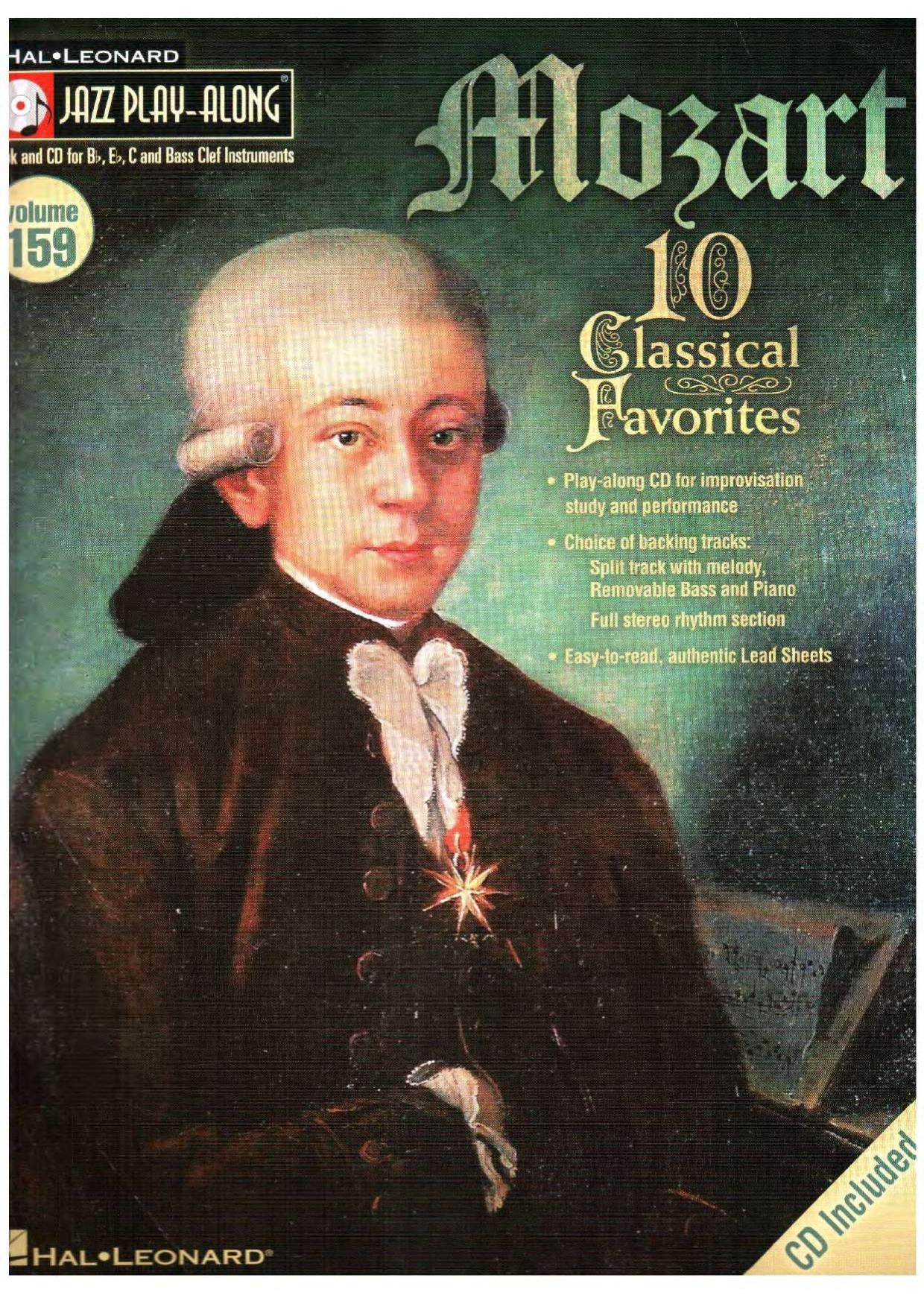
The Best of Mozart
1. Eine Kleine Nachtmusik, K. 525: I. Allegro (00:00) - Budapest Scoring Symphonic Orchestra 2. Eine Kleine Nachtmusik, K. 525: II. Romanze - Andante (07:45) - Budapest Scoring Symphonic Orchestra 3. Eine Kleine Nachtmusik, K. 525: III. Menuetto - Allegretto (12:50) - Budapest Scoring Symphonic Orchestra 4. Eine Kleine Nachtmusik, K. 525: IV. Rondo - Allegro (14:50) - Budapest Scoring Symphonic Orchestra 5. Symphony No 35 in D major, K. 385 (Haffner Symphony): I. Allegro con spirito (20:08) - Budapest Scoring Symphonic Orchestra 6. Symphony No 35 in D major, K. 385 (Haffner Symphony): IV. Presto (25:54) - Budapest Scoring Symphonic Orchestra 7. Symphony No 40 in G minor, KV. 550: I. Molto Allegro (29:53) - Budapest Scoring Symphonic Orchestra 8. The Magic Flute: Overture (37:29) - Budapest Scoring Symphonic Orchestra 9. The Marriage of Figaro: Overture (44:41) - Budapest Scoring Symphonic Orchestra
10. String Quartet No. 23 in F major, K. 590: I. Allegro moderato (49:12) - Accord quartet 11. String Quartet No. 23 in F major, K. 590: IV. Allegro (58:13) - Accord quartet 12. String Quartet No. 20 in D major, K. 499: II. Menuetto and Trio. Allegretto (1:03:17) - Accord quartet 13. Violin Sonata No. 26 in B-flat major, K. 378: III. Rondo. Allegro (1:06:38) - Accord quartet 14. Piano Concerto No. 21 in C major, K. 467: II. Andante (1:10:46) - Csabay Domonkos 15. Piano Concerto No. 23 in A major, K. 488: I. Allegro (1:16:25) - Csabay Domonkos 16. Piano Sonata No. 11 in A major, K. 331: III. Alla Turca (1:27:15) - Csabay Domonkos 17. Clarinet Concerto in A major, K. 622: II. Adagio (1:29:35) - Budapest Scoring Symphonic Orchestra 18. Violin Concerto No. 3 in G major, K. 216: I. Allegro (1:36:36) - Budapest Scoring Symphonic Orchestra 19. Flute Concerto No. 2 in D major, K. 314: II. Adagio non troppo (1:46:08) - Budapest Scoring Symphonic Orchestra 20. Horn Concerto No. 3 in E-flat major, K. 447: II. Romance. Larghetto (1:51:36) - Budapest Scoring Symphonic Orchestra
The best sheet music download from our Library.
Please, subscribe to our Sheet Music Library. Sheet music should be accessible and affordable for all musicians, from professionals to absolute beginners.
Wolfgang Amadeus Mozart: The Architect of Classical Music
Wolfgang Amadeus Mozart stands as one of the most extraordinary and influential figures in the history of Western music. In a career that spanned barely three decades, he composed more than 600 works, encompassing nearly every musical genre of his time—symphonies, concertos, chamber music, piano sonatas, and operas—and left an indelible mark on the trajectory of classical music. His music is celebrated for its melodic beauty, structural perfection, emotional depth, and dramatic vitality, qualities that continue to captivate audiences more than two centuries after his death.



Biography: From Prodigy to Freelance Genius
Wolfgang Amadeus Mozart was born on January 27, 1756, in Salzburg, then the capital of the sovereign Archbishopric of Salzburg within the Holy Roman Empire. He was the seventh and last child of Leopold Mozart, a deputy Kapellmeister and experienced violin teacher, and Anna Maria Pertl. Of the couple's seven children, only Wolfgang and his elder sister, Maria Anna—affectionately known as "Nannerl"—survived infancy. Baptized Joannes Chrysostomus Wolfgangus Theophilus Mozart, he generally called himself "Wolfgang Amadè Mozart" as an adult, though the Latinized "Amadeus" became the form by which posterity would know him.
Mozart's prodigious talent manifested at an astonishingly early age. According to his sister's recollections, the three-year-old Wolfgang would spend hours at the keyboard, "picking out thirds" and delighting in the sounds he produced. By the age of four, he was learning short keyboard pieces, which he could play "faultlessly and with the greatest delicacy," and by five, he was already composing small pieces that his father transcribed. Leopold, recognizing the extraordinary gift before him, largely abandoned his own compositional ambitions to devote himself to his son's education and career.
From 1762 onward, Leopold took his two children on a series of ambitious European tours, exhibiting them as child prodigies before the royal courts of Munich, Vienna, Prague, Paris, London, and The Hague. These journeys were formative for the young Mozart. In London, he met Johann Christian Bach, the youngest son of Johann Sebastian Bach, whose elegant, galant style made a deep impression on him. A subsequent journey to Italy (1769–1771) proved equally pivotal. In Bologna, he was accepted as a member of the prestigious Accademia Filarmonica, and in Rome, he famously transcribed Gregorio Allegri's Miserere from memory after a single hearing in the Sistine Chapel—a feat that demonstrated not only his phenomenal ear but also his fearless audacity.
In 1773, at the age of seventeen, Mozart accepted a post as a court musician in Salzburg under the newly appointed Prince-Archbishop Hieronymus Colloredo. During these years, he composed prolifically across many genres, producing symphonies, sonatas, string quartets, serenades, and occasional operas. Between April and December 1775, he developed a particular enthusiasm for the violin concerto, producing a series of five—the only ones he ever wrote—the last three of which remain staples of the repertoire. His Piano Concerto No. 9 in E-flat major, K. 271, composed in early 1777, is widely considered a breakthrough work, revealing a new depth of dramatic and structural sophistication.
Despite these artistic successes, Mozart grew increasingly restless in Salzburg. His salary was modest, and opportunities for opera—his true passion—were rare. In 1777, he resigned his position and embarked on a job-hunting tour that took him to Mannheim, where he encountered the finest orchestra in Europe, and to Paris, where he experienced both professional frustration and profound personal tragedy: his mother fell ill and died in June 1778. He eventually returned to Salzburg in 1779, taking up a new post as court organist and concertmaster, but his discontent persisted.
The turning point came in 1781. While in Vienna with Archbishop Colloredo, Mozart was treated as a mere servant and forbidden from performing before the Emperor. The ensuing quarrel culminated in his dismissal—literally, according to legend, "with a kick in the ass" administered by the archbishop's steward. This insult liberated Mozart to pursue a freelance career in Vienna, a bold and unprecedented step for a composer of his time.
The early Vienna years were auspicious. Mozart established himself as the finest keyboard player in the city, famously engaging in a piano competition with Muzio Clementi before Emperor Joseph II in December 1781. His opera Die Entführung aus dem Serail ("The Abduction from the Seraglio"), premiered in July 1782, achieved a huge success and cemented his reputation as a composer. That same year, against his father's wishes, he married Constanze Weber; the couple had six children, only two of whom survived infancy.
During 1782–1783, Mozart became closely acquainted with the music of Johann Sebastian Bach and George Frideric Handel through the influence of Baron Gottfried van Swieten, who owned many manuscripts of the Baroque masters. His study of these works had a powerful and lasting impact on his own musical language, evident in the fugal passages of Die Zauberflöte and the finale of his Symphony No. 41. The mid-1780s saw an extraordinary outpouring of creativity: the six string quartets dedicated to Joseph Haydn (1782–1785), the Piano Concertos Nos. 14–25, the operas Le nozze di Figaro (1786) and Don Giovanni (1787), and numerous other masterpieces.
Yet financial security remained elusive. Despite his fame, Mozart's income fluctuated wildly, and periods of prosperity alternated with penury. In 1791, his final year, he composed The Magic Flute, La clemenza di Tito, the Clarinet Concerto, and the Requiem, which remained unfinished at his death. He fell ill in the autumn of 1791 and died on December 5, at the age of thirty-five. The circumstances of his death—long the subject of myth and speculation—were most likely commonplace, and he was buried in a "common grave" (a non-aristocratic grave, not a pauper's grave) at St. Marx Cemetery outside Vienna.
Musical Style, Harmony, and Technique
Mozart's musical style is the quintessence of the Classical era, yet it transcends any simple categorization. His music is characterized by a seemingly effortless melodic grace, a "singing" quality that makes his lines feel inevitable, and a structural clarity that masks enormous sophistication beneath the surface. He was a master of the "galant" style—the light, elegant, and homophonic idiom favored by his contemporaries—but he consistently enriched it with learned counterpoint, chromatic harmony, and dramatic intensity, creating a style that was both accessible and profoundly complex.
Harmony
Mozart's harmonic language, while rooted in the diatonic tonality of the Classical period, is marked by a subtle and adventurous chromaticism that pointed toward the harmonic developments of the nineteenth century. He frequently employed secondary dominants—chords that tonicize a key other than the home key—to expand harmonic space and create a sense of forward momentum. A characteristic progression, for example, moves from the tonic to the dominant of the dominant before arriving at the dominant itself, a technique that adds color and tension to even the simplest cadences. His use of chromatic passing tones and neighbor notes gives his melodies a gliding, expressive quality, a "hovering" around the principal chords that is both sensuous and structurally purposeful.
The String Quartet in C major, K. 465, known as the "Dissonance" Quartet, is perhaps the most famous example of Mozart's harmonic daring. Its slow introduction presents a sequence of harmonies that defy the conventional expectations of the day, creating a haze of tonal ambiguity before resolving into the clear light of the Allegro. This passage reveals a composer willing to push the boundaries of tonal harmony in the service of expressive depth, foreshadowing the chromatic explorations of Beethoven and the Romantics.
Counterpoint and Technique
Mozart was one of the greatest contrapuntists in the history of Western music, though his approach to counterpoint was distinctive. Unlike Bach, whose music is often built from interwoven contrapuntal lines, Mozart's music often seems to pass through counterpoint, using it as a textural and dramatic resource rather than a structural foundation. He first encountered the full power of Baroque counterpoint through his study of Bach and Handel in the early 1780s, and thereafter he integrated fugal techniques into his own idiom with increasing confidence.
His String Quartet in G major, K. 387 (1782), was the first of the "Haydn" quartets and the first work in which he fused fugal procedures with sonata and rondo forms. The finale is a sonata-fugue hybrid, combining the developmental logic of sonata form with the imitative texture of a fugue, creating a movement of both intellectual rigor and theatrical tension. This "hybrid" approach—binding the galant style to the strict style—became a hallmark of his mature chamber music and orchestral writing. The finale of the "Jupiter" Symphony is a towering example of his contrapuntal mastery, weaving five independent melodic subjects into a single, culminating fugal texture.
Mozart's technical command extended to every genre he touched. In his piano concertos, he revolutionized the relationship between soloist and orchestra, treating the orchestra not as a mere accompaniment but as a dramatic partner in a constantly evolving dialogue. His orchestration is celebrated for its color and balance, and he had a particular affinity for the wind instruments, writing unforgettable parts for the clarinet, basset horn, oboe, and flute. His collaboration with the clarinetist Anton Stadler led to the Clarinet Concerto and the Clarinet Quintet, works that exploit the instrument's warmth and agility to sublime effect.
The Best Compositions: A Treasury of Masterpieces
See also: List of compositions by Wolfgang Amadeus Mozart, List of operas by Wolfgang Amadeus Mozart, and Mozart's compositional method
Mozart's catalogue, conventionally indexed by the Köchel number (K.), is a treasure trove of works that have become cornerstones of the concert repertoire. Any selection of his "best" compositions must necessarily be partial, but certain works stand out as definitive expressions of his genius.
Operas
Mozart's mature operas are widely regarded as the pinnacle of the form. Le nozze di Figaro (1786), Don Giovanni (1787), and Così fan tutte (1790) — the three collaborations with librettist Lorenzo Da Ponte — are recognized for their wit, psychological insight, and musical beauty. The Marriage of Figaro, with its intricate plotting and profound understanding of human character, is often cited as the perfect opera. Don Giovanni, a "dramma giocoso" that blends comedy and tragedy, is a work of dark, mythic power, while Così fan tutte is a bittersweet meditation on love and fidelity. The Magic Flute (1791), a singspiel with spoken dialogue, is a sublime allegory of Enlightenment ideals, combining Masonic symbolism, fairy-tale enchantment, and some of Mozart's most sublime music, including the Queen of the Night's famously demanding aria.
Symphonies
Mozart officially composed forty-one symphonies. The Symphony No. 40 in G minor, K. 550, with its opening theme of restless, chromatic anxiety, is one of the most instantly recognizable works in all classical music. The Symphony No. 41 in C major, K. 551, nicknamed the "Jupiter," is a monumental work whose finale is a magnificent display of contrapuntal ingenuity, combining multiple themes in a triumphant fugal peroration. The Symphony No. 25 in G minor, K. 183, composed when Mozart was seventeen, is a Sturm und Drang masterpiece of passionate intensity.
Concertos
Mozart's piano concertos are among his greatest achievements, revealing both his orchestral skill and his sense of drama. The Piano Concerto No. 21 in C major, K. 467, is celebrated for its joyous first movement and its almost preternaturally serene slow movement, which gained fame through its use in the film Elvira Madigan. The Clarinet Concerto in A major, K. 622, written for Anton Stadler, is a work of autumnal beauty and profound serenity, one of the last major works Mozart completed. The Violin Concerto No. 5 in A major, K. 219, and the Concerto for Flute and Harp in C major, K. 299, are also perennial favorites.
Chamber and Piano Music
The Serenade No. 13 in G major, K. 525, known as Eine kleine Nachtmusik ("A Little Night Music"), is perhaps the most universally beloved piece of chamber music ever written. The Gran Partita, Serenade No. 10 for eight wind instruments, is a magnificent, symphonic fifty-minute work considered one of Mozart's masterworks. The "Dissonance" Quartet and the other "Haydn" quartets are pillars of the string quartet repertoire. For solo piano, the Piano Sonata No. 11 in A major, K. 331, with its famous "Turkish March" finale, and the Fantasia in D minor, K. 397, are among his most popular works.
Sacred Music
Mozart's sacred output is dominated by the Requiem in D minor, K. 626, a work of peerless beauty, power, and pathos. Left unfinished at his death, it was completed by his student Franz Xaver Süssmayr. The "Lacrimosa," of which Mozart wrote only the first eight bars, is one of the most poignant movements in all sacred music. The Solemn Vespers, K. 339, composed in 1780, is another ravishing choral work, moving from exuberant psalm settings to a serene and tranquil Laudate Dominum before a bold final Magnificat.
Mozart's Music in Films
Mozart's music has enjoyed a rich and varied afterlife on the silver screen, its emotional directness and dramatic power making it ideally suited to cinematic storytelling. The most famous example is Miloš Forman's Amadeus (1984), which brought Mozart's music to a vast new audience. The soundtrack, recorded by the Academy of St Martin in the Fields under Sir Neville Marriner, features a generous selection of Mozart's works, from the opening of Symphony No. 25 to excerpts from The Magic Flute and the Requiem. The film's dramatization of Mozart's life, though heavily fictionalized, cemented his popular image as a giggling, irreverent genius.
Beyond Amadeus, Mozart's music has punctuated some of the most memorable moments in cinema. The letter duet "Sull'aria" from The Marriage of Figaro provides the transcendent climax of The Shawshank Redemption (1994), where Andy Dufresne plays it over the prison loudspeakers, momentarily liberating his fellow inmates through the power of music. The overture to Figaro has appeared in The King's Speech (2010), Willy Wonka & the Chocolate Factory (1971), Zombieland (2009), and Trading Places (1983). The slow movement of Piano Concerto No. 21 became so associated with the 1967 film Elvira Madigan that the work is often referred to by that name. The "Lacrymosa" from the Requiem has underscored the dark comedy of The Big Lebowski (1998). Cherubino's aria "Voi che sapete" from Figaro features in Pride and Prejudice (1995) and Wonder Woman 1984 (2020). More recently, Bill and Ted Face the Music (2020) imagined a musical duel between Mozart and Jimi Hendrix, built around Piano Sonata No. 16. The Queen of the Night's aria from The Magic Flute has become a cultural shorthand for virtuosic, otherworldly power, appearing everywhere from Gossip Girl to Amazon Alexa advertisements.
Collaborations with Other Musicians
Mozart's career was shaped by a network of fruitful and sometimes complicated collaborations. His most significant professional partnership was with the clarinetist Anton Stadler, a friend and fellow Freemason. Stadler was the preeminent wind player in Vienna in the 1780s, and Mozart wrote some of his most sublime music for him, including the Clarinet Concerto, the Clarinet Quintet, and the Gran Partita. Stadler also invented the basset clarinet, an instrument with an extended lower range, for which Mozart specifically conceived the Clarinet Concerto.
Mozart's relationship with Joseph Haydn was one of mutual respect and influence. The two composers met in Vienna in the early 1780s and became friends. Mozart dedicated his six "Haydn" String Quartets (1782–1785) to the older master, a gesture of profound admiration. Haydn, in turn, recognized Mozart's genius, famously telling Leopold Mozart that his son was "the greatest composer known to me in person or by name". The influence flowed in both directions: Mozart learned from Haydn's structural innovations, while Haydn was inspired by Mozart's melodic invention and harmonic boldness.
Mozart also collaborated, in a looser sense, with the Jacquin family. He was close friends with Gottfried von Jacquin, an amateur composer and singer, and likely helped him with several compositions or composed works jointly with him, including the notturni K. 346 and K. 436–439. Gottfried's sister, Franziska, was a keyboard student of Mozart's, and he wrote the "Kegelstatt" Trio, K. 498, and the Piano Duet Sonata, K. 521, for her. In his final days, Mozart's student Franz Xaver Süssmayr worked closely with him on the Requiem, and after Mozart's death, Süssmayr completed the work, ensuring its survival in the form we know today. Mozart also engaged in a famous keyboard competition with Muzio Clementi before Emperor Joseph II in 1781, a contest that pitted two of the greatest pianists of the age against each other.
Awards and Honors
In Mozart's time, formal awards in the modern sense did not exist. Recognition came through patronage, commissions, and honors bestowed by nobility and institutions. Mozart's most notable honor was being made a Knight of the Golden Spur by Pope Clement XIV in 1770, at the age of fourteen, following his extraordinary feats in Italy. That same year, he was elected a member of the prestigious Accademia Filarmonica in Bologna after passing a rigorous examination. These honors recognized his prodigious talent and opened doors to elite musical circles across Europe. In the centuries since his death, Mozart has been the recipient of countless posthumous tributes, monuments, and commemorations, including the monument in Vienna's Central Cemetery, where a section is dedicated to the city's great musicians.
Influences and Legacy
Mozart's influences were as varied as his talents. His earliest and most profound influence was Johann Christian Bach, whom he met in London as a child. J.C. Bach's elegant, singing melodies and galant style left an indelible mark on Mozart's own musical language. Later, his study of Johann Sebastian Bach and George Frideric Handel in the early 1780s transformed his understanding of counterpoint and fugue, adding a new intellectual depth to his music. He also learned from Joseph Haydn, with whom he shared a mutually enriching friendship, and from the composers of the Mannheim school, whose orchestral innovations he absorbed during his visits to Mannheim.
Mozart's own influence on subsequent music has been incalculable. Ludwig van Beethoven, whose early career was shaped by Mozart's example, wrote much of his early music "in Mozart's shadow". Beethoven's teacher, Haydn, famously assured him that he would "receive the spirit of Mozart from the hands of Haydn". In the nineteenth century, Franz Liszt considered Mozart "the greatest of all masters," and Frédéric Chopin and Felix Mendelssohn drew inspiration from his piano music and chamber works. In the twentieth century, Richard Strauss reflected Mozart's classical ideals of beauty and structural balance in works such as the Capriccio Sextet, and the neoclassical movement found in Mozart a model of clarity and proportion.
More than two centuries after his death, Mozart's music remains central to the Western concert repertoire. His operas are continually performed, his symphonies and concertos are staples of every orchestra, and his chamber music is cherished by amateurs and professionals alike. As Haydn wrote, "Posterity will not see such a talent again in 100 years". That prophecy has proven, if anything, an understatement. Mozart's music has become a universal language, speaking across centuries and cultures with a directness and beauty that remain unsurpassed.
Mozart: Myths, Personality, and the Köchel Catalogue
The myths surrounding Mozart are almost as famous as his music. The most persistent is the legend that he was poisoned by Antonio Salieri, a rival composer. This story, dramatized in Pushkin's play and later in the film Amadeus, has no basis in historical evidence. The two composers were, in fact, on friendly terms, and Salieri was one of the many musicians who attended the premiere of The Magic Flute and later praised Mozart's genius. The cause of Mozart's death remains uncertain, with theories ranging from rheumatic fever and streptococcal infection to trichinosis and kidney failure. He was buried in a common grave, as was customary for middle-class Viennese citizens of the time, though the exact location of his remains is unknown.
Mozart's personality, as revealed in his surviving letters, was complex and contradictory. He could be irreverent, scatological, and playful, yet also deeply serious, spiritual, and compassionate. He was a devoted Freemason, and Masonic symbolism permeates The Magic Flute and other works. He loved dancing, billiards, and social gatherings, and despite his financial worries, he lived a life filled with friends, music, and intellectual curiosity.
Finally, no account of Mozart would be complete without mentioning the Köchel catalogue (K. or KV), the chronological inventory of his works compiled by Ludwig von Köchel in 1862. This indispensable scholarly tool has allowed performers and listeners to navigate the vast expanse of Mozart's output, from the charming early pieces of a six-year-old to the sublime final works of a mature master.
In sum, Wolfgang Amadeus Mozart was not merely a composer of exceptional talent; he was a transformative figure in the history of music. His ability to unite the elegant and the learned, the popular and the profound, the comic and the tragic, created a body of work that continues to define what classical music can be. His life was brief, but his legacy is eternal.