
Scores for all instruments: 16,000+ (active and growing), over 236,000 pages.
All genres and levels: Jazz & Blues, Rock & Pop, Classical & Contemporary, Film & Musicals;
books & biographies; methods, études, play-along tracks (MP3) for Jazz & Rock.
Access & benefits: US$15.99 one-time payment, valid for lifetime, full Library access.
Table of Contents
Muse - Resistance

The best sheet music download from our Library.

Please, subscribe to our Sheet Music Library. Sheet music should be accessible and affordable for all musicians, from professionals to absolute beginners.
Muse are among the most ambitious and theatrical rock bands to emerge from the British alternative scene, a trio whose fusion of progressive rock, classical music, electronica, and science-fiction spectacle has made them one of the defining stadium acts of the twenty-first century. Formed in the coastal town of Teignmouth, Devon, in 1994, the band—Matt Bellamy (lead vocals, guitar, keyboards), Chris Wolstenholme (bass guitar, backing vocals), and Dominic Howard (drums)—has spent three decades constructing an ever-expanding sonic universe, one marked by operatic falsetto, apocalyptic themes, and a relentless drive toward the colossal.
Search your favorite sheet music in the Sheet Music Library Catalog


Biography: From Teignmouth to the World Stage
Muse: Rock’s Last Great Maximalists
The members of Muse first crossed paths as schoolboys at Teignmouth Community College in the early 1990s. Matt Bellamy, already a strikingly gifted guitarist and pianist, successfully auditioned for drummer Dominic Howard's band, Carnage Mayhem, quickly becoming its singer and songwriter. The pair then recruited Chris Wolstenholme—at the time the drummer for a band called Fixed Penalty—to take up the bass, a decision that completed the lineup that has remained unchanged ever since. After cycling through names including Gothic Plague and Rocket Baby Dolls, the band adopted the name Muse in 1994 following a local Battle of the Bands victory in which they smashed their equipment on stage in a gesture of defiant protest. Bellamy later recalled that the experience taught them that "emotion, the vibrations that you create, are as important as your technical skills".
The band's early years were lean. They held down day jobs ranging from caravan cleaning to factory work while honing their sound in small venues, and they were initially reluctant to continue playing covers. Their fortunes changed when Dennis Smith, the owner of Sawmills recording studio in Cornwall, discovered them and began offering them free studio time in 1997. Signed to Smith's newly created Taste Media, Muse released their self-titled debut EP in 1998, followed by the Muscle Museum EP in early 1999, which reached number three on the UK indie singles chart and attracted the attention of Radio 1's Steve Lamacq and the NME. After a showcase trip to New York, the band signed with Madonna's Maverick Records on Christmas Eve 1998, a deal that gave them their first real foothold in the United States.
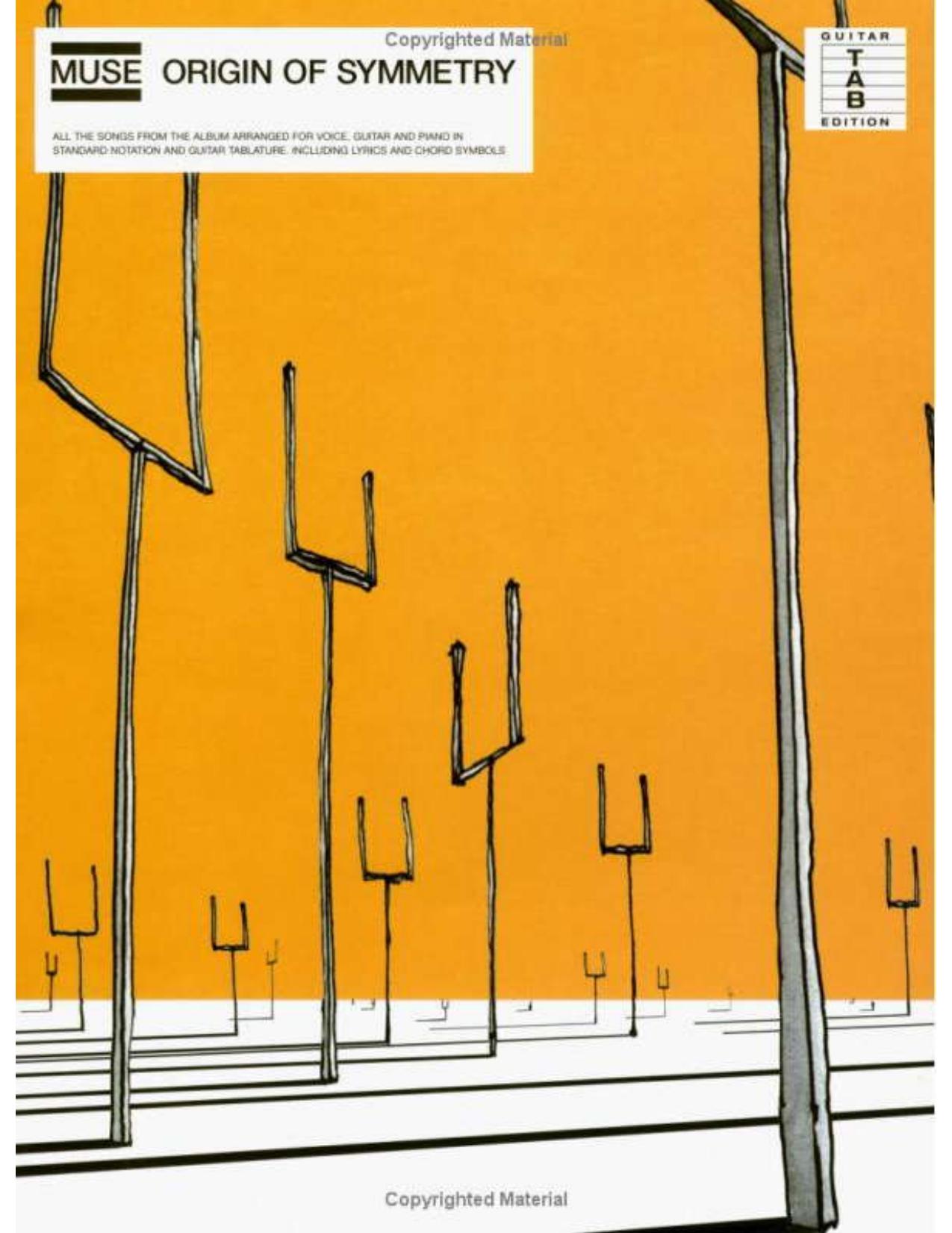
Their debut album, Showbiz, produced by John Leckie and Paul Reeve, arrived in 1999. It showcased Bellamy's keening falsetto and a melancholic, aggressive alternative rock style, with lyrics drawn from the band's struggles to establish themselves in their hometown. The album earned them a dedicated following and won Best New Band at the NME Awards. The follow-up, Origin of Symmetry (2001), was the artistic breakthrough. Expanding their palette with church organ, Mellotron, animal bones, and an enlarged drum kit, the album married Bellamy's arpeggiated guitar and piano playing to a newly confident sense of scale. Bellamy has cited Jimi Hendrix and Tom Morello as guitar influences, the latter audible in the riff-based attack and pitch-shifting effects of the record. The album's cover of "Feeling Good" became a signature, and Origin of Symmetry has since been ranked among the greatest British albums of all time.
Absolution (2003) marked the band's first UK number-one album and the beginning of an extraordinary run of seven consecutive chart-topping records. Produced by Rich Costey, Paul Reeve, and John Cornfield, it brought further classical influence, with string arrangements on tracks such as "Butterflies and Hurricanes," and yielded Muse's first top-ten hit, "Time Is Running Out," alongside "Hysteria" and "Sing for Absolution". In June 2004, Muse headlined Glastonbury Festival, a performance they later described as "the best gig of our lives"; tragically, Dominic Howard's father, who had attended the festival, died of a heart attack shortly after the set.
Black Holes and Revelations (2006) broadened Muse's international reach, incorporating electronic and pop elements most visibly on the single "Supermassive Black Hole". The album was nominated for the Mercury Music Prize and earned a Platinum Europe Award, and the ensuing tour saw the band become the first act to sell out the newly rebuilt Wembley Stadium in June 2007, documented on the acclaimed live release HAARP. The Resistance (2009) and The 2nd Law (2012) explored themes of government oppression and civil uprising, cementing Muse as one of the world's major stadium acts. The Resistance won the Grammy Award for Best Rock Album, and its closing three-part symphony, "Exogenesis," became a defining statement of the band's classical ambitions. Drones (2015), a concept album about drone warfare, returned the band to a harder rock sound and topped the US Billboard 200, winning a second Grammy for Best Rock Album. Simulation Theory (2018) leaned heavily into synthesizers and science-fiction themes, while Will of the People (2022) deliberately combined genres and motifs from across their career. As of 2022, Muse had sold more than thirty million albums worldwide.
Search your favorite sheet music in the Sheet Music Library Catalog


Musical Style, Harmony, and Technique
Muse's music defies easy categorization, drawing on alternative rock, progressive rock, space rock, hard rock, art rock, and electronic rock. What unites this sprawling stylistic range is a consistent aesthetic of excess: Muse songs are built for scale, characterized by huge choruses, driving dance-inflected beats, heavy bass, and a pervasive sense of theatrical drama. Critics have described a recognizable "Muse formula" involving Romantic-style chord progressions, a dance-y rhythmic pulse, and an overwhelming dynamic contrast between intimate verses and explosive refrains.
Bellamy's guitar playing is central to the band's identity. A classically trained pianist, he approaches the guitar with a keyboardist's sense of harmony and counterpoint, resulting in a style that is simultaneously virtuosic and unorthodox. He is a devoted user of pitch-shifting and synthesizer effects, allowing him to create textures that blur the line between guitar, keyboard, and electronic sound design. His playing frequently draws on the harmonic minor scale and its modes, lending Muse's music a neoclassical tension and a sense of dark, futuristic grandeur.
The band's harmonic language is one of their most distinctive features. Muse frequently employ the Phrygian dominant mode—the fifth mode of the harmonic minor scale—to create riffs and melodic lines of exotic, almost Middle Eastern intensity. "Stockholm Syndrome," from Absolution, is built around a main riff in the Phrygian dominant mode, while its verses follow a chromatic chord progression that was originally conceived on piano before being reworked for layered guitars and synthesizers. "Knights of Cydonia" similarly exploits the E Phrygian dominant scale, and the band's use of the harmonic minor scale more broadly has become a hallmark of their sound.
Muse's chord progressions often favor dramatic, non-diatonic motion. "Undisclosed Desires," from The Resistance, is set in G minor and moves through a VI–I progression in the verses and a iv–VI–i–III progression in the choruses, creating a sense of perpetual harmonic striving. "Map of the Problematique" cycles through C minor, E-flat major, A-flat major, and F minor, a progression that supports the song's driving electronic-rock momentum. "Megalomania," from Origin of Symmetry, is written largely in E harmonic minor with elements of E melodic minor, its chords alternating between D and F-sharp before resolving to the latter. This harmonic adventurousness, combined with Bellamy's classically inflected piano writing and the band's willingness to deploy orchestral strings and choirs, gives Muse a sonic density rare among rock bands. The three-part "Exogenesis: Symphony" on The Resistance, spanning nearly thirteen minutes and featuring a forty-piece orchestra, stands as the most explicit statement of their classical ambitions.
Discography
Muse's studio discography comprises ten albums, each representing a distinct phase in their evolution:
- Showbiz (1999) — Debut album; melancholic alternative rock with Bellamy's falsetto to the fore.
- Origin of Symmetry (2001) — Wider instrumentation, romantic classical influences, and a reputation-building live energy.
- Absolution (2003) — First UK number-one album; classical strings and apocalyptic themes.
- Black Holes and Revelations (2006) — Electronic and pop elements; international breakthrough.
- The Resistance (2009) — Themes of oppression and uprising; Grammy-winning; features the "Exogenesis" symphony.
- The 2nd Law (2012) — Broader influences from funk and film scores to electronica and dubstep.
- Drones (2015) — Concept album about drone warfare; return to a harder rock sound; US Billboard 200 number one.
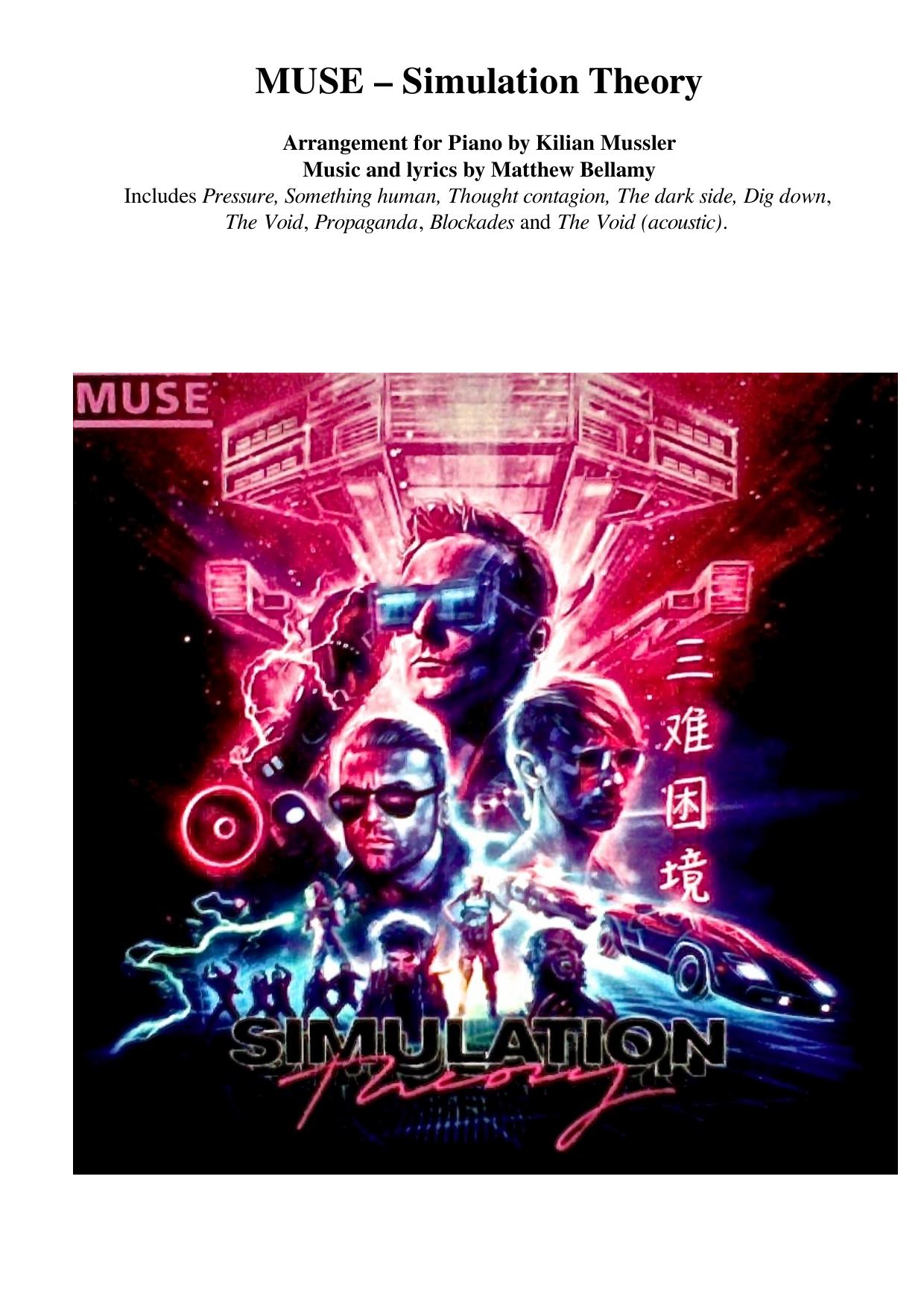
- Simulation Theory (2018) — Synthesizer-driven; science fiction and the simulation hypothesis.
- Will of the People (2022) — A genre-spanning synthesis of the band's previous eras.
- The Wow! Signal (2026) — The band's tenth studio album, featuring the single "Hush" with Ellie Goulding.
Most Known Compositions and Performances
Certain Muse songs have become enduring fixtures of the rock canon. "Plug In Baby," from Origin of Symmetry, is built on one of the most recognizable guitar riffs of the 2000s, while "Feeling Good" transformed the Anthony Newley and Leslie Bricusse standard into a towering showcase for Bellamy's vocal range. "Time Is Running Out" and "Hysteria" from Absolution remain live staples, the latter celebrated for its driving bass line and histrionic guitar work. "Supermassive Black Hole" brought a funk-inflected, dance-rock swagger to Black Holes and Revelations, and "Starlight" became one of the band's most emotionally direct and universally beloved songs. "Knights of Cydonia," a sprawling, cinematic epic that fuses progressive rock, space rock, and spaghetti-western imagery, is widely regarded as Muse's definitive closing number, often preceded in concert by Ennio Morricone's "Man with a Harmonica". From The Resistance, "Uprising" became an anthem of resistance and a Grammy-night performance piece, while the "Exogenesis" symphony demonstrated the band's capacity for sustained orchestral composition.
Muse's live performances are legendary for their visual and sonic spectacle. Their 2004 Glastonbury headline set is remembered as a career-defining moment, and their 2007 Wembley Stadium shows—captured on HAARP—established them as a stadium act of the first order. A 2013 gig at Tokyo's Zepp has become legendary among hardcore fans for its rare setlist, featuring deep cuts such as "Yes Please," "Agitated," "Futurism," "Fury," "Dead Star," "Micro Cuts," and "Hyper Music". More recent tours, including the Will of the People and The Wow! Signal tours, have continued to pair technically dazzling musicianship with elaborate stage production, fireworks, and theatrical imagery.
Discography
Main articles on Wikipedia: Muse discography and List of songs recorded by Muse
- Showbiz (1999)
- Origin of Symmetry (2001)
- Absolution (2003)
- Black Holes and Revelations (2006)
- The Resistance (2009)
- The 2nd Law (2012)
- Drones (2015)
- Simulation Theory (2018)
- Will of the People (2022)
- The Wow! Signal (2026)
Music in Films
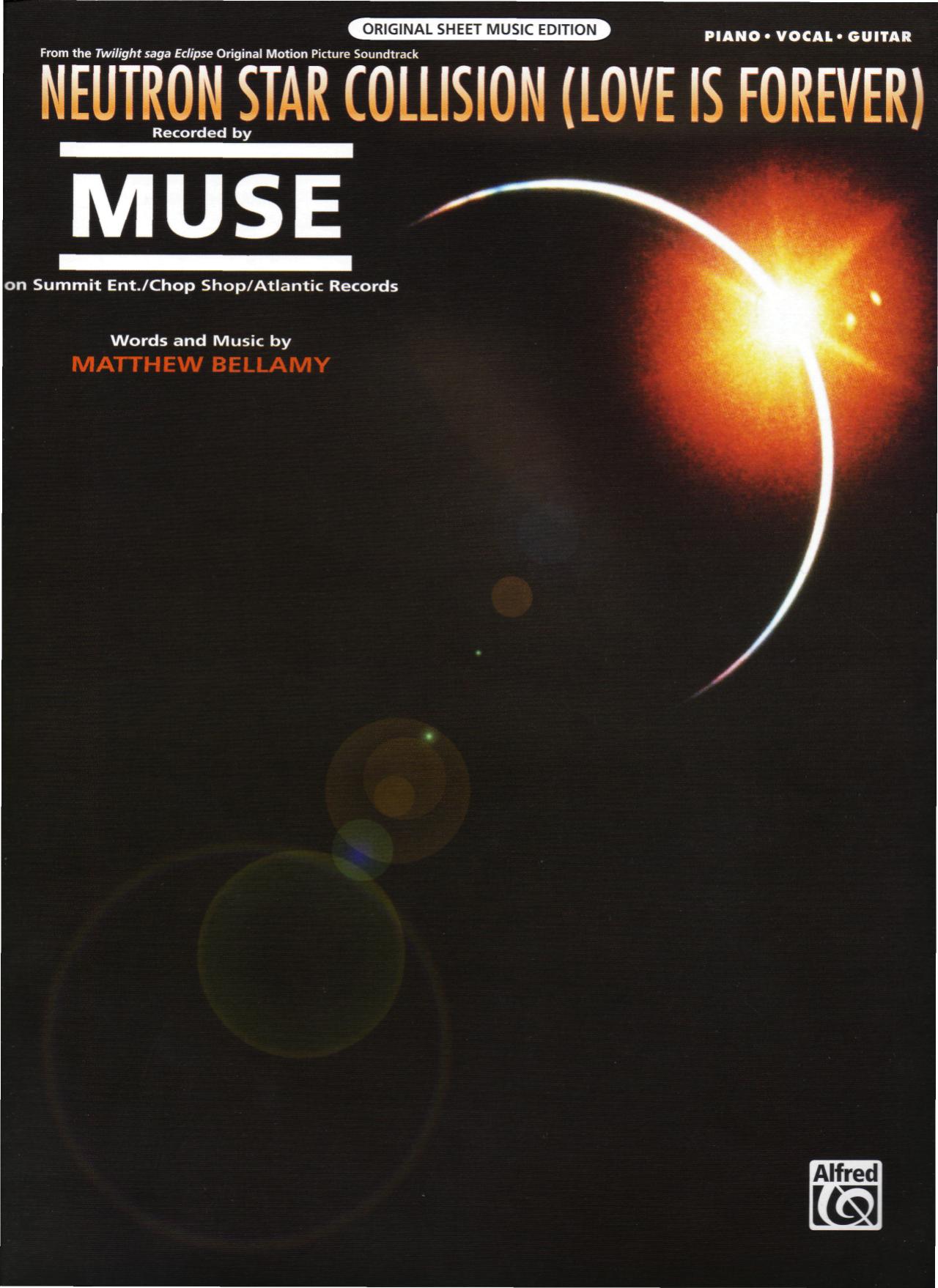
Muse's music has found a natural home in cinema, where its cinematic sweep and apocalyptic energy are ideally suited to visual storytelling. The band's most famous film relationship is with the Twilight saga: Muse appeared on the soundtracks of all three films, contributing "Supermassive Black Hole" (famously used during the Cullen family baseball scene in the first film), a remix of "I Belong to You" for New Moon, and the original song "Neutron Star Collision (Love Is Forever)" for Eclipse. Bassist Chris Wolstenholme likened the experience to "selling your soul" while acknowledging the practical value of reaching a vast American audience, and Twilight author Stephenie Meyer has spoken of Muse's music as an inspiration for her writing. Beyond Twilight, Muse's music was used extensively in the film World War Z (2013), with approximately fourteen minutes of the band's music—chiefly "Isolated System" from The 2nd Law—woven throughout the film. Their songs have also appeared in video games and television, further extending their cultural reach.
Collaborations and Relationships with Other Artists
Muse operated as a tightly closed creative unit for most of their career, with Bellamy as the primary songwriter. Their first major credited collaboration arrived with The Wow! Signal, which features Ellie Goulding on the song "Hush"—the first time Muse had a featured artist on one of their studio albums. Bellamy has said that Chris Martin of Coldplay encouraged him to open up to collaboration, a shift that led to the Goulding partnership. The band also worked with a range of producers and engineers over the years, including John Leckie, Rich Costey, and Mark Stent, and they were joined on tour for many years by additional keyboardist and multi-instrumentalist Morgan Nicholls, who performed with them from the Black Holes and Revelations era until 2022. In the broader musical ecosystem, Muse have been frequently compared to Radiohead—largely owing to the resemblance between Bellamy's falsetto and Thom Yorke's—as well as to Queen, Rush, and Pink Floyd, and their willingness to embrace grandiosity has positioned them as heirs to the tradition of eccentric English art-rock bands.
Awards and Honors
Muse have accumulated a formidable array of accolades. They have won two Grammy Awards—Best Rock Album for The Resistance and again for Drones—alongside two Brit Awards (both for Best British Live Act, in 2005 and 2007), five MTV Europe Music Awards, and multiple NME and Q Awards. In 2012, they received the Ivor Novello Award for International Achievement from the British Academy of Songwriters, Composers and Authors. In 2008, all three members were awarded honorary Doctorates of Arts by the University of Plymouth for their contributions to music. Their live releases have also earned critical recognition: HAARP was named the fortieth-greatest live album of all time by NME in 2018.
Influences and Legacy
Muse's influences are a broad and eclectic constellation. Bellamy has cited classical composers such as Sergei Rachmaninoff, Franz Liszt, and Frédéric Chopin as formative, and the band's music frequently reflects a Romantic sensibility in its harmonic language and emotional intensity. Among modern acts, Queen is perhaps the most frequently invoked comparison, with the band's layered vocals, theatrical dynamics, and genre-blurring ambition echoing Queen's own maximalist approach; Jimi Hendrix and Rage Against the Machine's Tom Morello are Bellamy's oft-cited guitar heroes. The band's later work has drawn on Depeche Mode, Lightning Bolt, Skrillex, Nero, and even film composers such as Hans Zimmer, reflecting an appetite for absorption that keeps their sound in constant motion.
Muse's legacy is that of a band who proved that rock music could be simultaneously intellectually ambitious, emotionally direct, and spectacularly popular. Their influence can be heard in the arena-rock grandeur of Imagine Dragons and Thirty Seconds to Mars, in the genre-fluid experimentation of later alternative acts, and in the willingness of younger bands to embrace classical instrumentation and science-fiction concepts without irony. They have been described as part of a lineage of "slightly mad, eccentric English" bands stretching back through Genesis, Queen, and Depeche Mode, and they have carried that tradition into the twenty-first century with uncommon conviction. Their ability to sell out stadiums worldwide while releasing a thirteen-minute symphony as the closing track of a chart-topping album is a testament to a rare kind of artistic courage.
Muse: Documentaries and Additional Information
Muse's story has been documented in several films and series. Muse: Under Review offers a career-spanning look at the band, featuring rare performance and interview footage alongside contributions from former manager Safta Jaffery, producer John Leckie, engineer Ric Peet, and biographer Mark Beaumont. Manic Depression, an unofficial DVD biography, was released in April 2005, and The Only Ones Who Know collects two documentary films tracing the band's rise and their position at the top of the music world. More recently, Muse launched With You, a six-part documentary series spotlighting the band's fans and their relationship with the music, drawn from footage accumulated during the Will of the People tour. The band's live releases—Hullabaloo, Absolution Tour, HAARP, and later concert films—function as documents of their evolving stagecraft, capturing the transformation from club band to stadium spectacle.
Muse remain a working, evolving entity, with The Wow! Signal extending their recorded legacy into a fourth decade. Their music continues to balance the intimate and the cosmic, the cerebral and the visceral, and their commitment to the idea that rock music can be a vehicle for grand statements—about power, technology, love, and the fate of the planet—has ensured that they remain one of the most consequential bands of their generation.