
Scores for all instruments: 16,000+ (active and growing), over 236,000 pages.
All genres and levels: Jazz & Blues, Rock & Pop, Classical & Contemporary, Film & Musicals;
books & biographies; methods, études, play-along tracks (MP3) for Jazz & Rock.
Access & benefits: US$15.99 one-time payment, valid for lifetime, full Library access.
Table of Contents
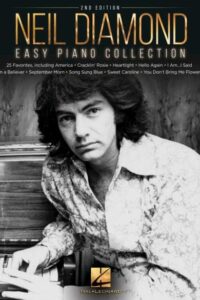
The best sheet music download from our Library.

Please, subscribe to our Sheet Music Library. Sheet music should be accessible and affordable for all musicians, from professionals to absolute beginners.
Neil Diamond - Sweet Caroline (Live At The Greek Theatre / 2012)
Neil Diamond: The People’s Songwriter
Neil Diamond is one of the most successful and enduring songwriters in the history of American popular music, a craftsman whose work bridges the Brill Building era of the 1960s and the adult contemporary mainstream of the decades that followed. With more than 128 million records sold worldwide, 37 Top 40 singles in the United States, and a catalog of songs that includes “Solitary Man,” “Sweet Caroline,” “Cracklin’ Rosie,” “Song Sung Blue,” and “America,” Diamond built a career on an unusual combination of commercial ubiquity and critical ambivalence. He was never a critics’ darling in the way that some of his singer-songwriter contemporaries were, yet his best songs have proved remarkably durable, moving across genres, generations, and formats—from the Monkees’ bubblegum pop to UB40’s reggae, from the concert hall to the seventh-inning stretch. His voice, a raw bass-baritone capable of both intimate vulnerability and stadium-filling drama, and his instinct for a memorable melody are his signatures, but so is his restlessness: a songwriter who began in the pop factory and spent the next half-century testing what a well-made song could do.
The Brill Building Heart of American Pop
From Brooklyn to the Brill Building
Neil Leslie Diamond was born on January 24, 1941, in Brooklyn, New York, to a Jewish family of Polish and Ukrainian descent. His father, Akeeba “Kieve” Diamond, was a dry-goods merchant, and the family moved frequently during his childhood, including a four-year stint in Cheyenne, Wyoming, while his father was stationed there in the army. Diamond’s interest in music began at sixteen, when he received his first guitar as a birthday present. The decisive moment came at a summer camp in upstate New York, where he witnessed a performance by folk singer Pete Seeger. Seeing Seeger and watching other children sing their own songs made Diamond realize that he could write songs too.
He attended Erasmus Hall High School in Brooklyn, where he sang in the Freshman Chorus alongside a classmate named Barbra Streisand—a connection that would later produce one of the biggest duets of the 1970s. After graduating, Diamond enrolled at New York University as a pre-med major on a fencing scholarship, even competing on the 1960 NCAA championship fencing team. But songwriting had already taken hold. He began cutting classes to take the train to Tin Pan Alley, trying to get his songs heard by publishers. In his senior year, Sunbeam Music Publishing offered him a sixteen-week job writing songs for fifty dollars a week, and he dropped out of college to accept it.
The Sunbeam job did not last, but it led Diamond into the ecosystem of the Brill Building, the legendary New York songwriting factory that also housed Carole King, Gerry Goffin, and Neil Sedaka. His early years there were lean: he sold roughly one song a week, earned barely enough to eat, and learned the hard way that the market wanted hooks rather than the wordy, introspective lyrics he was writing. The breakthrough came when he rented a small room above the Birdland jazz club, where, free from commercial pressure, he began writing the songs that would define him. “Solitary Man,” he later said, was “an outgrowth of my despair”.
His first success as a songwriter came in late 1965 with “Sunday and Me,” a Top 20 hit for Jay and the Americans. Far bigger was “I’m a Believer,” which the Monkees recorded in 1966. The song became a gold record within two days of release and topped the charts for seven weeks, making it the biggest-selling single of 1967. The Monkees also recorded “A Little Bit Me, a Little Bit You,” “Look Out (Here Comes Tomorrow),” and “Love to Love,” all written by Diamond. By the time his own recording career took off, he was already established as one of the most reliable hit-makers in pop.
Diamond signed with Bert Berns’s Bang Records in 1966, and his first releases for the label— “Solitary Man,” “Cherry, Cherry,” and “Kentucky Woman”—made him a solo star. A move to Los Angeles in 1969 coincided with a mellowing of his sound and a remarkable run of hits: “Sweet Caroline” (1969), “Holly Holy” (1969), “Cracklin’ Rosie” (1970), and “Song Sung Blue” (1972), the latter two reaching Number One on the Hot 100. “Sweet Caroline,” inspired by a photograph of nine-year-old Caroline Kennedy, became his most enduring cultural touchstone, a song that would later be adopted as an anthem at sporting events and singalongs around the world.
Musical Style: Craft, Harmony, and the Sound of the Voice
Diamond’s music is often described as “adult contemporary” or “soft rock,” but those labels undersell the range of his sources. His songs draw on rock, folk, blues, country, Tin Pan Alley, and Top 40 pop, and his best arrangements are marked by a lush, dramatic sensibility that owes as much to the Broadway and film-music traditions as to the singer-songwriter movement. A study of his work notes that his songs are “carried by strong melodies and lush arrangements,” a trademark of the middle-of-the-road style he helped define, but the emotional force comes from the way his voice interacts with those arrangements.
His harmonic language is fundamentally conservative but highly effective. Diamond favors clear, diatonic progressions, often built around piano or acoustic guitar, with chord changes that support the melodic line rather than challenge it. “Play Me,” for instance, is a medium-tempo waltz in 3/4 time with a flowing chord progression and a “characteristically expansive melodic line”. The simplicity is deliberate: Diamond’s gift is for the memorable phrase, the hook that lodges in the ear, and the harmonic understatement allows the melody and the vocal performance to carry the emotional weight.
Yet he has also shown a willingness to experiment within that framework. His 1976 album Beautiful Noise, produced by Robbie Robertson of the Band, was one of his most adventurous records. The title track came to Diamond when his daughter, watching a Puerto Rican Day parade from a New York hotel window, exclaimed, “What a beautiful noise, daddy!”. The album also contains “Street Life,” a song Diamond wrote using only one chord—a deliberate restriction that he described as liberating. “In the restriction of writing with one chord I found a freedom that I’d never found before,” he said. “That song had to stay on that one chord to maintain the tension of the whole thing”. The arranger Bob James helped keep the track interesting, but the experiment reveals a songwriter who, even at the height of his commercial powers, was curious about the limits of his craft.
As a vocalist, Diamond is instantly identifiable. His voice is a raw, slightly gravelly bass-baritone, with a natural grain that became more pronounced as he aged. Critics have noted that his range is not enormous, but his control of phrasing and tonal shading is distinctive. He can sound vulnerable and hesitant in one line and then swell into a roof-rattling chorus in the next, and that dynamic contrast is central to his appeal. Producer Rick Rubin, who worked with Diamond on 12 Songs (2005) and Home Before Dark (2008), deliberately had him accompany himself on acoustic guitar while singing, stripping away the orchestral bombast to reveal the “cautious, vulnerable” core of his voice. The results were among the most critically respected albums of Diamond’s later career.
The Essential Songs and Compositions
Any survey of Diamond’s best work must begin with the songs that defined his commercial peak. “Solitary Man” (1966) is a compact, melancholy character study that remains one of his personal favorites and one of his most covered songs. “Cherry, Cherry” is a jubilant, gospel-inflected rocker that showcased his early Bang Records sound. “Sweet Caroline” is a masterpiece of communal pop, its “ba ba ba” chorus and swelling brass making it a permanent fixture at weddings, sports arenas, and singalongs. “Cracklin’ Rosie” (1970) was his first Number One, a infectious, surging track built on a simple character sketch and a sparkling vocal. “Song Sung Blue” (1972) was his second Number One, a deceptively simple song inspired by Mozart that became a signature of his adult-contemporary phase. “I Am… I Said” (1971) is perhaps his most emotionally naked recording, a song about rootlessness and unworthiness in which his voice audibly cracks at the climax.
The 1970s produced further landmarks. “Love on the Rocks” (1980), co-written with Gilbert Bécaud, is a barroom lament that could have been written for Frank Sinatra. “America,” from The Jazz Singer soundtrack, is a sweeping, cinematic anthem about the immigrant experience that became a staple of his live shows. “You Don’t Bring Me Flowers,” co-written with Alan and Marilyn Bergman, began as a solo recording and became a Number One duet with Barbra Streisand after radio programmers began mashing up the two versions. Later songs such as “Hello Again,” “Forever in Blue Jeans,” and “September Morn” consolidated his status as a master of romantic balladry, while “Heartlight,” co-written with Carole Bayer Sager and Burt Bacharach, showed his continued ability to adapt to changing pop tastes.
Music for Film: Jonathan Livingston Seagull and The Jazz Singer
Diamond’s relationship with cinema produced two major soundtrack projects, both of which became substantial commercial successes even when the films themselves did not. His first film score was for Jonathan Livingston Seagull (1973), an adaptation of Richard Bach’s bestselling novella. Diamond had announced an early retirement from the concert scene to write what he called “a symphony,” and the resulting album was a lush, orchestral song cycle that earned him a Grammy Award for Best Album of Original Score Written for a Motion Picture or a Television Special. The soundtrack stayed on the charts for nearly a year and sold ten million copies, and Diamond often performed a Jonathan Livingston Seagull suite in his live shows.
His second and more famous film project was the 1980 remake of The Jazz Singer, in which Diamond starred opposite Laurence Olivier. The film was generally panned by critics, and Diamond’s acting was not well received. But the soundtrack was a triumph, producing three enduring songs: “America,” “Love on the Rocks,” and “Hello Again”. The album earned Diamond a Grammy nomination and cemented his role as a pop-culture icon, even if his screen career did not extend much beyond it. He later made a cameo appearance as himself in the comedy Saving Silverman (2001), a knowing acknowledgment of his status as a beloved, slightly camp figure.
Collaborations and Duets
Diamond’s collaborative history is narrower than that of some of his peers, but it includes several notable partnerships. The most commercially significant was his duet with Barbra Streisand on “You Don’t Bring Me Flowers,” a song that became a Number One hit and a Grammy-nominated record. The two had known each other since high school, and their voices—Streisand’s soaring soprano and Diamond’s gravelly baritone—complemented each other in a way that made the song’s rueful domestic drama feel immediate and real.
In 1976, Diamond worked with Robbie Robertson on Beautiful Noise, an album that brought him into contact with a roots-rock sensibility quite different from his own. Robertson assembled a remarkable backing band for the sessions, including drummers Jim Keltner, Jim Gordon, and Russ Kunkel, guitarist Jesse Ed Davis, pianist David Paich, and organists Dr. John and Garth Hudson of the Band. Diamond returned the favor by performing “Dry Your Eyes” with the Band at their farewell concert at Winterland Ballroom in 1976, a performance captured in Martin Scorsese’s documentary The Last Waltz.
Other collaborations include his 1996 country album Tennessee Moon, which featured duets with Waylon Jennings (“One Good Love”), Hal Ketchum (“Shame”), and Beth Nielsen Chapman (“Deep Inside of You”). He also recorded a duet with Natalie Maines of the Dixie Chicks on “Another Day (That Time Forgot)” for Home Before Dark. And in 1974, he appeared as a guest on Shirley Bassey’s television special, performing “Sweet Caroline” and “Longfellow Serenade” and joining her for a duet on “Play Me”.
Awards and Honors
Diamond’s awards shelf is substantial, even if his critical reputation has sometimes lagged behind his commercial achievements. He has been nominated for thirteen Grammy Awards, winning one: Best Album of Original Score Written for a Motion Picture or a Television Special for Jonathan Livingston Seagull in 1973. In 2018, he received the Grammy Lifetime Achievement Award. He was inducted into the Songwriters Hall of Fame in 1984 and received its Sammy Cahn Lifetime Achievement Award in 2000. In 2011, he was inducted into the Rock and Roll Hall of Fame and received a Kennedy Center Honor for his lifetime contributions to American culture. He has also won a Golden Globe Award and a Billboard Icon Award, and was named MusiCares Person of the Year in 2009.
His chart achievements are equally remarkable. He has scored 37 Top 40 singles and 16 Top 10 albums in the United States, including nine consecutive platinum hits. He is the only artist to score a Top 20 hit on Billboard’s Adult Contemporary chart in each decade since the chart’s launch in 1961, a testament to his extraordinary longevity. In 2018, the Library of Congress added “Sweet Caroline” to the National Recording Registry, recognizing it as “culturally, historically, or aesthetically significant”.
Influences and Legacy
Diamond’s influences reach back to the Tin Pan Alley craftsmen and the early rock and roll of Elvis Presley. A 1976 New York Times profile noted that he “reached back to the slick punkdom of the late 1950’s Elvis Presley and further back still to the pop craftsmen of Tin Pan Alley,” domesticating the energy of rock for older audiences without fully betraying it. His own songs, in turn, have been covered by an astonishing range of artists: Elvis Presley, Frank Sinatra, Johnny Cash, Chris Isaak, UB40, Urge Overkill, Smash Mouth, and countless others. UB40’s version of “Red Red Wine” topped the charts in both the US and the UK, and Urge Overkill’s cover of “Girl, You’ll Be a Woman Soon” became a key part of the Pulp Fiction soundtrack.
His critical standing has been more complicated. For much of his career, Diamond was seen as a mainstream entertainer rather than a serious artist, and the “bombast” of some of his arrangements was a frequent target for detractors. Yet the respect of fellow musicians has been consistent. Dave Grohl, speaking at the 2009 MusiCares tribute to Diamond, called him “our version of punk rock,” a striking characterization that captures the uncompromising, heart-on-sleeve quality of his best work. The Los Angeles Times noted that his “more than 20-year career has influenced every aspect of pop music,” and his willingness to experiment—with the one-chord structure of “Street Life,” with the orchestral ambition of Jonathan Livingston Seagull, with the stripped-back acoustic sound of his Rick Rubin albums—suggests a restlessness that belies his reputation as a purveyor of easy-listening fare.
Later Years and Enduring Presence
Diamond continued to record and perform into the 21st century. His 2005 album 12 Songs, produced by Rick Rubin, was widely praised for its spare, intimate sound, and its 2008 follow-up, Home Before Dark, debuted at Number One in both the United States and the United Kingdom. In January 2018, Diamond announced that he had been diagnosed with Parkinson’s disease and would retire from concert touring, though he said he would continue to write and record music. He made a surprise return to the stage in 2025, demonstrating that his connection with an audience remains undiminished. A jukebox musical based on his songs, A Beautiful Noise, opened on Broadway, and a 2025 film, Song Sung Blue, starring Hugh Jackman and Kate Hudson as members of a Diamond tribute band, further confirmed his status as a cultural institution.
Neil Diamond’s legacy is not that of a critical revolutionary or a genre-defining innovator. It is something perhaps more durable: that of a songwriter who understood, with almost uncanny precision, how to write songs that people want to sing. He took the craft of the Brill Building and the emotional directness of the singer-songwriter movement and fused them into a body of work that has survived changing fashions, shifting formats, and the periodic disdain of tastemakers. His voice—cracked, warm, and unmistakably human—and his best melodies have become part of the shared vocabulary of American popular music. As the Irish Independent put it, Diamond has “given the world songs with life filled to the brim”. That is a legacy worth celebrating.
Listen to Neil Diamond music on Spotify
Discography

Main article on Wikipedia: Neil Diamond discography
- The Feel of Neil Diamond (1966)
- Just for You (1967)
- Velvet Gloves and Spit (1968)
- Brother Love's Travelling Salvation Show (1969)
- Touching You, Touching Me (1969)
- Tap Root Manuscript (1970)
- Stones (1971)
- Moods (1972)
- Serenade (1974)
- Beautiful Noise (1976)
- I'm Glad You're Here with Me Tonight (1977)
- You Don't Bring Me Flowers (1978)
- September Morn (1979)
- On the Way to the Sky (1981)
- Heartlight (1982)
- Primitive (1984)
- Headed for the Future (1986)
- The Best Years of Our Lives (1988)
- Lovescape (1991)
- The Christmas Album (1992)
- Up on the Roof: Songs from the Brill Building (1993)
- The Christmas Album, Volume II (1994)
- Tennessee Moon (1996)
- The Movie Album: As Time Goes By (1998)
- Three Chord Opera (2001)
- 12 Songs (2005)
- Home Before Dark (2008)
- A Cherry Cherry Christmas (2009)
- Dreams (2010)
- Melody Road (2014)
- Acoustic Christmas (2016)
- Classic Diamonds (with London Symphony Orchestra, 2020)
- Wild at Heart (2026)
Filmography
- Mannix, "The Many Deaths of Saint Christopher", 1967, as himself
- The Last Waltz, 1978, as himself
- The Jazz Singer, 1980, starring role as Jess Robin
- Saving Silverman, 2001, appearing as himself
- Keeping Up with the Steins, 2006, appearing as himself
- Trevor Noah: Where Was I, 2023, appearing as himself
Browse in the Sheet Music Library:
Or browse in the categories menus & download the Library Catalog PDF: