
Scores for all instruments: 16,000+ (active and growing), over 236,000 pages.
All genres and levels: Jazz & Blues, Rock & Pop, Classical & Contemporary, Film & Musicals;
books & biographies; methods, études, play-along tracks (MP3) for Jazz & Rock.
Access & benefits: US$15.99 one-time payment, valid for lifetime, full Library access.
Table of Contents
The best sheet music download from our Library.

Please, subscribe to our Sheet Music Library. Sheet music should be accessible and affordable for all musicians, from professionals to absolute beginners.
Neil Young - Harvest Moon
Neil Young: The Restless Heart of North American Rock
Neil Young is an artist who defies easy categorization. Over a career spanning more than six decades, he has been a folk troubadour, a garage-rock primitive, a country-rock pioneer, an electronic experimentalist, and a protest singer. Born Neil Percival Young on November 12, 1945, in Toronto, Canada, he has released more than 40 studio albums, been inducted into the Rock and Roll Hall of Fame twice, and left an indelible mark on generations of musicians. His voice—a high, quavering tenor that can shift from a fragile whisper to a ragged howl—and his guitar playing, by turns delicate and violently expressive, are as instantly recognizable as any signature in popular music. More than a songwriter, Young is a restlessly searching artist whose only consistent quality has been his refusal to stay still.
Search your favorite sheet music in the Sheet Music Library Catalog
Early Life and the Road to Los Angeles
Young’s childhood was marked by upheaval and illness. His parents divorced when he was twelve, and he moved with his mother, Astrid, to Winnipeg, Manitoba, after his father, Scott Young, a well-known Canadian sportswriter, left the family. He contracted polio as a child and has lived with epilepsy, experiences that would later inform both his art and his activism. Music became an early obsession, encompassing rock, country, R&B, and doo-wop. By his mid-teens, he was performing in Winnipeg bands, including the Squires, before gravitating to the folk scene in Toronto’s Yorkville district. There he formed the Mynah Birds with future funk star Rick James, a group that briefly signed with Motown before dissolving amid legal troubles.
In 1966, Young drove to Los Angeles in an old Pontiac hearse, determined to make his mark in the American music industry. He soon crossed paths with Stephen Stills, and together with Richie Furay, Bruce Palmer, and Dewey Martin, they formed Buffalo Springfield. The band’s blend of folk-rock harmonies, psychedelic experimentation, and twin-guitar interplay made them one of the most influential groups of the late 1960s, even though their original incarnation lasted only about two years. Young’s songwriting contributions, including “Mr. Soul,” “Broken Arrow,” and “Expecting to Fly,” revealed an artist already testing the boundaries of conventional song form.

Forging a Solo Identity: From the Gold Rush to the Ditch
Buffalo Springfield’s breakup left Young disillusioned but also freed him to pursue his own vision. His 1969 self-titled solo debut sold poorly, but its follow-up, Everybody Knows This Is Nowhere, recorded with the garage band Crazy Horse, established a template that would define much of his career. Crazy Horse—guitarist Danny Whitten, bassist Billy Talbot, and drummer Ralph Molina—provided a raw, unpolished counterpoint to Young’s folkier instincts, and the chemistry was immediate. “Cinnamon Girl,” with its famously one-note guitar solo, and “Down by the River,” a long, hypnotic exploration of jealousy and violence, announced a distinctive voice in rock.
Young’s commercial breakthrough came with After the Gold Rush (1970) and, more massively, Harvest (1972). Recorded in Nashville with a group of session musicians dubbed the Stray Gators, Harvest became the best-selling album of 1972 and produced Young’s only Number One single, “Heart of Gold”. The album’s gentle, country-inflected sound—featuring Linda Ronstadt’s harmonies and the London Symphony Orchestra on two tracks—made Young a superstar, but the role sat uncomfortably with him. In reaction to the polished success of Harvest, he plunged into what has become known as the “Ditch Trilogy”: Time Fades Away (1973), On the Beach (1974), and Tonight’s the Night (1975). These albums were dark, raw, and emotionally brutal, shaped by the deaths of Crazy Horse guitarist Danny Whitten and roadie Bruce Berry from drug overdoses. Tonight’s the Night, in particular, is a ghostly, grief-stricken masterpiece that Young initially refused to release, fearing its starkness would alienate his new audience.
Musical Style: Harmony, Technique, and the Sound of Imperfection
Young’s musical language is built on a foundation of apparent simplicity that conceals considerable sophistication. His harmonic vocabulary is often rooted in the basic triads and seventh chords of folk and country music, but he deploys them with a painterly ear for tension and release. “Heart of Gold,” for instance, is built from just five chords—Em7, D, Em, C, and G—in the key of E minor, yet the song’s emotional weight comes from the way Young’s voice and harmonica hover over those changes, exploiting the ambiguity between the Em7 and Em to create a sense of yearning. His use of modal interchange, suspended chords, and unexpected harmonic turns—such as the haunting piano progression of “After the Gold Rush”—gives his work a distinctive melancholic glow.
As a guitarist, Young is one of rock’s great iconoclasts. His acoustic playing is characterized by a piston-like, rhythmic right-hand motion, often mixing chordal strumming with melodic fragments in a way that blurs the line between accompaniment and lead line. His electric playing, particularly with Crazy Horse, is an altogether more visceral proposition. He favors a heavily distorted, sustain-rich tone—most famously from his 1953 Gibson Les Paul, “Old Black,” often played through a Fender Deluxe amplifier—and his solos are less about technical precision than about texture, gesture, and emotional extremity. As one analysis notes, Young’s extended Crazy Horse solos tend to use rhythmic and melodic material as a basis for “timbral and gestural exploration,” with a wide dynamic range that can shift from a whisper to a roar in an instant.
Perhaps the most defining aspect of Young’s technique is his embrace of imperfection. He has built a career on notes that are deliberately out of tune, on vocal deliveries that are rough and unvarnished, and on performances that prioritize feeling over flawlessness. As country guitarist Kenny Vaughan has observed, Young “plays with notes that are deliberately out of tune,” using dissonance not as a mistake but as a tool to build tension and command attention. This aesthetic—what Jim Jarmusch has called “perfect imperfection”—is central to Young’s enduring power. His voice, too, is an instrument of expressive imperfection: a high, nasal tenor with a natural quaver, capable of both tender vulnerability and blunt aggression. It is a voice that has been imitated but never successfully replicated.
The Essential Songs and Compositions
Any attempt to distill Neil Young’s finest work into a list is destined to be incomplete, but certain songs stand as landmarks. “Sugar Mountain,” written when he was barely out of his teens, is a lament for lost youth that has become one of his most enduring acoustic ballads. “Ohio,” written in the immediate aftermath of the Kent State shootings, is a furious, concise protest song that named Richard Nixon and captured the rage of a generation. “Old Man,” from Harvest, is a gently philosophical meditation on aging and empathy, while “The Needle and the Damage Done,” also from that album, is a stark, acoustic warning about heroin addiction, written for Danny Whitten.
The Crazy Horse years produced some of Young’s most beloved epics. “Down by the River” and “Cowgirl in the Sand,” both from Everybody Knows This Is Nowhere, are long, winding guitar showcases that defined the band’s exploratory live sound. “Like a Hurricane” (1977) is a soaring, romantic epic built around one of Young’s most memorable riffs and a series of escalating, feedback-drenched solos. “Cortez the Killer” (1975) is a seven-minute meditation on conquest and loss, its lyrics a haunting counterpoint to the glacial power of the music. “Powderfinger” (1979) is a cinematic narrative of violence and fate, widely regarded as one of his greatest story-songs. And “Rockin’ in the Free World” (1989), written during the George H. W. Bush era, is a furious, ironic anthem that became a staple of his live shows and a bridge between his classic rock past and the alternative rock future.
Later-period songs have also entered the canon. “Harvest Moon” (1992) is a gorgeous, romantic waltz that revisits the acoustic warmth of Harvest with the wisdom of middle age, while “Angry World” (2010) won Young his first Grammy for Best Rock Song, proving that his capacity for righteous fury had not diminished.
Music for Film: The Cinematic Impulse
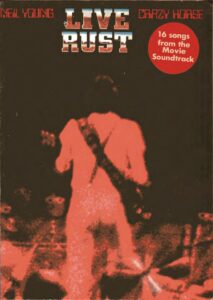
Young’s relationship with cinema has been as idiosyncratic as his relationship with the music industry. As an actor and director, he has worked under the pseudonym Bernard Shakey, creating films such as Journey Through the Past (1972), Rust Never Sleeps (1979), Human Highway (1982), and Greendale (2003). These projects are often willfully uncommercial and deeply personal, veering from concert documentaries to surreal narrative experiments.
His most celebrated contribution to film music, however, is his score for Jim Jarmusch’s 1995 Western, Dead Man. Jarmusch had been listening to Young’s music—particularly the instrumental passages of Crazy Horse songs like “Cortez the Killer”—while writing the script, and he invited Young to create the soundtrack. Rather than composing a traditional score, Young improvised almost the entire thing live to picture, watching a rough cut of the film in a San Francisco warehouse and responding in real time with his electric guitar. The result is a stark, haunting, and often violent soundscape, built largely from solo electric guitar. As one critic describes it, the music is “at times percussive and violent, at others bleakly poetic, and always—to invoke an unavoidable cliché—raw”. The score for Dead Man stands as one of the great achievements of Young’s career, a perfect fusion of his instinctive, texture-driven guitar playing with Jarmusch’s monochrome, dreamlike vision.
Young also contributed the song “Philadelphia” to Jonathan Demme’s 1993 film of the same name, earning an Academy Award nomination for Best Original Song. His work with Demme extended to a trilogy of concert films—Neil Young: Heart of Gold (2006), Neil Young Trunk Show (2009), and Neil Young Journeys (2011)—which captured the intimacy and power of his live performances.
Collaborations: From Buffalo Springfield to Promise of the Real
Collaboration has been a constant thread throughout Young’s career. With Buffalo Springfield, he formed a volatile but extraordinarily creative partnership with Stephen Stills, their twin-guitar interplay pushing both musicians to new heights. With Crosby, Stills, Nash & Young, he added a harder, more politically charged edge to the group’s folk-rock harmonies, contributing “Ohio” and “Helpless” to their 1970 album Déjà Vu. The supergroup’s internal tensions were legendary, but the music they made together—particularly on Déjà Vu and the live album 4 Way Street—remains a high-water mark of the era.
Crazy Horse is the collaborator most closely associated with Young. The band’s raw, unrefined sound has been the backdrop for some of his most powerful work, from Everybody Knows This Is Nowhere to Ragged Glory (1990) and Psychedelic Pill (2012). Other notable collaborators include the Stray Gators (the Harvest band), the country-rock ensemble the Santa Monica Flyers, and the R&B group Booker T. & the M.G.’s, with whom Young recorded Are You Passionate? (2002). In the 1990s, he found a kindred spirit in Pearl Jam, recording Mirror Ball (1995) with the band and touring with them; Eddie Vedder inducted Young into the Rock and Roll Hall of Fame in 1995, citing him as a profound influence. More recently, he has worked with Promise of the Real, the band fronted by Willie Nelson’s son Lukas, on albums such as The Monsanto Years (2015) and The Visitor (2017).
Young has also been a generous guest on other artists’ records. He played guitar on the Monkees’ “As We Go Along,” contributed harmonica to Joni Mitchell’s “Furry Sings the Blues,” sang harmony on Emmylou Harris’s “Sweet Old World,” and duetted with Waylon Jennings on “Bound for Glory”. These collaborations reveal the breadth of his musical curiosity and the respect in which he is held by artists across genres.
Awards and Honors
Neil Young’s awards shelf is crowded, even if he has often seemed indifferent to the accolades. He has won two Grammy Awards: Best Boxed or Special Limited Edition Package for Neil Young Archives Vol. I (1963–1972) in 2010, and Best Rock Song for “Angry World” in 2011. He has been nominated for 28 Grammys in total, including nods for Best Rock Album for Psychedelic Pill and Le Noise. In 2010, he was honored as the MusiCares Person of the Year, and in 2014 he received the President’s Merit Award from the Recording Academy’s Producers & Engineers Wing.
He has been inducted into the Rock and Roll Hall of Fame twice: as a solo artist in 1995 and as a member of Buffalo Springfield in 1997. He is an Officer of the Order of Canada, a recipient of the Governor General’s Performing Arts Award, and has received multiple Juno Awards. He has also been nominated for an Academy Award and has won the Grammy for Best Music Film (as a nominee) for BARN in 2023. In 2025, his 80th birthday was celebrated by the music world with retrospectives and tributes, a testament to his enduring relevance.
Influences, Legacy, and the “Godfather of Grunge”
Young’s influences are as eclectic as his output. He has cited Elvis Presley and the Beatles as formative childhood inspirations, but his musical DNA also draws on folk, country, blues, and R&B. His early folk-rock contemporaries, including Bob Dylan and Joni Mitchell, were significant peers, and his fascination with the landscapes and mythologies of North America has been a constant thematic thread.
His legacy, however, may be most powerfully measured by the artists he influenced. Young is widely regarded as the “Godfather of Grunge,” a title earned through his pioneering use of feedback and distortion and his uncompromising, raw approach to rock music. Kurt Cobain quoted Young’s lyric “It’s better to burn out than to fade away” in his suicide note, a tragic testament to the resonance of Young’s words with a generation of alienated youth. Eddie Vedder, Thom Yorke of Radiohead, Sonic Youth, Dinosaur Jr., and countless others have cited him as a foundational influence. The Australian band Powderfinger even named themselves after his song.
Beyond music, Young’s legacy includes his activism. He co-founded Farm Aid in 1985 with Willie Nelson and John Mellencamp, an annual benefit concert that has raised millions of dollars for family farmers. He founded the Bridge School in 1986 with his then-wife Pegi, a nonprofit dedicated to educating children with severe speech and physical disabilities; the annual Bridge School Benefit Concerts drew some of the biggest names in music. His advocacy for high-resolution digital audio and his outspoken environmentalism—including his protest against the use of genetically modified seeds by Monsanto—have further demonstrated that his restless energy extends far beyond the recording studio.
Neil Young: The Unfinished Song
Neil Young remains, at heart, a searcher. He has never settled into a comfortable persona, never allowed his audience to predict what he might do next. He has followed his instincts from acoustic tenderness to electric violence, from country crooning to electronic alienation, from commercial triumph to willful obscurity. His voice, with all its cracks and quavers, and his guitar, with all its wrong notes and perfect gestures, have become a kind of North American vernacular—a sound that feels as vast, as contradictory, and as beautiful as the continent itself. As he once sang, “Rust never sleeps,” and neither does the creative spirit that has driven him for more than half a century. Neil Young is not simply a survivor of rock history; he is one of its most vital, unpredictable, and enduring authors.
Browse in the Sheet Music Library:
Or browse in the categories menus & download the Library Catalog PDF:
Discography
Main article on Wikipedia: Neil Young discography and filmography
See also: Crazy Horse (band) § Discography; Buffalo Springfield § Discography; and Crosby, Stills, Nash & Young discography
- Neil Young (1968)
- Everybody Knows This Is Nowhere (1969) (with Crazy Horse)
- After the Gold Rush (1970)
- Harvest (1972) (with The Stray Gators)
- Journey Through The Past (1972)
- Time Fades Away (1973) (with The Stray Gators)
- On the Beach (1974)
- Tonight's the Night (1975)
- Zuma (1975) (with Crazy Horse)
- Long May You Run (1976) (credited to The Stills–Young Band)
- American Stars 'n Bars (1977)
- Comes a Time (1978)
- Rust Never Sleeps (1979) (with Crazy Horse)
- Hawks & Doves (1980)
- Re·ac·tor (1981) (with Crazy Horse)
- Trans (1983)
- Everybody's Rockin' (1983) (with the Shocking Pinks)
- Old Ways (1985)
- Landing on Water (1986)
- Life (1987) (with Crazy Horse)
- This Note's for You (1988) (with the Bluenotes)
- Freedom (1989)
- Ragged Glory (1990) (with Crazy Horse)
- Harvest Moon (1992) (with The Stray Gators)
- Sleeps with Angels (1994) (with Crazy Horse)
- Mirror Ball (1995) (with Pearl Jam)
- Broken Arrow (1996) (with Crazy Horse)
- Silver & Gold (2000)
- Are You Passionate? (2002) (with Booker T. & the M.G.'s)
- Greendale (2003) (with Crazy Horse)
- Prairie Wind (2005)
- Living with War (2006)
- Chrome Dreams II (2007)
- Fork in the Road (2009)
- Le Noise (2010)
- Americana (2012) (with Crazy Horse)
- Psychedelic Pill (2012) (with Crazy Horse)
- A Letter Home (2014)
- Storytone (2014)
- The Monsanto Years (2015) (with Promise of the Real)
- Peace Trail (2016)
- Hitchhiker (2017, recorded 1976)
- The Visitor (2017) (with Promise of the Real)
- Colorado (2019) (with Crazy Horse)
- Homegrown (2020, recorded 1974–75)
- Barn (2021) (with Crazy Horse)
- Toast (2022, recorded 2001) (with Crazy Horse)
- World Record (2022) (with Crazy Horse)
- Chrome Dreams (2023, recorded 1974–77) (with Crazy Horse)
- Early Daze (2024, recorded 1969) (with Crazy Horse)
- Oceanside Countryside (2025, recorded 1977)
- Talkin to the Trees (2025) (with Chrome Hearts)
- Second Song (2026) (with Chrome Hearts)