
Scores for all instruments: 16,000+ (active and growing), over 236,000 pages.
All genres and levels: Jazz & Blues, Rock & Pop, Classical & Contemporary, Film & Musicals;
books & biographies; methods, études, play-along tracks (MP3) for Jazz & Rock.
Access & benefits: US$15.99 one-time payment, valid for lifetime, full Library access.
Table of Contents

The best sheet music download from our Library.
For the price of a single songbook, get a full Sheet Music Library!

Please, subscribe to our Sheet Music Library. Sheet music should be accessible and affordable for all musicians, from professionals to absolute beginners.
Igor Stravinsky: The Composer Who Exploded the Twentieth Century
Igor Stravinsky (1882–1971) is arguably the most consequential composer of the twentieth century, a figure whose radical innovations in rhythm, harmony, and form reshaped the very language of music. From the scandalous premiere of The Rite of Spring in 1913 to his late, austere serial works, Stravinsky’s career traced an astonishing arc across nationalism, neoclassicism, and twelve-tone technique, making him a central architect of modernism. His influence extends far beyond the concert hall, permeating jazz, rock, film music, and contemporary classical composition, cementing his legacy as a truly universal artist.
Stravinsky: Music for Piano & Orchestra
Tracklist: Capriccio, K050: 00:00 I. Presto 07:10 II. Andante Rapsodico 12:52 III. Allegro Capriccioso Ma Tempo Giusto Concerto for Piano and Wind Instruments, K042: 18:24 I. Largo - Allegro 25:39 II. Largo 31:15 III. Allegro 36:12 Tango (1940), K062 39:40 Ragtime (1919), K030 44:55 Circus Polka. For a Young Elephant (1942), K064 48:35 Valse Pour Les Enfants (1917), Kn16 49:49 Piano-Rag-Music (1919), K032
Search your favorite sheet music in the Sheet Music Library Catalog
Biography: From St Petersburg to the World Stage
Igor Fyodorovich Stravinsky was born on 17 June 1882 in Oranienbaum, a resort town near St Petersburg, into a family deeply embedded in Russian musical life. His father, Fyodor, was a renowned bass singer at the Mariinsky Opera, and the young Igor grew up in an environment of strict discipline and high cultural expectation. Despite showing precocious talent at the piano and a gift for improvisation, his father dismissed his early compositional attempts and enrolled him at law school in 1901, seemingly steering him away from a musical career.
Two decisive events altered this trajectory. The death of his father in 1902 and a subsequent meeting with Nikolai Rimsky-Korsakov proved pivotal. Rimsky-Korsakov, the great master of Russian orchestration, became Stravinsky’s mentor and composition professor until his death in 1908, instilling in the young composer a rigorous and inventive approach to the orchestra. Early works such as Scherzo fantastique and Fireworks (both 1908) displayed a shimmering virtuosity that caught the attention of Serge Diaghilev, the impresario of the Ballets Russes.
Diaghilev commissioned Stravinsky to write a ballet for the 1910 Paris season, and the result, The Firebird, made the twenty-eight-year-old composer an overnight celebrity. This was followed by Petrushka (1911), which fully announced the crisp rhythms and pungent harmonies of his mature style, and then by the seismic shock of The Rite of Spring (1913). The premiere of The Rite at the Théâtre des Champs-Élysées on 29 May 1913 provoked one of the most famous riots in cultural history, with fistfights breaking out in the audience between defenders and detractors of the work. The scandal left Stravinsky confined to bed with fever for six weeks, yet it also cemented his reputation as the most advanced and controversial composer of his age.
The outbreak of World War I forced Stravinsky to flee to Switzerland, where he remained until 1920. Deprived of the resources of the Ballets Russes, he turned to works for smaller forces, including Renard (1916), The Soldier’s Tale (1918), and the sung ballet Les Noces (completed 1923). The Russian Revolution had stripped his family of its wealth, and after the war he settled in France, becoming a French citizen in 1934 and supporting himself as a pianist and conductor. This period saw the emergence of his neoclassical style, first fully realised in the ballet Pulcinella (1920), which drew on music attributed to Pergolesi.
A series of personal tragedies—the deaths of his daughter, wife, and mother within a few months—prompted Stravinsky to move to the United States in 1939. He settled in Hollywood, married his longtime companion Vera Sudeikina in 1940, and became an American citizen in 1945. In America he completed his full-length opera The Rake’s Progress (1951) and, under the influence of his young assistant Robert Craft, began exploring the serial techniques of Schoenberg and Webern. This led to a superb sequence of late works—Canticum sacrum (1955), Agon (1957), Threni (1958), and the Requiem Canticles (1966)—that reconciled his lifelong rhythmic vitality with twelve-tone discipline. Igor Stravinsky died of heart failure in New York on 6 April 1971, at the age of 88.
Musical Style, Harmony, and Technique
Stravinsky’s style is notoriously resistant to easy categorisation, evolving through three broad periods—Russian, neoclassical, and serial—yet unified by certain fundamental concerns. Chief among these is rhythm, which Stravinsky placed at the very foundation of musical art, declaring that “rhythm and motion, not the element of feeling, are the foundation of musical art”. His music is characterised by motoric ostinatos, shifting metres, polyrhythms, and a percussive use of dissonance that liberates rhythm from the tyranny of the barline.
His harmonic language is equally distinctive. In the early Russian ballets, Stravinsky moved rapidly from the Rimsky-Korsakov-derived symmetry of The Firebird to the audacious superimpositions of Petrushka, most famously the “Petrushka chord”—a dissonant combination of a C-major and an F-sharp-major triad that brilliantly captures the puppet-hero’s dual nature. The Rite of Spring took this further, superimposing an E-flat dominant-seventh chord on an E-major triad and doubling folk melodies in screeching tritones and major sevenths, creating a harmonic world of unprecedented harshness and power.
While the octatonic scale (an eight-note scale of alternating tones and semitones) became a favoured resource, Stravinsky’s music was never confined to a single system: in The Rite alone, modal, pentatonic, octatonic, diatonic, chromatic, and atonal elements combine to produce a truly astonishing harmonic universe.
The neoclassical period saw Stravinsky deliberately reopen the door to tonal harmonies, plain major and minor triads, and Baroque and Classical forms, yet he did so with a modernist’s irony and detachment. Works such as Pulcinella, Oedipus Rex, and the Symphony of Psalms engage with the past not as nostalgia but as a creative dialogue, filtering eighteenth-century models through a twentieth-century sensibility. In his final serial period, Stravinsky adopted twelve-tone rows but retained a distinctive tonal gravitation and contrapuntal clarity, insisting that “the intervals in my series gravitate toward tonality”. Agon, his great late ballet, is a laboratory of this synthesis, juxtaposing tonal-centric and serialised movements into a coherent whole while retaining his trademark rhythmic play.
The Essential Compositions
Further information: List of compositions by Igor Stravinsky
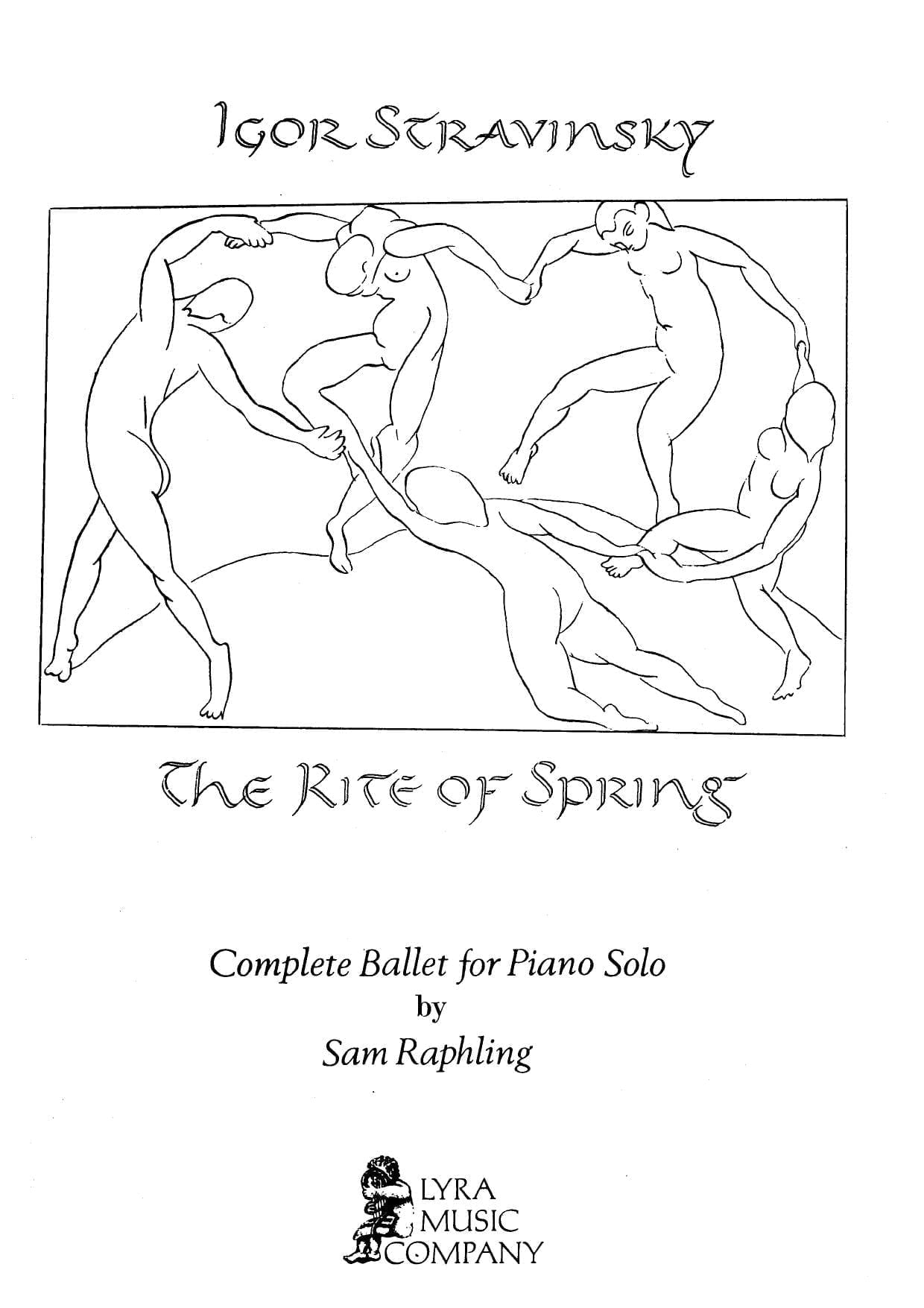
Stravinsky’s catalogue is vast, but a core of masterpieces defines his achievement. The three early Ballets Russes scores remain cornerstones of the repertoire. The Firebird (1910) is a sumptuous, brilliantly orchestrated fairy-tale ballet that consummates his Rimsky-Korsakov inheritance while hinting at the radicalism to come. Petrushka (1911) is his first major expedition into uncharted territory, a tragicomic puppet drama of astonishing rhythmic vitality and harmonic daring. And The Rite of Spring (1913) is simply one of the foundational works of modern music: a depiction of pagan Russian fertility rites that unleashed a new conception of rhythm, dissonance, and orchestral power, described by Stravinsky’s friend Robert Craft as “the prize bull that inseminated modernism in music”.
The wartime years produced works of lean economy and searing intensity. Les Noces (completed 1923) is a sung ballet for chorus, soloists, four pianos, and percussion, a machine-like ritual of Russian peasant wedding customs that harnesses Stravinsky’s rhythmic obsession to devastating effect. The Soldier’s Tale (1918) is a compact music-theatre piece for narrator, actors, and a septet of instruments, a parable of a soldier’s pact with the devil that matches its moral starkness with a lean, unsentimental score.
The neoclassical masterpieces include Pulcinella (1920), a witty reimagining of Pergolesi that scandalised purists but opened a new path for twentieth-century music; Oedipus Rex (1927), an opera-oratorio of monumental austerity setting Cocteau’s Latin text; and above all the Symphony of Psalms (1930), commissioned by the Boston Symphony Orchestra and dedicated “to the glory of GOD”. In this work Stravinsky deliberately excluded the sensuous sheen of violins and violas, employed a chorus without soloists, set the texts in impassive Vulgate Latin, and built the outer movements on motoric ostinatos and the central movement on a double fugue, achieving what one commentator called “the exemplary balance of intellect and clear-eyed emotion that marks his greatest works”.
Later masterpieces include The Rake’s Progress (1951), a full-length opera with a libretto by W. H. Auden and Chester Kallman that is both a homage to and a critique of Mozartian opera; Agon (1957), a ballet of seventeenth-century dance forms refracted through serial technique, described by the New York Times as “a faintly sad and ironic evocation of a vanished time”; and the Requiem Canticles (1966), a brief, intense setting of the Latin Requiem that distils his lifelong concern with small, self-contained musical cells into a final testament.
Stravinsky in Film and Musical Theatre
Despite living in Los Angeles for nearly three decades, Stravinsky never scored a Hollywood feature film, believing that film music’s subordination to narrative and image was fundamentally incompatible with his conception of music as an autonomous art. His most famous cinematic association came through Walt Disney’s Fantasia (1940), for which Leopold Stokowski conducted an abbreviated and rearranged version of The Rite of Spring to accompany animated sequences of dinosaurs and volcanic eruptions. Stravinsky was reportedly horrified by the adaptation, and the financial arrangements led to a falling-out with Disney, but the film introduced his music to millions and remains a landmark in the popularisation of classical music.
Other film adaptations of his stage works include a 2005 television film of his opera The Nightingale (Le Rossignol), based on Hans Christian Andersen’s fairy tale, which follows Stravinsky’s score and libretto faithfully. Ballets such as Petrushka and The Firebird have also been filmed in staged productions, preserving the choreographies of Michel Fokine and others.
On Broadway, Stravinsky contributed ballet music to the 1944 musical revue Seven Lively Arts, produced by Billy Rose, which also featured songs by Cole Porter and scenery by Salvador Dalí. The show ran for 183 performances and was considered a flop by Broadway standards, but it remains a curious footnote in Stravinsky’s engagement with popular entertainment.
Collaborations: Diaghilev, Nijinsky, Balanchine, and Beyond
Stravinsky’s career was shaped by a series of extraordinary creative partnerships. Serge Diaghilev, the impresario of the Ballets Russes, was the first and perhaps most decisive: it was Diaghilev who commissioned The Firebird, nurtured Stravinsky’s early career, and brought his ballets to Parisian audiences. The choreographer Vaslav Nijinsky created the revolutionary dance for The Rite of Spring, and the work was a deeply collaborative project involving the artist and archaeologist Nicholas Roerich, who designed the sets and contributed to the scenario.
After Diaghilev’s death in 1929, Stravinsky found his most enduring choreographic partner in George Balanchine. The two met in 1925, when Balanchine made a dance to Le Chant du Rossignol for the Ballets Russes, and their collaboration flourished in America. Balanchine would go on to choreograph around forty works to Stravinsky’s music, including such masterpieces as Apollo (1928), Agon (1957), Symphony in Three Movements, Violin Concerto, and Duo Concertant. Their partnership was so profound that New York City Ballet’s 1972 Stravinsky Festival, staged a year after the composer’s death, presented thirty ballets in a single week, twenty of them new, as a declaration of love and gratitude from the choreographer to his departed friend.
Other notable collaborators included the Swiss writer Charles Ferdinand Ramuz, who provided the texts for Renard and The Soldier’s Tale during Stravinsky’s wartime exile in Switzerland; Jean Cocteau, who wrote the libretto for Oedipus Rex and helped shape Stravinsky’s turn toward neoclassicism; and Robert Craft, the young American conductor and writer who became Stravinsky’s assistant in 1948 and was instrumental in guiding him toward serialism in his final years.
Awards and Honours
Stravinsky received a remarkable array of honours throughout his long career. He was awarded the Royal Philharmonic Society Gold Medal in 1954, the Léonie Sonning Music Prize in 1959, and the Wihuri Sibelius Prize in 1963. He won multiple Grammy Awards, including Best Contemporary Classical Composition in 1961 and 1962 (for The Flood) and Best Orchestral Performance in 1962, and he was posthumously awarded the Grammy Lifetime Achievement Award in 1987. He also received a star on the Hollywood Walk of Fame in 1960 and was made a Commander of the Military Order of Saint James of the Sword. These honours reflect not only his artistic achievement but also his unique position as a bridge between the avant-garde and the mainstream of twentieth-century culture.
Influences and Legacy
Stravinsky’s influence is almost immeasurable, radiating across genres and generations. In jazz, The Rite of Spring became a kind of source book for musicians seeking new rhythmic and harmonic possibilities. Charlie Parker famously quoted the opening bassoon melody of The Rite in his solo on “Salt Peanuts” in Paris in 1949, and later quoted The Firebird in “Ko-Ko” at Birdland in 1951, delighting Stravinsky, who was in the audience. Ornette Coleman, Alice Coltrane, Joni Mitchell, and Weather Report all absorbed elements of Stravinsky’s language, and the jazz trio The Bad Plus arranged the entire Rite of Spring for piano trio.
In rock, the powerful riffs and atavistic violence of The Rite left an indelible mark on the more adventurous corners of the genre. Frank Zappa claimed to have listened to The Rite of Spring “more than any man in the world,” and its influence can be heard in King Crimson, Metallica, and even the Pet Shop Boys. In film music, Stravinsky is a pervasive presence: John Williams has often been noted for his Stravinskian orchestration and rhythmic patterns, with the Tatooine desert music in Star Wars bearing a striking resemblance to the steppes of The Rite, and the primal score of Jaws echoing Stravinsky’s rhythmic urgency. Danny Elfman and countless other film composers have cited him as a muse.
Among classical composers, Stravinsky’s influence is equally profound. Minimalists Steve Reich and Philip Glass were shaped by his rhythmic procedures, and his neoclassical synthesis provided a model for composers seeking to engage with tradition without sacrificing modernist credibility. His late serial works demonstrated that twelve-tone technique could be reconciled with tonal gravitation and rhythmic vitality, opening possibilities that subsequent generations would explore. As the New York Times obituary noted, The Rite of Spring “exploded in the face of the music world in 1913 and blew it into the 20th century”, and that explosion continues to reverberate.
Additional Perspectives
Beyond the music, Stravinsky was a formidable writer and thinker. His Chronicles of My Life (1936) and the series of “conversation books” produced with Robert Craft remain essential—if sometimes deliberately misleading—sources for understanding his aesthetics. He was a celebrated conductor of his own works, and his recordings remain benchmarks for clarity, precision, and rhythmic incisiveness. His personal life was marked by complexity: a long marriage to his cousin Yekaterina Nosenko, with whom he had four children, coexisted with a longstanding relationship with Vera de Bosset, whom he eventually married after Yekaterina’s death.


Stravinsky’s legacy is also institutional. The Igor Stravinsky Archive and Foundation preserve his manuscripts and papers, and centenary and bicentenary celebrations have reaffirmed his centrality to the twentieth-century canon. The Stravinsky Festival at New York City Ballet in 1972, the composer’s centenary in 1982, and the ongoing prominence of his works in concert halls, opera houses, and ballet companies worldwide testify to a continuing relevance that few composers of any era can match.
Stravinsky
Igor Stravinsky was not merely a composer of extraordinary gifts; he was a force that redefined what music could be. He stripped rhythm of its subservience to melody and harmony, opened harmony to new worlds of dissonance and juxtaposition, and moved through stylistic periods with a restless intelligence that refused to settle into any comfortable orthodoxy.
Whether shocking Parisian audiences with pagan rites, reinventing eighteenth-century forms with ironic elegance, or distilling his art into the austere beauty of his late serial works, Stravinsky remained throughout a modernist in the deepest sense: an artist committed to the new, the difficult, and the true. His music continues to challenge, provoke, and delight, and his influence shows no sign of diminishing. As a composer, conductor, thinker, and cultural icon, Igor Stravinsky stands as one of the supreme artistic figures of the modern age.
Browse in the Sheet Music Library:
Or browse in the categories menus & download the Library Catalog PDF: