
Scores for all instruments: 16,000+ (active and growing), over 236,000 pages.
All genres and levels: Jazz & Blues, Rock & Pop, Classical & Contemporary, Film & Musicals;
books & biographies; methods, études, play-along tracks (MP3) for Jazz & Rock.
Access & benefits: US$15.99 one-time payment, valid for lifetime, full Library access.
Table of Contents
Search your favorite sheet music in the Sheet Music Library Catalog
Loreena McKennitt: The Celtic Muse of the Modern World
Few artists in contemporary music have built a world as distinctive and internally coherent as Loreena McKennitt’s. Across four decades, the Canadian singer, harpist, pianist, and composer has crafted what is most often called “eclectic Celtic”—a sound that weaves together the folk traditions of the British Isles, the modal colors of the Middle East, the solemnity of classical music, and the narrative instincts of a literary antiquarian. She has sold more than fourteen million albums worldwide, earned two Juno Awards and two Grammy nominations, and done so while remaining entirely self-managed, self-produced, and the owner of her own record label, Quinlan Road. For an artist whose music is so frequently described as ancient or timeless, her career is also a remarkably modern story of entrepreneurial independence and artistic control.
The best sheet music download from our Library.
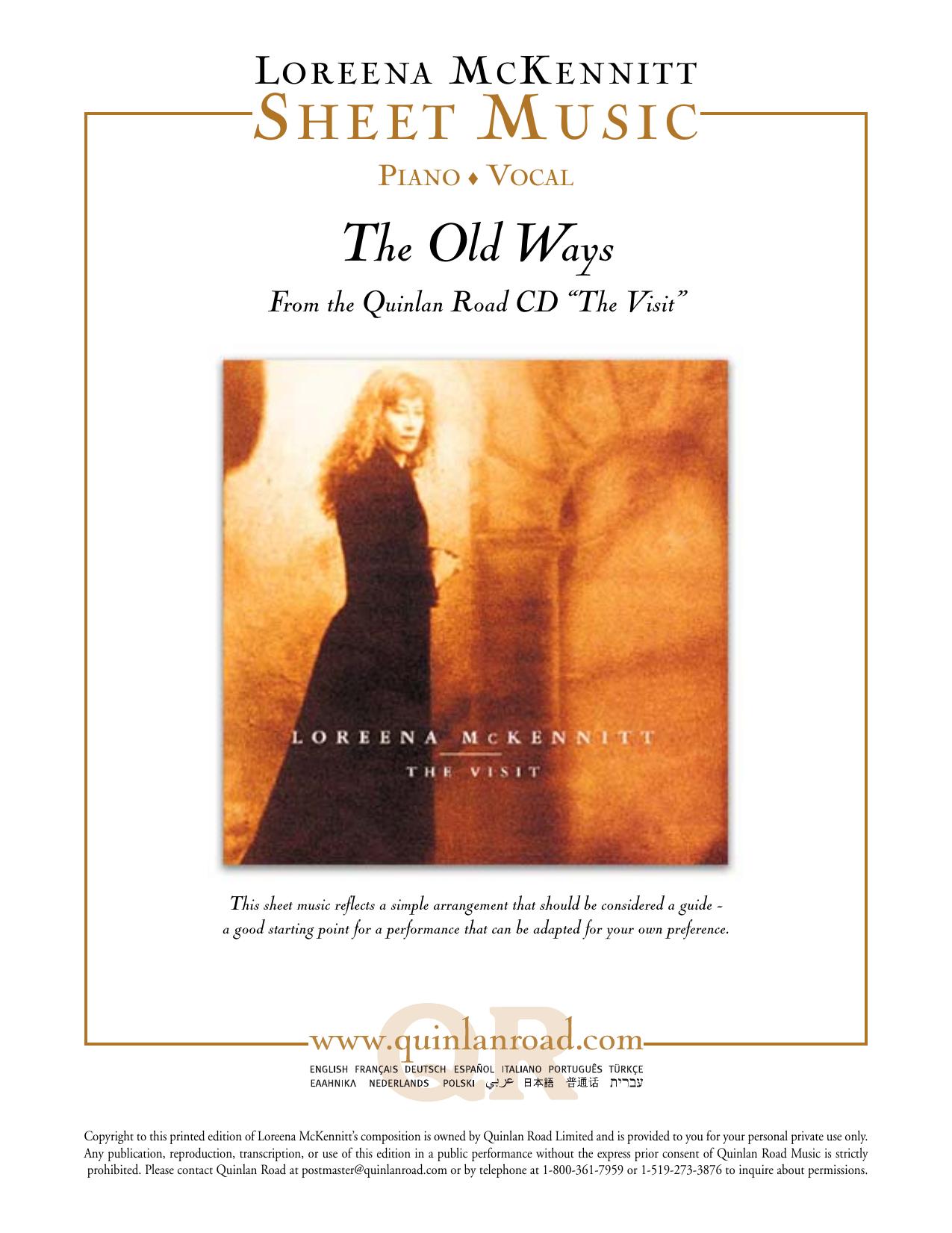
Please, subscribe to our Sheet Music Library. Sheet music should be accessible and affordable for all musicians, from professionals to absolute beginners.
Loreena McKennitt – Dante's Prayer (Live 2006)
Early Life and the Making of a Musical Traveler
Loreena Isabel Irene McKennitt was born on February 17, 1957, in Morden, Manitoba, a small prairie community in Canada. Her parents, Jack and Irene McKennitt, were of Irish and Scottish descent, and the family’s ethnic heritage would later become one of the central creative threads in her work. Morden itself was not a cultural backwater in the way one might expect. McKennitt has spoken of the musical traditions of the local Mennonite community as an early influence, and she grew up taking piano and voice lessons—training that gave her a technical foundation she would later draw upon in her classical-influenced arrangements.
Her first ambition, however, was not music but veterinary medicine. She enrolled at the University of Manitoba in Winnipeg with the intention of becoming a veterinarian, a plan that reflected the practical, rural world of her upbringing. Winnipeg, however, proved decisive in a different way. There she discovered folk music—not the sanitized commercial variety but the work of Canadian singer-songwriters such as Neil Young, Joni Mitchell, and Gordon Lightfoot, artists whose literary sensibilities and commitment to personal expression would leave a lasting mark on her own approach to songwriting. After performing at the inaugural Winnipeg Folk Festival in 1974, McKennitt developed a serious interest in Celtic music and traveled to Ireland to hear it in its natural setting. She learned to play the Celtic harp and began busking in places such as Toronto’s St. Lawrence Market, earning the money that would eventually fund her first recording.
In 1981, McKennitt moved to Stratford, Ontario, home of the renowned Stratford Festival, where she initially worked as an actor, singer, and composer in productions including The Tempest and The Two Gentlemen of Verona. This theatrical apprenticeship was formative: it taught her how to shape a narrative through music, how to use silence and atmosphere, and how to command a stage without relying on the conventions of pop performance. She still resides in Stratford today.
Search your favorite sheet music in the Sheet Music Library Catalog

Building an Independent Musical Empire
McKennitt’s recording career began in 1985 with Elemental, released on her own newly founded label, Quinlan Road, named for the rural road that ran past her farmhouse. In the early years, she ran the entire operation from her kitchen table, selling recordings by mail order and producing her own concert tours across Canada. This decision to retain control of her masters, her marketing, and her touring was unusual at the time and has since become a model for independent artists. She was not simply a musician who happened to own a label; she was a businesswoman who built an international career on her own terms, later overseeing strategic planning, marketing, and distribution while maintaining a distribution partnership with Universal Music Group.
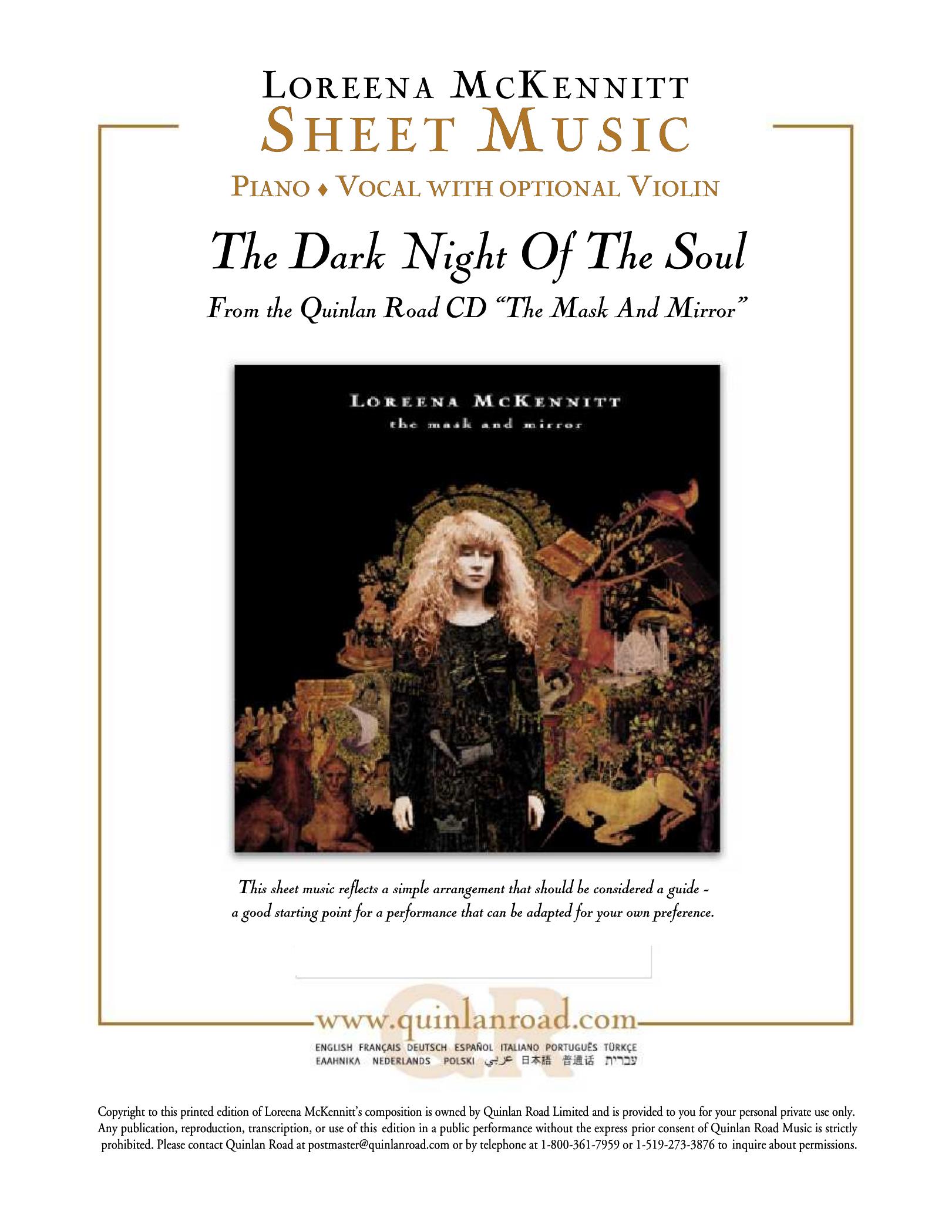
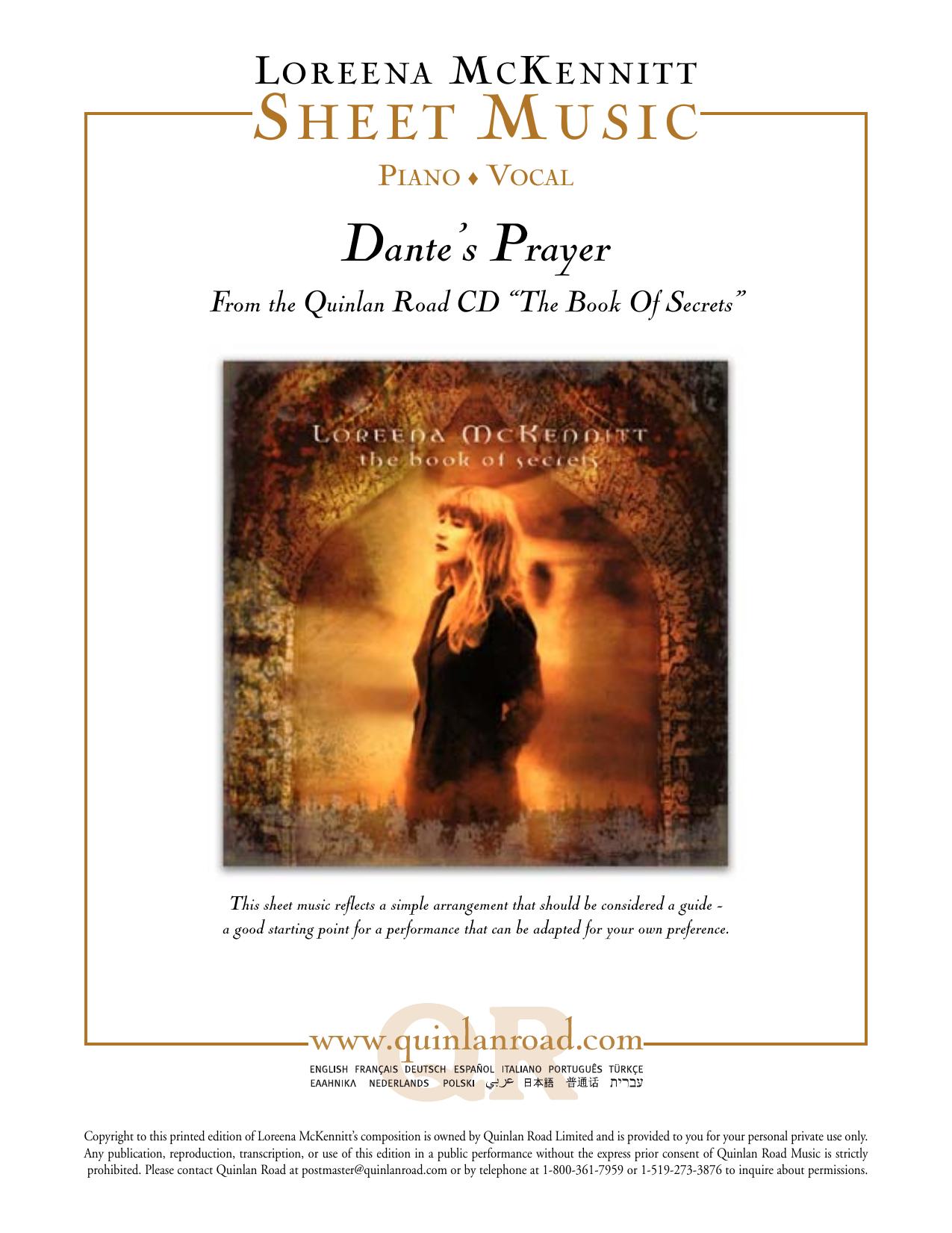
The albums that followed—To Drive the Cold Winter Away (1987), Parallel Dreams (1989), and especially The Visit (1991)—established her signature sound. The Visit was her breakthrough, a “quietly majestic tapestry of worldbeat and Celtic pop” that earned her a groundbreaking distribution deal with Warner Music Canada and introduced her to a global audience. Its success was surpassed by The Mask and Mirror (1994), an album shaped by research in Galicia and the Arabic roots of that Celtic region of Spain, and then by The Book of Secrets (1997), recorded at Peter Gabriel’s Real World Studios and featuring the international hit “The Mummers’ Dance”. The Book of Secrets sold over four million copies worldwide, topped the Billboard World Music chart, and became that chart’s most successful crossover album ever, debuting at number one in Greece and Turkey and reaching the top ten in Canada, Italy, New Zealand, and Germany.
In July 1998, McKennitt’s life was shattered by personal tragedy. Her fiancé, Ronald Rees, his brother Richard, and their close friend Gregory Cook drowned in a boating accident on Georgian Bay. McKennitt founded the Cook-Rees Memorial Fund for Water Search and Safety in the same year, and proceeds from the live album Live in Paris and Toronto were donated to the fund, eventually raising some three million dollars. She withdrew from public performance and released no new recordings for several years, a period of grief and reorientation that makes her later return to music all the more remarkable.
She began working on new material in 2005, and in 2006 released An Ancient Muse, an album inspired by travels along the Silk Road and among the cultures of the Mediterranean and the Middle East. The album earned a Grammy nomination and marked the beginning of a new phase of touring and recording. Subsequent releases—A Midwinter Night’s Dream (2008), The Wind That Shakes the Barley (2010), Troubadours on the Rhine (2012), Lost Souls (2018), and Under a Winter’s Moon (2022)—have consolidated her reputation as an artist who can move between original compositions, traditional Celtic material, seasonal music, and live performance without ever losing her distinctive voice. In 2023 she was inducted into the Canadian Songwriters Hall of Fame, and in 2025 into the Canadian Music Hall of Fame.
Musical Style and Technique: A Harmony of Worlds
The Voice
At the center of McKennitt’s music is her voice: a refined, clear soprano, often described as “crystalline” and “ethereal” but possessing a strength and control that distinguish it from the more breathy delivery of some of her contemporaries. Her classical training is audible in her breath management, her consistent tone across her range, and her ability to shift between what she has called different “colors and textures” of vocal production. She is capable of a dramatic soprano range, and her singing can move from the intimate closeness of a ballad to the soaring, almost liturgical intensity of a piece such as “Dante’s Prayer” or “The Mystic’s Dream”.
Crucially, McKennitt’s voice is almost never treated as a conventional pop lead vocal. She often multi-tracks her voice, layering harmonies and creating a choir-like texture that reinforces the sense of antiquity and ritual in her music. In live performance, her vocals are often supported by a band that includes cello, violin, guitar, and a range of percussion, but the voice remains the gravitational center of the sound.
Instrumentation and Texture
McKennitt is a multi-instrumentalist: she plays piano, harp, and accordion, and she is particularly associated with the Troubadour lever harp, a pedal-free instrument designed for travel and durability. The harp is not merely an accompanying instrument in her music; it is a timbral signature. Its plucked, decaying tones create a sense of space and antiquity that synthesizers cannot easily replicate, and its presence anchors even her most elaborately arranged pieces in a recognizable acoustic world.
Beyond the harp, McKennitt’s arrangements draw on an unusually broad instrumental palette. Her albums have featured uilleann pipes, fiddle, bouzouki, hurdy-gurdy, oud, tabla, sitar, cello, balalaika, and various synthesizers and drones. The effect is not eclecticism for its own sake but a carefully controlled fusion: instruments from different traditions are used to create a unified atmosphere of travel and cultural encounter. The sitar and harp, for example, are superimposed over a low synth drone in “Cymbeline,” a combination that lays out the melodic material of the vocal line while also suggesting that “multiple musical idioms can conjoin to make a broader musical whole”.
Harmony and Modality
The harmonic language of McKennitt’s music is one of its most distinctive features, and it is here that her classical training and her folk instincts intersect most clearly. Her music is fundamentally modal rather than tonal in the conventional pop sense. She makes extensive use of modal scales, including Dorian, Mixolydian, and Aeolian, and she often avoids the leading-tone-based harmonies that define most popular music. This absence of the leading tone is not a technical accident; it is what shifts her music “out of the normative tonality of much popular music and into the folk/antique idiom”.
In analytical terms, McKennitt’s harmonic practice can be understood through several recurring strategies. First, she frequently employs drones and pedal points, sustained bass notes that provide a stable foundation while the upper voices move through modal inflections. This is a technique common to both Celtic folk music and various Middle Eastern traditions, and it contributes to the hypnotic, ritual quality of much of her work. Second, she uses parallel motion, including parallel fifths and octaves, which in classical tonal harmony would be considered errors but in modal and folk contexts create a sense of archaic sonority and collective singing.
Third, McKennitt’s harmonic language is marked by a careful use of chromatic inflection within a modal framework. In some of her pieces, a single pitch-class is altered in the harp tuning to change the color of a modal harmony, creating a subtle but perceptible shift in emotional register without abandoning the modal center. This technique allows her to achieve harmonic variety and tension without recourse to the functional chord progressions of tonal music.
The result is a harmonic language that feels both ancient and strangely modern: ancient because it draws on pre-tonal modal traditions, modern because it refuses the teleological drive of tonal harmony and instead creates atmosphere through stasis, repetition, and timbral color. It is a harmonic world in which a chord does not need to “go” anywhere; it can simply be inhabited.
Literary Adaptation as a Compositional Method
McKennitt’s approach to text is inseparable from her musical style. She is known for setting to music the words of poets and writers from across centuries—William Shakespeare, Alfred Lord Tennyson, W. B. Yeats, Dante, St. John of the Cross, Sir Walter Scott, Archibald Lampman, and Alfred Noyes, among others. Her method is not to impose a pre-existing musical form onto a poem but to allow the poem’s rhythm, imagery, and emotional arc to shape the musical setting. As one critic has put it, her approach is “to take traditional Celtic folk songs or literary works, and adapt them to her own music without sacrificing the mood or dignity of their historic significance”.
This literary orientation has had an interesting effect on her critical reception. Reviewers have often devoted more attention to her choice of texts than to her musical innovations, and fans likewise tend to discuss the literary sources of her songs more than their harmonic or structural features. Yet the literary dimension is not separate from the musical one: the length and structure of the poems she chooses—Tennyson’s “The Lady of Shalott,” for example, runs to nearly twelve minutes in her setting—invite extended, through-composed musical forms that would be unusual in conventional pop songwriting. Her music is, in this sense, closer to the tradition of the art song or the ballad than to the three-minute pop single, even when it incorporates rock and world-music rhythms.
The Essential Compositions
Any account of McKennitt’s best work must begin with the songs that have become signatures, but her catalogue is deeper than the familiar highlights.
“The Mummers’ Dance” (from The Book of Secrets, 1997) is her most commercially successful composition and the song that introduced her to a mass audience. Inspired by the seasonal mumming traditions of the British Isles—house-to-house performances involving disguise, dance, and ritual—the song blends Celtic instrumentation with a gently insistent worldbeat groove. It received heavy airplay in North America, was used as the theme for the short-lived television series Legacy, and appeared in the trailer for the 1998 film Ever After. Its success on MTV and cross-format radio made it a rare example of a world-music-adjacent song crossing into the pop mainstream without compromising its stylistic identity.
“The Mystic’s Dream” (from The Mask and Mirror, 1994) is perhaps the purest distillation of McKennitt’s aesthetic. It opens with a wordless, arrhythmic cry in a double harmonic scale—sometimes called the Byzantine scale—before settling into a hypnotic, modal groove. The song’s combination of Celtic harp, Middle Eastern modalities, and layered vocals creates a soundscape that feels simultaneously ancient and cinematic. It was later used in the soundtrack of the film Jade (1995) and became the title music for the TNT miniseries The Mists of Avalon (2001), confirming its status as one of her most evocative compositions.
“The Lady of Shalott” (from The Visit, 1991) is a setting of Tennyson’s Arthurian poem that runs to nearly twelve minutes. It is a test case for McKennitt’s literary method: the poem’s narrative of isolation, art, and doomed love is matched by a musical setting that moves through several distinct sections, using modal harmonies and restrained instrumental accompaniment to sustain tension across an extended span. McKennitt has said that in composing the piece she was paying tribute not only to Tennyson but also to the southern, Moorish influences on Arthurian legend, a characteristic example of her desire to trace cultural connections across geographies.
“Bonny Portmore” is a traditional Irish song that McKennitt arranged and recorded; her version became widely known after it was featured in Highlander III: The Sorcerer (1994) and subsequently on the Highlander soundtrack. It is a lament for the destruction of ancient oak forests, and McKennitt’s rendition—spare, mournful, and built around her voice and harp—demonstrates her ability to inhabit traditional material without overburdening it.
“Caravanserai” (from An Ancient Muse, 2006) represents the Silk Road phase of her career. With its “seductive rhythms and Silk Road influences,” the song evokes the caravanserais of the Ottoman world, the roadside inns where travelers and merchants from disparate cultures met and exchanged stories. It is a musical travelogue in miniature, and it shows how McKennitt’s research-based method can yield music that is both specific in its cultural references and accessible to listeners who may not know the history behind it.
“Dante’s Prayer” (from The Book of Secrets) is a setting of words from Dante’s Divine Comedy, and it has become one of her most beloved songs. Its slow, processional pace, its use of drone and layered vocals, and its movement toward a quiet but intense climax exemplify her ability to create spiritual intensity without conventional religious sentimentality.
“Penelope’s Song” (from An Ancient Muse) takes Homer’s Odyssey as its starting point, giving voice to Penelope’s patient waiting. It is a good example of McKennitt’s interest in the feminine perspective within epic narratives, a theme that runs through much of her work.
Other compositions that deserve mention include “All Souls Night” and “Tango to Evora” from The Visit, “The Bonny Swans” (based on the traditional ballad “The Twa Sisters”) from The Mask and Mirror, “Skellig” and “The Mummers’ Dance” from The Book of Secrets, “The Gates of Istanbul” from An Ancient Muse, and “The Wind That Shakes the Barley” from the album of the same name. Her seasonal music—including “Coventry Carol,” “God Rest Ye Merry Gentlemen,” and the songs gathered on A Winter Garden and Under a Winter’s Moon—has also become a significant part of her catalogue, demonstrating that her aesthetic can illuminate familiar material as effectively as it can obscure literary texts.
Music for Film and Television
McKennitt’s music has a strong cinematic quality—its atmosphere, its sense of narrative pacing, and its use of instrumental color all lend themselves to visual media—and it is therefore not surprising that her work has been used in a number of films and television productions.
Her first screen credit came in 1990, when she provided music for the National Film Board of Canada documentary The Burning Times, a feminist revisionist account of the Early Modern European witchcraft trials. The main theme she composed for that documentary was later re-recorded on The Visit as “Tango to Evora”.
Her music reached a wider film audience in the mid-1990s. “Bonny Portmore” was featured in Highlander III: The Sorcerer (1994) and became associated with the Highlander franchise; the film’s soundtrack also used her song “The Two Trees” and the piece “Ce He Mise Le Ulaingt?”. In 1995, “The Mystic’s Dream” was included in the soundtrack of the film Jade, directed by William Friedkin, and it has since become one of her most widely licensed compositions.
In 2001, McKennitt’s music provided the main title theme for the TNT miniseries The Mists of Avalon, an adaptation of Marion Zimmer Bradley’s Arthurian novel. “The Mystic’s Dream” served as the title music, and the soundtrack album included her song alongside Lee Holdridge’s score. The association with Arthurian legend was a natural fit for an artist whose work so often draws on the Matter of Britain.
In 2008, McKennitt contributed both music and narration to Disney’s direct-to-video animated film Tinker Bell. She wrote and composed “To the Fairies They Draw Near” as the theme song and also provided narration for the film. The collaboration introduced her music to a younger audience and demonstrated her ability to adapt her aesthetic to a different kind of storytelling.
Her music has also appeared in films such as The Santa Clause, Soldier, and Holy Man, and in television series including Due South and Roar. In 2007, her concert at the Alhambra in Spain was filmed and released as Nights from the Alhambra, which aired on PBS as part of its Great Performances series. While McKennitt has not pursued a conventional career as a film composer, her music’s presence in visual media has been significant, and it has helped to define the popular sound of “Celtic mysticism” in film and television.
Collaborations and the Musical Community
McKennitt’s career has been defined by independence, but it has not been solitary. Her music has been shaped by a close circle of long-term collaborators, and she has also worked with a range of guest musicians from different traditions.
The most important of these collaborators is Brian Hughes, a guitarist and producer who has worked with McKennitt for over twenty years. Hughes has co-produced many of her recordings, led her touring band, and contributed guitar, guitar synthesizer, and balalaika to albums including The Visit and The Book of Secrets. He was nominated for a Juno Award as Producer of the Year in 1991 for his work on The Visit. The McKennitt–Hughes partnership is one of the enduring creative relationships in her career, and his guitar work—whether acoustic, electric, or synthesized—is a key element of her sound.
Caroline Lavelle, a cellist and singer, has been another essential collaborator since the mid-1990s. She began recording and touring with McKennitt in 1995 and has appeared on albums including A Winter Garden, An Ancient Muse, and Under a Winter’s Moon. Her cello provides a low, singing counterweight to McKennitt’s soprano, and the two instruments often intertwine in arrangements that feel both classical and folk-derived.
Other regular collaborators include Hugh Marsh on violin, George Koller on bass and various instruments, Patrick Hutchinson on uilleann pipes, and Cedric Smith, who has contributed recitation to several recordings. On An Ancient Muse, McKennitt worked with a group of Armenian and Greek musicians, including Haig Yazdjian, Panos Dimitrakopoulos on qanun, Sokratis Sinopoulos on lira, Georgios Kontogiannis on bouzouki, and the percussion ensemble Krótala, reflecting her commitment to collaborating with musicians from the cultures she explores.
In 2012, McKennitt released Troubadours on the Rhine, a trio recording with Hughes and Lavelle that captured a stripped-down, intimate performance at the German radio station SWR1. The album was nominated for a Grammy for Best New Age Album and stands as a testament to the chemistry of this core trio. McKennitt has also lent her support to charitable and collaborative projects, including a 2012 performance at Carnegie Hall in aid of Kate Winslet’s Golden Hat Foundation, alongside artists such as Sarah McLachlan, Andrea Corr, and Hayley Westenra.
Influences: Literature, Travel, and the Celtic Diaspora
McKennitt’s influences are unusually diverse, and they are not limited to music. Her work is shaped by three intertwined sources: literature, travel, and the history of the Celtic peoples.
Her literary influences are the most visible. She has set to music the words of Shakespeare, Tennyson, Yeats, Dante, St. John of the Cross, Blake, Scott, Lampman, and Noyes, and she has spoken of her collaboration with “a wonderful number of dead poets” as one of the defining pleasures of her career. But her relationship to literature is not merely decorative. She uses poems as structures for musical composition, allowing their rhythms and images to determine the shape of her songs. This literary orientation distinguishes her from many of her contemporaries in the world-music field, and it has attracted a devoted audience that values her work as much for its textual richness as for its sound.
Her travels have been equally formative. Before composing an album, McKennitt engages in extensive research on a specific subject, and this research often involves travel. She traveled to Ireland for inspiration before Elemental and Parallel Dreams; she studied Galicia and its Arabic roots before The Mask and Mirror; she explored the Silk Road and the cultures of the Mediterranean and the Middle East before An Ancient Muse; and her travels have taken her to China, Mongolia, Turkey, and North Africa, as well as on a trans-Siberian train journey across the former Soviet Union. She describes her work as a form of “musical travel writing,” and the phrase is apt: her albums are not anthropological documents but imaginative responses to the places and histories she encounters.
Her understanding of “Celtic” is similarly expansive. Rather than treating Celtic music as a fixed repertoire associated with Ireland, Scotland, and Wales, she approaches it as a diasporic and global phenomenon, one that has interacted with Arabic, Mediterranean, and Eastern European traditions over centuries. This broad conception of Celtic identity is one of her most important contributions to contemporary music: she has helped to loosen the category from its narrow associational meanings and opened it to a wider range of historical and geographical connections.
Among her musical influences, she has cited Joni Mitchell, Gordon Lightfoot, Buffy Sainte-Marie, and Sylvia Tyson, as well as the traditional music she encountered in Ireland and the folk music she discovered in Winnipeg. Her classical training in voice and piano is audible in her arrangements, and her interest in early music and modal traditions has shaped her harmonic language. The result is an influence profile that is unusually broad for a popular musician, and it helps to explain why her music resists easy categorization.
Legacy: Independence, Scholarship, and the “Modern Bard”
Loreena McKennitt’s legacy operates on several levels. The most obvious is commercial and institutional: she has sold more than fourteen million albums, earned gold and platinum certifications in fifteen countries across four continents, won two Juno Awards, received two Grammy nominations, and been inducted into both the Canadian Songwriters Hall of Fame and the Canadian Music Hall of Fame. She has performed for Queen Elizabeth II, at the Vancouver Winter Olympics opening ceremony, and at historic venues including the Alhambra Palace, Carnegie Hall, and the Royal Albert Hall.
But her significance extends beyond sales and awards. McKennitt was one of the first major artists to demonstrate that a musician could build an international career while retaining complete ownership of her recordings and her business. Quinlan Road, which she founded in 1985 and still operates, is a model of independent artistic entrepreneurship, and her willingness to speak at industry conventions and advocate for copyright reform has made her an important voice for artists’ rights. She has also been active as a philanthropist, founding the Cook-Rees Memorial Fund for Water Search and Safety, purchasing and transforming a closed public school into the Falstaff Family Centre in Stratford, and supporting cultural, environmental, and social causes through the Three Oaks Foundation.
Her musical legacy is perhaps best understood through the idea of the “modern bard,” a phrase that critics have used to describe her. McKennitt is not a folklorist in the strict sense; she does not claim to reproduce traditional music authentically, and she has sometimes been criticized for creating a polished, accessible version of ancient cultures. But she is a storyteller who uses music to carry the voices of the past into the present. Her settings of poems, her adaptations of traditional songs, and her musical travelogues across the Celtic world and the Silk Road have introduced millions of listeners to literatures and histories they might otherwise never have encountered. She has made antiquity feel contemporary without making it feel trivial.
Her influence can be heard in the work of later Celtic and world-music artists, and her music has become part of the broader cultural vocabulary of “Celtic mysticism” that shapes film, television, and popular spirituality. But her most important legacy may be the example she sets: an artist who has remained uncompromisingly herself, who has built a career on curiosity rather than trend-following, and who has demonstrated that a deep engagement with history and literature can be not a retreat from the contemporary world but a way of illuminating it.
At a time when popular music is often driven by algorithmic brevity and manufactured immediacy, McKennitt’s long, modal, literary, and patiently constructed songs stand as a reminder that music can still be a form of travel, a form of scholarship, and a form of communion with the dead. She is, in the truest sense, a modern bard—and her song continues to carry across the centuries.
Listen to Loreena McKennitt music on Spotify
Browse in the Sheet Music Library:
Or browse in the categories menus & download the Library Catalog PDF: