
Table of Contents
Scores for all instruments: 16,000+ (active and growing), over 236,000 pages.
All genres and levels: Jazz & Blues, Rock & Pop, Classical & Contemporary, Film & Musicals;
books & biographies; methods, études, play-along tracks (MP3) for Jazz & Rock.
Access & benefits: US$15.99 one-time payment, valid for lifetime, full Library access.
Scores for all instruments: 16,000+ (active and growing), over 236,000 pages.
All genres and levels: Jazz & Blues, Rock & Pop, Classical & Contemporary, Film & Musicals;
books & biographies; methods, études, play-along tracks (MP3) for Jazz & Rock.
Access & benefits: US$15.99 one-time payment, valid for lifetime, full Library access.
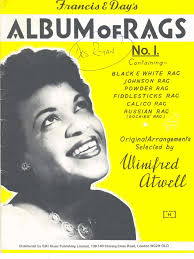
Winifred Atwell: Black and White Rag, sheet music, Noten, partitura, partition, spartiti

The best sheet music download from our Library.
Please, subscribe to our Sheet Music Library.
Search your favorite sheet music in the Sheet Music Library Catalog
Who as Winifred Atwell?
Una Winifred Atwell (27 February or 27 April 1910 or 1914 – 28 February 1983) was a pianist and composer born in the country of Trinidad who migrated to Britain. He enjoyed great popularity in Britain and Australia from the 1950s with a series of boogie-woogie and ragtime hits, selling over 20 million records. She was the first black artist to have a number-one hit in the UK singles chart and had the first piano instrumental to reach number one in the UK singles chart, with "Let's Have Another Party" in 1954. As of 2023, she remains the only female instrumentalist to do so.
Biography
Early Life and Classical Foundations
- Birthplace: Born in Tunapuna, Trinidad and Tobago. Her exact birth year remains uncertain across official records, fluctuating between 1910 and 1915.
- Child Prodigy: She began practicing the piano at age four, playing Chopin recitals for charity concerts by her youth.
- The Pharmacist: Her parents operated a local pharmacy. At her father's insistence, she earned a degree in pharmacy and worked in the family shop before pursuing music professionally.
- Formal Education: After playing for troops in Trinidad during World War II, she moved to New York to study classical technique with Alexander Borovsky. In 1946, she migrated to London, enrolling at the Royal Academy of Music where she became the first woman to earn the institution's highest grade for musicianship.
Rise to Fame and the "Other Piano"
- The Big Break: To fund her studies, she performed in London dance halls and clubs. In 1948, she stepped in as a last-minute substitute for an ailing performer at a London Casino charity concert, mesmerizing the audience and earning a contract with theater impresario Bernard Delfont.
- Signature Sound: While highly proficient in classical works, she found monumental success playing rollicking boogie-woogie and ragtime music.
- Dual Pianos: Her signature performance style involved starting a concert on a pristine grand piano before moving over to her “other piano”—a battered, deliberately out-of-tune upright bought for just 50 shillings.
- Management: In 1947, she married variety artist Lew Levisohn. He stepped away from his own career to manage her, famously encouraging her switch to ragtime and cultivating her iconic stage persona. [1, 2, 3, 4, 5, 6]
Chart Success and Historical Milestones
- Making History: In 1954, Atwell made UK chart history when her piano instrumental medley, "Let's Have Another Party," shot to number one. She scored a second number-one hit in 1956 with "The Poor People of Paris".
- Chart Longevity: Between 1952 and 1960, she spent 117 weeks in the UK charts and secured 11 top-ten hits. Her popular rendition of George Botsford’s "Black and White Rag" later gained massive multi-generational fame as the theme song for the BBC snooker tournament show, Pot Black.
- Royal Favor: She was a favorite of the British Royal Family, performing at three Royal Variety Performances and giving private sets for Queen Elizabeth II at Buckingham Palace.
- Television Pioneer: She became a major television personality, fronting her own popular broadcast series on both the BBC and ITV networks during the mid-to-late 1950s.
Entrepreneurship and Later Years
- Brixton Salon: Beyond her musical pursuits, Atwell was a sharp entrepreneur. Utilizing her background as a trained chemist, she opened the UK’s first dedicated Black hair and beauty salon in Brixton in 1956, providing tailored products and empowering Afro-Caribbean women.
- Relocation to Australia: Having toured Australia extensively to adoration from fans, she and her husband officially retired to Sydney in 1970. Despite the country's restrictive “White Australia” immigration policy at the time, she was granted residency due to her global prestige and was later granted full citizenship in 1981.
- Passing: Following her husband's death in 1977, her health declined. She passed away from a heart attack in Sydney on February 28, 1983.
Legacy
Winifred Atwell broken open racial, gender, and musical barriers in mid-century Britain. To preserve her lasting impact on British culture, English Heritage officially honored her with a prestigious blue plaque at her former home in Mayfair, London.
Winifred Atwell Discography
Albums
- Double Seven – Seven Rags Seven Boogies (1956), UK London Records
- Chartbusters – Winifred Atwell, Music for Leisure
Charting singles
- "Britannia Rag" (1952) – UK No. 5
- "Coronation Rag" (1953) – UK No. 5
- "Flirtation Waltz" (1953) – UK No. 10
- "Let's Have a Party" (1953) – UK No. 2
- "Rachmaninoff's 18th Variation on a Theme by Paganini (The Story of Three Loves)" (1954) – UK No. 9
- "Let's Have Another Party" (1954) – UK No. 1
- "Let's Have a Ding Dong" (1955) – UK No. 3
- "The Poor People of Paris" (1956) – UK No. 1
- "Port-au-Prince" (1956) – UK No. 18
- "Left Bank (C'Est A Hamburg)" (1956) – UK No. 14
- "Make It a Party" (1956) – UK No. 7
- "Let's Rock 'N' Roll" (1957) – UK No. 24
- "Let's Have a Ball" (1957) – UK No. 4
- "Moonlight Gambler" (1957) – US No. 16 (Music Vendor)
- "Dawning" (1958) – US No. 95 (Music Vendor)
- "The Summer of the Seventeenth Doll" (1959) – UK No. 24
- "Piano Party" (1959) – UK No. 10
- "Mexico City" (1966)
- "Five Finger Boogie" and "Rhapsody Rag" (Philips PB 182)
- "Moonlight Fiesta" and "18th Variation on a Theme of Paganini" (Philips PB 234)
Browse in the Sheet Music Library:
Or browse in the categories menus & download the Library Catalog PDF: