Come join us now, and enjoy playing your beloved music and browse through great scores of every level and styles!
Can’t find the songbook you’re looking for? Please, email us at: sheetmusiclibrarypdf@gmail.com We’d like to help you!
Table of Contents
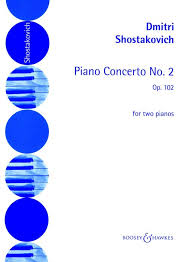
Shostakovich Piano Concerto N 2 Andante For 2 Pianos sheet music, Noten, partitura, spartiti, 楽譜, 乐谱
Best Sheet Music download from our Library.
Please, subscribe to our Sheet Music Library.
If you are already a subscriber, please, check our NEW SCORES’ page every month for new sheet music. THANK YOU!
Of all the works in Dmitri Shostakovich’s vast and turbulent oeuvre, his Piano Concerto No. 2 in F Major, Op. 102 stands as a delightful, and often deceptive, outlier. Composed not for the Soviet state nor as a covert act of dissidence, but as a 19th birthday gift for his son, Maxim, the concerto radiates a youthful exuberance and neoclassical charm that belies the composer’s more familiar, angst-ridden voice. Yet, to dismiss it as mere lighthearted fodder is to miss the layers of wit, craftsmanship, and profound tenderness that have secured its enduring place in the concert hall.
A Father’s Gift: The Story Behind the Music
The year was 1957. Shostakovich, having navigated the treacherous waters of Soviet censure and rehabilitation, was in a period of relative creative freedom. His son, Maxim, was a talented pianist studying at the Moscow Conservatory. For his birthday, the doting father composed a concerto that Maxim could perform, one that was both technically impressive and joyfully accessible.
Shostakovich himself described the piece with characteristic self-deprecation, calling it a work with “no artistic merit.” He premiered it himself, with his son conducting the Moscow Philharmonic, in a touching reversal of the usual roles. This personal genesis is key to understanding the concerto’s character. It is, first and foremost, music of affection, free from the heavy burdens of political subtext that weigh on so many of his other works.
A Neoclassical Joyride: Style and Structure
The concerto is a masterful exercise in neoclassicism, harking back to the clear forms and sprightly energy of the 18th century, but filtered through a distinctly 20th-century harmonic lens.
First Movement (Allegro)
The opening is one of the most recognizable in the repertoire: a sprightly, almost cheeky trumpet and woodwind fanfare, immediately answered by the piano’s energetic entry. The movement is structured in a clear sonata-allegro form, but it’s the spirit that captivates. The piano writing is percussive and brilliant, full of scales, arpeggios, and crisp passage work that sparkles with youthful virtuosity. It’s playful, optimistic, and irresistibly propulsive.

Second Movement (Andante)
This is the heart of the concerto, and one of the most beautiful and haunting melodies Shostakovich ever wrote. In a stark contrast to the outer movements, the piano enters alone with a simple, chorale-like theme of sublime, aching beauty. The strings then join, swelling with a romantic passion that feels both deeply personal and universally moving. This movement transcends its neoclassical framework, revealing the profound emotional depth that Shostakovich could access, even in a “light” work. It’s a moment of pure, unguarded lyricism, a father’s lullaby for his grown son.
Third Movement (Allegro)
The finale is a whirlwind of a rondo, bursting with the energy of a circus gallop. It’s rhythmically driven, harmonically cheeky, and demands formidable technical skill from the soloist. The movement is filled with witty quotes and parodies, including a passage that bears a suspicious (and likely intentional) resemblance to the “Sabre Dance” from Khachaturian’s Gayane. It builds to a breakneck coda that concludes the concerto in a blaze of unadulterated joy.
Harmonies and Influences: Between Classicism and Modernity
While the concerto’s surface is predominantly tonal and accessible, Shostakovich’s signature harmonic quirks are ever-present. He employs biting dissonances, unexpected modulations, and a percussive use of the piano that grounds the music firmly in the 20th century. The influence of Prokofiev, another master of neoclassical wit and motoric rhythms, is palpable, particularly in the outer movements.
However, the ghost of J.S. Bach also looms large, not just in the structural clarity but explicitly in the piano’s baroque-style figurations in the first movement. Shostakovich seamlessly blends these influences—the order of Bach, the playfulness of Prokofiev, and his own unique voice of melancholic lyricism and sharp-witted satire—into a cohesive and original whole.
Impact and Legacy: From Soviet Russia to Global Icon
Upon its premiere, the concerto was an immediate success. Its direct emotional appeal and brilliant writing made it a favorite with audiences and a coveted showpiece for pianists. For a time, it was sometimes criticized by Western modernists for its “conservative” and “accessible” style, a charge often leveled at Shostakovich during the Cold War.
Yet, its legacy has only grown. The concerto’s impact was significantly amplified by its use in the 1999 French film “The Talented Mr. Ripley,” where the sublime second movement provides the soundtrack to a scene of both opulent beauty and underlying menace. This introduction brought the piece to a new, global generation, cementing the Andante as a modern classical “hit.”

Today, the Piano Concerto No. 2 holds a dual legacy.
- A Repertoire Staple: It remains one of the most frequently performed piano concertos of the 20th century. Its combination of technical dazzle and heartfelt melody makes it a guaranteed crowd-pleaser and a rite of passage for aspiring pianists.
- A Glimpse of the Private Shostakovich: In a catalog filled with symphonies that are frequently interpreted as secret protests against tyranny, the Second Piano Concerto offers a precious look at the man behind the public figure. It is a testament to his capacity for joy, his deep love for his family, and his masterful ability to write music that is, quite simply, beautiful and life-affirming.
In the end, Shostakovich’s Piano Concerto No. 2 endures not in spite of its apparent simplicity, but because of the profound humanity that lies within it. It is a work that reminds us that even the most complex and tormented artists can, and must, find moments of pure, uncomplicated joy. It is a gift from a father to a son that has become a timeless gift to the world.
Browse in the Library:
Or browse in the categories menus & download the Library Catalog PDF: