Come join us now, and enjoy playing your beloved music and browse through great scores of every level and styles!
Can’t find the songbook you’re looking for? Please, email us at: sheetmusiclibrarypdf@gmail.com We’d like to help you!
Table of Contents
Search your favorite sheet music in the Sheet Music Catalog
Please, subscribe to our Sheet Music Library.
If you are already a subscriber, please, check our NEW SCORES’ page every month for new sheet music. THANK YOU!
Toshio Hosokawa: The Sound of Silence, the Calligraphy of Sound
Toshio Hosokawa stands as one of the most significant and distinctive voices in contemporary classical music. His work represents a profound and elegant synthesis of the philosophical and aesthetic traditions of his native Japan with the technical and formal complexities of the European avant-garde. He is not merely a composer who uses Japanese themes; he is an artist who has fundamentally reoriented the very materials of Western music—sound, silence, and time—through a lens shaped by Zen Buddhism, calligraphy, and the ancient art of the garden. To explore Hosokawa’s world is to enter a realm where music becomes a living organism, a meditation, and a spiritual journey.
Biography: A Journey Between Two Worlds
Toshio Hosokawa was born on October 23, 1955, in Hiroshima. The post-war environment of his childhood, in a city that had experienced profound destruction, inevitably shaped his consciousness. While he was not a direct witness to the atomic bombing, the collective memory of loss and the imperative for rebirth and peace became a subtle undercurrent in his later work. He began studying piano at a young age, and his early musical diet was predominantly Western: Beethoven, Chopin, and later, the Russian modernists.
His compositional journey began in Japan under the tutelage of Yun Isang (Isang Yun), a Korean composer who was himself a master of synthesizing Eastern philosophical concepts (notably Taoist ideas of tension between opposites) with European modernism. Yun’s influence was pivotal, providing Hosokawa with a technical foundation in serialism and avant-garde techniques while simultaneously encouraging him to find his own cultural voice.
In 1976, Hosokawa moved to Europe to continue his studies, first at the Hochschule für Musik Berlin and later at the Hochschule für Musik Freiburg, where he worked with another towering figure, Klaus Huber. The European avant-garde scene of the 1970s, with its intense focus on deconstruction and complex notation, was both a stimulus and a point of resistance for Hosokawa. He felt a growing disconnect between this intellectualized music and his own inner world. A period of creative crisis ensued, which was only resolved when he consciously decided to turn back to his Japanese roots.
This “return to the source” was not a rejection of his European training but a transformative integration of it. He began to study traditional Japanese arts in depth: Gagaku (the ancient imperial court music), Shōmyō (Buddhist chant), and the Noh theater. More importantly, he immersed himself in the aesthetics of Zen, particularly the concepts of ma (the space or interval between things, a pregnant silence), yūgen (a profound, mysterious grace and beauty), and wabi-sabi (the beauty of imperfection and transience).
Since the 1980s, Hosokawa has built an international career, receiving numerous commissions from prestigious ensembles, opera houses, and festivals worldwide. He has served as Composer-in-Residence for the Tokyo Symphony Orchestra and the Festival d’Aix-en-Provence, among others. His status as a cultural ambassador, bridging East and West, is firmly established.
Music Style and Aesthetic Philosophy
Hosokawa’s music is instantly recognizable. It is not a style built on melody or rhythm in the conventional sense, but on the behavior of sound itself. His aesthetic can be understood through several key principles:
- Music as a Living Organism: Hosokawa often describes his music in biological terms. Sounds are like seeds, blossoms, or living cells. They are “born” from silence, they grow, breathe, mutate, interact with other sounds, and eventually decay back into silence. A single note is not a static event but a process with its own birth (attack), life (sustain, fluctuation), and death (decay). This creates a music of immense fragility and intense, focused energy.
- The Primacy of Silence (Ma): In Hosokawa’s universe, silence is not an empty void but a charged, creative field. It is the canvas upon which sound is painted. The spaces between sounds are as important as the sounds themselves. This creates a temporal experience that feels suspended, meditative, and deeply spacious, akin to the empty spaces in a Zen ink painting.
- The Calligraphy of Sound: This is one of his most central metaphors. He envisions the musical line as a brushstroke. A single tone from a violin or a shakuhachi (Japanese bamboo flute) is not played evenly; it is shaped with microtonal inflections, dynamic swells, breath noises, and tremolos, much like a calligrapher varies the pressure, speed, and ink saturation of the brush. The line is alive, expressive, and embodies the spirit of the moment of its creation.
- Landscape and Garden: Many of his works are inspired by nature, but not in a picturesque, Romantic way. For Hosokawa, composing is like designing a Japanese garden. He places “sonic objects” (a cluster of strings, a percussion gesture, a flute melody) in a musical space, carefully considering their relationship, balance, and the paths the listener’s ear will travel between them. The composition is a curated experience of a spiritual and auditory landscape.
Harmony, Chord Progressions, and Improvisational Licks
It is crucial to understand that traditional Western concepts of functional harmony and chord progressions are largely irrelevant to Hosokawa’s music. He does not build tension and release through harmonic cadences. Instead, his harmonic language is one of sonority and texture.
- Sound Clouds and Clusters: His music is often constructed from dense, static clusters—groups of closely spaced notes played by strings or winds. These clusters are not chords in a progression; they are sonic environments, like mist or a dense forest. They shimmer, pulsate, and slowly transform over time.
- The “In-Between” Sounds (Noise as Music): Influenced by both the European musique concrète tradition and Japanese aesthetics that embrace imperfection, Hosokawa incorporates a vast array of non-pitched sounds. This includes breath sounds in wind instruments, the scraping of a bow on a string instrument’s wood, key clicks, and the rustling of percussion. These are not effects but essential elements of his sonic palette, representing the raw, unrefined aspects of nature.
- Microtonality and Pitch Bending: His melodies are rarely diatonic. They weave through microtonal intervals, creating a sense of fluidity and organic growth. This is where the “improvisational licks” concept finds its place. While his music is meticulously notated, it is designed to sound improvisatory. A solo line for shakuhachi or cello will be filled with rapid flurries, pitch bends, sudden dynamic explosions, and moments of near-silence, mimicking the free, spontaneous flow of an improvisation. The “lick” is not a pre-learned pattern but a notated instruction to engage in a specific, highly expressive sonic gesture—a cry, a sigh, a gust of wind.
Influences
Hosokawa’s influences are a tapestry woven from East and West:
- Traditional Japanese Arts: Gagaku (for its slow, ritualistic pace and unique tonal system), Noh theater (for its stylized movement and spiritual intensity), Shakuhachi music (for its breath-based phrasing and expressive noise), and Zen Buddhism (providing the philosophical foundation).
- European Modernism: The Second Viennese School (Schoenberg, Berg, Webern) for their fragmentation of melody and emphasis on Klangfarbenmelodie (melody of tone colors). The post-war avant-garde, particularly composers like Luigi Nono, whose late works explore sound and silence with a profound spiritual and political dimension, was a significant influence. His teacher, Isang Yun, provided the initial model for cultural synthesis.
- Toru Takemitsu: Hosokawa is often seen as the spiritual successor to Takemitsu. While both share a deep connection to Japanese aesthetics, Hosokawa’s music is often more stark, raw, and directly engaged with the principles of calligraphy and Zen than Takemitsu’s sometimes more impressionistic sound world.
Cooperation with Other Artists
Hosokawa is a collaborative artist who has worked with a wide range of musicians and creators.
- Ensembles and Soloists: He has a long-standing relationship with ensembles like the Arditti String Quartet, who have championed his quartets, and soloists such as cellist Jean-Guihen Queyras (for whom he wrote Chant). His collaborations with shakuhachi masters like Yukio Tanaka and Mayumi Miyata have been essential in refining his understanding of the instrument’s capabilities.
- Directors and Visual Artists: His operas have been staged by renowned directors such as Pierre Audi (Matsukaze, The Raven). He has also collaborated with visual artists; for instance, his composition Hikari (Light) for orchestra and electronics was performed with a light installation by the artist Rosaline de Thélin.
- Interdisciplinary Projects: His work often exists at the intersection of genres. Voiceless Voice in Hiroshima is a powerful music theatre piece for choir, orchestra, and shakuhachi, reflecting on the atomic bomb and the universal desire for peace.

Legacy
Toshio Hosokawa’s legacy is multifaceted. He has successfully created a unique and universally resonant musical language that is deeply rooted in Japanese culture without being exotic or parochial. He has shown a generation of composers that it is possible to engage with the Western classical tradition from a position of cultural strength and difference.
He has expanded the technical and expressive possibilities of Western instruments, teaching musicians to approach their craft with a new sensitivity to sound-as-process. Furthermore, in an increasingly noisy world, his music, with its profound respect for silence and its meditative quality, offers a vital spiritual and aesthetic counterpoint. He composes not for entertainment, but for contemplation, remembrance, and a reconnection with the natural world.
Major Works
Hosokawa’s output is vast and includes orchestral works, chamber music, concertos, and operas.
Orchestral:
- “Koto-Uta – Songs of the Earth” (1999): A cello concerto for Jean-Guihen Queyras, depicting the cello as a wandering soul interacting with the orchestral landscape.
- “Circulating Ocean” (2005): A magnificent tone poem that evokes the endless motion of the sea, from calm serenity to violent storms, using his signature techniques of evolving sound clouds.
- “Klage” (Lament, 2011): Written in response to the 2011 Tōhoku earthquake and tsunami, this is a deeply moving, mournful work that gives voice to collective grief.
Opera and Music Theatre:
- “Vision of Lear” (1998): His first opera, based on Shakespeare’s King Lear, reinterprets the story through a Noh theater lens, focusing on the internal, spiritual turmoil of the characters.
- “Matsukaze” (2011): Often considered his operatic masterpiece. Based on a classic Noh play, it tells the story of two sister spirits waiting for their lover. The music is ethereal, delicate, and haunting, perfectly capturing the essence of yūgen.
- “The Raven” (2012): Based on the Edgar Allan Poe poem, this monodrama explores the descent into madness, again using Noh-derived stylization.
Chamber Music:
- “Landscape I-V” Series: A seminal cycle of works for various ensembles that fully embodies his “garden” aesthetic.
- String Quartets: His quartets, particularly No. 3 “In Memory of Isang Yun” and No. 5 “Cloudscapes”, are major contributions to the genre, exploring texture and silence within the intimate quartet setting.
- “Vertical Song I” for Shakuhachi (1995): A quintessential solo work that treats the shakuhachi as a vehicle for spiritual breath and calligraphic line.
Filmography
Unlike his contemporary Toru Takemitsu, Hosokawa has not been significantly involved in commercial film scoring. His work is conceived for the concert hall and opera stage. However, his music has been used in documentary and art film contexts, and there are numerous high-quality filmed performances of his operas and concert works available, such as the celebrated production of Matsukaze from the Festival d’Aix-en-Provence.
Discography (A Selection)
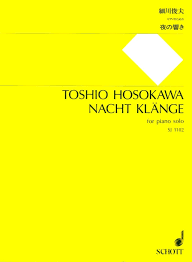
Hosokawa is well-served on record, with dedicated releases on labels like ECM, Wergo, Kairos, and Neos.
- “Hosokawa: Landscapes” (Arditti String Quartet, etc.) – A superb introduction to his chamber music.
- “Hosokawa: Circulating Ocean & Horn Concerto” (WDR Symphony Orchestra, etc.) – Excellent recordings of major orchestral works.
- “Matsukaze” (Netherlands Chamber Choir, etc.) – The definitive recording of his seminal opera.
- “Hosokawa: Voyage X” (Ensemble Modern) – Showcases his works for premier contemporary music ensemble.
- “Silent Flowers” (ECM) – Early chamber works that established his international reputation.
- “Hosokawa & Takemitsu: Aesthetics in Japanese Music” (Various) – Compilation albums often pair the two composers, allowing for fascinating comparison.
Most Known Compositions and Performances
His most renowned pieces are those that most perfectly encapsulate his aesthetic:
- “Matsukaze” is his most-performed opera, a work that has captivated audiences worldwide with its breathtaking beauty and spiritual depth.
- “Circulating Ocean” has become a modern orchestral staple, programmed by major orchestras as an example of powerful, evocative, and accessible contemporary music.
- The “Landscape” series is foundational for understanding his compositional philosophy and is frequently performed by specialized new music ensembles.
- His Cello Concerto “Koto-Uta” is a favorite among virtuoso cellists seeking a profound and technically demanding concerto with a deep spiritual core.
Toshio Hosokawa is more than a composer; he is a sonic philosopher and a spiritual cartographer. His work invites us to slow down, to listen not just to the notes but to the life within and between them. In a world of cacophony, he offers a disciplined, beautiful, and deeply moving art of silence and essence, ensuring his place as one of the most important and enduring creative figures of our time.
Browse in the Library:
Or browse in the categories menus & download the Library Catalog PDF:
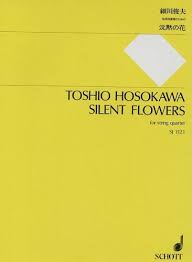
Toshio Hosokawa (細川俊夫) – Silent Flowers (1998) for string quartet
Silent Flowers (1998) for string quartet Composer: Toshio Hosokawa (細川俊夫) (b. 1955) Performers: Arditti Quartet: Irvine Arditti & Ashot Sarkissjan, violin; Ralf Ehlers, viola; Lucas Fels, cello
Search your favorite sheet music in the Sheet Music Catalog
“In Silent Flowers (1998), the genesis and decay of sound are especially connected to reflections on Asian conceptions of time. This work, commissioned for the Donaueschingen Music Festival and premiered by the Arditti Quartet, takes its point of departure from the art of ikebana [flower arrangement] that Hosokawa learned from his family (his grandfather was an ikebana master) and the theories of ikebana he encountered in the writings of the Japanese philosopher Nishitani Keiji (1900-1990). “The flowers for ikebana are cut from living flowers.
Death stands ready in the background. Because of this, the pricelessness of life seems more beautiful and more fragile. Life is not endless; it is fleeting and passes away, which is why it is so beautiful. Such thoughts relating to time are prevalent in all the traditional arts of Japan […]. The formation of sound cannot create eternity, because by virtue of its origin out of silence, sound must return into the silence from which it came.” In the first section of Silent Flowers, silence takes on a theatrical form: the individual fields of sound disappear after only a few measures into a series of silences, with the instruction to “freeze!”.
Here the musicians stop playing abruptly and remain in a motionless state; the physical aspect of the playing is frozen. The vertical accents, experimented with previously in Landscape I, are here taken to the extreme. Already at the beginning, hard, percussive slashes of sound (sforzato, often marked as Bartok pizzicatos) appear out of nothing, or they cut off crescendos of sounds. Here again the sound gestures seem derived from calligraphic gestures, where the movement of the brush — which initially does not touch the canvas — finds an equivalent in silence or extremely soft sounds: The master chooses a point in the air (called konton kaiki), moves the brush from this point, touches the paper, and then returns to the same point in the air. Traces of the linear movement can be seen on the paper — they are the visible part of the motion, just as important as the invisible part. I have interpreted this in my music as sound and silence.”
But aspects of noh theater have also inspired Hosokawa’s Silent Flowers, because the blossom (hana in Japanese) is in noh the symbol of an achieved artistic representation. “Like a flower that blooms in darkness, like the beautiful form of a noh actor, who opens himself in a performance — I wanted to compose such a flower in sound, which would blossom out of silence.” This piece in three parts (as often with Hosokawa) follows a principle of gradually increasing intensity, in which the sound processes constantly return to silence in order to develop an even greater intensity on their next appearance. Individual passages can take on a merciless expressivity when sounds are produced at the bridge, bowed with great pressure.
The ubiquitous presence of noise elements in the sound is an essential aspect of Hosokawa’s musical language and can be traced back to the practices of articulation in Japanese and Korean court music, to sound techniques of the western avant-garde, and to acoustical impressions from nature — a trio of references with substantial significance for the character of Hosokawa’s music.” ~Dirk Wieschollek (translated by John Patrick Thomas and W. Richard Rieves) Source: CD booklet