
| Community Musicians, building a worldwide Community Music. | |
| All the music you want to play on one site. Sharing the world’s best Contemporary, jazz, Popular, film, and classical Sheet Music | |
| Scores for all instruments: >15,000 (active and growing), over 231,000 pages All genres, styles, instruments, and Categories: Jazz & Blues, Rock & Pop, classical & contemporary, film & musicals’ scores; books & biographies; methods, études, and exercises; play along background tracks (MP3), audios & PDFs for Jazz & Rock Access and benefits: Subscription fee: $15.99 one-time payment, valid for lifetime How to join the Sheet Music Library 🔍 Search in the Library Catalog — FAQs — Join us |
Table of Contents
Irving Berlin Sheet music

Best Sheet Music download from our Library.

Please, subscribe to our Sheet Music Library.
If you are already a subscriber, please, check our NEW SCORES’ page every month for new sheet music. THANK YOU!
White Christmas Irving Berlin Sheet music partitura partition noten spartiti 乐谱 楽譜
Irving Berlin: The Untrained Architect of the American Songbook
He couldn’t read or write music in the traditional sense. He never learned to play the piano properly, working his entire life exclusively on the black keys with the aid of a custom-built transposing lever. He had no formal training in harmony, counterpoint, or orchestration. Yet, Irving Berlin, born Israel Beilin in the depths of Tsarist Russia, became the most quintessentially American composer of the 20th century. Over a career that spanned more than six decades, he penned an estimated 1,500 songs, many of which have become immutable standards, woven into the very fabric of American cultural identity. He was the man who gave the nation “God Bless America,” “White Christmas,” and “There’s No Business Like Show Business.” His story is not just one of artistic triumph, but a testament to the power of melody, lyric, and an unerring instinct for the American psyche.
Browse in the Library:
Or browse in the categories menus & download the Library Catalog PDF:
Biography: From the Lower East Side to the Pinnacle of Tin Pan Alley
Early Life and Immigration (1888-1905)
Irving Berlin was born on May 11, 1888, in Tyumen, Russia (though he later claimed Mogilev, now in Belarus). He was the youngest of eight children born to Moses and Lena Beilin. His early life was marked by poverty and persecution as a Jewish family in the Pale of Settlement. In 1893, fleeing a pogrom that saw their home burned to the ground, the Beilin family emigrated to the United States, settling in New York City’s Lower East Side, a teeming melting pot of immigrants.

Tragedy struck soon after their arrival when Irving Berlin’s father, a cantor and kosher poultry inspector, died, leaving the family in dire financial straits. At the age of thirteen, Izzy, as he was known, left home to fend for himself. He worked as a street singer, a newsboy, and a “song plugger”—a pianist and singer hired to popularize new sheet music in the storefronts of Tin Pan Alley, the music publishing district of New York. It was in these gritty, competitive surroundings that he learned what resonated with the public.
The First Bloom of Success (1907-1911)
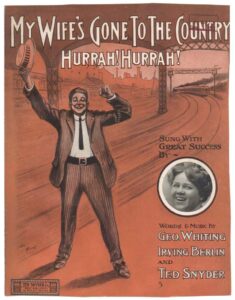
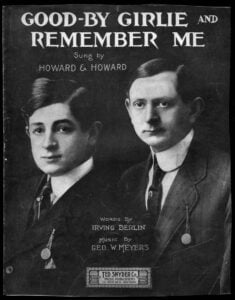
His first published song was “Marie from Sunny Italy” (1907), for which he wrote the lyrics. The sheet music credited the music to the pianist who helped him notate it, Mike Nicholson, but the lyrics were attributed to “I. Berlin”—a typesetter’s error that gave him his new, Americanized name. He soon began writing both music and lyrics.
His first major hit came in 1911 with “Alexander’s Ragtime Band.” While not a true rag in the Scott Joplin sense, its syncopated rhythm and infectious energy captured the nation’s burgeoning fascination with ragtime. It became an international sensation, selling over two million copies of sheet music and single-handedly catapulting Berlin to superstardom. He was 23 years old.
Broadway and the War Years (1914-1932)
Berlin quickly transitioned from writing individual songs to creating full Broadway revues. In 1914, he wrote his first complete stage score, Watch Your Step, starring the famed ballroom dancers Vernon and Irene Castle. The 1920s were a period of phenomenal productivity. He founded his own music publishing company, Irving Berlin, Inc., giving him unprecedented control over his work—a savvy business move that would make him one of the wealthiest entertainers in America.
He also found love, marrying socialite Dorothy Goetz in 1912. Tragically, she died of typhoid fever just five months after their honeymoon. A heartbroken Berlin poured his grief into the ballad “When I Lost You,” his first deeply poignant song. In 1926, he married Ellin Mackay, the Catholic heiress to a telegraph fortune, in a union that caused a massive society scandal. Despite her father’s disinheritance, their marriage was a long and happy one, lasting until Ellin’s death in 1988.
During World War I, while serving at Camp Upton in Yaphank, New York, he wrote, produced, and starred in an all-soldier revue, Yip, Yip, Yaphank (1918). It was for this show that he initially wrote “God Bless America.” Deeming it too solemn for a comedic revue, he filed it away for two decades.

Hollywood and the Astaire-Rogers Era (1933-1940)
With the advent of sound film, Berlin, like many Broadway composers, headed to Hollywood. His first major film score was for Top Hat (1935), starring Fred Astaire and Ginger Rogers. The soundtrack is a masterpiece, featuring “Cheek to Cheek,” “Top Hat, White Tie and Tails,” and “Isn’t This a Lovely Day?.” The collaboration with Astaire and Rogers was magical; Berlin’s witty, sophisticated lyrics and graceful melodies were the perfect complement to Astaire’s effortless dancing. They collaborated on a string of successful films, including Follow the Fleet (1936) and Carefree (1938).
It was in 1938, with the rise of Adolf Hitler and a new world war looming, that Berlin revived “God Bless America.” He made a slight lyrical change, replacing “stand beside her” with “guide her” in the final line. Sung by Kate Smith on her radio show, it became an instant, unofficial national anthem, a beacon of patriotic hope. Berlin established all royalties from the song to be donated to the Boy Scouts and Girl Scouts of America, a trust that has generated millions.
Annie Get Your Gun and the Post-War Years (1946-1962)
After serving his country again in World War II with another soldier show, This Is the Army (1942), Berlin faced a new musical landscape dominated by Rodgers and Hammerstein’s integrated musical plays. He rose to the challenge with what many consider his finest score: Annie Get Your Gun (1946). Written for Ethel Merman, the show was packed with hits: “There’s No Business Like Show Business,” “Doin’ What Comes Natur’lly,” “They Say It’s Wonderful,” and the hilarious competitive duet “Anything You Can Do.” The show was a triumph, a perfect fusion of character and song.
He continued to have successes, notably Call Me Madam (1950), another vehicle for Merman, but the golden age of the Broadway musical he helped define was beginning to wane. His last Broadway show, Mr. President (1962), was a critical and commercial failure. Berlin, sensitive to changing tastes, chose to retire, though he lived for another 27 years in quiet seclusion. He died on September 22, 1989, at the age of 101.
Music Style and Harmony: The Simplicity of Genius
Berlin’s musical style is a fascinating study in instinctual genius overcoming technical limitation.
Melody and Lyric: Berlin’s primary gift was his ability to craft a perfect, seemingly inevitable melody. He famously said, “The notes I use are all old friends.” His melodies are often deceptively simple, built on small, memorable motifs that are easy to sing and hard to forget. He had an unparalleled ability to match a melody to the natural rhythm of speech, making his lyrics feel conversational and authentic. A master of both comedy and pathos, he could write the sly, internal rhymes of “A Pretty Girl is Like a Melody” and the profound, aching simplicity of “What’ll I Do?” with equal skill.
Chord Progressions and Harmony: Because he was a self-taught pianist who played only in F-sharp (using the black keys), his harmonic vocabulary was inherently limited, yet profoundly effective. He relied heavily on strong, diatonic chord progressions—the fundamental building blocks of popular music (I-IV-V-I, ii-V-I). What he lacked in complex jazz harmony, he made up for with ingenious melodic construction and rhythmic vitality.
One of his signature techniques was the use of the “ice cream change” (the shift from the I chord to the IV chord, and back). He used this simple movement to great emotional effect in songs like “Blue Skies.” His harmony was always in service of the melody and the lyric, never drawing attention to itself. This accessibility is a key reason his songs have been so widely performed and recorded by artists of all genres; they provide a sturdy, beautiful framework upon which any musician can improvise and interpret.
A classic Berlin progression can be found in “How Deep Is the Ocean?” The verse uses a series of ascending dominant seventh chords that create a sense of yearning and unresolved emotion, perfectly mirroring the lyric’s questioning nature. In “Cheek to Cheek,” the main melody floats over a simple, waltzing I-vi-ii-V progression, but the release (“Heaven… I’m in Heaven”) introduces a sudden, breathtaking shift to the parallel minor, a moment of harmonic color that elevates the entire song.
Improvisational Licks and Interpretive Flexibility
While Berlin did not write complex, pre-composed “licks” in the way a jazz soloist might, his songs are constructed in a way that inherently invites improvisation. Their clear, strong harmonic structures and memorable “A” sections provide the perfect canvas for improvisers.
- “Blue Skies”: The simple, repetitive 12-bar blues-influenced structure of the chorus is a playground for jazz musicians. A soloist can easily superimpose blues scales, arpeggiate the chords, or play with rhythmic displacement over its buoyant changes.
- “Cheek to Cheek”: The song’s graceful, long-phrased melody is often used as a vehicle for ballad playing. Improvisers will frequently paraphrase the melody in their solos, respecting its romantic character while adding their own ornamental flourishes and harmonic substitutions, particularly over the ii-V progressions.
- “How About Me?”: This lesser-known ballad has a sophisticated, almost chromatic chord progression in the bridge that offers rich material for more harmonically advanced improvisation, allowing players to explore altered scales and extended chords.
The genius of a Berlin standard is that it provides both a satisfying, complete statement on its own and a flexible set of “changes” that can be deconstructed, re-harmonized, and re-imagined by generations of jazz artists, from Louis Armstrong to Billie Holiday to John Coltrane.
Cooperation with Other Artists
Berlin was not a recluse; he was a central figure in the entertainment industry who collaborated with its brightest stars.
- Fred Astaire: This was one of the most fruitful collaborations in film history. Astaire’s precise, elegant style demanded songs with clear rhythm and sophisticated lyrics, which Berlin supplied in abundance. Berlin understood that his songs for Astaire were not just to be listened to, but to be danced to. Their partnership resulted in some of the most iconic musical moments ever captured on film.
- Ethel Merman: Berlin wrote two of his biggest Broadway hits, Annie Get Your Gun and Call Me Madam, specifically for Merman’s powerful, brass-like belt. He crafted songs that showcased her unmatched ability to hold a note and project a character of brash, unapologetic confidence. “There’s No Business Like Show Business” is the ultimate Merman anthem.
- Bing Crosby: Crosby’s relaxed, crooning baritone was the ideal vehicle for Berlin’s warmer, more sentimental ballads. Their most famous collaboration was on “White Christmas,” which Crosby introduced in the 1942 film Holiday Inn. The song’s massive success is inextricably linked to Crosby’s intimate, fireside delivery.
- Kate Smith: The singer Kate Smith was the perfect voice for “God Bless America.” Her robust, earnest delivery transformed the song from a simple ballad into a national prayer, cementing its place in American culture.
Influences and Legacy
Berlin’s influences were the world around him: the ragtime of the era, the Yiddish theater of his youth, the sentimental ballads of the day, and the syncopated rhythms of early jazz. He synthesized these elements into a uniquely American sound.
His legacy is immeasurable. He is, along with Cole Porter, George Gershwin, and Richard Rodgers, a pillar of the Great American Songbook. Composer Jerome Kern famously said, “Irving Berlin has no place in American music. He is American music.”
His influence extends far beyond the Great White Way. His songs provided the foundational repertoire for the golden age of jazz. Every major jazz artist has recorded a Berlin standard. He helped define the sound of Hollywood musicals. He gave the nation its most beloved secular Christmas carol and its most powerful patriotic anthem outside of “The Star-Spangled Banner.”
Berlin demonstrated that artistic greatness could be achieved through melody, lyric, and emotional truth, regardless of formal training. He embodied the American Dream—the immigrant who arrived with nothing and, through sheer talent and determination, shaped the nation’s soundtrack.
Selected Works, Filmography, and Discography
Most Known Compositions (A Tiny Fraction):
- “Alexander’s Ragtime Band” (1911)
- “A Pretty Girl Is Like a Melody” (1919)
- “What’ll I Do?” (1924)
- “Always” (1925)
- “Blue Skies” (1926)
- “Puttin’ on the Ritz” (1929)
- “How Deep Is the Ocean?” (1932)
- “Easter Parade” (1933)
- “Check to Check” (1935)
- “Top Hat, White Tie and Tails” (1935)
- “Let’s Face the Music and Dance” (1936)
- “God Bless America” (1938, revised from 1918)
- “White Christmas” (1942)
- “There’s No Business Like Show Business” (1946)
- “Anything You Can Do” (1946)
- “They Say It’s Wonderful” (1946)
Major Stage Works:
- Watch Your Step (1914)
- The Cocoanuts (1925)
- Face the Music (1932)
- As Thousands Cheer (1933)
- Louisiana Purchase (1940)
- This Is the Army (1942)
- Annie Get Your Gun (1946)
- Call Me Madam (1950)
- Mr. President (1962)
Select Filmography (featuring his scores/songs):
- The Jazz Singer (1927) – featured song “Blue Skies”
- Top Hat (1935)
- Follow the Fleet (1936)
- On the Avenue (1937)
- Carefree (1938)
- Second Fiddle (1939)
- Holiday Inn (1942) – introduced “White Christmas”
- This Is the Army (1943)
- Blue Skies (1946)
- Easter Parade (1948)
- White Christmas (1954)
- There’s No Business Like Show Business (1954)
Discography:
As a composer, not a performer, Berlin’s discography is vast and encompasses thousands of recordings by other artists. Key historical recordings include:
- Original Cast Recordings: Annie Get Your Gun (1946 & 1966), Call Me Madam (1950).
- Film Soundtracks: Top Hat, Holiday Inn, Easter Parade.
- Definitive Artist Albums:
- Ella Fitzgerald Sings the Irving Berlin Songbook (1958) – A landmark album arranged by Paul Weston.
- The Astaire Story (1952) – Fred Astaire performing his hits with a jazz ensemble led by Oscar Peterson.
- Bing Crosby’s recordings of “White Christmas” (the best-selling single of all time for decades) and “God Bless America.”
- Countless recordings by Frank Sinatra, Billie Holiday, Louis Armstrong, and Diana Krall.
In conclusion, Irving Berlin’s life and work represent a singular phenomenon in American art. He was a conduit for the nation’s emotions—its joys, its sorrows, its patriotism, and its romance. With an ear for a hit and a heart tuned to the feelings of everyday people, he built an edifice of song that remains, like the man himself, both timeless and profoundly American.
Search your favorite sheet music in the Sheet Music Catalog
“White Christmas” is not merely a song; it is a cultural touchstone, a seasonal institution, and the best-selling single of all time. Its deceptively simple melody and lyrics conceal a profound emotional depth that has resonated with generations. Here is a comprehensive analysis of Irving Berlin’s masterpiece.
The Story of Irving Berlin’s “White Christmas”
A Melancholy in Midtown
The origins of “White Christmas” are shrouded in a bit of legend, but the most widely accepted story begins in 1940 or early 1941. Irving Berlin, arguably the most famous songwriter in America, was staying at the La Quinta Hotel in Phoenix (or, by some accounts, at the Arizona Biltmore). Despite the sunny, warm surroundings, he found himself feeling intensely lonely and depressed.
He was known to work through the night, and one night, he called his musical secretary, Helmy Kresa, in a state of excitement. “I want you to come down right away,” he said. “I have a new song for you. Not just a new song, but the best song I’ve ever written—the best song anybody has ever written!”
This was a staggering claim from a man who had already written “God Bless America,” “Cheek to Cheek,” and “There’s No Business Like Show Business.” But Berlin understood the magic he had captured.
The song was initially written for a stage review that was never produced. It found its true home when Berlin was hired to write the score for the 1942 Paramount film Holiday Inn, starring Bing Crosby and Fred Astaire. The film was structured around a series of holiday-themed musical numbers, and Berlin slotted “White Christmas” into the Christmas segment.
A Song for a Homesick Nation
The song’s official debut was on Bing Crosby’s NBC radio show, The Kraft Music Hall, on Christmas Day, 1941—just 18 days after the attack on Pearl Harbor. The United States was now fully immersed in World War II, and a wave of anxiety and homesickness swept the nation. Millions of young men were being shipped off to training camps and, soon, to battlefields overseas.
When Holiday Inn was released in the summer of 1942, “White Christmas” struck a nerve that no one could have fully anticipated. Crosby’s warm, calm, reassuring baritone delivered a lyric that was not a jubilant celebration, but a quiet, poignant longing for an idealized, peaceful past. For soldiers far from home, it perfectly articulated their yearning for the familiar comforts of family and hearth. It became an anthem for a nation under duress, a musical symbol of what they were fighting to protect.
The song won the Academy Award for Best Original Song in 1942. Crosby’s original 1942 recording with the John Scott Trotter Orchestra and the Ken Darby Singers is the one that made history. It is estimated to have sold over 50 million copies worldwide before the era of digital downloads, with the Guinness World Records listing it at 50 million copies, a number that continues to grow. When combined with other versions, the song has sold over 100 million copies.
A tragic footnote adds another layer of poignancy. Berlin’s only son, Irving Berlin Jr., died on Christmas Day, 1928, at the age of three weeks. While Berlin never publicly connected this loss to the song, it is impossible to ignore the shadow this personal tragedy cast over the holiday for him and his wife, making the song’s longing for a perfect, untroubled Christmas all the more profound.
The Lyrics: The Art of Yearning
The lyrical genius of “White Christmas” lies in its masterful use of contrast and its focus on feeling rather than description.
- The Opening Image: The song doesn’t begin with joy. It begins with a daydream: “I’m dreaming of a white Christmas.” This immediately establishes a distance between reality and desire. The singer is not experiencing this perfect Christmas; he is longing for it.
- Economy of Language: The lyrics are remarkably simple and direct. There are no complex metaphors or clever wordplay. Berlin uses universally understood images: “treetops glisten,” “children listen to hear sleigh bells in the snow.” This simplicity is key to its accessibility; everyone can project their own memories and ideals onto this basic canvas.
- The Devastating Second Verse: Often omitted in popular renditions, the second verse deepens the melancholy: I’m dreaming of a white Christmas
With every Christmas card I write.
May your days be merry and bright,
And may all your Christmases be white. Here, the act of writing Christmas cards—a ritual of connection—triggers the longing. The famous closing couplet, “May your days be merry and bright…” is revealed not as a generic greeting, but as a heartfelt, almost pleading wish the singer makes for others, contrasting with his own reality. It’s a selfless expression of hope in the face of personal sadness.
The Harmony and Musical Structure: Simplicity as Sophistication
For a man who could only play in F-sharp on the piano, Berlin crafted a harmonic progression that is both sturdy and subtly evocative. The song is a classic AABA form (32 bars total), one of the most common structures in the Great American Songbook.
- The A Sections (The Longing): The harmony of the main melody (“I’m dreaming of a white Christmas…”) is built on a bedrock of simple, diatonic chords. It primarily moves between the I (tonic) and IV (subdominant) chords, with a passing ii-V progression. This creates a feeling of stability and nostalgia. The melody itself is narrow in range, almost like a gentle hum or a sigh, making it incredibly easy to sing and remember.
- The Bridge (The Release): The B section (“I’m dreaming of a white Christmas…”) provides the emotional and harmonic lift. Berlin moves to the relative minor (vi chord), a classic songwriting technique for introducing a touch of melancholy or introspection. The melody also rises to its highest point in the song on the word “Christmases,” providing a moment of emotional climax before gracefully descending back into the final, resigned A section.
Key Choice: Bing Crosby’s iconic recording is in the key of B-flat major. This key sits perfectly in the warm, rich, comfortable part of Crosby’s baritone voice. It’s not too high to be strained, nor too low to be murky. It feels like a cozy, familiar sweater.
The harmonic genius is in what Berlin doesn’t do. There are no complex jazz substitutions or daring modulations. The harmony serves the lyric perfectly, providing a warm, consonant bed for the wistful melody, making the moments of slight tension (like the move to the relative minor in the bridge) all the more effective.
Influences and Legacy
Influences:
While “White Christmas” sounds utterly unique, it draws from a few key traditions:
- The Sentimental Ballad: Berlin was a master of the heartfelt ballad (“What’ll I Do?”, “Always”). “White Christmas” fits squarely within this tradition, but with a more specific, seasonal focus.
- Nostalgia in American Song: The theme of longing for a idealized home or past is a staple of American folk and popular music. Berlin tapped into this deep-seated national sentiment.
- The Christmas Carol: It follows the tradition of Christmas songs that describe an idyllic, snowy scene, but it subverts the genre by framing it as a memory or a dream, not a present reality.
Legacy:
“White Christmas” is in a category of its own.
- Commercial Juggernaut: Its sales records are unlikely ever to be broken.
- Cultural Anchor: It defined the modern sound of an American Christmas. Along with the 1942 film Holiday Inn and the later 1954 film White Christmas (which Berlin produced and for which he wrote new songs), it cemented the imagery of snow as an essential part of the Christmas fantasy, even for those who live in warm climates.
- An Enduring Symbol: For the WWII generation, it remains a powerful emotional trigger. For subsequent generations, it is the sound of the holiday season. Its melancholy core allows it to be both a cheerful backdrop in a shopping mall and a deeply moving expression of personal loss and longing.
- Artistic Interpretations: Beyond Crosby’s definitive version, it has been recorded by everyone from Frank Sinatra and Elvis Presley to The Drifters (whose rhythm and blues version is a classic in its own right) and even punk bands. Each interpretation finds something new in its simple structure, proving the song’s incredible durability and emotional range.
“White Christmas” is Irving Berlin’s ultimate triumph of feeling over form. It demonstrates that the most powerful art often comes not from technical complexity, but from an authentic connection to a universal human emotion. It is a seasonal ghost, a beautiful, bittersweet dream of a perfect peace that, for the singer, exists only in the past and in the hearts of those he loves.