
Come join us now, and enjoy playing your beloved music and browse through great scores of every level and styles!
Can’t find the songbook you’re looking for? Please, email us at: sheetmusiclibrarypdf@gmail.com We’d like to help you!
Table of Contents
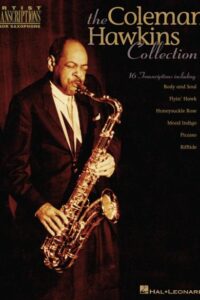
Happy birthday, Coleman Hawkins, born on this day in 1904.
Best Sheet Music download from our Library.

Please, subscribe to our Sheet Music Library.
If you are already a subscriber, please, check our NEW SCORES’ page every month for new sheet music. THANK YOU!
Coleman Hawkins: The Father of the Tenor Saxophone
In the pantheon of jazz, few figures stand as colossally transformative as Coleman Hawkins. He was not merely a virtuoso player; he was a pioneer who single-handedly carved out a space for the tenor saxophone as a premier vehicle for jazz expression. Before Hawkins, the saxophone was often viewed as a novelty, a comedic or secondary instrument. After him, it became a cornerstone of the jazz language, an essential voice of swing, bebop, and beyond. His robust, voluminous tone, his harmonically sophisticated improvisations, and his profound musical intellect established a standard that every tenor player who followed would have to confront. To understand Coleman Hawkins is to understand the very evolution of jazz improvisation in the 20th century.
Biography: From Missouri to Immortality
Coleman Randolph Hawkins was born on November 21, 1904, in St. Joseph, Missouri. His was a middle-class family that valued culture and education. His mother, a pianist and organist, ensured he received a thorough musical education. He began with piano at five, moved to cello at seven, and finally, at nine, settled on the tenor saxophone. This early training on classical string instruments would profoundly influence his conception of tone and phrasing on the saxophone, giving him a legato and vocal quality that was unique.
By his late teens, Hawkins was a professional musician. In 1921, while playing in Kansas City, he was discovered by the famed singer Mamie Smith, who asked him to join her Jazz Hounds. This move took the 17-year-old Hawkins to New York City, the burgeoning epicenter of jazz. He toured and recorded with Smith, gaining invaluable experience.
The pivotal moment of his early career came in 1923 when he joined Fletcher Henderson’s Orchestra, the most prestigious African-American big band of the era. Hawkins would remain with Henderson for eleven crucial years. Initially, his style was rooted in the slap-tongue, rhythmic effects of players like Coleman’s predecessor, Bud Freeman. However, Hawkins was a relentless practicer and a musical intellectual. He immersed himself in the works of European classical composers like Bach and Debussy, seeking to expand his harmonic understanding.
During his tenure with Henderson, Hawkins slowly but surely transformed the role of the tenor sax. He developed a huge, breathy, and commanding sound that could cut through the entire band. He began constructing solos that were not just strings of melodic variations but complex, arpeggiated explorations of the underlying chord progressions. He became the band’s star soloist, and his featured spots, such as on “The Stampede” (1926), were early blueprints for the power and potential of the tenor.
Seeking new horizons and tiring of the competitive New York scene, Hawkins left for Europe in 1934. He spent five years there, primarily as a featured soloist with Jack Hylton’s band in the UK and leading his own groups across the continent. This period was one of artistic consolidation and celebrity. He was revered in Europe, free from the racial prejudices that were more pronounced in America, and he recorded prolifically with both American expatriates and European musicians.
He returned to the United States in July 1939, an established star but somewhat forgotten in a fast-changing jazz landscape. To reassert his dominance, he went into the studio on October 11, 1939, and in a legendary two-hour session, recorded a masterpiece that would become his signature and one of the most important recordings in jazz history: “Body and Soul.”

Browse in the Library:
Or browse in the categories menus & download the Library Catalog PDF:
Hawkins spent the rest of his life as a revered elder statesman of jazz, yet he never ceased to evolve. He embraced the bebop revolution in the 1940s, hiring young innovators like Thelonious Monk, Dizzy Gillespie, and Miles Davis for his recording sessions. He led all-star groups on tours and at jazz festivals, and he continued to record prolifically for various labels, often in a small-combo setting that highlighted his improvisational genius. He remained a formidable and competitive player until the very end, his style adapting to encompass the harmonic freedoms of the new jazz. Coleman Hawkins died of liver disease on May 19, 1969, leaving behind a legacy that is literally audible in every tenor saxophonist who has picked up the horn since.
Instrument and Sound: The Hawk’s Voice
Hawkins’s instrument of choice was the tenor saxophone, and he forged an identity for it that was entirely his own.
- The Sound: His sound was the foundation of his artistry. It was enormous, warm, thick with vibrato, and possessed a commanding authority. He used a hard rubber mouthpiece (often a Berg Larsen) and a stiff reed to produce this powerful, vocalized tone. Unlike the lighter, drier sound of his contemporary, Lester Young, Hawkins’s sound was “vertical”—it was a dense column of air that filled the sonic space. He treated the saxophone like a bel canto opera singer, with a profound emphasis on breath support and a wide, pulsing vibrato that he used for emotional emphasis. This sound became the default for the instrument for decades, influencing a direct lineage of players from Ben Webster to Sonny Rollins in his ballad style.
- Phrasing and Articulation: His early training on the cello was evident in his legato phrasing. He could spin long, flowing lines that connected across bar lines, avoiding the choppy, riff-based phrasing common in the 1920s. His articulation was precise, but he used slurs and ghosted notes to create a sense of conversational spontaneity.
Music Style and Improvisational Licks: The Architecture of a Solo
Hawkins was a master architect of the jazz solo. His style was built on a foundation of harmonic mastery rather than purely melodic invention.
- Harmonic Improvisation: This is Hawkins’s most significant contribution. While earlier improvisers often embellished the melody, Hawkins was obsessed with the chord changes. He would dissect a progression and build his solos by arpeggiating the chords—playing up and down the triads, seventh chords, and their extensions. A classic “Hawkins lick” is often a fluid, sweeping run that outlines the harmony in a creative way. For example, over a simple II-V-I progression (Dm7-G7-Cmaj7), instead of playing a simple scale, Hawkins might play:
- A Dm7 arpeggio (D-F-A-C) moving into a G7 arpeggio (G-B-D-F), perhaps adding the b9 (Ab) for tension, and resolving to the 3rd (E) or 5th (G) of the Cmaj7 chord.
- He was a pioneer in using passing chords and substitutions. He would imply chords that weren’t explicitly in the progression to create more sophisticated harmonic movement. A famous example is his use of the tritone substitution before it was common parlance. Over a G7 chord, he might imply a Db7, because the two chords share the same critical tritone interval (B and F in G7 is the same as F and Cb/B in Db7).
- The “Running the Changes” Approach: His solos on uptempo tunes like “Hollywood Stampede” or “The Man I Love” are masterclasses in this technique. He doesn’t just skate over the top of the harmony; he digs into it, revealing its inner structure with breathtaking speed and precision. This approach was the direct precursor to the bebop revolution, where this type of chord-scale relationship became paramount.
- Ballad Mastery: “Body and Soul” is the ultimate testament to his ballad style. The recording is a three-chorus solo with only a brief, oblique reference to the original melody in the final bars. The rest is pure, spontaneous composition. He uses the entire range of the horn, from the guttural low register to the passionate altissimo cries. He employs dramatic pauses, double-time passages, and his immense vibrato to create a performance of unparalleled romantic intensity and intellectual depth. It remains the benchmark for ballad playing on any instrument.
Cooperation with Other Artists: A Generous Giant
Hawkins was a central node in the jazz network for over four decades. His collaborations tell the story of jazz itself.
- Fletcher Henderson: This was his conservatory. The Henderson orchestra was a who’s who of early jazz talent, including Louis Armstrong, whose influence on Hawkins’s sense of swing and melodic conception was profound.
- The European Interlude: He recorded with legends like Django Reinhardt and Benny Carter in Paris, creating classic sides that blended swing with gypsy jazz.
- Embracing Bebop: Unlike many of his swing-era peers, Hawkins did not resist the new music. In 1944, he led the first official bebop recording session, which featured Dizzy Gillespie and Don Byas. He hired a young, unknown Thelonious Monk for his 1944 quartet, giving Monk his first significant exposure. His recording of “Picasso” (1948) is a landmark unaccompanied saxophone solo, showcasing his advanced harmonic thinking.
- The Jazz at the Philharmonic Tours: As part of Norman Granz’s touring packages, Hawkins regularly shared the stage with Charlie Parker, Lester Young, and Roy Eldridge. His famous “trading fours” battles with young modernists like Sonny Stitt are legendary, proving he could hold his own in any era.
- Dueling with Sonny Rollins: The 1963 album Sonny Meets Hawk! is a fascinating clash of titans, pitting Hawkins’s chord-based approach against Rollins’s thematic, motivic style.
- Partnership with Roy Eldridge: His collaborations with the fiery trumpeter Roy Eldridge were particularly fruitful and long-lasting, resulting in many thrilling recordings that captured the essence of swinging, conversational jazz.
Chord Progressions and Music Harmony: The Intellectual Engine
Hawkins’s harmonic language was revolutionary. He treated popular songs not as simple melodies but as complex harmonic frameworks for exploration.
- Arpeggiation as Melody: He demonstrated that the notes of a chord (1-3-5-7-9) could be sequenced, inverted, and rhythmically altered to create compelling melodic lines. This shifted the focus of improvisation from “what can I play over this melody?” to “what can I discover inside these chords?”
- Chromaticism: Hawkins was a master of using chromatic passing tones and approach notes to smooth out his lines and add surprise. He would connect chord tones with half-steps, creating a fluid, seamless sound that was both sophisticated and swinging.
- Implied Harmony: As heard on “Body and Soul,” he was a genius at implying more complex chords than what was written. Over a simple tonic chord, he might weave in the #11, the 9th, or the 13th, giving his improvisations a rich, contemporary flavor that pointed directly toward modern jazz.
- Blues Foundation: For all his harmonic complexity, Hawkins never lost his connection to the blues. His playing on tunes like “Queer Notions” or his own “Bean and the Boys” is deeply rooted in the blues tradition, proving that intellectual rigor and raw emotion were not mutually exclusive.
Influences and Legacy: The Enduring Shadow
Influences on Hawkins: His primary early influence was Louis Armstrong, from whom he learned about swing, rhythmic drive, and the concept of the virtuosic solo. He also drew inspiration from saxophonists like Bud Freeman and Stump Evans, but his true teachers were the classical composers whose works he studied obsessively.
Hawkins’s Influence: The list of musicians influenced by Hawkins is essentially a roll call of jazz tenor saxophone.
- Ben Webster: Directly inherited Hawkins’s huge sound and breathy ballad style.
- Chu Berry: A close contemporary and disciple who further developed the Hawkins approach.
- Don Byas: Bridged the gap between Hawkins’s swing and the new language of bebop.
- Sonny Rollins: While he developed a radically different style, Rollins’ foundational knowledge of harmony comes from the Hawkins school.
- John Coltrane: Coltrane’s famed “sheets of sound” technique is a logical, intensified extension of Hawkins’s arpeggiated, change-running style.
- Joe Henderson, Wayne Shorter, Michael Brecker: Every modern improviser who delves deeply into harmony walks a path that Coleman Hawkins was the first to clear.
His legacy is the tenor saxophone itself. He defined its sound, its technical potential, and its intellectual scope.
Most Known Compositions and Performances
- “Body and Soul” (1939): His magnum opus. The definitive version of this standard.
- “Picasso” (1948): A groundbreaking unaccompanied tenor saxophone performance.
- “Honey-suckle Rose” (with Fletcher Henderson and later versions): A showcase for his blistering technique on an uptempo standard.
- “The Man I Love” (multiple versions): A masterclass in building a solo on a standard ballad progression.
- “Bean and the Boys” (his own composition): A riff-based original that highlights his swinging, bluesy side.
- “Stumpy” and “Queer Notions” (with Fletcher Henderson): Early, harmonically adventurous recordings that stunned his contemporaries.
Discography (Selective)
- The Fletcher Henderson Orchestra (1923-1934) – Various labels
- Coleman Hawkins 1934-1937 (JSP) – His European recordings
- Body and Soul (1939) – The landmark recording.
- The Hawk Flies High (Riverside, 1957) – A brilliant comeback album.
- The Genius of Coleman Hawkins (Verve, 1957) – Featuring a stellar lineup including J.J. Johnson and Oscar Peterson.
- Coleman Hawkins Encounters Ben Webster (Verve, 1959) – A legendary meeting of two tenor titans.
- At Ease with Coleman Hawkins (Moodsville, 1960) – A beautiful ballad album.
- The Hawk Relaxes (Moodsville, 1961)
- Sonny Meets Hawk! (RCA Victor, 1963) – With Sonny Rollins.
- Today and Now (Impulse!, 1962) – A late-career highlight.
Filmography
Hawkins appeared in several films, often as himself or a band member.
- The Big Beat (1957) – A jazz musical featuring performances by Hawkins, Fats Domino, and others.
- After Hours (1961) – A TV drama featuring Hawkins and his group.
- Jazz Hots (shorts from the 1930s) – Various musical shorts featuring his European band.
Coleman Hawkins: The Inaugurator
Coleman Hawkins was more than a great musician; he was an inaugurator. He inaugurated the tenor saxophone as a serious jazz voice. He inaugurated a harmonic, vertical approach to improvisation that would define the music’s future. He inaugurated the model of the jazz musician as a relentless seeker, an intellectual as well as an instinctual artist. His career spanned from the rough-and-tumble dance halls of the 1920s to the avant-garde fringe of the 1960s, and he never became a relic. He was, as critic Gary Giddins called him, “the first modernist.” The sound of jazz, particularly the sound of the tenor saxophone, is forever the sound of Coleman Hawkins—a sound of immense power, profound intelligence, and timeless soul.
Search your favorite sheet music in the Sheet Music Catalog
Coleman Hawkins The Complete Jazztone Recordings 1954
Tracks:
1 Get Happy 00:00 2 If I Had You 05:35 3 Lullaby Of Birdland 10:10 4 Time On My Hands 15:26 5 Out Of Nowhere 23:10 6 Ain’t Misbehavin’ 29:57 7 Blue Lou 37:32 8 Stompin’ At The Savoy 42:41 9 Cheek To Cheek 49:00 10 Just You, Just Me 57:07 11 Honeysuckle Rose 01:03:17 12 Undecided 01:06:17