
Come join us now, and enjoy playing your beloved music and browse through great scores of every level and styles!
Can’t find the songbook you’re looking for? Please, email us at: sheetmusiclibrarypdf@gmail.com We’d like to help you!
Table of Contents
Genesis – Duke (Full Album, 1980)
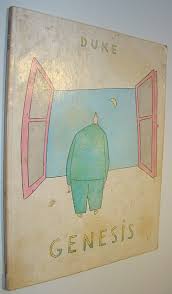
Best Sheet Music download from our Library.
From Prog Pioneers to Pop Titans: How Genesis Forged a New Future with ‘Duke’
The story of the rock band Genesis is one of the most remarkable and unlikely in popular music. It’s a tale of two distinct eras, bridged by a period of turbulent transition and culminating in global superstardom. To understand their journey is to understand a band constantly in flux, and at the very heart of that transformation stands a key, often underrated, milestone: the 1980 album “Duke.”
The Components: A Band of Evolving Parts
Genesis has never been a static entity. Its history can be broken down into distinct phases, defined by its key components:
1. The Foundation Era (Peter Gabriel Fronted): In the late 1960s and early 70s, Genesis, with frontman Peter Gabriel, keyboardist Tony Banks, bassist/guitarist Mike Rutherford, and drummer Phil Collins, became architects of progressive rock. With guitarist Steve Hackett completing the classic lineup, they crafted intricate, sprawling soundscapes filled with fantastical storytelling. Albums like Selling England by the Pound and the conceptual epic The Lamb Lies Down on Broadway are masterpieces of the genre. This era was defined by Gabriel’s theatrical, costume-heavy performances and complex musical structures.
2. The Transition (A Trio is Forged): In 1975, Peter Gabriel departed, a move that many thought would be fatal. After an unsuccessful search for a replacement, drummer Phil Collins stepped tentatively to the microphone. The band continued as a quartet with 1976’s A Trick of the Tail, proving they could survive. However, when guitarist Steve Hackett left in 1977, the core of the band was reduced to its essential trio: Tony Banks, Mike Rutherford, and Phil Collins.
This trio entered a period of experimentation. 1978’s …And Then There Were Three… and the more atmospheric Duke were the sound of a band searching for a new identity, caught between their progressive past and an uncertain future.
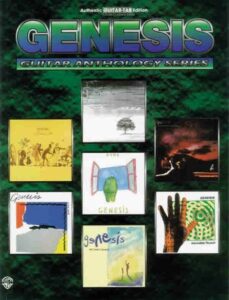

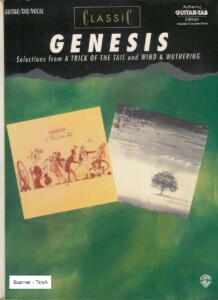


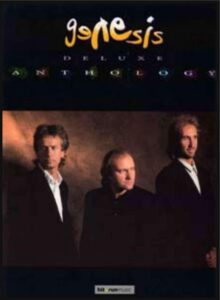


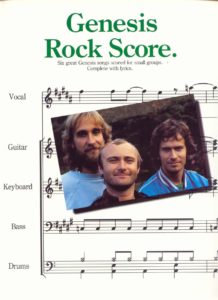
Please, subscribe to our Sheet Music Library.
If you are already a subscriber, please, check our NEW SCORES’ page every month for new sheet music. THANK YOU!
Why “Duke” Was the Turning Point
While not a concept album in the traditional sense, Duke is unified by themes of isolation and emotional turmoil, heavily influenced by Phil Collins’ recent divorce. It represents the moment the scales tipped decisively, marking the birth of the “Trio” sound that would dominate the 1980s. Here’s why it was so pivotal:
1. The Crystallization of the Trio’s Sound: With Banks, Rutherford, and Collins now the sole songwriters, their individual voices had to merge and adapt. Duke is where this fusion truly clicked. Tony Banks’ lush, romantic keyboard textures found a new context within more concise song structures. Mike Rutherford’s knack for a simple, powerful riff (the bedrock of “Turn It On Again”) and melodic bass lines became more central. And Phil Collins’ soul-influenced drumming and vulnerable, everyman vocals became the band’s new focal point.
2. The Perfect Balance of Prog and Pop: Duke masterfully walks a tightrope. It contains the last great, sprawling progressive suite of their career in the loosely connected “Duke Suite” (“Behind the Lines,” “Duchess,” “Guide Vocal,” “Turn It On Again,” “Duke’s Travels,” “Duke’s End”). This 18-minute piece showcases their heritage of complex time signatures and thematic development.
Yet, placed alongside it are some of the most direct, emotionally resonant pop songs they had ever written. “Misunderstanding,” a bright, Californian-style pop tune written solely by Collins, became their first major hit in America. “Turn It On Again,” with its revolutionary 13/8 time signature disguised as a driving rock anthem, became an instant classic. The album proved they didn’t have to abandon their musical intelligence to be accessible.
3. Phil Collins Comes into His Own: On Duke, Collins is no longer a substitute vocalist; he is the voice of Genesis. His performances on songs like the heartbreaking “Please Don’t Ask” and the soaring “Duchess” are raw and deeply personal. He brought a new, relatable emotional depth that contrasted sharply with Gabriel’s mythical characters. This connection with the audience would become a hallmark of their future success.
4. A Blueprint for the Future: The success of Duke gave Genesis a clear roadmap. The hit singles brought in a massive new audience, while the album’s artistic integrity retained their core fans. It directly paved the way for the streamlined, hit-filled success of Abacab (1981) and the global pop domination of their self-titled 1983 album, featuring “Mama” and “That’s All.”
The Legacy
Duke was not just another album; it was a declaration of survival and reinvention. It proved that Genesis was more than the sum of its legendary parts. By successfully fusing the ambitious spirit of their past with the melodic directness of the present, they forged a new identity that would carry them to unprecedented commercial heights.
It is the crucial bridge in their story—the album where the progressive rock pioneers of the 1970s confidently transformed into the arena-filling pop titans of the 1980s, without losing the soul that made them Genesis in the first place.
Genesis – Duke (Full Album, Non-Remastered) With Lyrics – The Best of Genesis Playlist 2022
Genre: Art Rock, Progressive Rock, Progressive Pop Format: Vinyl, LP, Album, 8-track, Stereo Label: Atlantic Records Country: United States Released: March 31, 1980 Recorded: November – December, 1979 at Polar Stockholm, Sweden
SIDE ONE 1. 00:00 Behind The Lines 2. 05:41 Duchess 3. 12:04 Guide Vocal 4. 13:31 Man Of Our Times 5. 19:05 Misunderstanding 6. 22:19 Heathaze SIDE TWO 1. 27:24 Turn It On Again 2. 31:17 Alone Tonight 3. 35:14 Cul-De-Sac 4. 40:20 Please Don’t Ask 5. 44:23 Duke’s Travels 6. 52:48 Duke’s End
Personnel
Genesis
- Tony Banks – keyboards, backing vocals, 12-string guitar, duck
- Mike Rutherford – guitars, bass guitar, bass pedals, backing vocals
- Phil Collins – lead vocals, drums, drum machine, percussion, duck
Search your favorite sheet music in the Sheet Music Catalog
Critical reception
Duke received a mostly positive reception from music critics. In his review for Rolling Stone, David Fricke noted that “Turn It On Again” is “vibrant rock & roll” and thought that “Man of Our Times”, “Duchess”, “Duke’s Travels”, and “Duke’s End” “possess a refreshing urgency”.
Fricke points out the band’s losses without Gabriel and Hackett in the line-up, yet summarized Duke as “comforting: a reassurance that Genesis aren’t for an exodus yet.” Sounds‘ Hugh Fielder gave the album four stars out of five, enjoying the opening of “Behind the Lines” and considering Collins’s vocals to be “more convincing than … before”. He felt the first side was better than the second, and criticized some lyrics, but concluded “no Genesis fan could be disappointed”.
The Los Angeles Times‘s Steve Pond described the album’s music as “identifiably Genesis, but it is toned-down” and “a more confident and successful album than …And Then There Were Three…“. He criticized the album as inconsistent with a lack of “melodic invention” on side one, but thought “Duke’s Travels” and “Duke’s End” were “one of the best and most consistent pieces of music that band has made in some time”