Come join us now, and enjoy playing your beloved music and browse through great scores of every level and styles!
Can’t find the songbook you’re looking for? Please, email us at: sheetmusiclibrarypdf@gmail.com We’d like to help you!
Happy heavenly birthday, Nino Rota, born on this day in 1911
Table of Contents
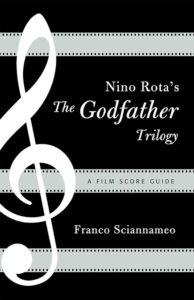
Best Sheet Music download from our Library.
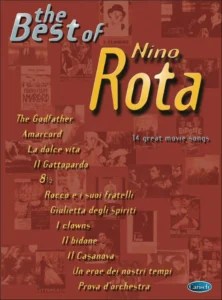
Please, subscribe to our Sheet Music Library.
If you are already a subscriber, please, check our NEW SCORES’ page every month for new sheet music. THANK YOU!
Nino Rota: The Maestro of Lyricism and Whimsy
Nino Rota (1911–1979) stands as one of the most prolific, versatile, and beloved composers of the 20th century. While his name is indelibly linked to the enchanting scores of Federico Fellini’s films, his legacy encompasses a vast output of concert music, ballets, operas, and scores for over 150 films, ranging from neorealist dramas to Shakespearean adaptations and Hollywood epics. Rota possessed a unique alchemy: he could conjure profound melancholy, carnivalesque frenzy, and childlike wonder, often within the same composition. His music, characterized by its immediate melodic appeal, sophisticated harmony, and deep roots in both Italian tradition and European modernism, continues to captivate audiences worldwide, transcending the confines of cinema to claim a place in the standard repertoire.
Browse in the Library:
Or browse in the categories menus & download the Library Catalog PDF:
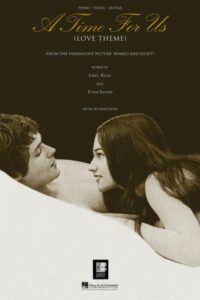
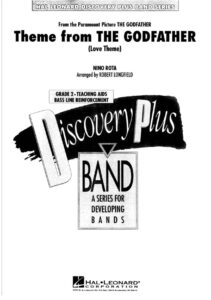
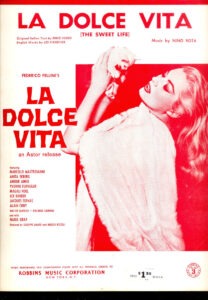
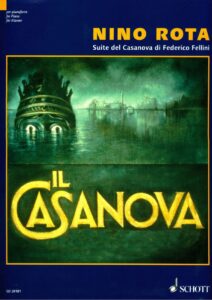

Biography: A Prodigy’s Journey
Early Life and Prodigious Beginnings (1911–1929)
Nino Rota was born Giovanni Rota Rinaldi on December 3, 1911, in Milan, into a musical family. His mother was a pianist, and his talent emerged startlingly early. By the age of eight, he had begun composing, and at eleven, he wrote an oratorio, L’infanzia di San Giovanni Battista, which demonstrated a precocious mastery of form and expression. In 1923, he was admitted to the prestigious Milan Conservatory, where he studied under luminaries such as Ildebrando Pizzetti (composition) and Giacomo Orefice. His early works already showed a blend of late-Romantic lyricism and emerging modernist tendencies.
Formative Years and American Interlude (1930–1939)
After earning his diploma in 1930, Rota moved to Rome, immersing himself in the city’s vibrant cultural scene. He also began his foray into film scoring during this period. A pivotal moment came in 1931 when the conductor Arturo Toscanini, impressed by his work, recommended him for a scholarship at the Curtis Institute of Music in Philadelphia. From 1931 to 1932, Rota studied in the United States under composers like Rosario Scalero (who also taught Samuel Barber) and Fritz Reiner. This exposure to American music and culture would later subtly infuse his work. Returning to Italy, he completed a literature degree at the University of Milan while continuing to compose.
War Years and Artistic Development (1940–1949)
The 1940s were a period of intense productivity and artistic consolidation. Rota taught theory and solfège at the Liceo Musicale in Bari (later the Niccolò Piccinni Conservatory), a post he held with dedication until the 1970s. He composed significant concert works, including symphonies, chamber music, and his first opera, Il cappello di paglia di Firenze (1945), a brilliant comic opera that remains a staple in Italian houses. His film career also accelerated, with notable scores for Renato Castellani (Sotto il sole di Roma) and Alberto Lattuada.
The Fellini Era and International Acclaim (1950–1979)
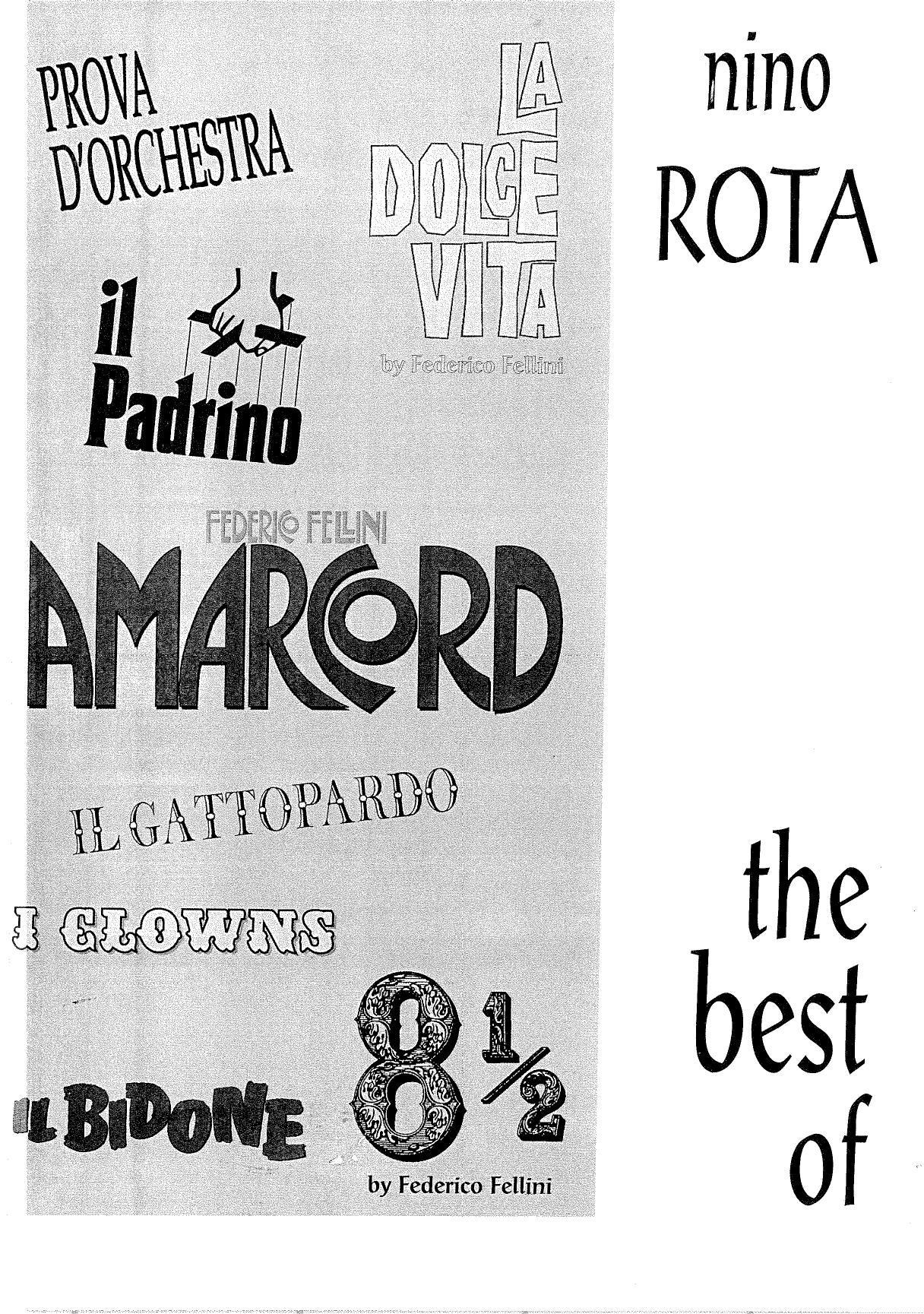
Rota’s meeting with Federico Fellini in 1952 for Lo sceicco bianco (The White Sheik) marked the beginning of one of the most celebrated director-composer partnerships in cinema history. This symbiotic relationship—spanning La Strada (1954), Notti di Cabiria (1957), La Dolce Vita (1960), 8½ (1963), Amarcord (1973), and many others—defined the sound of Fellini’s cinematic universe. Simultaneously, Rota achieved global fame through his scores for Franco Zeffirelli’s Romeo and Juliet (1968) and, most famously, Francis Ford Coppola’s The Godfather (1972) and The Godfather Part II (1974), for which he won his only competitive Academy Award (the first Godfather score was controversially disqualified for using pre-existing themes). Rota continued to compose concert works until his death from a coronary thrombosis in Rome on April 10, 1979.
Musical Style and Harmony: Between Tradition and Invention
Rota’s style is deceptively simple. Its surface is often tuneful, direct, and evocative, yet it is underpinned by a refined and idiosyncratic harmonic language.
Melodic Genius: Rota was a melodic fountain. His themes are instantly memorable, often possessing a folk-like quality, a singing cantabilità rooted in the Italian opera and song tradition. They can be wistfully nostalgic (“Gelsomina’s Theme” from La Strada), exuberantly quirky (“Carlotta’s Galop” from 8½), or romantically sweeping (“Love Theme” from Romeo and Juliet).
Harmonic Language: Rota’s harmony sits at a fascinating crossroads:
- Neo-Classical Foundation: He frequently employed clear tonal centers, diatonic progressions, and classical forms (especially in his concert works), reflecting his admiration for Stravinsky’s neo-classical period.
- Modal and Chromatic Color: He infused this base with modal interchanges (particularly Dorian and Mixolydian), adding a timeless, sometimes archaic flavor. Subtle chromaticism and unexpected key shifts create poignancy and ambiguity, as in the melancholic harmonies of Il Gattopardo (The Leopard).
- Polystylism and Quotation: A musical magpie, Rota would seamlessly weave in quotes from popular songs, circus music, liturgical chant, and classical works (e.g., the use of Bach in 8½), creating a rich, collage-like texture that perfectly matched Fellini’s aesthetic.
- Chord Progressions: Rota favored progressions that balanced predictability with surprise. A common tactic was to establish a simple, repeating chord sequence (like the wistful I-vi-ii-V loop in Amarcord) and then subtly alter it for emotional effect. In more dramatic scenes, he used ascending chromatic bass lines or sudden shifts to distant keys to heighten tension.
Orchestration: A master colorist, Rota’s orchestration is always precise and evocative. He had a particular affinity for:
- Woodwinds: Used for whimsy, melancholy, and character themes (the solo piccolo for Gelsomina, the haunting alto saxophone in La Dolce Vita).
- Brass: For grandiosity, parody, and marches (the circus bands in La Strada, the papal celebration in Roma).
- Strings: For lush, romantic lyricism (Romeo and Juliet, The Godfather).
- Unusual combinations: He often paired instruments in novel ways, such as harpsichord with bassoon or accordion with strings, to create a unique, slightly off-kilter soundscape.
Improvisational Licks and Musical Gestures
While Rota’s written scores are precise, his music often feels improvisatory, capturing the spontaneity of commedia dell’arte or street performance.
- Circus and Carnival Idioms: His scores are filled with galloping rhythms, fanfares, parade marches, and calliope-like figures that evoke a sense of improvisatory play. The scores for La Strada and I Clowns are masterclasses in this style.
- Virtuosic Woodwind Lines: Many of his themes, especially for solo flute, clarinet, or oboe, feature playful runs, trills, and arabesques that mimic the embellishments of a folk fiddler or street musician.
- Piano Figurations: In both film scores (like The Godfather’s “Michael’s Theme”) and concert works, Rota used flowing arpeggios and decorative passagework that suggest the fluidity of improvisation.
- The “Rota Rhythm”: A distinctive, jaunty syncopated rhythm (often in 6/8 or 2/4 time) permeates his work, giving it a characteristic bounce and energy.
Cooperation with Other Artists
- Federico Fellini: This was a symbiotic, almost telepathic partnership. Rota was not just a composer for Fellini’s films; he was a co-author of their dreamlike reality. Fellini would often have Rota’s music played on set during filming to establish mood. Their collaboration blurred the line between diegetic and non-diegetic sound, with source music (from radios, bands, nightclubs) seamlessly becoming part of the film’s score.
- Luchino Visconti: For Visconti, Rota provided scores of sweeping historical grandeur and intimate tragedy (Rocco e i suoi fratelli, Il Gattopardo). Here, his music served a more traditional, supportive role, underlining the epic scale and emotional depth of the narratives.
- Franco Zeffirelli: Rota’s score for Romeo and Juliet is perhaps the most famous Shakespearean film music ever written, its youthful passion and tragedy capturing the film’s essence perfectly. He also scored Zeffirelli’s The Taming of the Shrew (1967).
- Francis Ford Coppola: Despite initial controversy, Rota’s score for The Godfather became iconic. Coppola sought a distinctly “Italian” sound, and Rota provided a melancholic, operatic score that framed the Corleone saga as a tragic epic, not a mere gangster film.
- Renato Castellani, Mario Monicelli, King Vidor: Rota worked across genres and national cinemas, proving his remarkable adaptability without sacrificing his distinctive voice.
Influences and Legacy
Influences: Rota’s musical DNA contains strands from:
- Italian Opera: Verdi and Puccini (for melody and drama).
- Russian Composers: Stravinsky (neo-classical rhythm and orchestration) and Tchaikovsky (lyrical sweep).
- German Tradition: Bach (counterpoint) and Richard Strauss (orchestral virtuosity).
- French Impressionism: Debussy and Ravel (harmonic color).
- Popular and Folk Music: Italian canzonettas, circus music, and Neapolitan song.
Legacy: Nino Rota’s legacy is immense and multifaceted:
- In Film: He elevated film scoring to an art form of equal partnership with the image. He demonstrated that film music could be both immediately functional and profoundly artistic, worthy of concert performance.
- In Concert Music: He kept the flame of Italian instrumental music alive during a period dominated by opera and the avant-garde. His concert works are experiencing a well-deserved renaissance.
- For Composers: He influenced generations of film composers, from Ennio Morricone (who admired his melodic gift and eclecticism) to contemporary figures like Alexandre Desplat. His ability to bridge “high” and “low” culture remains a model.
- In Popular Culture: Themes from The Godfather, Romeo and Juliet, and La Dolce Vita are part of the global auditory consciousness.
Major Works and Filmography (Selected)
Concert Works:
- Operas: Il cappello di paglia di Firenze (1945), La visita meravigliosa (1970), Napoli milionaria! (1977).
- Ballets: La Strada (1966), Le Molière imaginaire (1976).
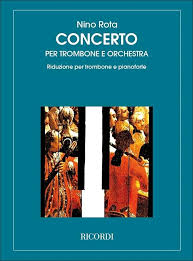
- Orchestral: 3 Symphonies (1936–39, 1975, 1976), Concerto festivo (1973), Concerto per trombone e orchestra (1973).
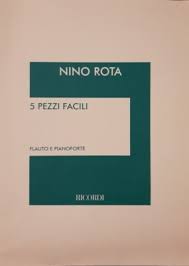
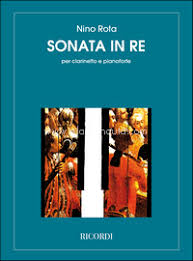
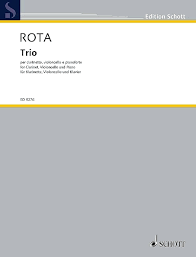
- Chamber Music: Numerous sonatas for various instruments, string quartets, the delightful Trio for Flute, Violin, and Piano (1958).
Filmography (A Selection):
- With Fellini: La Strada (1954), Le notti di Cabiria (1957), La Dolce Vita (1960), 8½ (1963), Juliet of the Spirits (1965), Satyricon (1969), Roma (1972), Amarcord (1973), Il Casanova di Federico Fellini (1976).
- With Visconti: Rocco e i suoi fratelli (1960), Il Gattopardo (1963).
- With Zeffirelli: The Taming of the Shrew (1967), Romeo and Juliet (1968).
- Other Landmarks: The Glass Mountain (1949), War and Peace (King Vidor, 1956), La grande guerra (Monicelli, 1959), Waterloo (1970), The Godfather (1972), The Godfather Part II (1974), Death on the Nile (1978).
Discography and Most Known Compositions
Rota’s discography is vast. Essential recordings include:
- Film Music: The original soundtracks for The Godfather, 8½, La Dolce Vita, and Romeo and Juliet. Compilations by conductors like Carlo Savina and the composer himself are invaluable.
- Concert Music: Notable recordings include Riccardo Muti and the Philharmonia Orchestra performing the symphonies, and various chamber music recordings by ensembles like the Borciani Quartet.
Most Known Compositions:
- “Love Theme” from Romeo and Juliet (A Time for Us) – The quintessential romantic theme.
- “The Godfather Waltz” & “Speak Softly, Love” – Synonymous with cinematic tragedy and power.
- “La Dolce Vita” Theme – Capturing the glamour and ennui of Rome’s Via Veneto.
- “Gelsomina’s Theme” from La Strada – A heartbreakingly simple motif for innocence lost.
- “8½” Main Titles – A complex, swirling parade of circus and fantasy.
- “Amarcord” Theme – Nostalgic, waltzing remembrance.
- “Il Gattopardo” Waltz – A sumptuous, decaying aristocratic dance.
- “Rocco e i suoi fratelli” Theme – A stirring, tragic melody for strings.
Nino Rota:
Nino Rota was a composer of rare unity and duality. He was both a serious academic and a populist melodist; a traditionalist steeped in European classicism and a modernist unafraid of collage and quotation; a painter of intimate miniatures and a crafter of epic tapestries. His genius lay in his ability to speak directly to the heart through melody, while fascinating the mind with his inventive harmony and orchestration.
He did not merely accompany images; he gave them a soul, breathing musical life into the dreams of Fellini, the tragedies of Visconti, and the epics of Coppola. In the concert hall, his works affirm the enduring power of lyricism and formal clarity. More than four decades after his death, Nino Rota’s music remains utterly alive—a testament to the timeless appeal of creativity fueled by profound humanism, wit, and an unerring sense of beauty.
Search your favorite Sheet Music of Film, movie and musicals.
Nino Rota: The Godfather – Suite, Boian Videnoff – Mannheimer Philharmoniker.
Nino Rota: The Godfather – Suite Mannheimer Philharmoniker Boian Videnoff, conductor Stefan Tarara, concertmaster Live from the Rosengarten Mannheim, 01. January 2019 Director: Sören Klitzing Director of Photography: Thomas Kutschker Sound: Bauer Studios Ludwigsburg Streaming: in medias res, Jens Breith Post-Production: Sören Klitzing.