Community Musicians, building a worldwide Community Music.
All the music you want to play on one site. Sharing the world’s best Contemporary, Jazz, Popular, Film, and Classical Sheet Music.
Scores for all instruments: over 15,000
(active and growing), over 231,000 pages.
All genres, styles, and instruments — Jazz & Blues, Rock & Pop, Classical & Contemporary, Film & Musicals;
books, methods, études, play-along tracks (MP3) for Jazz & Rock.
Access & benefits: $15.99 one-time payment, valid for lifetime.
Table of Contents
Search your favorite sheet music in the Sheet Music Catalog
Please, subscribe to our Sheet Music Library.
If you are already a subscriber, please, check our NEW SCORES’ page every month for new sheet music. THANK YOU!
Takashi Yoshimatsu: The Cosmic Weaver of Neo-Romanticism and J-Pop Fusion
Takashi Yoshimatsu (吉松 隆, Yoshimatsu Takashi, born March 18, 1953) stands as one of Japan’s most significant and beloved contemporary composers. In a musical landscape often dominated by avant-garde intellectualism, Yoshimatsu emerged as a passionate voice for melody, emotional directness, and a joyful synthesis of Western classical traditions with the vibrant energy of Japanese popular culture and jazz. He has declared himself a “post-modernist who loves the past,” crafting a sound universe that is both nostalgically beautiful and thrillingly modern.
Biography: From Engineering to “The Birds”
Yoshimatsu’s journey is a testament to following one’s true passion. Born in Tokyo, he initially pursued a path in engineering at Keio University, a field seemingly distant from music. However, his autodidactic musical spirit was irrepressible. Largely self-taught as a composer, his early influences were not the serialist techniques taught in academia, but the symphonies of Beethoven and Sibelius, the progressive rock of Emerson, Lake & Palmer, and later, the intricate jazz fusion of Pat Metheny and the melodic rock of The Beatles.
A pivotal moment came in 1978, when a performance of Messiaen’s monumental Turangalîla-Symphonie left him deeply moved yet also resolved to forge a different path—one that embraced “beauty” over what he perceived as the arid intellectualism of much 20th-century classical music. His official debut, “Threnody to Toki” for string orchestra (1980), already displayed his lyrical gift and concern for nature, a theme that would become a constant. However, it was his “Concerto for Guitar and Chamber Orchestra, ‘Kishin’” (1983) that brought him to national attention, winning a prize and establishing his unique voice.

The late 1980s and 1990s saw his star rise with a series of major works, most notably his “Symphony No. 1, ‘Kamui-Chikap’” (1990), a grand, nature-inspired work that became a cornerstone of his repertoire. His five symphonies, composed between 1990 and 2013, trace the evolution of his style from sweeping romanticism to more concise, crystalline forms.
Parallel to his “serious” compositions, Yoshimatsu never hid his love for anime, composing the iconic score for the groundbreaking series “Giant Robo: The Day the Earth Stood Still” (1992-1998). This work, blending orchestral grandeur with rock and jazz, introduced his music to a global pop-culture audience. He has since lived a dual life as a celebrated concert composer and a masterful creator of film and game scores, refusing to recognize a hierarchy between the two.
Music Style: The “Yoshimatsu Sound”
Yoshimatsu’s style is a masterful, seamless fusion of diverse elements:
- Neo-Romantic Lyricism: At its heart is a unabashed return to melody and tonal harmony. His themes are often long-breathed, soaring, and instantly memorable, evoking the vast landscapes of Sibelius or the emotional warmth of Rachmaninoff.
- Jazz and Fusion Fluidity: The influence of Pat Metheny is particularly profound. Yoshimatsu incorporates extended harmonies (major 7ths, added 9ths, sharp 11ths), sophisticated swing rhythms, and the timbral palette of jazz—especially in his use of the saxophone, which features prominently in many concertos.
- J-Pop and Rock Energy: Straight-eight-note rock grooves, electric guitar timbres, and the bright, optimistic harmonic progressions of Japanese pop music frequently surface, giving his music an infectious, contemporary vitality.
- “Avian” Orchestration: A self-proclaimed ornithologist in music, Yoshimatsu’s orchestration is remarkably light, transparent, and colorful. He often writes high, fluttering woodwind lines, bell-like piano and harp sounds, and avoids dense, muddy textures. His music truly “sings” and “flies.”
- Mathematical Playfulness: His engineering background manifests in a love for playful structures, palindromes, and numerical games (like the Fibonacci sequence), but always subsumed into the musical flow rather than as a rigid constraint.
Improvisational Licks and Harmonic Language
While not an improviser on stage, Yoshimatsu’s writing, especially in his concertos, is imbued with the spirit of improvisation.
- Saxophone Licks: In works like the “Cyberbird” Concerto for Alto Saxophone or the “Sing Bird” Concerto for Soprano Saxophone, the solo lines are filled with fluid, scale-based runs that blur the line between written-out cadenza and jazz improvisation. He uses rapid altissimo register leaps, bluesy bends (notated with grace notes), and passages that mimic the spontaneous energy of a jazz solo.
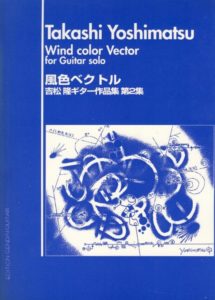
- Guitar Writing: His guitar music (e.g., “Pegasus Effect”) often features metallic, clean-toned arpeggios reminiscent of Pat Metheny, with lush polychordal harmonies (chords stacked on top of each other) creating a shimmering, cosmic soundscape.
- Piano Figuration: His piano writing can shift from Chopinesque lyricism to repetitive, minimalist patterns or to jazzy block chords in the left hand with melodic right-hand ornaments.
Chord Progressions and Harmony: Yoshimatsu’s harmony is tonal but richly expanded. He favors:
- Planing: Moving lush chords (like major 7ths) in parallel motion, creating a dreamy, cinematic effect.
- Modal Interchange: Borrowing chords from parallel minor or major scales (e.g., a bright major passage suddenly colored by a dark iv chord from the minor mode).
- Static Harmony with Melodic Motion: A hallmark of his style is holding a beautiful, complex chord (like Fmaj7#11) for several bars while the melody and inner voices weave intricate patterns above and within it, creating a sense of suspended, ecstatic time.
- Unexpected Resolutions: He will lead a progression to the brink of a standard cadence, then resolve to a surprising, yet satisfying, distant chord, keeping the sense of wonder alive.
Cooperation with Other Artists
Yoshimatsu has cultivated long-term collaborations with musicians who understand his hybrid world:
- Saxophonist Nobuya Sugawa: The dedicatee and premier interpreter of many of his saxophone concertos, Sugawa’s virtuosic yet lyrical playing is inextricably linked to these works.
- Guitarist Daisuke Suzuki: A frequent performer of his guitar works, bridging the classical and jazz worlds.
- Conductor Sachio Fujioka: A key champion of his orchestral music, leading definitive recordings.
- Anime Director Yasuhiro Imagawa: Their collaboration on “Giant Robo” is legendary, a perfect marriage of epic narrative and equally epic music.
- The British Chamber Orchestra & London Philharmonic Orchestra: Have recorded major cycles of his works for the Chandos label, bringing his music to a wide Western audience.
Influences
Yoshimatsu’s pantheon is tellingly eclectic:
- Classical: Jean Sibelius (nature mysticism, organic form), Olivier Messiaen (bird song, color, spiritual awe), Claude Debussy (harmonic color), Béla Bartók (folk-inspired rhythms).
- Jazz & Fusion: Pat Metheny (harmony, soundscape, melodic joy), Chick Corea.
- Progressive & Popular Rock: Emerson, Lake & Palmer, The Beatles, Japanese folk and pop music.
- Japanese Tradition: While less overt, a Japanese aesthetic of clarity, asymmetry, and reverence for nature permeates his work.

Legacy
Yoshimatsu’s legacy is profound. He proved that a contemporary composer could achieve widespread popularity without compromising a sophisticated, personal voice. He re-legitimized melody and emotional expression in an art form that had often turned inward. For many in Japan and abroad, he is a gateway composer, drawing listeners from anime and jazz into the concert hall. He represents a truly “post-modern” model: where high and low culture, Western and Japanese sensibilities, intellect and heart, coexist in joyous harmony.
Major Works
- Orchestral: Symphony No. 1 ‘Kamui-Chikap’ (1990), Symphony No. 4 (2000), Symphony No. 5 (2013).
- Concertos: “Cyberbird” Concerto for Alto Saxophone and Orchestra (1994), “White Landscapes” Concerto for Cello and Orchestra (2019), Piano Concerto “Memo Flora” (1997), Guitar Concerto “Pegasus Effect” (1998).
- Chamber & Instrumental: “And Birds Are Still…” for solo saxophone (1992), “Sing Bird” Suite for Soprano Saxophone and Piano (1991), String Quartets.
- Piano: “Piano Folio” series, “Garden of Cosmos.”
Browse in the Library:
Or browse in the categories menus & download the Library Catalog PDF:
Filmography (Selective)
- Giant Robo: The Day the Earth Stood Still (OVA Series, 1992-1998) – His most famous anime score.
- Birdy the Mighty (OVA, 1996-1997).
- A Tree of Palme (Film, 2002).
- Buzzer Beater (Anime Series, 2005).
- Video Game: “Ace Combat 04: Shattered Skies” (contributor, 2001).
Discography (Key Albums)
Yoshimatsu is well-served on recordings, primarily on the Chandos and Naxos labels.
- Symphonies Nos. 1 & 3 (BBC Welsh Symphony Orchestra / Tadaaki Otaka, Chandos)
- Cyberbird – Saxophone Concertos (Nobuya Sugawa, BBC Philharmonic / Sachio Fujioka, Chandos)
- Pegasus Effect – Guitar Concerto (Daisuke Suzuki, London Philharmonic / Sachio Fujioka, Chandos)
- Giant Robo Original Soundtrack (multiple discs)
- And Birds Are Still… – Complete Works for Saxophone (Nobuya Sugawa, BIS)
Most Known Compositions and Performances
- “Cyberbird” Concerto: Arguably his most popular concert work, a thrilling fusion of jazz fusion energy and concerto brilliance.
- Symphony No. 1 ‘Kamui-Chikap’: His breakthrough large-scale orchestral statement.
- “And Birds Are Still…”: A hauntingly beautiful solo saxophone piece, a staple of the modern saxophone repertoire.
- “Giant Robo” Overture: The main theme from the anime is a concert piece in its own right, instantly recognizable to a generation of fans.
- “White Landscapes” Cello Concerto: A later masterpiece, showcasing his mature, reflective style.
Takashi Yoshimatsu is a cosmic weaver of sound. He draws threads from the symphonic tradition, the freedom of jazz, the pulse of pop, and the quiet beauty of the natural world, spinning them into a tapestry that is uniquely his own. In an age of fragmentation, his music offers a vision of wholeness—a celebration of all that is lyrical, colorful, and alive. He is not just a composer for our time, but a composer for the enduring human spirit.