Come join us now, and enjoy playing your beloved music and browse through great scores of every level and styles!
Can’t find the songbook you’re looking for? Please, email us at: sheetmusiclibrarypdf@gmail.com We’d like to help you!
Table of Contents

Search your favorite sheet music in the Sheet Music Catalog
Please, subscribe to our Sheet Music Library.
If you are already a subscriber, please, check our NEW SCORES’ page every month for new sheet music. THANK YOU!
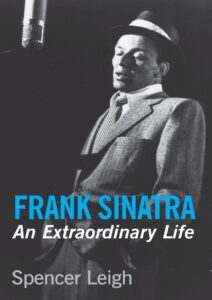
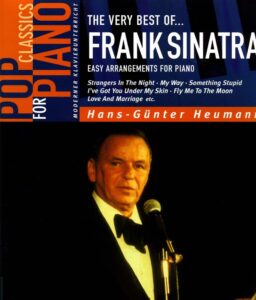
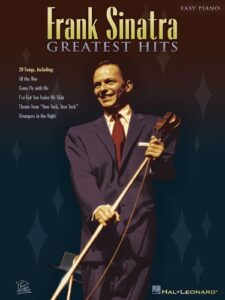
Happy heavenly birthday, Frank Sinatra, born on this day in 1915.
Frank Sinatra: The Voice, The Legend, The Enduring Century
Born on December 12, 1915, in a tenement apartment in Hoboken, New Jersey, Francis Albert Sinatra would emerge from humble, often tough beginnings to become the definitive popular singer of the 20th century. More than just an entertainer, Sinatra was a cultural force—a pioneer of the concept album, a masterful film actor, a controversial personality, and the architect of a musical ethos centered on intimate, conversational storytelling. To examine Sinatra is to trace the evolution of American music itself, from the swing era through the birth of the LP to the modern era of artistic autonomy.
Browse in the Library:
Or browse in the categories menus & download the Library Catalog PDF:

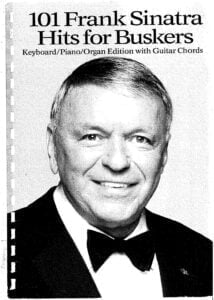
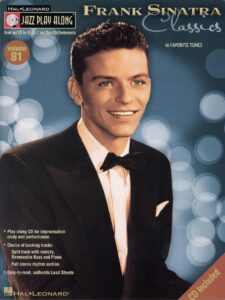
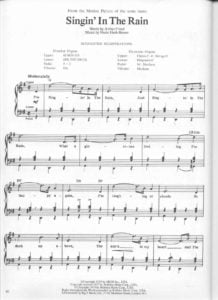

Full Biography: From Hoboken to Olympus
Sinatra’s early life was marked by a singular determination to escape the factory-lined destiny of his hometown. Inspired by Bing Crosby’s relaxed baritone, he began singing professionally in his teens. His big break came in 1935 when he, along with a vocal trio, won a radio talent show, leading to his hiring as a salaried singer for bandleader Harry James in 1939. This was the golden age of the big band, and Sinatra was about to change its dynamic forever.
His true ascent began when he joined the wildly popular Tommy Dorsey Orchestra in 1940. Dorsey’s seamless, breath-controlled trombone phrasing became the young singer’s most profound technical influence. Sinatra studied Dorsey’s legato endlessly, learning how to shape a musical line without seeming to breathe. The hits with Dorsey—“I’ll Never Smile Again,” “There Are Such Things”—catapulted him to stardom. But Sinatra chafed under the bandleader’s contract, and in a move of unprecedented risk, he left the security of the orchestra in 1942 to pursue a solo career. Many predicted failure; instead, he ignited a cultural phenomenon known as “Sinatramania.” His solo appearances at New York’s Paramount Theatre in 1943 caused riots of teenage “bobby-soxers,” a scene of fan hysteria presaging the Beatles two decades later.
The post-war years brought a shocking slump. His voice faltered, his film career stalled, and his public image suffered from reports of association with unsavory figures. By the early 1950s, he was considered finished. His phoenix-like resurrection is the stuff of legend. Determined to rebuild, he fought for and won the dramatic, non-singing role of Maggio in From Here to Eternity (1953), for which he won an Academy Award. Concurrently, he signed with Capitol Records and began a collaboration that would produce his most enduring artistic statements.
The Capitol years (1953-1962) are the zenith of the Sinatra canon. Teamed with arranger-conductors like Nelson Riddle, Billy May, and Gordon Jenkins, he pioneered the concept of the thematic album, crafting cohesive collections of song that were cinematic in scope. This period solidified his persona: the swaggering swinger and the tender, lonely romantic. In 1961, he founded his own label, Reprise Records, declaring it the home of “freedom” for artists. He continued to record and perform at a staggering pace through the 1960s and 70s, becoming a central figure in the Rat Pack’s Las Vegas hedonism and a global icon. Though his voice darkened and roughened with age, his interpretive skills only deepened. Frank Sinatra performed almost until the end of his life, his final concert in 1995. He died on May 14, 1998, at the age of 82.
Musical Style and Harmonic Language: The Art of Phrasing
Sinatra’s style cannot be divorced from his revolutionary approach to phrasing. While pre-war popular singing was often formal and rhythmically square, Sinatra treated lyrics as dramatic monologues. He leaned behind or rushed ahead of the beat with a jazz musician’s instinct, creating a sense of spontaneous, emotional speech. This conversational quality made every song feel newly minted, a confession rather than a recitation.
Technically, his instrument evolved dramatically. The early “Voice” was a pure, yearning tenor, capable of a breathtaking pianissimo (soft tone) that could reach the back of a theater. The post-Capitol voice was the iconic “Saloon Singer” baritone—darker, grainier, bruised with experience, yet wielded with even greater dramatic authority. He used vibrato not as a constant ornament, but as an emotional tool, tightening it for tension or letting it widen for passion.
Harmonically, Sinatra operated within the sophisticated architecture of the Great American Songbook, but his genius lay in highlighting harmonic tension through his phrasing. Arrangers like Nelson Riddle provided lush, complex backdrops. In swing numbers, Riddle used sharp, staccato brass and propulsive rhythms to frame Sinatra’s aggressive, syncopated delivery. In ballads, the harmonies became richer, using clusters of strings and woodwinds to create a profound sense of melancholy or lush romance. Sinatra would often land on the “blue” note within a chord, emphasizing the emotional dissonance. He didn’t scat or improvise melodies wildly like a jazz singer; instead, he improvised the meaning of the lyric, bending notes and altering rhythms to uncover new shades of feeling within a standard chord progression.
The Canon: Essential Albums and Songs
While hit singles like “Strangers in the Night” or “My Way” are ubiquitous, Sinatra’s legacy is best understood through his album-length masterpieces:
- “In the Wee Small Hours” (1955) – Arguably the first true concept album. Arranged by Nelson Riddle, it is a seamless, haunting suite of late-night loneliness and lost love. Key track: “In the Wee Small Hours of the Morning.”
- “Songs for Swingin’ Lovers!” (1956) – The definitive swing album. Riddle’s arrangements are bursting with inventive, playful energy, and Sinatra’s phrasing is effortlessly confident. Key track: “I’ve Got You Under My Skin,” featuring a breathtaking, building crescendo.
- “Only the Lonely” (1958) – The peak of the torch song genre. Arranged by Riddle with profound melancholy, it is Sinatra’s most emotionally devastating work. Key track: “One for My Baby (And One More for the Road).”
- “Come Fly with Me” (1958) – A travelogue album with Billy May’s bright, brassy, and exotic arrangements. It captures the jet-age optimism and Sinatra’s charismatic authority. Key track: the title song.
- “September of My Years” (1965) – A mature, autumnal reflection on aging and memory, perfectly arranged by Gordon Jenkins for a man turning 50. Key track: “It Was a Very Good Year.”
Other quintessential songs that define his personas include “Fly Me to the Moon” (swinging optimism), “Night and Day” (tormented obsession), “The Lady Is a Tramp” (insouciant cool), “All or Nothing at All” (dramatic yearning), and “That’s Life” (defiant resilience).
Filmography: From Song-and-Dance to Serious Actor
Sinatra’s film career was prolific and varied. He began in lightweight musicals like Anchors Aweigh (1945). His dramatic rebirth in From Here to Eternity proved his mettle. He delivered other powerful dramatic performances in The Man with the Golden Arm (1955), as a heroin addict, and The Manchurian Candidate (1962), in a finely tuned performance of paranoia. He excelled in musicals like Guys and Dolls (1955) as Nathan Detroit and Pal Joey (1957), perfectly capturing the charming heel. He also starred in a series of Rat Pack “caper” films like Ocean’s 11 (1960), which were extensions of his off-stage persona—cool, careless, and clique-ish.
Collaborations with Jazz Musicians
Though not a jazz singer in the purest sense, Sinatra was deeply jazz-adjacent and collaborated with the greatest musicians of the genre. His relationship with the Count Basie Orchestra produced two of the hardest-swinging albums ever recorded: Sinatra-Basie (1962) and It Might as Well Be Swing (1964), arranged by a young Quincy Jones. The pairing was electric—Sinatra’s razor-sharp phrasing slicing through Basie’s minimalist, rhythmic pulse.
He worked with stellar jazz instrumentalists on his records, including Harry “Sweets” Edison (trumpet), Stan Getz (tenor sax), and Ben Webster (tenor sax), whose breathy, lyrical tones complemented Sinatra’s own. His 1956 album Songs for Swingin’ Lovers! featured breathtaking solos by trumpeter Harry Edison and trombonist Milt Bernhart. His collaborations with Quincy Jones in the 60s and Don Costa in later years always incorporated top-tier jazz soloists. Furthermore, his longtime pianist and musical director, Bill Miller, provided impeccable, jazz-inflected accompaniment for decades.
Influences and Legacy: The Chairman’s Chair
Sinatra’s primary influence was Bing Crosby, from whom he learned the power of intimacy and conversational singing via the microphone. From Tommy Dorsey, he acquired technical mastery over breath and legato. He also admired the lyrical clarity of Mabel Mercer and the emotional directness of Billie Holiday.
His own influence is immeasurable. He democratized phrasing for every singer who followed, making lyrical interpretation paramount. Elvis Presley, Tony Bennett, Bobby Darin, Paul McCartney, Bono, and Lady Gaga have all cited him as foundational. He created the blueprint for the modern pop album as a cohesive artistic statement, influencing everyone from The Beatles to Marvin Gaye to contemporary concept-album creators. He modeled a persona of rugged individuality and emotional vulnerability that became the template for the modern male pop star.
Frank Sinatra was a complex, often contradictory figure: generous and vengeful, supremely confident and deeply insecure, a champion of civil rights who kept dubious company. But in music, these contradictions fused into a profound artistic truth. He taught us how to listen to a song—not just to hear the melody, but to feel the story. He embodied the American ideals of reinvention and resilience. More than just “The Voice,” he was the most complete musical communicator of his century, a singer for whom every note was a thought, and every breath, a feeling. As he himself sang in “Put Your Dreams Away,” the closing theme to his radio shows and the epitaph on his grave, the music—his legacy—does not end; it simply fades out, lingering in the air forever.
Search your favorite sheet music in the Sheet Music Catalog
Frank Sinatra – My Way (Live At Madison Square Garden, New York City / 1974
Frank Sinatra performing “My Way” Live from Madison Square Garden in 1974. The original studio version of ‘My Way’ was recorded on December 30, 1968 in one take. ‘My Way’ has gone on to become an all-time classic, a song which will be forever associated with the Chairman of the Board, as one of his signature tunes, and one which Frank Sinatra regularly closed his live shows with.