Come join us now, and enjoy playing your beloved music and browse through great scores of every level and styles!
Can’t find the songbook you’re looking for? Please, email us at: sheetmusiclibrarypdf@gmail.com We’d like to help you!
Table of Contents
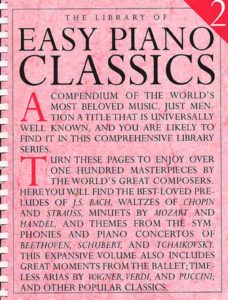
Easy Piano Classics Easy Classical Piano Selected By James Bastien.

Best Sheet Music download from our Library.
Please, subscribe to our Sheet Music Library.
If you are already a subscriber, please, check our NEW SCORES’ page every month for new sheet music. THANK YOU!
Contents List Download:
Contents:
- Air [Purcell, Henry]
- Allegro In B Major (Mozart)
- Arabesque Op.100 No.2 [Burgmuller, Friedrich]
- Ave Maria [Bach, Johann Sebastian] [Gounod, Charles]
- Bagatelle [Diabelli, Anton]
- Ballade From 25 Progressive Pieces (Burgmuller)
- Ecossaise In G [Beethoven, Ludwig Van]
- Emperor Waltz Op.437 [Strauss II, Johann]
- Fantaisie Impromptu (Chopin/Bastien)
- First Loss From Album For The Young (Schumann)
- Folk Dance From For Children (Bartok)
- Follow The Leader From 24 Little Pieces For Children (Kabalevsky)
- Follow The Leader From For Children (Bartok)
- Fur Elise (Bagatelle In A Minor WoO 59) [Beethoven, Ludwig Van]
- Gavotte [Turk, Daniel Gottlob]
- German Dance [Haydn, Franz Joseph]
- Hungarian Dance No.5 [Brahms, Johannes]
- Hungarian Folk Song From For Children (Bartok)
- Hunting Song (Album For The Young) [Schumann, Robert]
- I Love Thee (Ich Liebe Dich) ( Grieg/Bastien)
- Italian Folk Song From The Children’s Album (Tchaikovsky)
- Ivan Sings From Children’s Pieces (Khatchaturian)
- Largo (Symphony No.9 In E Minor ‘From The New World’ Op.95) [Dvorak, Antonin]
- Le Petit-rien (The Trifles) [Couperin, Francois]
- Liebestraum (Liszt/Bastien)
- Little Dance From 24 Little Pieces For Children (Kabalevsky)
- Little Song From Album For The Young (Schumann)
- March (Six Children’s Pieces Op.69) [Shostakovich, Dmitri]
- March In D Major (Notebook For Anna Magdalena Bach) [Bach, Johann Sebastian]
- Minuet And Trio (K.1) (Mozart)
- Minuet In C K.6 [Mozart, Wolfgang Amadeus]
- Minuet In D Minor From Notebook Of Anna Magdalena (Bach)
- Minuet In F [Handel, George Frideric]
- Minuet In F K.2 [Mozart, Wolfgang Amadeus]
- Minuet In F Major [Haydn, Franz Joseph]
- Minuet In G [Haydn, Franz Joseph]
- Minuet In G Major No.1 (Bach)
- Minuet In G Major No.2 (Bach)
- Minuet In G Minor From Notebook For Anna Magdalena (Bach)
- Minuet In Rondo Form [Rameau, Jean-Philippe]
- Minuetto In C (Scarlatti)
- Morning Song (Gurlitt)
- Musette (English Suite No.3 In G Minor BWV 808) [Bach, Johann Sebastian]
- Musette In D (The Notebook For Anna Magdalena Bach)
- My Herat At Thy Sweet Voice (Samson And Delilah) (Saint-Saens)
- Nocturne [Chopin, Frederic]
- Piano Concerto In A Minor (Theme From 1st Movement) (Grieg/Bastien)
- Piano Concerto No.1 (Theme From 1st Movement) (Tchaikovsky/Bastien)
- Piano Concerto No.2 (Theme From 3rd Movement) (Rachmaninov/Bastien)
- Polovetsian Dances (Prince Igor) [Borodin, Alexander]
- Prelude In C Major From Twelve Short Preludes (Bach)
- Romanze (Mendelssohn)
- Russian Folk Song (Beethoven)
- Sad Song From For Children (Bartok)
- Sarabande [Corelli, Arcangelo]
- Sarabande for a sandwich
- Scherzo (Weber)
- Scherzo Form Sonato No.3 [Haydn, Franz Joseph]
- Sicilienne From Album For The Young (Schumann)
- Soldiers March Form Album For The Young (Schumann)
- Sonatina (Clementi)
- Sonatina From Children’s Pieces (Kabalevsky)
- Sonatina In G (Beethoven)
- Springtime Song From For Children (Bartok)
- Symphony No.1 Theme From Finale (Brahms/Bastien)
- Theme – Third Movement (Scheherazade) (Rimsky-Korsakov, Nicolay)
- The Clown (Kabalevsky)
- The Doll’s Funeral From Children’s Album (Tchaikovsky)
- The Merry Farmer Op.68 No.10 [Schumann, Robert]
- The Toreador Song (Carmen) [Bizet, Georges]
- The Weary Traveller (Bartok)
- The Wild Horseman Op.68 No.8 (Album For The Young) [Schumann, Robert]
- Theme (First Movement – Symphony No.94 In G’ The Surprise’) [Haydn, Franz Joseph]
- To A Wild Rose (Woodland Sketches Op.51) [Macdowell, Edward]
- Toccatina (Children’s Pieces Op.27) [Kabalevsky, Dmitri]
- Variations On A Minuet By Fischer
- Waltz In A (Schubert)
- Waltz In A Minor (Six Children’s Pieces) [Shostakovich, Dmitri]
- Waltz In C (Schubert)
Browse in the Library:
Or browse in the categories menus & download the Library Catalog PDF:
The Piano Library for Older Beginners is today’s timeless piano course designed especially for older beginners from the age of 12 to 80 young people. A carefully planned instructional program consists of method books, theory/technique books, and supplemental materials. The approach is functional: the skills acquired are transferable. Students play and harmonize melodies from the beginning. An all-round musicality combined with original music and carefully selected familiar melodies form a unified structure that builds a sonic program of happy, uninterrupted progress.
Easy Piano Classics by James Bastien


Search your favorite sheet music in the Sheet Music Catalog
THE BAROQUE PERIOD (1600-1750)
The art and architecture of the Baroque period reflect an often bizarre style characterized by ornamental decorations. Especially notable in churches, palaces, and other buildings of the period is the profusion of worldly splendor evident in grandiose designs and elaborate decorations. The music of the period reflects the decorative art in the use of ornamentation to embellish melodies. A thick and complex polyphonic texture prevails in many composers’ works. A sense of drama and urgency is infused in vocal forms such as the cantata, mass, opera, oratorio, and passion, and in instrumental forms such as the concerto, concerto grosso, prelude, fugue, toccata, sonata, and suite.
Vibrant rhythms and expressive dissonances heighten tension in many Baroque works. Much of the Baroque keyboard music written for the harpsichord and clavichord was written in suites comprising separate dance pieces, changing in tempo and meter, but maintaining key unity throughout. The suite {Italian: Partita, Sonata da Camera; German: Suite, Partita, Overture; French: Order, S uite; English: Lessons) consists of dances such as the a llemande, courante, sarabande, gigue, and others such as the gavotte, musette, bourree, minuet, and pavane. Each dance piece (movement) is usua lly written in two sections, called binary form, and is generally performed with each section repeated.
Other forms of keyboard music from the Baroque period are theme and variation, passacaglia, chaconne, invention, prelude, fugue, choral prelude, ricercare, fantasy, toccata, and concerto. The two best known Baroque composers are Johann Sebastian Bach and George Frederick Handel, both Germans. Other German Baroque composers include Heinrich Schütz, Samuel Scheidt, Johann Froberger, Dietrich Buxtehude, Johann Pachelbel, Johann Kuhnau, and Georg Telemann. English Baroque composers include William Byrd. John Bull, and Henry Purcell. Notable Italian Baroque composers include Claudio Monteverdi, Arcangelo Corelli, Antonio Vivaldi, and Alessandro and Domenico Scarlatti. Prominent French Baroque composers include Jean Baptiste Lully, Francois Couperin, and Jean Philippe Rameau.
THE CLASSICAL PERIOD (1750-1820)
A transitional era ofabo11t thirty years, termed “Rococo,” between the Baroque and Classical periods set the stage for the emergence of the Classical style. The Rococo musical style was characterized by delicate, frivolous expression designed more to please than to excite the listener. Some transitional composers are Francois Couperin, Domenico Scarlatti, and the sons of J. S. Bach. Emerging from the Baroque period was a new style, highly refined, simple in melodic line and harmonic texture, and unified by symmetrical form. Developing during the early Classical period were expanded instrumental forms such as the sonata allegro and the rondo.
The binary dance movements of the Baroque gave way to the ternary first movements of most Classical period works (sonata, concerto, chamber music, symphony) which comprised three parts: exposition (A), development (8 ), and recapitulation (A). Frequently, well-defined melodies were harmony.ed with triadic harmony.
Especially in keyboard works with a broken-chord figure called the Alberti bass (named after Domenico Alberti who was one of the first to use this type of accompaniment . Major Classical period composers arc Franz Joseph Haydn, Wolfgang Amadeus Mozart, and Ludwig van Beethoven.
Others include Domenico Cimarosa and Luigi Cherubini (Italians, best known for their operas), Karl Ditters von Dittersdorf (Viennese, a composer of symphonies, choral music, and operas ), Christoph Gluck (Viennese, best remembered for his operas), and Muzio Clementi (Italian, best known today for his keyboard sonatinas).
THE ROMANTIC PERIOD (1820-1900)
The impact of the French Revolution (1789- 1794 ) set the stage for free thinkers and encouraged men of action to independent endeavors. The Romantic period was ushered in by artists who expressed themselves freely and personally. The desire to release emotion and achieve freedom is succinctly expressed in the watchword term “Strum und Orang” (“storm and stress”) which comes from a play (1776) by the German author Friedric h von Klinger. Literary works such as Goethe’s Faust (1808) about a man who defies convention, and novels by E.T. A. Hoffmann (1776-1822) and others inspired musicians to new emotional he ights. Romantic music developed over a period of almost a hundred years.
During this time new forms emerged: the art song (li ed) which combi ned Romantic poetry with voice and piano; stylized piano music such as the waltz, mazurk a, polonaise, a nd etude (study piece); piano mu sic in free form such as the fantasy, arabesque, rhapsody, romanza, ballade, and nocturne; and symphoni c works s uch as the to n e poem (descripti ve piece ). Programmatic content was expressed in tone poems (by Liszt and others), in symphonic works such as Berlioz’ Symphony Fantastique, and in piano music such as Mu ssorgsky’s Pictures a t an Exhibition (later orchestrated in 1923 by Maurice Ravel). Nationalism is prevalent in works such as Chopin’s polonaises and mazurkas, Liszt’s Hungarian Rh apsodies, Smetana’s The Bartered Bride (opera usi ng patriotic themes) and The Moldau (symphonic poem), Borodi n’s opera Prince Igor, and Rimsky- Korsakov’s orchestrally resplendent Sch ehe r eza de.
The music of the Romantic period ofien contained warm, personal melodies (so tuneful that many have been made into popular so ngs); expressive indications (espressivo-expressively, dolce-sweetly, con amore-with love , con fuoco- with fire ; etc.); implied interpretative freedom ( rubato-rhythmic “give-and-take”); and harmonic color (new chords: altered, seventh, and ninth, and chromatic harmony). Color was intensified in mu sic by the improvements on the piano (enlargement of the piano and perfection of the pedals) and in the orchestra (development of instruments, improvement in technique by the players, and larger scoring by the composers).
Virtuoso performers carried playing to new heights (Niccolo Paganini – violinist, 1782-1842; Franz Liszt-pianist, 1811-1886; others). During the Romantic period exaggerated emotional emphasis was displayed in the contradictory qualities of v irtuosity (large scale solo pieces, concertos, etc. ) and intimacy (s alon music s uch as the subjective piano piece and so lo song). Ludwig van Beethoven (1770-1827) bridged the Classical and Roma ntic periods in both his life and works, reflecting Classical influences in his early music and Romantic influences in his middle and later yea rs. Significant Romantic period composers are Franz Schubert, Hector Berlioz, Felix Mendelssohn, Frederic Chopin, Robe r t Schumann, Franz Li szt, Richard Wagner, Giuseppe Verdi, Cesar Franck , Johannes Brahms, Modest Mussorgsky , Peter l lyich Tchaikovsky, Anton Dvofiak , Edvard Grieg, Nikola i Rimsky-Korsakov , and Giacomo Puccini.
THE CONTEMPORARY PERIOD (1900-present)
The bridge to the Contemporary period was formed during the last quarter of the ninetee nt h century through a new painting movement called Impressio nism . About 1870 a group of French painters includ ing Claude Monet, Pierre Renoir , Edgar Degas, and others rejected the accepted Romanticis m in fa vor of a new painting style which sought to portray art as the artist’s impression of a subject.
Composers Claude Debussy (1862- 1918) and Maurice Ravel ( 1875-1937) portrayed musically these innovations in art and new directions in poetry (Arthur Rimbaud , Paul Verlaine, Stiéphane Mallarmé, and others). New sonorities in orchestration and piano music developed which often incorporated extramusic and material from art and literature, sometimes contained non-Western melodies and rhythms, introduced new scales (whole tone modes) and chord uses (altered chords, parallel motion chords, ninth and eleventh chords), and frequently used unresolved dissonances to portray veiled, illusionary effects.
20th century music reflects the influences of art and literature in a mechanistic, atomic age. The emergence of pleasant sounding, pastel-colored Impressionistic music led to experimentation with twelve-to ne music (Arnold Schoenberg-1874-1951, and others) which produced cerebral, atonal, often angular and disjunct musical effects.
Other twentieth century musical experimentations with electronic music and music for “prepared piano” (use of objects in the piano to produce unusual sounds) have produced totally new mediums for musical expression . Influences such as electronically amplified instruments and jazz, rock, and popular elements are also associated with the period. Within the “modern” era grcnt style variations are found, ranging from Post Romanticism (Gustav Mahler- 1824-1911 , Alexander Scriabin- 1872- 1915, Sergei Rachmaninoff- 1873-1943, and others), to Impressionism, to new concepts or melody-tonality-rhythm expressed in the music, or composers such as Bela Bartok (1881- 1945), Igor Stravinsky (1882- 1971), Sergei Prokofiev 1889-1932, -Aaron Copland (1900-1990, Dmitri Shostakovich (1906-1975), Samuel Barber 1900-1981), Pierre Boulez (1925-2016 ), and Krzystor Penderecki (1933-2020).