Come join us now, and enjoy playing your beloved music and browse through great scores of every level and styles!
Can’t find the songbook you’re looking for? Please, email us at: sheetmusiclibrarypdf@gmail.com We’d like to help you!
Table of Contents
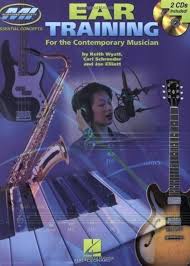
Ear Training For The Contemporary Musician Book with Audio MP3 Embedded Tracks
Best Sheet Music download from our Library.
Getting Started
Every musician has heard about or met someone who seems to be able to pull music right out of Getting Started the air and play it without effort-—someone who can hear a tune once and then play it from memory, dream up a melody and write it down without ever checking a single note, or play fresh, inspired solos night after night. These musicians are able to imagine, interpret, and play musical patterns without any apparent lag between thought and execution. Though this ability is typically referred to as a “gift’— that is, something bestowed upon a person by an outside force—it rests on concrete skills that can, in fact, be learned. The skill that ties together all of a musician’s resources—technique, Intelligence, and creativity—is ear training, and it is the key to becoming not just good but great.
Please, subscribe to our Sheet Music Library.
If you are already a subscriber, please, check our NEW SCORES’ page every month for new sheet music. THANK YOU!
Here are a few frequently asked questions about ear training, along with answers, to help you get started properly:
Do I have to be born with great ears?
No. Talent may be defined as the ability to effectively link imagination to execution without a great deal of effort. Just as it’s true that, for example, some people naturally shoot a basketball better than others, it’s also true that some musicians naturally play their instruments better than others. But It is also true that just as average basketball players can develop outstanding skills through dedicated physical training, average musicians can develop outstanding skills through dedicated ear training.
After years of experience working with thousands of musicians at all skill levels, the authors can verify that while talent undoubtedly provides a head start in ear training. In the end, it is far outweighed by such factors as motivation and discipline.
Browse in the Library:
Or browse in the categories menus & download the Library Catalog PDF:
Do I have to know music theory?
No. Music is a form of language, and like any language, it includes a vocabulary and certain rules for usage. The bigger your vocabulary and the better you understand how to use it, the more freedom you have to express yourself. We will explain the rules of harmony, melody, and rhythm as necessary in order to help you understand how sounds are organized, but the emphasis is on practical application, not theory (however, as noted below, you do need to know what musical notation means).
If you want more complete explanations of theory and notation, we recommend that you obtain a popular or jazz-based theory text (classical theory uses very different terminology and systems of organization). In particular, we recommend Harmony & Theory: a Comprehensive Source for All Musicians by Keith Wyatt and Carl Schroeder (MI Press/Hal Leonard Corporation), which uses the same terms and concepts as this book.
What do I need to know to get started?
This method is designed to be an introduction to ear training, but we do need to make a few basic assumptions about your skill level:
1. You can hear pitch differences. If you honestly can’t tell whether a given note is higher or lower in pitch than another note, you’ll need to work with a private teacher who can give you specific guidance on how to develop this skill. Before you begin this method.
2. You have some basic skills on either a guitar or a keyboard. You don’t need any special amount of technique, but you do need to have some way to play and visualize melodies and chords on an instrument. At a minimum, what you need to be able to do is:
* Find notes on your instrument by alphabet name (C, D, E, etc.)
* Play major and minor triads in different keys
* Play the major scale in different keys.
If you’ve just started playing and can’t yet do these things, work with a method book or take a few lessons before starting this book. It won’t take long to learn the basics, and your ear training will progress much more quickly.
3. You understand basic musical notation. You do not need to be a sight reader (i.e., someone who can read musical notation in tempo), but you do need to understand what various notes and rhythms mean. Any fundamental theory or technique book will explain musical notation.
4. You have regular access to your instrument and a media player. A media player with easy-to-use pause, cue, and review functions is essential for gaining maximum benefits from the MP3s that accompany this book.
5. You have regular time to practice in a quiet, private place. Set up a practice station where you keep your instrument, media player (with either speakers or headphones), manuscript paper, blank paper, pencil, eraser, and a clock or watch all ready to go. The less you have to do to get ready each time you sit down to practice, the easier it will be for you to stay disciplined.
How do I practice?
Each exercise in this book includes specific practice instructions. There are exercises that develop your singing, listening, writing, visualizing, and playing skills, sometimes individually and sometimes all at once. The MP3 examples that accompany the text are designed to improve specific skills, and they provide you with a step-by-step method that combines each new element with those previously learned.
How often do | need to practice?
Ear training is best accomplished through short, focused practice sessions of 15–30 minutes every day rather than longer, infrequent sessions. You cannot “cram” ear training the same way you might study for a test. Like learning a new language, you have to hear it and use it regularly over a period of time before it begins to sink in. When you practice, if you find yourself getting tired, take a break—when you are tired, your ability to hear patterns will suffer. Do something else for a while and then come back to ear training when you are fresh.
How do I use the MP3s?
The MP3 tracks that accompany this book include dozens of exercises containing hundreds of individual examples. In most cases, the text explains the first example in detail, and then you complete the rest of the examples using the same demonstrated method. Within each exercise, examples are arranged progressively, beginning with easier material and gradually becoming more difficult. (The demonstration example is designed to be moderately difficult in order to prepare you for all levels within the exercise.)
These exercises were not designed to be performed in “real time”; that is, you are expected to pause during and between examples while you sing, analyze, visualize, write, and/or play. You should also expect to repeat individual examples, perhaps many times, before you move on to the next exercise (that’s why you need a media player that allows you to move back and forth in small increments).
What if I want more exercises?
Although the MP3 exercises provide a considerable amount of practice material, in some cases you may want more. The time-honored way to get this is do it yourself. If you want more practice on major scale melodies, for example, write some examples for yourself, record them, put the recording away for a day or two, then test yourself with it. Better yet, trade recordings with a friend. As you record your own exercises, you’ll have the added benefit of learning the patterns much more effectively than when you only hear someone else play them.
Do I need to start at the beginning?
Depending on your prior experience, you may be able to skip over parts of this book, or you may be challenged from the first page. This method is progressive, but your background may not be—if you’ve never studied ear training in an organized way, you are likely to have holes in your understanding and abilities. It is worth your while to start at the beginning in order to fill in gaps that could later undermine your progress. On the other hand, don’t waste time and energy going over topics you already understand well—move quickly until you reach a level that challenges you.
How fast should I move through the book?
There is no simple answer to this question—it’s a matter of several factors including how much experience you have and how often and how effectively you practice. Just as with physical training, ear training requires discipline and repetition, and you won’t always move forward at a constant pace. Some topics may be relatively easy for you to master, while others take more time. There is no overall time limit on any of the exercises, but avoid staying on one exercise for too long—the resulting frustration could cause more harm than good. Rather than striving for perfection on each exercise as you go, work until you are accurate about 8 out of 10 times. After you listen to an exercise for long enough, you will begin to memorize it, and that’s good—it means the sounds are becoming part of your vocabulary, and it also means that you should move on.
How do I know if I’m getting better?
Ear training is a process, not an event. Training your ears is like lifting weights—for a long time nothing seems to be happening, then one day you look in the mirror and are surprised to see how much you’ve changed. Ear training progress may seem slow in coming, but after you’ve begun to build a solid foundation, one day you will find yourself listening to a piece of music and understanding the patterns without much effort—proof that you are getting better whether you’re aware of it or not.
How far will this book take me?
The focus of this book is on training your ears to understand the patterns of contemporary popular music, music that is beat-driven and organized around common systems of melody and harmony. This includes most rock, R&B, blues, country, pop, and their multiple subcategories. Jazz or classically-oriented methods will take you farther into complex sounds, but the skills taught in this method support further development in any style you like.
Jazz Ear Training: 10 Exercises