| Community Musicians, building a worldwide Community Music. | |
| All the music you want to play on one site. Sharing the world’s best Contemporary, jazz, Popular, and classical Sheet Music for all instruments. | |
| Scores: >15,000 (active and growing every day), over 231,000 pages All genres and Categories: Jazz & Blues, Rock & Pop, classical & contemporary, film & musicals’ scores; books & biographies; methods, études, and exercises; play along background tracks (MP3), audios & PDFs for Jazz & Rock Access and benefits: Subscription fee: $15.99 one-time payment, valid for lifetime (secure Payment via Paypal, or Stripe) How to join the Sheet Music Library 🔍 Search in the Library Catalog — FAQs — Join us |
Table of Contents
Music History Events: Jazz albums recorded Jan. 22
Music History Events: Jazz albums recorded Jan. 22:
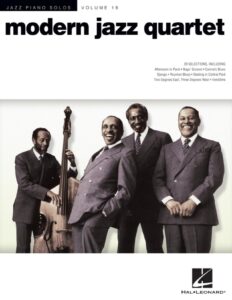
The Modern Jazz Quartet – Fontessa (1956)
Fontessa is a 1956 album by the Modern Jazz Quartet released on Atlantic Records. It was the first of their albums released on Atlantic. The album was released in the USA in mono on the black Atlantic label with catalogue number 1231. It was released in the USA in stereo on the green Atlantic label with catalogue number SD 1231. The prefix SD stands for Stereo Disc. The current internationally available CD release is the mono version. A Japanese CD exists of the stereo version. Additionally both mono and stereo versions were released in many other territories, for example the UK with London LTZ-K 15022 for the mono and London SAH-K 6031 for the stereo. The 11-minute title tune by the group’s pianist and musical director John Lewis was inspired by Commedia dell’arte, and the four characters depicted in it are pictured on the cover. Lewis wrote of it in the liner notes:
Fontessa is a little suite inspired by the Renaissance Commedia dell’Arte. I had particularly in mind their plays which consisted of a very sketchy plot and in which the details, the lines, etc. were improvised. This suite consists first of a short Prelude to raise the curtain and provide the theme. The first piece after the Prelude has the character of older jazz and improvised parts are by the vibraphone. This piece could perhaps be the character of Harlequin. The second piece has the character of less old jazz and the improvised parts are played by the piano. The character here could perhaps be Pierrot. The third piece is of a still later jazz character and develops the main motif. The improvised parts are by the drums. This character could perhaps be Pantaloon. The opening Prelude closes the suite. Fontessa is the three-note main motif of the suite and is perhaps a substitute for the character of Colombine.
— John Lewis
The Modern Jazz Quartet later made a full album based on this theme, The Comedy (1962). The title track was released on a 45-rpm 7-inch EP with the track being split across the two sides.
The mono version of the album has a good recorded sound quality as one would expect from an important 1956 jazz release. The stereo version is marred by a number of technical flaws. The first of these is a very powerful mains hum consisting of a 60 Hz tone and its harmonics at 120 Hz and 180 Hz. The second flaw is a remarkably high level of tape hiss. Lastly, the level of the bass playing is much lower than that of the mono release. The combination of these errors would seem to suggest that the stereo recording was experimental in nature and that these recordings were probably only released after commercial pressure for a stereo version. The quality of the stereo image is high despite these flaws and it is possible to get a true sense of space and position of the players.
Track 5, “Bluesology”, features a different take on the mono and stereo versions of the record. A recent multi-CD retrospective release featured the mono version of the album, with the stereo version of this tune as a bonus track.
Please, subscribe to our Sheet Music Library.
If you are already a subscriber, please, check our NEW SCORES’ page every month for new sheet music. THANK YOU!
Track listing
"Versailles" (John Lewis) – 3:22
"Angel Eyes" (Earl Brent, Matt Dennis) – 3:48
"Fontessa" (Lewis) – 11:12
"Over the Rainbow" (Harold Arlen, E.Y. Harburg) – 3:50
"Bluesology" (Milt Jackson) – 5:04
"Willow Weep for Me" (Ann Ronell) – 4:47
"Woody 'n' You" (Dizzy Gillespie) – 4:25
Personnel
John Lewis – piano
Milt Jackson – vibraphone
Percy Heath – double bass
Connie Kay – drums
The Arrival of Victor Feldman (1958)
The Arrival of Victor Feldman is an album by vibraphonist and pianist Victor Feldman recorded in 1958 and released on the Contemporary label.
“Serpent’s Tooth” – 3:28 “Waltz” – 5:30 “Chasing Shadows” – 3:58 “Flamingo” – 3:18 “S’posin’” – 4:29 “Bebop” – 2:46 “There Is No Greater Love” – 4:24 “Too Blue” – 4:13 “Minor Lament” – 4:00 “Satin Doll” – 5:59
Track listing:

Best Sheet Music download from our Library.
All compositions by Victor Feldman except where noted.
"Serpent's Tooth" (Miles Davis) – 3:28
"Waltz" (Frédéric Chopin) – 5:30
"Chasing Shadows" – 3:58
"Flamingo" (Ted Grouya, Edmund Anderson) – 3:18
"S'posin'" (Paul Denniker, Andy Razaf) – 4:29
"Bebop" (Dizzy Gillespie) – 2:46
"There Is No Greater Love" (Isham Jones, Marty Symes) – 4:24
"Too Blue" – 4:13
"Minor Lament" – 4:00
"Satin Doll" (Duke Ellington, Billy Strayhorn, Johnny Mercer) – 5:59
Personnel
Victor Feldman – vibraphone, piano
Scott LaFaro – bass
Stan Levey – drums
Ray Brown with the All-Star Big Band (1962)
Ray Brown with the All-Star Big Band is a 1962 album by the jazz double bassist Ray Brown accompanied by a big band featuring the alto saxophonist Cannonball Adderley.
Track listing
"Work Song" (Nat Adderley) – 5:17
"It Happened in Monterey" (Billy Rose, Mabel Wayne) – 3:06
"My One and Only Love" (Robert Mellin, Guy Wood) – 3:56
"Tricrotism" (Oscar Pettiford) – 3:54
"Thumbstring" (Ray Brown) – 4:42
"Cannon Bilt" (Brown) – 3:34
"Two for the Blues" (Neal Hefti, Jon Hendricks) – 4:07
"Day In, Day Out" (Rube Bloom, Johnny Mercer) – 2:49
"Baubles, Bangles, & Beads" (Robert Wright, George Forrest) – 3:29
Personnel
Ray Brown – double bass, cello
Cannonball Adderley – alto saxophone
Sam Jones – double bass
Budd Johnson, Earle Warren, Jerome Richardson, Seldon Powell, Yusef Lateef – woodwind
Britt Woodman, Jimmy Cleveland, Melba Liston, Paul Faulise – trombone
Clark Terry, Ernie Royal, Joe Newman, Nat Adderley – trumpet
Tommy Flanagan – piano
Osie Johnson – drums
Al Cohn – arranger
Ernie Wilkins – arranger, conductor
Ray Hall – engineer
Burt Goldblatt, Chuck Stewart – photography
Jim Davis – producer
Best Sheet Music download from our Library.
Miles Davis – E.S.P. (1965)
E.S.P. is an album by Miles Davis, recorded on January 20–22, 1965 and released on August 16 of that year by Columbia Records. It is the first release from what is known as Davis’s second great quintet: Davis on trumpet, Wayne Shorter on tenor saxophone, Herbie Hancock on piano, Ron Carter on bass, and Tony Williams on drums. The album was named after a tune by Shorter, and was inspired by the fact that, “since Wayne Shorter’s arrival, the five members of the quintet seemed to communicate by mental telepathy.
Personnel
Miles Davis – trumpet
Wayne Shorter – tenor saxophone
Herbie Hancock – piano
Ron Carter – bass
Tony Williams – drums
Best Sheet Music download from our Library.
Tracklist:
- E.S.P.
Written-By – Miles Davis, Wayne Shorter - Eighty-One
Written-By – M. Davis, R. Carter - Little One
Written-By – H. Hancock - R.J.
Written-By – R. Carter - Agitation
Written-By – M. Davis - Iris
Written-By – Mies Davis, W. Shorter - Mood
Written-By – Ron Carter
Ed Schuller – The Eleventh Hour (1991)
Edwin Gunther Schuller (January 11, 1955) is an American jazz bassist and composer. His father is Gunther Schuller, a composer, horn player, and music professor, and his younger brother is drummer George Schuller.
Joe Lovano – Quartets Live at the Village Vanguard (1995)
Quartets: Live at the Village Vanguard is a live album by the American jazz saxophonist Joe Lovano recorded at the Village Vanguard in 1994 and 1995 and released on the Blue Note label.
Track listing
All compositions by Joe Lovano except as indicated
Disc One

"Fort Worth" [Set 2] - 10:01
"Birds of Springtime Gone By" [Set 1] - 6:43
"I Can't Get Started" [Set 1] (Vernon Duke, Ira Gershwin) - 8:32
"Uprising" [Set 3] - 7:35
"Sail Away" [Set 2] (Tom Harrell) - 10:51
"Blues Not to Lose" [Set 3] (Eddie Boyd) - 9:19
"Song and Dance" [Set 2] - 8:27

Disc Two

"Lonnie's Lament" [Set 2] (John Coltrane) - 11:12
"Reflections" [Set 2] (Thelonious Monk) - 9:51
"Little Willie Leaps" [Set 1*] (Miles Davis) - 9:22
"This Is All I Ask" [Set 2] (Gordon Jenkins) - 9:18
"26-2" [Set 2] (Coltrane) - 9:42
"Duke Ellington's Sound of Love" [Set 3] (Charles Mingus) - 6:15
"Sounds of Joy" [Set 1] - 10:19

    Recorded at the Village Vanguard in New York City on March 12, 1994 (Disc One) and January 20 & *22, 1995 (Disc Two)
Personnel
Joe Lovano – tenor saxophone, soprano saxophone, C melody saxophone
Tom Harrell - trumpet, flugelhorn (Disc One)
Mulgrew Miller – piano (Disc Two)
Anthony Cox (Disc One), Christian McBride (Disc Two) – bass
Billy Hart (Disc One), Lewis Nash (Disc Two) – drums
Greg Osby – St. Louis Shoes (2003)
A traditionalist album for a modern and creative musician. In “St. Louis Schoes,” the young saxophonist, who comes from R&B, gives a twist to the arrangements of primitive pieces in jazz history dating back to the early twentieth century. Osby masterfully covers old Ellingtonian themes and manages to make the swing come out of his sax naturally.
Odean Pope Quartet – Two Dreams (2004)
Odean Pope (born October 24, 1938) is an American jazz tenor saxophonist.
Best Sheet Music download from our Library.
Search your favorite sheet music in the category of Jazz, Blues, Soul, & Gospel.

Search your favorite sheet music in the Sheet Music Catalog