| Community Musicians, building a worldwide Community Music. | |
| All the music you want to play on one site. Sharing the world’s best Contemporary, jazz, Popular, and classical Sheet Music for all instruments. | |
| Scores: >15,000 (active and growing every day), over 231,000 pages All genres and Categories: Jazz & Blues, Rock & Pop, classical & contemporary, film & musicals’ scores; books & biographies; methods, études, and exercises; play along background tracks (MP3), audios & PDFs for Jazz & Rock Access and benefits: Subscription fee: $15.99 one-time payment, valid for lifetime (secure Payment via Paypal, or Stripe) How to join the Sheet Music Library 🔍 Search in the Library Catalog — FAQs — Join us |
Table of Contents
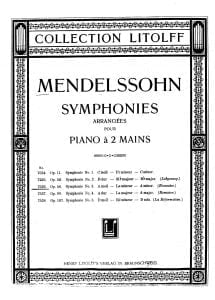
Mendelssohn Symphony No. 3 Op. 56 (Scottish) 1 Andante con moto (Piano solo arr.) sheet music, Noten, partitura, spartiti, 楽譜, 乐谱
Best Sheet Music download from our Library.
Please, subscribe to our Sheet Music Library.
If you are already a subscriber, please, check our NEW SCORES’ page every month for new sheet music. THANK YOU!
The Scottish Symphony (Symphony No. 3 in A minor) was written and revised intermittently between 1829 (when Mendelssohn noted down the opening theme during a visit to Holyrood Palace) and 1842, when it was given its premiere in Leipzig, the last of his symphonies to be premiered in public. This piece evokes Scotland’s
atmosphere in the ethos of Romanticism, but does not employ any identified Scottish folk melodies.
Jakob Ludwig Felix Mendelssohn Bartholdy (3 February 1809 – 4 November 1847), widely known as Felix Mendelssohn, was a German composer, pianist, organist, and conductor of the early Romantic period. Mendelssohn’s compositions include symphonies, concertos, piano music, organ music and chamber music.
His best-known works include the overture and incidental music for A Midsummer Night’s Dream (which includes his “Wedding March”), the Italian and Scottish Symphonies, the oratorios St. Paul and Elijah, the Hebrides Overture, the mature Violin Concerto, the String Octet, and the melody used in the Christmas carol “Hark!”. The Herald Angels Sing”. Mendelssohn’s Songs Without Words are his most famous solo piano compositions.
Browse in the Library:
Or browse in the categories menus & download the Library Catalog PDF:
Something of Mendelssohn’s intense attachment to his personal vision of music is conveyed in his comments to a correspondent who suggested converting some Songs Without Words into lieder by adding texts: “What [the] music I love expresses to me, are not thoughts that are too indefinite for me to put into words, but on the contrary, too definite.”
Charles Rosen, in a chapter on Mendelssohn in his 1995 book The Romantic Generation, both praised and criticized the composer. He called him “the greatest child prodigy the history of Western music has ever known” whose command at age 16 surpassed that of Mozart or Chopin at 19, the possessor at an early age of a “control of large-scale structure unsurpassed by any composer of his generation”, and a “genius” with a “profound” comprehension of Beethoven.
Rosen believed that in the composer’s later years, without losing his craft or genius, he “renounced … his daring”; but he called Mendelssohn’s relatively late Violin Concerto in E minor “the most successful synthesis of the Classical concerto tradition and the Romantic virtuoso form”. Rosen considered the “Fugue in E minor” (later included in Mendelssohn’s Op. 35 for piano) a “masterpiece”; but in the same paragraph called Mendelssohn “the inventor of religious kitsch in music”. Nevertheless, he pointed out how the dramatic power of “the juncture of religion and music” in Mendelssohn’s oratorios is reflected throughout the music of the next fifty years in the operas of Meyerbeer and Giuseppe Verdi and in Wagner’s Parsifal.

Mendelssohn’s mature symphonies are numbered approximately in the order of publication, rather than the order in which they were composed. The order of composition is: 1, 5 “Reformation”, 4 “Italian”, 2 “Lobgesang”, 3 “Scottish”. The placement of No. 3 in this sequence is problematic because he worked on it for over a decade, starting the sketches soon after he began work on No. 5 but completing it after both Nos. 5 and 4.