Come join us now, and enjoy playing your beloved music and browse through great scores of every level and styles!
Can’t find the songbook you’re looking for? Please, email us at: sheetmusiclibrarypdf@gmail.com We’d like to help you!
Table of Contents
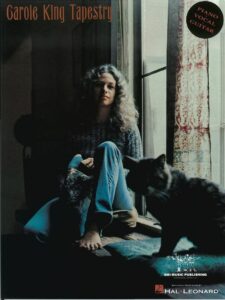
‘TAPESTRY’ (Carole King) Released on this day in 1971.
Best Sheet Music download from our Library.
Please, subscribe to our Sheet Music Library.
If you are already a subscriber, please, check our NEW SCORES’ page every month for new sheet music. THANK YOU!
On February 10, 1971 (one day after her 29th birthday), Carole King released the album “Tapestry” in the U.S., one of the most successful albums in pop history.
In 1968, Carole divorced her first husband, Gerry Goffin, with whom she had written a handful of hit songs for other performers such as Shirelles, Bobby Vee, Little Eva, Crystals, Chiffons, Monkees, Aretha Franklin, Byrds and Blood Sweat & Tears, including 4 No. 1s and 20 that reached the top 40 of the Hot100. From the beginning of their relationship, Carole was deeply in love with Gerry. For him, Carole was still the girl he had to marry in high school for getting her pregnant.

Browse in the Library:
Or browse in the categories menus & download the Library Catalog PDF:
In 1964, with two daughters and 22 years old, he discovered that Goffin was going to have another child with singer Darlene McCrea of the vocal group The Cookies. However, she endured the marriage for a few more years, composing songs with Gerry, some of which were even intended for Darlene. Despite their personal separation, they would continue to collaborate professionally in the future.
Carole began a new relationship in 1967 with Charles Larkey, bassist of a group that King and Goffin had tried to promote for their own label, Tomorrow Records, which did not prosper. At that moment Carole considered that the time had come to go from being a composer to being the interpreter of her songs. He had made a timid attempt as a soloist in 1962 with the song “It might as well rain until September”, which Goffin had taken it upon himself to hinder because he did not look favorably on his young wife fully involved in show business.
She moved with her future second husband Larkey and their two daughters to California where she came into contact with the Laurel Canyon scene and met Joni Mitchell and other Ladies of the Canyon of the counterculture, not forgetting Frank Zappa and his Mothers. Installed in an apartment in Los Angeles, a short distance from the Sunset Strip – where the major record labels were located – and ten minutes from Hollywood and Malibu beach, Carole immediately began to reinvent herself.
With Larkey”s help, they recruited guitarist Danny Kortchmar and renowned drummer Jim Gordon to form The City, a group with which Carole prepared to make the definitive leap as a solo artist. He recorded an album with them in 1968 produced by Lou Adler that had little impact, which was followed by “Writer” with Carole”s name on the cover. The twelve songs on “Writer” were compositions by King with her ex-husband and one with Toni Stern, which gave meaning to the title of the album. In her interpretation of “Up on the roof” (published by The Drifters with success in 1962), you could already perceive the great work that was to come.
“Tapestry” was named after the knitting piece Carole worked on between takes in the recording sessions held between January 4 and 15 at Hollywood”s A&M Studios, in a building that had once housed the sets of Charlie Chaplin Studios. In the photograph illustrating the cover, she is seen with the tapestry in her hands, which ended up being a gift for Lou Adler.
When King presented Adler with his new compositions, he instantly knew how to produce the album. Lou, who was an old fox (he produced Jan & Dean, Johnny Rivers, Barry McGuire, Mamas & Papas and Spirit as well as co-producing the Monterey Festival), let Carole”s personal and above all, sincere voice stand out, wrapping her with spartan arrangements, making the songs sound almost as if they were a demo, generating an intimate and “home” atmosphere that brought the artist”s spirit closer to the listener. The songs were so powerful that they didn”t need much disguise.
In addition to his regular band (Russ Kunkel had taken over from Jim Gordon on drums), Adler hired Curtis Amy (tenor, soprano and baritone saxophones and flute), David Campbell (cello, viola, and string quartet) among a few other session musicians. Joni Mitchell sang backing vocals on “You”ve Got a Friend” and “Will You Love Me Tomorrow” along with James Taylor. He often appeared for sessions (he was recording his own version of “You”ve Got a Friend” in a nearby studio) and contributed his acoustic guitar to several songs on the album. (“So far away”, “Home again” and “Way over yonder”).
In March 1971, with the album and single “I Feel the Earth Move” on the street and heading to No. 1 on the charts, Carole embarked on her first major national tour, opening for James Taylor and playing piano in his band.
They played in more than 25 cities in the country. The experience did not satisfy King, who noticed that after the third or fourth performance he lost some spontaneity singing, due to the closed and measured structure of the shows. Even then he developed a phobia for live performances, preferring to work in the studio. “I”m not a great singer and my songs are my only means of communicating with the people I perform for. But I can do that through my recordings and I prefer to devote my energy to writing new songs that I can offer to people on my albums. I know it”s not the same as live, but I feel more comfortable that way.”
In May, broadcasters were broadcasting tracks from “Tapestry” all over the country and Lou Adler got Carole to make her headlining debut at the Troubadour, a legendary 250-seat hall in West Hollywood. On this occasion she was also accompanied by her good friend James Taylor, as well as, a month later, at Carnegie Hall, Carole King”s first concert in her hometown, in which the highlight of the night was when Carole and James performed together “You”ve Got a Friend”, which although many believe was written by Carole with Taylor in mind, it had no real addressee, the lyrics emerging – as the author confessed – spontaneously as she wrote them.
When you’re down and troubled
and you need a helping hand
and nothing, oh nothing is going right,
close your eyes and think of me
and soon I will be there
to brighten up even your darkest night.
You just call out my name
and you know wherever I am
I´ll come running, oh yeah baby, to see you again.
Winter, spring, summer or fall,
all you got to do is call
and I’ll be there yeah yeah yeah
you’ve got a friend.
If the sky above you
should turn dark and full of clouds
and that old north wind should begin to blow,
keep your head together
and call my name out loud now
soon I’ll be knocking upon your door.
You just call out my name
and you know wherever I am
I´ll come running, oh yes I will, to see you again.
Winter, spring, summer or fall,
all you got to do is call
and I’ll be there yeah yeah yeah.
Ain´t it good to know
that you´ve got a friend
people can be so cold
they’ll hurt you and desert you
well they’ll take your soul if you let them
oh yeah don’t you let them.
You just call out my name
and you know wherever I am
I´ll come running to see you again
Oh baby don´t you know now.
Winter, spring, summer or fall,
hey, now, all you gotta do is call
cos I’ll be there yeah yeah yeah
you’ve got a friend, you’ve got a friend yeah,
ain’t it good to know you’ve got a friend
ain’t it good to know you’ve got a friend
Oh yeah yeah, you’ve got a friend.
In the summer of 1971 the album had already reached No. 1 where it remained for 15 consecutive weeks, a record not surpassed by a female artist until 40 years later, with Adele”s album “21” (2012). She received four Grammy Awards: “Album of the Year”, “Best Female Vocal Performance”, “Song of the Year” for “You”ve Got a Friend” and “Record of the Year” for the single “It”s Too Late”. Until the appearance of “Thriller” ten years later, it was the best-selling album in history in the US and with more than 14 million copies sold worldwide it was until well into the nineties, the best-selling work of a singer.
Jon Landau, editor of Rolling Stone, wrote in the April issue: “…”Tapestry” has delivered on the promises made in his first work, “Writer” and confirms the fact that King is one of the most creative figures in pop music.”
3) ‘It’s too late’ (letra de Toni Stern)
4) ‘Home again’
5) ‘Beautiful’
8) ‘Where you lead’ (letra de Toni Stern)
9) ‘Will you love me tomorrow?’ (Goffin, King)
10) ‘Smackwater Jack’ (Goffin, King)
11) ‘Tapestry’
12) ‘(You make me feel like) A natural woman’ (Goffin, King, Wexler)
Search your favorite sheet music in the Sheet Music Catalog
Personnel:
- Carole King – lead and backing vocals (1–12), piano and keyboards (1–12)
- Ralph Schuckett – electric piano (3,8,10)
- Danny “Kootch” Kortchmar – acoustic and electric guitars (1,3,6,8–10), congas (3,5,7)
- James Taylor – acoustic guitar (2,4,6,7,9), backing vocals (9)
- Charles Larkey – electric bass (1–3,5,6,8,10), string bass (4,7,9,12)
- Joel O’Brien – drums (1,3,5,6,10)
- Russ Kunkel – drums (2,4,8,9)
- Curtis Amy – flute (2), soprano saxophone (3), tenor saxophone (6), baritone saxophone (10)
- Barry Socher – violin (6,7)
- David Campbell – viola (6,7)
- Terry King – cello (6,7)
- Perry Steinberg – string bass (6)
- Merry Clayton – backing vocals (6,8,10)
- Julia Tillman – backing vocals (8,10)
- Joni Mitchell – backing vocals (9)