
Come join us now, and enjoy playing your beloved music and browse through great scores of every level and styles!
Can’t find the songbook you’re looking for? Please, email us at: sheetmusiclibrarypdf@gmail.com We’d like to help you!
Table of Contents
Earth Wind And Fire Best Of
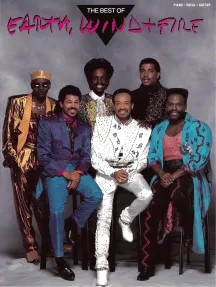
Best Sheet Music download from our Library.

Please, subscribe to our Sheet Music Library.
If you are already a subscriber, please, check our NEW SCORES’ page every month for new sheet music. THANK YOU!
Earth, Wind & Fire is often described as a band, but to call them simply that is like calling the Sistine Chapel a room with a nice ceiling. They were a force of nature, a joyful big bang of funk, soul, jazz, and unadulterated optimism. Formed in Chicago in 1969 by the visionary drummer and philosopher Maurice White, the group transcended genres to become a cultural institution.
Contents List Download:
The story, however, begins with a fizzle, not a firework. Before Earth, Wind & Fire, White was a session drummer for Chess Records and a member of the Ramsey Lewis Trio. In 1969, he joined friends Wade Flemons and Don Whitehead to form a songwriting trio called The Salty Peppers . After a modest regional hit, White relocated to Los Angeles, bringing his younger brother, Verdine White, on bass and reshaping the group entirely. It was here, inspired by his astrological sign’s elemental qualities, that Maurice changed the name to Earth, Wind & Fire—deliberately omitting water to represent a specific cosmic balance.
Browse in the Library:
Or browse in the categories menus & download the Library Catalog PDF:
Despite a self-titled debut and a soundtrack for the film Sweet Sweetback’s Baadasssss Song, success was not immediate. By 1972, the original iteration of the band dissolved, leaving only Maurice and Verdine standing. Rather than quit, Maurice did what geniuses do: he rebuilt. He audaciously assembled a new squad of virtuosos, recruiting a young singer with a four-octave range named Philip Bailey, keyboardist Larry Dunn, and percussionist Ralph Johnson . This lineup—later fortified by guitarist Al McKay and saxophonist Andrew Woolfolk—solidified into the classic, hit-making machine the world would come to revere .
The alchemy for global domination was perfected with the arrival of producer Charles Stepney. The result was the 1975 album That’s the Way of the World. Initially conceived as the soundtrack for a film about the music industry, the album became the band’s manifesto. It spawned “Shining Star,” a song that did more than hit number one; it became the first Earth, Wind & Fire record to top both the pop and R&B charts, earning the group its first Grammy Award . The album itself sat at the apex of the Billboard 200, a position it cemented as one of the definitive funk albums of the decade .
From that point on, Earth, Wind & Fire rocketed through the stratosphere. They were not just musicians; they were showmen draped in dazzling, Egyptian-inspired regalia, performing inside pyramids and emerging from spaceships on stage . Their sound was dense and meticulously arranged, anchored by Verdine White’s melodic, thundering bass lines and the punch of the Phenix Horns. It was a sound that made joy intelligent. Hits came in relentless succession: the disco exorcism of “Boogie Wonderland,” the timeless, un-ironic euphoria of “September,” and the Quiet Storm elegance of “After the Love Has Gone” .
Critics often struggled to categorize them, tossing them into the “disco” bin. But the music itself refused to stay put. It pulled from Afro-pop, Latin rhythms, gospel, and rock. Maurice’s use of the kalimba—the African thumb piano—became an auditory signature, a thread of ancestral memory woven through modern funk . Miles Davis declared them his favorite band. Quincy Jones claimed he was a fan from day one . They were the first African-American act to sell out Madison Square Garden, a feat that signaled a seismic shift in the concert industry .
The accolades are staggering. The band has sold over 90 million records worldwide, a figure that places them among the best-selling artists of all time . They have won six Grammy Awards from over twenty nominations, and in 2016, they received the Grammy Lifetime Achievement Award . They were inducted into the Rock and Roll Hall of Fame in 2000, the Vocal Group Hall of Fame, and received a star on the Hollywood Walk of Fame in 1995 . In 2019, they were honored with the Kennedy Center Honors, a testament to their indelible impact on American culture .
Yet the music industry can be cruel to its dreamers, and by the mid-1980s, shifting trends and fatigue led Maurice to put the band on hiatus . They returned in 1987 and continued to tour and record, but the ultimate price of Maurice’s vision was his health. Diagnosed with Parkinson’s disease, he stopped touring in the mid-1990s, though he remained the bands spiritual leader until his death in 2016 .
Maurice White once said, “Music is always a creative process that comes from the heart. It’s a feeling, a vibration, that we ride on” . That vibration continues. Verdine White, still impossibly energetic on bass, carries the torch alongside Philip Bailey, whose falsetto remains untouched by time. Ralph Johnson, now co-lead vocalist, keeps the rhythm . The current lineup even includes Bailey’s son, Philip Bailey Jr., a living testament to the bands legacy .
To listen to Earth, Wind & Fire is to understand that joy is not naive—it is a radical act of resistance. They built a universe where the horns are always bright, the harmonies are always celestial, and the groove never, ever stops. Long after the spaceship has landed, the music still shines.