Come join us now, and enjoy playing your beloved music and browse through great scores of every level and styles!
Can’t find the songbook you’re looking for? Please, email us at: sheetmusiclibrarypdf@gmail.com We’d like to help you!
Table of Contents
Happy birthday, Michel Legrand, born on this day in 1932.

Best Sheet Music download from our Library.
Please, subscribe to our Sheet Music Library.
If you are already a subscriber, please, check our NEW SCORES’ page every month for new sheet music. THANK YOU!
Michel Legrand: An Exhaustive Biography of a Musical Maestro
Who as Michel Legrand?
The Maestro of Melody: A Life in Music, Film, and Jazz
Michel Legrand & Phil Woods – Watch What Happens 2001 Montreal
Michel Legrand & Phil Woods Quartet July 1, 2001 22. Festival International de Jazz de Montreal, Spectrum of Montreal, Montreal, Canada Michel Legrand – piano, vocals Phil Woods – alto sax Eric Lagace – bass Ray Brinker – drums Watch What Happens
1. Full Biography: A Prodigy from Paris
Early Life and Conservatory Years (1932-1952)
Michel Jean Legrand was born on February 24, 1932, in the Bécon-les-Bruyères district of Paris, France, into a family steeped in music . His father, Raymond Legrand, was a renowned conductor and composer of popular music, while his mother, Marcelle Der-Mikaëlian, was the sister of conductor Jacques Hélian and came from an Armenian bourgeois family. Despite this musical lineage, Legrand’s childhood was reportedly solitary, finding solace only at the piano . At the age of ten, he entered the prestigious Paris Conservatoire, an event that transformed his life. There, he encountered a world that spoke his language . For seven years, he came under the rigorous tutelage of legendary teachers, including the formidable Nadia Boulanger, Henri Challan, and Noël Gallon . He graduated with top honors in piano, harmony, fugue, and counterpoint, mastering a dozen other instruments in the process and building the ironclad classical foundation that would underpin all his future work.
Browse in the Library:
Or browse in the categories menus & download the Library Catalog PDF:
Jazz Epiphany and Early Career
anist and musical director for major French singers, including the iconic Maurice Chevalier, with whom he toured internationally. In 1954, at just 22 years old, Legrand burst onto the international scene with his instrumental album I Love Paris. It became a surprise sensation, selling over eight million copies in the United States and topping the album charts, instantly establishing his name abroad. This success was followed by a series of popular albums like Holiday in Rome (1955) and his interpretations of Cole Porter, showcasing his talents as both a pianist and arranger.
French New Wave and the Demy Collaboration
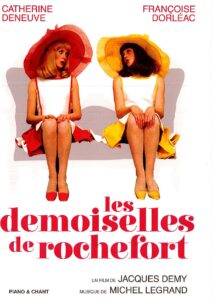
Same an integral part of the French New Wave . He composed music for directors like Jean-Luc Godard (including Vivre sa vie, 1962) and Agnès Varda (appearing in Cléo from 5 to 7, 1961). However, his most significant creative partnership was with director Jacques Demy. Together, they reinvented the film musical. The Umbrellas of Cherbourg (1964) was a revolutionary work—a film where all dialogue, even the most mundane, was sung. Against all industry skepticism, it was a global triumph, winning the Palme d’Or at Cannes . The score, with its haunting “I Will Wait for You,” brought Legrand his first Academy Award nominations . They followed this with the effervescent The Young Girls of Rochefort (1967), a vibrant homage to the Hollywood musical, and the beloved fairy-tale musical Donkey Skin (1970) .
Hollywood Conquest and a String of Classics
In 1968, seeking a change of scenery, Legrand moved to Los Angeles . He quickly befriended fellow composers Quincy Jones and Henry Mancini, who introduced him to the legendary lyricists Alan and Marilyn Bergman. This collaboration proved catalytic. For The Thomas Crown Affair (1968), Legrand composed “The Windmills of Your Mind,” a song with a swirling, circular melody that won him his first Academy Award for Best Original Song. This began a period of immense productivity. He delivered the achingly nostalgic score for Summer of ’42 (1971), winning his second Oscar (Best Original Dramatic Score), and followed it with other iconic themes for films like Brian’s Song (1971), Lady Sings the Blues (1972), and The Three Musketeers (1973) . His third Oscar came for his work adapting and scoring Barbra Streisand’s Yentl (1983).
Personal Life and Later Years
Legrand’s personal life was as rich as his professional one. He was married three times and had three children with his first wife, Christine Bouchard. In 2014, he married actress and writer Macha Méril, to whom he remained wed until his death. His family connections extend to the next generation of music; his sister Christiane was a founding member of The Swingle Singers, and his niece Victoria Legrand is the lead vocalist of the acclaimed dream-pop band Beach House. Legrand remained active and energetic until the very end, performing and composing. He died of sepsis on the night of January 26, 2019, at the American Hospital of Paris, at the age of 86. His funeral was held at the Alexander Nevsky Cathedral in Paris, and he was laid to rest at the Père Lachaise Cemetery.
2. Music Style and Encounters with Other Artists
Legrand’s style is an alchemical fusion of his three great loves: classical discipline, jazz freedom, and popular songcraft. He defied categorization, tearing down barriers between jazz, classical music, and easy listening. His music is instantly recognizable for its lush, sophisticated harmonies and, above all, its unforgettable melodic lines. As he himself stated, following Nadia Boulanger’s advice, “it’s the melody that counts”.
Collaborations with Luminaries
His career is a map of 20th-century music, marked by encounters with titans. In 1958, he traveled to New York to record the seminal album Legrand Jazz, for which he assembled a dream band featuring Miles Davis, John Coltrane, Bill Evans, and Phil Woods. This session alone cemented his credibility in the jazz world. He later reunited with Davis for the Australian film Dingo (1991). He worked extensively with vocal giants, arranging and conducting for Sarah Vaughan on the Grammy-winning Sarah Vaughan with Michel Legrand (1972). He collaborated with Stan Getz, Lena Horne, and Dusty Springfield. His relationship with lyricists Alan and Marilyn Bergman was particularly profound, producing a treasure trove of standards including “What Are You Doing the Rest of Your Life?,” “How Do You Keep the Music Playing?,” and the songs for Yentl. On the concert stage, he led his big band on tours with stars ranging from Ray Charles and Diana Ross to the violinist Stéphane Grappelli and even the avant-pop icon Björk.
3. Harmony, Tonality, and Melodic Style
Legrand’s compositional characteristics are a textbook study in sophisticated emotional manipulation. While firmly tonal, his harmony is enriched by extended chords (ninths, elevenths, thirteenths) and modal inflections borrowed from his jazz background. A hallmark of his style is the subtle and poignant use of modality and unexpected key changes that heighten the emotional narrative of a song.
“Begins a composition in a melancholic minor key, segues into a major upbeat key for several bars, and concludes in a minor key – ‘What Are You Doing the Rest of Your Life?’, ‘The Summer Knows’, ‘The Way He Makes Me Feel’, etc.”
This technique perfectly mirrors the bittersweet nature of memory and love—the fleeting joy within a prevailing sadness. His melodies are, in a word, cantabile (song-like). They are often long-limbed and architecturally perfect, as exemplified by the circular, hypnotic structure of “The Windmills of Your Mind,” which musically mimics its lyrical theme. Formally, he was equally at home with the strict through-composed structure of The Umbrellas of Cherbourg, the 32-bar American songbook standard, or a multi-movement jazz suite. Critics noted that while a brilliant pianist, he was less a straight-ahead jazz soloist and more a “jazz impressionist,” using the piano to re-conceptualize his own melodies with expanded harmonies and flourishes reminiscent of Art Tatum, Bill Evans, or McCoy Tyner.
4. Influences and Legacy
Legrand’s primary influences were the classical masters he studied at the Conservatoire (like Ravel and Debussy, whose harmonic fingerprints are all over his work) and the sheer excitement of bebop he heard in that pivotal Dizzy Gillespie concert. His father’s world of popular French music also provided a foundation in direct, emotional communication. This unique blend allowed him to create a sound that was both high art and universally accessible.
His legacy is monumental. He composed over 200 film and television scores and recorded more than 100 albums. He won three Oscars, five Grammys, and was nominated for an Emmy and a Tony. Along with Henry Mancini, Burt Bacharach, and John Barry, he defined the sound of 1960s and 70s popular cinema, proving that sophisticated jazz and pop could coexist with orchestral grandeur. His songs—”The Windmills of Your Mind,” “I Will Wait for You,” “What Are You Doing the Rest of Your Life?,” “The Summer Knows”—have entered the Great American Songbook, performed and recorded by countless artists across genres. He was inducted into the Songwriters Hall of Fame in 1990. Beyond his own work, his influence persists in the sampling of his music by hip-hop artists and in the dream-pop soundscapes of his niece Victoria Legrand’s band, Beach House, proving that his musical DNA continues to evolve.
5. List of Works and Filmography (Selected)
Legrand’s filmography is vast. Here is a selection of his most significant and celebrated scores.
1961Cléo from 5 to 7 (dir. Agnès Varda)
1962Vivre sa vie (dir. Jean-Luc Godard)
1962Eva (dir. Joseph Losey)
1964The Umbrellas of Cherbourg (dir. Jacques Demy) 3 Oscar noms
1967The Young Girls of Rochefort (dir. Jacques Demy) Oscar nom
1968The Thomas Crown AffairOscar win (Song)
1968Ice Station Zebra
1969The Happy EndingOscar nom (Song)
1969The Swimming Pool (La Piscine)
1970Donkey Skin (Peau d’âne) (dir. Jacques Demy)
1970Pieces of DreamsOscar nom (Song)
1971Summer of ’42Oscar win (Score)
1971The Go-Between
1971Brian’s Song (TV) Grammy win
1972Lady Sings the Blues
1973Breezy (dir. Clint Eastwood)
1973The Three Musketeers
1974F for Fake (dir. Orson Welles)
1980Atlantic City (dir. Louis Malle)
1982Best FriendsOscar nom (Song)
1983Yentl (dir. Barbra Streisand) Oscar win (Score)
1988Switching Channels
1991Dingo (with Miles Davis)
1998Madeline
2018The Other Side of the Wind (dir. Orson Welles, posthumous)
Musical Theatre
- Le Passe-muraille (1997) – later adapted on Broadway as Amour (2002), earning Legrand Tony and Drama Desk nominations.
- Marguerite (2008) – a musical set in WWII Paris, created with the Les Misérables team.
6. Discography and Most Known Compositions
Selected Studio Albums & Soundtracks
I Love Paris (1954) – The breakthrough album.
Legrand Jazz (1958) – Featuring Miles Davis, John Coltrane, Bill Evans. Landmark jazz album
The Umbrellas of Cherbourg (1964) – The complete soundtrack.
Sarah Vaughan with Michel Legrand (1972)Grammy winner
Images (1975)Grammy winner for Big Band
After the Rain (1983)
Michel Legrand by Michel Legrand (2002) – First solo piano album of his own songs.
Entre elle et lui (2013) – A duet album with his wife, Macha Méril.
Most Famous Compositions and Recordings
These songs have become enduring standards, performed by a who’s who of popular and jazz music.
- “The Windmills of Your Mind” (from The Thomas Crown Affair, 1968) – Covered by Dusty Springfield, Sting, Barbra Streisand, and many others.
- “I Will Wait for You” (from The Umbrellas of Cherbourg, 1964) – Recorded by Frank Sinatra, Tony Bennett, Louis Armstrong, Liza Minnelli.
- “What Are You Doing the Rest of Your Life?” (from The Happy Ending, 1969) – A jazz vocal standard recorded by Sarah Vaughan, Frank Sinatra, Bill Evans.
- “The Summer Knows” (Theme from Summer of ’42, 1971) – An instrumental and vocal classic.
- “You Must Believe in Spring” (from The Young Girls of Rochefort, 1967) – A beloved jazz standard, with lyrics by Alan and Marilyn Bergman.
- “Watch What Happens” (from The Umbrellas of Cherbourg, with English lyrics) – A popular standard.
Famous Performers of His Music
The list of artists who have performed Legrand’s music reads like a pantheon of 20th-century music: Miles Davis, John Coltrane, Sarah Vaughan, Frank Sinatra, Ella Fitzgerald, Barbra Streisand, Tony Bennett, Stan Getz, Bill Evans, Lena Horne, Dusty Springfield, Kiri Te Kanawa, Stéphane Grappelli, Nana Mouskouri, Jack Jones and countless others.
7. Covers in Modern Music: The Sampling Legacy
Michel Legrand’s influence extends deep into the 21st century, particularly through the sampling of his work by hip-hop and electronic artists, introducing his genius to a new generation.
- Nas sampled “What Are You Doing the Rest of Your Life?” for his 2014 track “One Love (feat Sadat X) – One L Main Mix.”
- Sage Francis also used “What Are You Doing the Rest of Your Life?” for “Message Sent.”
- M.F. Grimm sampled “The Windmills of Your Mind” for “American Hunter (breakfast)” in 2006.
- Elevator Suite sampled both “The Windmills of Your Mind” (“Dirty Little Job,” 1995) and “Cash And Carry” from The Thomas Crown Affair (“Crown Caper”).
- Busdriver used “Doubting Thomas” from The Thomas Crown Affair in 2005.
- Facção Central, a Brazilian rap group, sampled the Ice Station Zebra score in 2005.
- Oxmo Puccino and Aloe Blacc (Emanon) have sampled “Django” from the 1958 Legrand Jazz album.
- Skee-Lo sampled the Miles Davis/Legrand collaboration Dingo for his track “Come Back To Me.”
8. Last Works and Final Years
Far from slowing down, Legrand’s final years were a flurry of creative activity. He continued to perform live with his jazz trio and big band, with concerts scheduled for the spring following his death. In 2017, he revisited one of his most beloved scores for a re-release of Donkey Skin (Peau d’âne) as a “Féerie Musicale.” A significant late-career achievement was completing the score for Orson Welles’s long-lost final film, The Other Side of the Wind. Legrand had originally worked with Welles on F for Fake (1974), and his work on this project was posthumously released on Netflix in 2018, serving as a beautiful bookend to a career that spanned the history of modern cinema. He remained a force of nature until the very end, a compulsive musician who, as he described himself, could not be pigeonholed.
Michel Legrand – 24 February 1932 ✧ 26 January 2019 – “Melody is a mistress to whom I’ll always be faithful.”