Come join us now, and enjoy playing your beloved music and browse through great scores of every level and styles!
Can’t find the songbook you’re looking for? Please, email us at: sheetmusiclibrarypdf@gmail.com We’d like to help you!
Table of Contents
Music History Events: Jazz albums recorded March 2
Music History Events: Jazz albums recorded March 2:
Dave Brubeck – Jazz at Oberlin (1953)
Dave Brubeck – Jazz at Oberlin 00:00 These Foolish Things 06:24 Perdido 14:10 Stardust 20:37 The Way You Look Tonight 28:13 How High The Moon
Personnel:
- Dave Brubeck – piano
- Paul Desmond – alto saxophone
- Lloyd Davis – drums
- Ron Crotty – bass
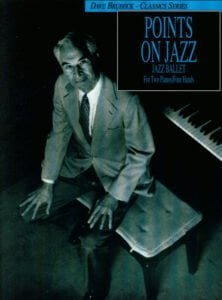
Best Sheet Music download from our Library.
Jazz at Oberlin is a live album by the Dave Brubeck Quartet. It was recorded in the Finney Chapel at Oberlin College in March 1953, and released on Fantasy Records as F 3245. The Fantasy Records album back cover states that drummer Lloyd Davis had a 103-degree fever during the performance.
Critic Nat Hentoff wrote in Down Beat magazine that the album ranks with the College of the Pacific and Storyville sets “as the best of Brubeck on record”, and jazz critic Gary Giddins has written that it would “make many short lists of the decade’s outstanding albums”.
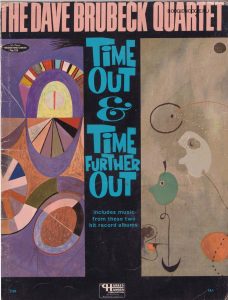
The concert is credited with making jazz a legitimate field of musical study at Oberlin, and furthermore initiating it as a subject of serious intellectual attention; Wendell Logan, the chair of Oberlin’s Jazz Studies Department, described it as “the watershed event that signaled the change of performance space for jazz from the nightclub to the concert hall”.
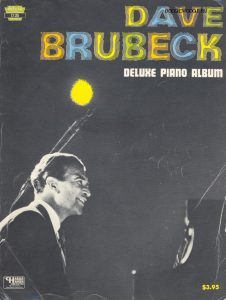
In addition, it was one of the early works in the cool jazz stream of jazz; The Guardian’s John Fordham wrote in 2010 that it “indicated new directions for jazz that didn’t slavishly mirror bebop, and even hinted at free-jazz piano techniques still years away from realisation”; he further observed that it “marked Brubeck’s eager adoption by America’s (predominantly white) youth – a welcome that soon extended around the world … for a rhythmically intricate instrumental jazz”.
The album was given 24-bit remastering and reissued in 2010 as part of the Concord label’s Original Jazz Classics (OJC) Remasters series. Fordham remarked on “The enthusiasm of the college audience, audible throughout the album”.
Miles Davis – Kind of Blue (1959)
Kind of Blue is a studio album by American jazz musician Miles Davis, released on August 17, 1959, by Columbia Records. For this album, Davis led a sextet featuring saxophonists John Coltrane and Julian “Cannonball” Adderley, pianist Bill Evans, bassist Paul Chambers, and drummer Jimmy Cobb, with new band pianist Wynton Kelly replacing Evans on “Freddie Freeloader“. The album was recorded at Columbia’s 30th Street Studio in New York City in two sessions on March 2 and April 22, 1959.
Influenced in part by Evans, who had been a member of the ensemble in 1958 and was called back for this album, Davis departed further from his early hard bop style in favor of greater experimentation with musical modes. As on the title track of his previous album, Milestones. (1958). Basing Kind of Blue entirely on modality, Davis gave each performer a set of scales that encompassed the parameters of their improvisation and style and consequently more creative freedom with melodies; Coltrane later expanded on this modal approach in his own solo career.
Kind of Blue is regarded by many critics as Davis’s masterpiece, the greatest jazz album ever recorded, and one of the greatest albums of all time. Its impact on music, including jazz, rock, and classical music, has led writers to also deem it one of the most influential albums ever made. The album was one of fifty recordings chosen in 2002 by the Library of Congress for the inaugural year of the National Recording Registry, being deemed “culturally, historically, or aesthetically significant”.
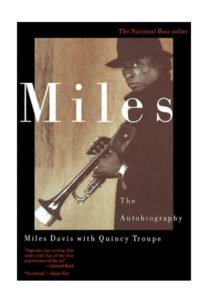
In 2003, it was ranked number 12 on Rolling Stone magazine’s list of the “500 Greatest Albums of All Time“, repositioned to number 31 in the 2020 revision. In 2019, Kind of Blue was certified 5× Platinum by the Recording Industry Association of America (RIAA) for shipments of at least five million copies in the United States.
Personnel:
Credits are taken from the album’s liner notes.
- Miles Davis – trumpet
- Julian “Cannonball” Adderley – alto saxophone except on “Blue in Green” and live version of “So What”
- John Coltrane – tenor saxophone
- Bill Evans – piano except on “Freddie Freeloader” and live version of “So What”
- Wynton Kelly – piano on “Freddie Freeloader” and live version of “So What”
- Paul Chambers – double bass
- Jimmy Cobb – drums
- Fred Plaut – recording engineer (not credited on liner notes)

Track listing
Original release
Side one
- “So What” Miles Davis 9:22
- “Freddie Freeloader” Davis 9:46
- “Blue in Green” Davis, Bill Evans 5:27
Total length: 24:35
Side two: - “All Blues” Davis 11:33
- “Flamenco Sketches” Davis, Evans 9:26
Total length: 20:59 45:34

Tina Brooks – The Waiting Game (1961)
The Waiting Game is an album recorded by hard-bop tenor saxophonist Tina Brooks, recorded on March 2, 1961, for Blue Note, but not released as a single album until 1999. It features performances by Brooks, Johnny Coles, Kenny Drew, Wilbur Ware and Philly Joe Jones. It was Brooks last recording as leader.
Tenor Saxophone – Tina Brooks…. Trumpet – Johnny Coles…. Bass – Wilbur Ware…. Drums – Philly Joe Jones…. Piano – Kenny Drew.

1 Talkin’ About 7:41 2 One For Myrtle 4:39 3 Dhyana 6:53 4 David The King 6:40 5 Stranger In Paradise 7:32 6 The Waiting Game 6:12
Recorded – Van Gelder Studio, Englewood Cliffs, New Jersey on March 2, 1961.
Art Ensemble of Chicago – The Meeting (2003)
The Meeting is a reunion studio album released by the jazz group the Art Ensemble of Chicago (AEOC). It was recorded during the spring of 2003 in Madison, Wisconsin and released on August 19, 2003, on the international label Pi Recordings.
Track listing
"Hail We Now Sing Joy" (Jarman) — 4:56
"It's the Sign of the Times" (Favors) — 18:44
"Tech Ritter and the Megabytes" (Mitchell) — 4:22
"Wind and Drum" (Art Ensemble of Chicago) — 11:09
"The Meeting" (Mitchell) — 6:49
"Amin Bidness" (Art Ensemble of Chicago) — 8:33
"The Train to Io" (Art Ensemble of Chicago) — 4:53
Personnel
Joseph Jarman — flute, percussion, gong, saxophone (alto, soprano, tenor), bells
Malachi Favors Maghostus — bass, percussion
Roscoe Mitchell — flute, piccolo, saxophone (alto, bass, soprano. tenor)
Don Moye — bongos, conga, drums
Browse in the Library:
Or browse in the categories menus & download the Library Catalog PDF:
Please, subscribe to our Sheet Music Library.
If you are already a subscriber, please, check our NEW SCORES’ page every month for new sheet music. THANK YOU!
Best Sheet Music download from our Library.
Search your favorite sheet music in the category of Jazz, Blues, Soul, & Gospel.
Search your favorite sheet music in the Sheet Music Catalog