| Community Musicians, building a worldwide Community Music. | |
| All the music you want to play on one site. Sharing the world’s best Contemporary, jazz, Popular, and classical Sheet Music. | |
| Scores: >15,000 (active and growing every day), over 231,000 pages All genres and Categories: Jazz & Blues, Rock & Pop, classical & contemporary, film & musicals’ scores; books & biographies; methods, études, and exercises; play along background MP3 audios & PDFs for Jazz & Rock Music Access and benefits: Subscription fee: $15.99 one-time payment, valid for lifetime (Secure Payment via Paypal, or Stripe) How to join the Sheet Music Library 🔍 Search in the Library Catalog — FAQs — Join us |
Table of Contents
Who was Art Tatum?
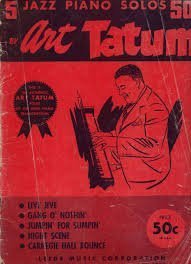
Best Sheet Music download from our Library.
| Community Musicians, building a worldwide Community Music. | |
| All the music you want to play on one site. Sharing the world’s best Contemporary, jazz, Popular, and classical Sheet Music. | |
| Scores: >15,000 (active and growing every day), over 231,000 pages All genres and Categories: Jazz & Blues, Rock & Pop, classical & contemporary, film & musicals’ scores; books & biographies; methods, études, and exercises; play along background MP3 audios & PDFs for Jazz & Rock Music Access and benefits: Subscription fee: $15.99 one-time payment, valid for lifetime (Secure Payment via Paypal, or Stripe) How to join the Sheet Music Library 🔍 Search in the Library Catalog — FAQs — Join us |
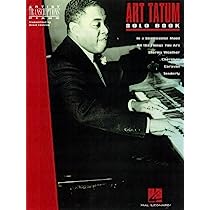
Please, subscribe to our Sheet Music Library.
If you are already a subscriber, please, check our NEW SCORES’ page every month for new sheet music. THANK YOU!
Art Tatum: The Supreme Pianist of Jazz
Introduction
Arthur Tatum Jr. (October 13, 1909 – November 5, 1956) stands as one of the most extraordinary figures in American music history. Widely regarded as the greatest jazz pianist of all time, Tatum’s technical facility, harmonic imagination, and sheer musical invention remain unsurpassed more than six decades after his death . Fellow musicians spoke of him in awestruck terms: classical pianist Vladimir Horowitz reportedly said, “If Tatum had taken up classical music, I would have been out of a job,” while saxophonist Benny Green observed that “Tatum’s place in jazz is unique. There is no such thing as a school of Tatum; there is only Tatum”.
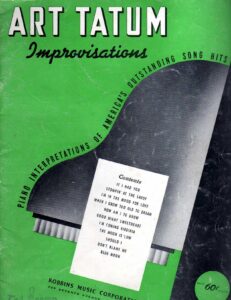
Browse in the Library:
Or browse in the categories menus & download the Library Catalog PDF:
Biography
Early Life in Toledo (1909-1932)
Art Tatum was born in Toledo, Ohio, to Arthur Tatum Sr., a mechanic from North Carolina, and Mildred Hoskins, a domestic worker from Virginia . The family was church-going and conventional, with Tatum’s younger siblings Arline and Karl following more typical paths—Karl eventually becoming a social worker .
From infancy, Tatum had impaired vision due to cataracts . Eye operations improved his sight somewhat by age eleven, but an assault in his early twenties left him completely blind in his left eye and with very limited vision in his right . Despite this profound challenge, accounts suggest he enjoyed playing cards and pool—activities requiring visual acuity—indicating both determination and the limited functional vision that remained.
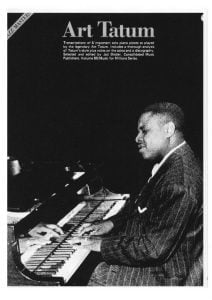
Tatum’s musical gifts manifested early. He played piano by ear, demonstrating perfect pitch, an excellent memory, and unusual sensitivity to intonation—insisting on frequent tunings as a child . He learned from radio broadcasts, records, and piano rolls, though he later disputed stories that he copied rolls made by two pianists simultaneously .
His formal education included Jefferson School in Toledo, the School for the Blind in Columbus, and the Toledo School of Music, where Overton G. Rainey provided classical instruction but discouraged jazz . This background suggests Tatum was largely self-taught as a jazz pianist, developing his revolutionary approach independently while absorbing the influences that surrounded him.
The Toledo Years and First Recordings
By 1924-25, the teenage Tatum was playing professionally in Toledo clubs. In 1927, he won an amateur competition and began performing on Toledo radio station WSPD, eventually securing his own daily program . During 1928-29, this program was rebroadcast nationwide by the Blue Network, bringing his playing to a national audience while he was still in his teens.
Tatum developed a pattern that would characterize much of his career: formal performances followed by extended after-hours sessions with fellow musicians, accompanied by prodigious alcohol consumption . This lifestyle, while contributing to his creative spontaneity, ultimately damaged his health severely.
National stars passing through Toledo—including Duke Ellington and Fletcher Henderson—visited clubs to hear the young phenomenon . Despite their encouragement, Tatum felt unready for New York until 1932, when vocalist Adelaide Hall heard him and recruited him for her touring band .
New York and the Cutting Contest (1932-1935)
Tatum’s arrival in New York marked a turning point in jazz history. At Morgan’s bar in Harlem, he participated in a legendary “cutting contest” with the reigning stride masters: James P. Johnson, Fats Waller, and Willie “The Lion” Smith . The standard contest pieces included Johnson’s “Carolina Shout” and Waller’s “Handful of Keys.” Tatum offered his arrangements of “Tea for Two” and “Tiger Rag” .
Johnson later recalled: “When Tatum played ‘Tea for Two’ that night I guess that was the first time I ever heard it really played” . From that moment, Tatum was recognized as the preeminent jazz pianist of his generation.
His first solo New York engagement was at the Onyx Club on 52nd Street, reportedly paying “$45 a week and free whiskey” . In March 1933, he made his first released solo recordings for Brunswick: “St. Louis Blues,” “Sophisticated Lady,” “Tea for Two,” and “Tiger Rag” . The last, taken at approximately 376 beats per minute, stunned listeners with its technical audacity.
The Middle Years: Chicago, California, and the Trio (1935-1949)
In 1935, Tatum married Ruby Arnold of Cleveland . That same year, he began a year-long residency at Chicago’s Three Deuces, first as a soloist, then leading a quartet . He then moved to California, traveling by train due to his fear of flying .
The 1940s brought significant developments. Tatum formed his most famous trio with guitarist Tiny Grimes and bassist Slam Stewart, later replaced by Everett Barksdale and bassist Bill Pemberton . This configuration proved commercially successful and musically influential, with Stewart’s bowed, humming solos becoming a signature sound.
Tatum’s trio work balanced his solo virtuosity with genuine ensemble interaction. The collaboration with Stewart and Barksdale (and later Remo Palmieri) demonstrated his ability to function within a group context while maintaining his distinctive voice .
The Granz Years and Final Recordings (1949-1956)
Despite his fame, Tatum’s popularity waned in the late 1940s as bebop revolutionized jazz. He continued playing in his established style, largely ignoring the new movement . His career revived dramatically in the mid-1950s through association with impresario Norman Granz.
Granz, who had long admired Tatum, signed him to his new Pablo label and recorded him extensively in multiple contexts: solo, trio, and small group collaborations with leading jazz figures . The resulting “Tatum Group Masterpieces” series captured him with artists including Ben Webster, Buddy DeFranco, Lionel Hampton, and Roy Eldridge.
The September 11, 1956 session with Ben Webster proved especially significant . This quartet date, featuring Red Callender on bass and Bill Douglass on drums, produced an album often cited among the greatest jazz recordings . Critics praised the contrast between Webster’s warm, breathy tenor tone and Tatum’s elaborate pianistic arabesques . The Penguin Guide to Jazz included it in their “core collection” of essential recordings .
Tatum died less than two months later, on November 5, 1956, at age 47, from uremia complicated by diabetes and exacerbated by alcoholism.
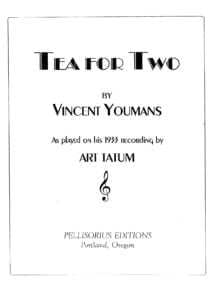
Art Tatum‘s arrangement of Youmans’ Tea for Two (sheet music transcription)
Musical Style and Technical Approach
The Complete Pianist
Tatum’s playing represented a synthesis of everything that preceded him and a prefiguring of much that followed. He absorbed the stride tradition of Johnson and Waller, the orchestral approach of Earl Hines, and the sophisticated harmony of non-jazz pianists like Lee Sims .
His technique was legendary. The 1933 “Tiger Rag” recording demonstrates right-hand eighth notes executed at tempos exceeding 376 beats per minute . But speed alone doesn’t explain his impact. As one critic noted, Tatum’s accomplishment “was of a different order from what most people, from what even musicians, had ever heard. It made musicians reconsider their definitions of excellence, of what was possible” .
Reharmonization and Harmonic Expansion
Tatum’s most significant contribution to jazz harmony was his systematic reharmonization of popular songs. He possessed an encyclopedic knowledge of the Great American Songbook, drawing on tunes by Cole Porter, Rodgers and Hart, the Gershwins, and others . Rather than simply playing melodies with conventional chord changes, he completely reimagined the harmonic underpinnings.
His approach included extensive use of chord substitutions, diminished scale patterns, and what one critic termed “harmonic expansion” . He often employed bitonality—simultaneously implying two keys—and complex voicings that anticipated the harmonic language of bebop and beyond.
The album Art Tatum: Improvisations correctly frames his work as “composition in real time,” giving improvisation equal billing with composition . This perspective recognizes that Tatum’s interpretations were not mere embellishments but complete recompositions of standard material.
Stride Foundation and Left Hand Independence
Tatum never abandoned the stride piano foundation he learned from Waller and Johnson. His left hand maintained the alternating bass note-chord pattern characteristic of stride, but with unprecedented sophistication. As described in a recent review, he demonstrated remarkable facility in “taking hold of complex chords with his left hand, while supporting ornate runs and complicated passages with his right” .
This independence allowed him to create the illusion of multiple pianists simultaneously. His left hand might outline walking bass lines, punch chordal accents, and provide rhythmic propulsion while his right hand executed rapid-fire arpeggios and melodic elaborations.
Improvisational Vocabulary and Licks
Tatum’s improvisational language included several characteristic elements:
Run-filled embellishment: His melodic lines often featured cascading runs filling the spaces between phrase fragments. These were not mere displays of speed but carefully crafted linear statements.
Arpeggiated patterns: He frequently broke chords into sweeping arpeggios covering much of the keyboard’s range, creating what one critic called “ornate runs and complicated passages” .
Reharmonization in real time: Even within a single chorus, Tatum might reharmonize a melody multiple ways, each pass revealing new harmonic possibilities.
Tempo manipulation: While capable of astonishing speed, he also manipulated time, creating tension through rubato passages before launching into double-time runs.
Classical Influences
Tatum’s knowledge extended beyond jazz. He incorporated material from the classical repertoire, as demonstrated by his recordings of Dvořák’s “Humoresque” and Massenet’s “Elegy” . These weren’t novelty items but serious reinterpretations that applied jazz harmony and rhythm to classical themes.
His piano-playing mechanism reflected classical training—proper fingering, pedaling, and touch. The Naxos recording by Steven Mayer, Art Tatum: Improvisations, positions Tatum’s work within the context of American classical music, arguing that his “improvisatory jazz” represents “the true American Classical Music” .
Repertoire and Interpretation
The Great American Songbook
Tatum rarely performed original compositions. Instead, he drew from the standard jazz and popular repertoire, reimagining familiar tunes through his unique harmonic and technical lens . This approach aligns him with classical tradition, where performers interpret existing works rather than presenting original compositions.
Key songs in his repertoire included “Tea for Two,” “Tiger Rag,” “St. Louis Blues,” “Body and Soul,” “Sweet Lorraine,” and “Someone to Watch Over Me” . Each existed in multiple recorded versions, as Tatum never played a tune the same way twice.
Signature Pieces and Performances
“Tea for Two”: This Vincent Youmans composition became Tatum’s calling card. His 1933 recording stunned the jazz world, and his performance at the Morgan’s cutting contest established his reputation . He took it at extreme tempos while maintaining clarity and harmonic invention .
“Tiger Rag”: The 1933 recording remains a benchmark of jazz piano technique. Its 376 bpm tempo and crystalline articulation seemed superhuman to contemporary listeners .
“Yesterdays”: His April 1954 performance on the Spike Jones Show survives on film, offering rare visual documentation of his playing . The hands move with deceptive calm while producing extraordinary complexity.
“Humoresque” and “Elegy”: These classical adaptations demonstrated his ability to transform material from outside the jazz tradition while respecting its essential character .
Collaborations with Other Artists
The Trio Format
Tatum’s trios represented his most sustained collaborative work. The 1940s trio with Tiny Grimes (guitar) and Slam Stewart (bass) achieved commercial success and musical integration . Stewart’s distinctive approach—bowing melodic solos while humming an octave above—created a unique textural blend with Tatum’s piano.
Later trios featured guitarist Everett Barksdale and bassist Bill Pemberton . The 2024 Resonance Records release Jewels in the Treasure Box documents this configuration extensively, with Barksdale described as providing “a perfect complement to Tatum’s piano, weaving in and out of the melodies with grace and finesse” while Stewart “anchors the rhythm with precision and groove” .
The Tatum Group Masterpieces
Norman Granz’s series of collaborative albums captured Tatum with major jazz figures in the mid-1950s. Each session paired him with a different soloist, creating revealing musical dialogues.
With Ben Webster: The September 11, 1956 session proved among the most successful . Webster’s warm, breathy tenor saxophone provided ideal contrast to Tatum’s elaborate piano. The combination works, critic Scott Yanow noted, because Webster’s tone and professionalism matched Tatum’s sophistication . The album appears at number 42 in Ben Ratliff’s Jazz: A Critic’s Guide to the 100 Most Important Recordings .
With Roy Eldridge: The trumpeter’s aggressive style created productive tension with Tatum’s harmonic complexity.
With Lionel Hampton: The vibraphonist’s rhythmic energy sparked particularly spirited exchanges.
With Buddy DeFranco: The clarinetist’s fluid lines complemented Tatum’s pianistic approach.
Adelaide Hall and Early Collaborations
Tatum’s first recordings accompanied vocalist Adelaide Hall in August 1932 . These sides—”I’ll Never Be the Same” and “Strange as It Seems”—capture him in an accompanying role, already displaying the harmonic sophistication that would define his mature style.
Film Appearances
Tatum appeared in several film shorts, providing rare visual documentation of his playing :
March of Times, Volume X, Issue 5: “Music in America” (December 1943): Filmed at the Three Deuces in New York, this segment shows Tatum with Tiny Grimes and Slam Stewart performing “Tiny’s Exercise” .
The Fabulous Dorseys (1946): This feature film included Tatum performing “Turquoise” as a solo and “Art’s Blues” with an all-star group including Ziggy Elman, Tommy Dorsey, Jimmy Dorsey, and Charlie Barnet .
Spike Jones Show (April 17, 1954): Tatum performed “Yesterdays” on this television program, one of his few small-screen appearances .
Influence on Jazz and Beyond
Contemporary Reaction
Tatum’s contemporaries responded with awe. Pianist Hank Jones recalled: “When I first heard Art Tatum, I was overwhelmed. I thought, ‘What’s the use of my playing? I might as well give up’”—a sentiment echoed by countless pianists who encountered Tatum’s recordings.
Fats Waller, Tatum’s primary influence, reportedly told a club audience when Tatum entered: “I just play the piano, but God is in the house tonight” . This oft-repeated anecdote captures the reverence Tatum inspired.
Oscar Peterson and Subsequent Pianists
Oscar Peterson became Tatum’s most direct successor, inheriting both his virtuoso technique and his harmonic conception. Peterson acknowledged the debt freely, and his 1958 recording of “Tenderly” at the Vancouver BC Jazz Festival demonstrates Tatum’s influence in its “harmonic coloration and interpretative passages” .
Other pianists showing Tatum’s influence include:
Bud Powell: Transformed Tatum’s harmonic language into bebop vocabulary.
Herbie Hancock: Extended Tatum’s reharmonization techniques into modal and post-bop contexts.
Adam Makowicz: Combined Tatum’s technical approach with classical polish.
Keith Jarrett: Absorbed Tatum’s solo piano conception while developing an entirely personal language.
Beyond Jazz
Tatum’s influence extended beyond jazz. Classical pianists studied his recordings, and his approach to reharmonization influenced popular music arrangers. His complete command of the instrument set new standards for piano playing in any genre.
Legacy and Historical Significance
Critical Assessment
Tatum’s reputation has only grown since his death. He is consistently ranked among the greatest jazz musicians, regardless of instrument. The Penguin Guide to Jazz includes multiple Tatum recordings in its core collection, and his work remains in print through various reissue programs .
The Granz Recordings as Final Testament
Norman Granz’s mid-1950s recording campaign ensured Tatum’s legacy. By documenting him in solo, trio, and group settings, Granz created an enduring portrait of his art. The solo masterpieces reveal his complete harmonic and technical vocabulary; the group masterpieces show his adaptability and generosity as a collaborator .
The final session with Ben Webster, recorded just two months before his death, finds Tatum in full command despite failing health . His playing shows no diminution of powers, making the early loss all the more tragic.
Continuing Relevance
Contemporary jazz pianists continue to study Tatum’s recordings. His reharmonization techniques have been absorbed into mainstream jazz education, while his technical standards remain aspirational. The 2004 Naxos release of Tatum interpretations by Steven Mayer and the 2024 Resonance collection Jewels in the Treasure Box demonstrate ongoing interest in his work .
Complete Discography and Major Works
Solo Piano Recordings
Tatum’s solo recordings form the core of his legacy:
Brunswick Recordings (1933): “St. Louis Blues,” “Sophisticated Lady,” “Tea for Two,” “Tiger Rag” .
Decca Solo Sides (1934-1940): Numerous recordings, many unreleased for decades .
Capitol Solo Recordings (1949-1952): Including his interpretations of classical themes .
Pablo Solo Masterpieces (1953-1956): Extensive documentation by Norman Granz.
Trio Recordings
With Tiny Grimes and Slam Stewart: Including the filmed “Tiny’s Exercise” (1943) .
With Everett Barksdale and Slam Stewart: Documented extensively on Jewels in the Treasure Box (2024) .
With Everett Barksdale and Bill Pemberton: Later trio configuration.
Group Masterpieces Series
Volume 1: With Roy Eldridge, Alvin Stoller, John Simmons
Volume 2: With Lionel Hampton, Buddy Rich, Ray Brown
Volume 3: With Benny Carter, Louie Bellson
Volume 4: With Buddy DeFranco
Volume 5: With Harry Edison, Louie Bellson
Volume 6: Complete editions
Volume 7: More collaborations
Volume 8: With Ben Webster, Red Callender, Bill Douglass (1956)
Live Recordings
The 10-CD box set TatumArt (Storyville, 2008) collects live performances from 1934-1956, including previously unreleased material and a bonus DVD with film appearances . This comprehensive collection demonstrates Tatum’s consistency across decades and settings.
Most Known Compositions
While Tatum rarely composed original tunes, several pieces bear his name:
“Tatum Pole Boogie”: Included on the Improvisations album .
“Art’s Blues”: Performed in The Fabulous Dorseys film (1946) with an all-star band .
“Tiny’s Exercise”: The trio piece filmed for March of Times .
These original works, however, represent a tiny fraction of his recorded legacy. His art was interpretive rather than compositional—he transformed existing materials rather than creating new ones.
Art Tatum remains unique in jazz history. His technical command, harmonic imagination, and sheer musical fertility set him apart from all predecessors and successors. He extended the boundaries of jazz piano beyond anything previously imagined, establishing new ground through reharmonization, innovative voicing, and bitonal harmony .
His life followed patterns common among jazz musicians of his era—early recognition, relentless performance schedules, heavy drinking, and early death. But his music transcended these circumstances. The recordings survive as testaments to an extraordinary musical intelligence operating through an instrument he had completely mastered.
Tatum never adapted to bebop or other stylistic developments of his later years. He continued playing in the style he had perfected, ignoring jazz’s evolution . This apparent conservatism masked deeper radicalism: his approach to harmony and technique had already anticipated much that followed, and his refusal to change reflected confidence in his complete artistic vision.
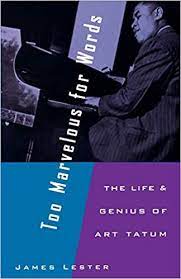
Sixty-eight years after his death, Tatum’s recordings still startle first-time listeners. They reveal possibilities in jazz piano that remain incompletely explored. As James Lester, his biographer, observed: “His accomplishment was of a different order from what most people, from what even musicians, had ever heard” . That statement remains true today. Art Tatum was, and remains, the supreme pianist in jazz history.
References
- Wikipedia, “Art Tatum”
- All About Jazz, “Steven Mayer: Art Tatum – Improvisations” (2004)
- Wikipedia, “The Tatum Group Masterpieces, Volume Eight”
- OhioLINK Library Catalog, “TatumArt [sound recording]”
- Apple Music, “Art Tatum” artist biography
- All About Jazz, “Art Tatum: Jewels in the Treasure Box” (2024)
- FYE, “Art Tatum / Ben Webster – Art Tatum & Ben Webster Quartet”
- University of Colorado Boulder Library Catalog, “TatumArt [sound recording]”
- Shazam, “Art Tatum” artist biography