Community Musicians, building a worldwide Community Music.
Scores
for all instruments: 15,000+
(active and growing),
over 231,000 pages.
All genres and levels: Jazz & Blues, Rock & Pop, Classical & Contemporary, Film & Musicals;
books & biographies; methods, études, play-along tracks (MP3) for Jazz & Rock.
Access & benefits: US$15.99 one-time payment, valid for lifetime, full Library access.
Table of Contents
Happy birthday, Ornette Coleman, born on this day in 1930
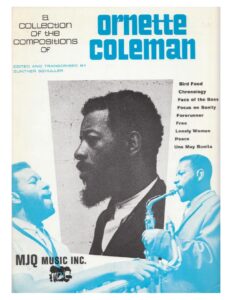
Best Sheet Music download from our Library.

Please, subscribe to our Sheet Music Library.
If you are already a subscriber, please, check our NEW SCORES' page every month for new sheet music. THANK YOU!
The Shape of Jazz to Come: The Revolutionary Life of Ornette Coleman
Born March 9, 1930
On a spring day in 1930, in Fort Worth, Texas, a figure was born who would grow up to fundamentally alter the landscape of modern music. Ornette Coleman, whose very name would become synonymous with avant-garde jazz, didn't just play music; he deconstructed it, questioned its most basic assumptions, and rebuilt it in his own profound and deeply emotional image.
More than just a saxophonist and composer, Coleman was a philosopher of sound, a man who challenged the very definition of improvisation and harmony, sparking a debate that continues to this day. His life’s work was a testament to the power of raw, untethered creativity, a journey that took him from the segregated dance halls of Texas to the esteemed stages of the world, leaving a legacy as "The Shape of Jazz to Come."
Browse in the Library:
Or browse in the categories menus & download the Library Catalog PDF:
Fort Worth Foundations (1930-1940s)
Ornette Randoph Coleman was born into a world of profound struggle and rich musical heritage. Fort Worth's Stop Six neighborhood was a tight-knit, predominantly Black community where the sounds of the blues, the sanctified church, and early rhythm and blues were the soundtrack of daily life. Music was not an art form for the elite; it was a necessity, a means of expression and survival.

Coleman's introduction to music was informal and self-driven. His mother, Rosa, a seamstress, saved up to buy him his first alto saxophone when he was fourteen. Largely self-taught, he immersed himself in the local music scene, absorbing the styles of the day. He learned to play blues-inflected R&B, the kind of music that got people dancing in the local juke joints. This grounding in the blues would prove to be the bedrock of his entire musical philosophy, a raw emotional core that would never leave him, no matter how abstract his music became.
However, even in these early years, Coleman’s approach was unorthodox. He was more interested in expressing the feeling of a melody than playing it with precise technical correctness. He would bend notes, experiment with timbre, and follow his ear in ways that didn't always align with the strict rules of harmony. This led to his first experiences with the kind of resistance that would follow him for years. In a small band, he might be laughed at or corrected for his "wrong" notes. The seeds of his revolutionary concept were already being sown, much to the confusion of his peers who were more interested in playing the blues "right."
Seeking to expand his horizons, he studied harmony briefly at the A. Maceo Smith High School, but formal education felt constrictive. He was more interested in the vibrant, if commercially driven, world of the touring R&B bands. In the late 1940s, he took to the road, working with performers like Clarence Samuels and Pee Wee Crayton. It was on the road, in Natchez, Mississippi, that a defining incident occurred. After a show, a local white crowd began to taunt him. When a fight broke out, Coleman was arrested, and his saxophone was destroyed by the police. It was a brutal reminder of the racial realities of America, an experience that likely deepened the sense of alienation and outsider status that would permeate his art.
Los Angeles and the Search for a Sound (1950s)
Disillusioned but undeterred, Coleman relocated to Los Angeles in the early 1950s. He hoped to find a more receptive environment for his musical ideas. Instead, he found more of the same. He took odd jobs, including one as an elevator operator, and continued to play his saxophone, but his sound was still met with bafflement and hostility. Fellow musicians would refuse to play with him, club owners wouldn't book him, and he was often ridiculed as being unable to play his instrument.

It was during this period of struggle that Coleman began to develop the theoretical underpinnings of his new music. He met like-minded individuals who were also seeking a way out of the perceived harmonic and structural straitjacket of bebop. The most crucial of these was the enigmatic trumpeter Don Cherry. Cherry shared Coleman's restless spirit and was open to his ideas. Together, they would play in tiny apartments, working out a new way of improvising together, one that was based on the emotional arc of a melody rather than a pre-set series of chord changes. This was the birth of what would later be called "harmolodics."
Other key figures began to orbit around this nascent scene. Bassist Charlie Haden, with his deep, folksy sound and profound melodic sensibility, heard something profound in Coleman's playing. So did drummer Billy Higgins, whose light, swinging touch provided the perfect rhythmic foil for the new music. This quartet—Coleman, Cherry, Haden, and Higgins—would become the crucible in which a new jazz was forged.
Despite their dedication, finding work was nearly impossible. They were eventually discovered by the Modern Jazz Quartet's pianist and musical director, John Lewis. Lewis, a highly respected figure in the jazz establishment, heard past the "out-of-tune" wails and recognized a deep compositional logic and raw emotional power. He became an early champion, helping Coleman secure a scholarship to the Lenox School of Jazz in Massachusetts in 1959.
More importantly, Lewis introduced Coleman to the owner of Contemporary Records, Lester Koenig, who agreed to let him record. The result was Coleman's debut album, Something Else!!!!: The Music of Ornette Coleman (1958). The title was a statement of intent, and the music was a revelation. On tracks like "Invisible" and "The Blessing," the blues was still present, but the structure was fluid. The horns played the theme together, but then the solos were not tethered to a rigid harmonic grid. The improvisations were free to follow the melody's logic, creating a sound that was at once jarring and strangely beautiful. The album was a commercial failure and critically divisive, but it was a shot across the bow of the jazz world.
The Shape of Jazz to Come and the "Double Quartet" Controversy (1959-1961)
If Something Else!!!! was a warning shot, Coleman's next albums were the revolution itself. In 1959, he signed with Atlantic Records, a major label, which gave him a much wider platform. That year, he brought his working quartet—Don Cherry, Charlie Haden, and Billy Higgins—into the studio to record an album that would live up to its name: The Shape of Jazz to Come.
From the opening notes of "Lonely Woman," it was clear that a new world had arrived. The track is a masterpiece of melancholic beauty. Coleman's keening, vocalized alto saxophone cry, doubled by Cherry's plaintive trumpet, creates a melody of profound loneliness and angular grace. It is not "free" in the sense of being chaotic; it is a tightly composed and emotionally focused piece of music. The improvisations that follow are lyrical and passionate, unbound by chords but deeply connected to the feeling of the piece. Other tracks like "Peace" and "Congeniality" further explored this new terrain, establishing a vocabulary for a music that was harmonically open and melodically free. The album was a landmark, a seismic event that shattered the prevailing orthodoxy of jazz based on song forms and chord progressions.
The quartet’s residency at the Five Spot Cafe in New York City later that year became the stuff of legend. The jazz elite came to witness the phenomenon firsthand. Legends like Leonard Bernstein, Miles Davis, and John Coltrane were in the audience. The reactions were starkly divided. Some, like Bernstein and Coltrane, were deeply intrigued. Others, like trumpeter Roy Eldridge, were famously quoted as saying, "I think he's jiving, baby." The debate was fierce. Critics like Martin Williams heard genius, while others, most famously DownBeat magazine’s John Tynan, dismissed it as chaotic noise, coining the phrase "anti-jazz."
Coleman's response was never to argue; it was to keep creating. His next album, Change of the Century (1960), solidified his approach. The title itself was a statement of purpose. The quartet was playing with a telepathic unity, their collective improvisations a swirling, emotional tapestry.
Coleman then pushed the concept even further. On Free Jazz: A Collective Improvisation (1961), he assembled not one, but two quartets—one in the left stereo channel and one in the right. The result was a 37-minute continuous performance of collective improvisation, a dense, polyphonic sound-mass that was both exhilarating and challenging. The album's title became the name for an entire movement. Coleman himself preferred the term "harmolodics" to describe his system, but "free jazz" was the label that stuck, defining a new genre.
Harmolodics Explained
At the core of Coleman's musical philosophy is a concept he called "harmolodics." He never provided a single, simple definition, preferring to let the music speak for itself, but its principles can be understood. The term is a portmanteau of harmony, movement, and melody, and it proposes a radical democratic system for music-making.
In traditional jazz, the harmony (the chord progression) is the foundation. The soloist improvises a melody that fits those chords. In harmolodics, Coleman flipped this hierarchy. He proposed that melody is primary. Harmony is not a fixed set of rules but is derived from the melodic interplay of the instruments.
In a harmolodic ensemble, all instruments are theoretically equal. The bass is not confined to playing the root notes of chords. It can play melodies, rhythms, and phrases, responding to the soloist as another voice in the conversation. The drums are not just a timekeeper but a melodic and harmonic voice in their own right. Everyone is free to improvise simultaneously, creating a collective texture where the tonality and structure are constantly shifting and being renegotiated in real-time. This is why Coleman’s music often has a raw, urgent, and conversational feel. It’s not a soloist with accompaniment; it’s a group of equals in a deep, spontaneous dialogue, all following the emotional logic of the melody.
The "Blue Period" and Hiatus (1962-1975)
The intensity of the early years was not sustainable. The business pressures of leading a band, the constant critical fire, and the sheer emotional energy of his music took their toll. In 1962, feeling frustrated with the jazz scene and wanting to explore his ideas in new contexts, Coleman abruptly stopped performing publicly. He retreated from the scene, a period often referred to as his "blue period."
During this time, he taught himself to play trumpet and violin. Characteristically, he did not approach them in a conventional way. He played them with his own unique fingering and embouchure, producing a raw, untrained, and highly personal sound that many critics found grating. But for Coleman, it was not about technical proficiency; it was about expanding his expressive palette and finding new voices for his harmolodic concepts.
He emerged from his self-imposed exile in 1965 with a new quartet, featuring his son Denardo Coleman on drums, who was just ten years old. While some saw it as a gimmick, Denardo grew into a remarkably empathetic and powerful drummer, perfectly attuned to the emotional swells of his father's music. Albums from this period, like At the "Golden Circle" Stockholm (1965), are among the fiercest and most passionate of his career.
The late 60s and early 70s saw Coleman continuing to evolve. On albums like The Empty Foxhole (1966) and Ornette at 12 (1968), he delved deeper into his unique string playing and compositional structures. He then took a dramatic turn with Science Fiction (1971), an album that incorporated wordless vocals by Indian classical singer Asha Puthli and the searing poetry of the Black Arts Movement. Tracks like "What Reason Could I Give" and "Street Woman" showed a new, funkier, and more overtly political dimension to his music. He was moving towards a sound that incorporated rock rhythms and electric instrumentation, culminating in the formation of his electric band, Prime Time.
Prime Time and Dancing in Your Head (1975-1990s)
With the formation of Prime Time in the mid-1970s, Coleman fully embraced the world of electric guitar, bass, and drums. This was harmolodics applied to a rock and funk context. The music was dense, polyrhythmic, and loud, with multiple guitars playing interlocking, often dissonant patterns over complex, funky drum beats. It was a natural evolution of his principles; instead of one drummer, he often had two, playing in different, competing time feels.
The 1976 album Dancing in Your Head introduced the world to this new sound, particularly the track "Theme from a Symphony" (which later became known as "Midnight Sunrise"). It was a relentless, joyous, and chaotic groove. The music was no longer "free jazz" in the conventional sense; it was a new form of avant-garde funk that he called "free funk." He continued to explore this electric terrain on albums like Body Meta (1976) and Of Human Feelings (1982), influencing a new generation of musicians in the No Wave and downtown New York scenes.
Coleman’s influence expanded beyond music. He collaborated with abstract expressionist painters and, most notably, with the poet and playwright William S. Burroughs. He composed for string quartets and woodwind ensembles, most famously on the album Skies of America (1972), a symphonic work that applied harmolodic principles to a full orchestra.
The Legacy and Final Years (1990s-2015)
In the 1990s and 2000s, Coleman's status as a living legend was universally cemented. He was awarded a MacArthur Fellowship ("Genius Grant") in 1994. In 2007, he received a Grammy Lifetime Achievement Award and the Pulitzer Prize for Music for his album Sound Grammar. This was a particularly significant honor, as it acknowledged his work not as a controversial outlier but as a major contribution to the canon of American music. Recorded live in 2005 with his son Denardo and two bassists, Sound Grammar was a triumphant return to form, a masterclass in harmolodic interplay that was both deeply complex and accessible.
Throughout his later years, he continued to perform and compose, often revisiting his classic tunes with new ensembles. His influence had become pervasive. You can hear his impact in the music of artists as diverse as Sonic Youth, Yo La Tengo, and the punk-funk of the 1980s No Wave scene. In jazz, his shadow looms large over figures like saxophonists Steve Coleman (no relation), who developed the M-Base collective based on similar principles, and pianist Vijay Iyer.
Ornette Coleman passed away on June 11, 2015, in New York City, at the age of 85. He left behind a body of work that is a testament to the power of conviction and the endless possibilities of human expression.
Essential Compositions: A Starting Point
Navigating Coleman's vast discography can be daunting. Here are some essential compositions that serve as perfect entry points into his world.
- "Lonely Woman" (from The Shape of Jazz to Come, 1959): His most famous and accessible composition. A haunting, blues-drenched melody of profound beauty that demonstrates the emotional core of his music.
- "Peace" (from The Shape of Jazz to Come, 1959): A beautiful, gentle ballad that shows the lyrical side of his harmolodic approach.
- "The Blessing" (from Something Else!!!!, 1958): One of his earliest masterpieces, a 12-bar blues form that is subtly twisted and reshaped into something new.
- "Broadway Blues" (from New York Is Now!, 1968): A perfect example of how he could deconstruct a classic form. The melody has the swagger of a standard but is fragmented and rebuilt in his own image.
- "Ramblin'" (from Change of the Century, 1960): A playful, blues-inflected tune that features a magnificent, storytelling solo from Coleman, full of bent notes and raw emotion.
- "What Reason Could I Give" (from Science Fiction, 1971): A stunning example of his later work, with a simple, powerful melody sung by Asha Puthli, set against a complex, shifting backdrop.
- "Theme from a Symphony" / "Midnight Sunrise" (from Dancing in Your Head, 1976): The quintessential Prime Time track. A hypnotic, funky, and chaotic groove that defines the electric phase of his career.
Filmography and Notable Collaborations
While not a prolific film composer, Coleman's music and persona have appeared in film. He composed the powerful, haunting score for the experimental film Chappaqua (1966). He also appeared in the documentary Ornette: Made in America (1985) by Shirley Clarke, a brilliant, impressionistic portrait of the artist. His music has been featured in countless other films and documentaries about jazz.
His collaborations were a who's who of musical innovation:
- Don Cherry: His musical soulmate and the perfect foil for his melodies.
- Charlie Haden: The bassist whose deep, folk-like sound provided the emotional gravity for the classic quartet.
- Billy Higgins & Ed Blackwell: The two great drummers of the classic period, whose unique, melodic approaches to rhythm were essential.
- John Coltrane: The two saxophone giants shared a deep mutual respect and admiration, though they never recorded together. Coltrane was profoundly influenced by Coleman's leap into the unknown.
- Pat Metheny: The guitarist collaborated with Coleman on the album Song X (1986), a powerful and successful fusion of Metheny's lyricism with Coleman's harmolodic intensity.
- Yoko Ono, Lou Reed, Jerry Garcia: He recorded and performed with all of them, demonstrating his broad appeal beyond the confines of jazz.
Ornette Coleman: The Gift of Freedom
Ornette Coleman’s greatest legacy is not a specific technique or a harmonic system, but the idea of freedom itself. He demonstrated that structure and emotion are not mutually exclusive, that beauty can be found in the most unexpected places, and that true innovation comes from listening to the voice inside, no matter how much the outside world may scoff. He took the blues, the most fundamental of American musical forms, and stretched it to its breaking point, finding new universes of feeling within its simple framework.
From the dusty streets of Fort Worth to the hallowed halls of the Pulitzer committee, his journey was a testament to the enduring power of a singular vision. He didn't just change the shape of jazz; he changed the way we think about creativity, reminding us that the only real rule in art is to be true to the music you hear. For that, we celebrate him, not just on the anniversary of his birth, but every time we dare to listen for the shape of things to come.
Ornette Coleman - Free Jazz (1961) (Full Album)
Alto Saxophone – Ornette Coleman Bass – Charlie Haden, Scott LaFaro Bass Clarinet – Eric Dolphy Design (Album Design) – Loring Eutemy Drums – Billy Higgins, Ed Blackwell Trumpet – Freddie Hubbard Trumpet (Pocket) – Donald Cherry Engineer (Recording) – Tom Dowd Painting (White Light) – Jackson Pollock Recording Supervisor – Nesuhi Ertegun
A1 Free Jazz (Part 1) B1 Free Jazz (Part 2)