Come join us now, and enjoy playing your beloved music and browse through great scores of every level and styles!
Can’t find the songbook you’re looking for? Please, email us at: sheetmusiclibrarypdf@gmail.com We’d like to help you!
Dvořák Symphony No 9 in E minor 2nd Mov. Piano Solo sheet music, Noten, partitura, spartiti, 楽譜, 乐谱
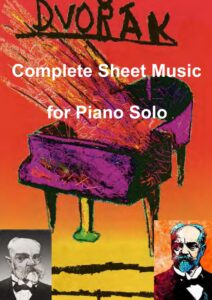
Best Sheet Music download from our Library.
Please, subscribe to our Sheet Music Library.
If you are already a subscriber, please, check our NEW SCORES’ page every month for new sheet music. THANK YOU!
Antonín Dvořák: The Symphonist of the Soul of Nations
Antonín Dvořák (1841-1904) stands as one of the most extraordinary and beloved composers of the Romantic era. More than just a master of melody and orchestration, he was a musical synthesist of profound depth, a composer who seamlessly wove the folk idioms of his native Bohemia into the grand tapestry of Western classical forms, and who, later in life, performed a similar alchemy with the indigenous music of America. His journey from a humble butcher’s son in a small Czech village to the director of the National Conservatory of Music in New York and a globally celebrated figure is a testament to his genius, perseverance, and the universal language of his art.
Part I: Full Biography
Early Life and Roots in Nelahozeves (1841-1857)
Antonín Leopold Dvořák was born on September 8, 1841, in Nelahozeves (pronounced Nel-a-ho-zhe-ves), a village north of Prague on the Vltava River. He was the first of nine children born to František Dvořák, a butcher, innkeeper, and professional zither player, and his wife Anna. Music was an intrinsic part of daily life. Young Antonín grew up surrounded by the sounds of folk songs, dance tunes, and his father’s zither playing. He began his musical education early, taking violin lessons from the village schoolmaster, Josef Spitz, and quickly joined the local band, playing at dances and festivals.
His innate talent was undeniable, but his family’s modest means pointed him toward a practical trade. At the age of 12, he was sent to the nearby town of Zlonice to learn German and further his musical studies with Antonín Liehmann, a prominent local musician. It was Liehmann who recognized the boy’s extraordinary potential and taught him organ, piano, and music theory. In 1857, after a brief period back in Nelahozeves helping in the family butcher shop, Dvořák persuaded his father to let him pursue a musical career. He enrolled at the Institute for Church Music in Prague, where he studied organ, harmony, and counterpoint with Karl Pietsch and Josef Foerster.
The Prague Years: Struggle and Discovery (1857-1871)
Graduating in 1859, Dvořák entered the professional world, but not as a composer. He joined Karel Komzák’s band, which played in restaurants and for public gatherings. This period was formative, providing him with a deep practical knowledge of orchestral instruments and the popular dance music of the day (polkas, waltzes). In 1862, the band became the nucleus of the orchestra of the Provisional Theatre, where Dvořák played viola for nearly a decade. This was an invaluable education. He performed in the pit for countless operas, including the premieres of Smetana’s The Brandenburgers in Bohemia and The Bartered Bride, absorbing the dramatic and musical styles of the time.
During these years, Dvořák began composing intensely but with little public recognition. He was deeply influenced by the German Romantics, particularly Wagner and Liszt, which is evident in his early, more experimental works. He even destroyed many of these pieces after they failed to gain critical or financial success. His personal life also took shape; in 1865, he fell in love with one of his piano students, Josefína Čermáková, who did not return his affections (she later married another man). The pain of this unrequited love is believed to have informed his later song cycle, Cypresses. In 1873, he married Josefína’s younger sister, Anna Čermáková, a contralto in the theatre choir. Theirs would prove to be a stable and loving marriage, producing nine children.
Breakthrough and International Fame (1871-1892)
The early 1870s marked a turning point. His patriotic cantata, Hymnus (The Heirs of the White Mountain), premiered in 1873 and was a resounding success, establishing him for the first time as a significant voice in Czech music. He resigned from the theatre orchestra to devote himself to composition. The key to his international breakthrough came in 1875 when he was awarded a state stipend by the Austrian government. This grant brought him into contact with the most influential critic of the era, Johannes Brahms, who served on the panel. Brahms was immediately struck by Dvořák’s talent and, in 1877, recommended him to his own publisher, Fritz Simrock of Berlin.
This relationship with Simrock catapulted Dvořák onto the world stage. Simrock published the Moravian Duets and, most famously, the first set of Slavonic Dances (1878), originally written for piano four-hands. Their immediate popularity, followed by their orchestral arrangement, swept across Europe. Suddenly, Dvořák was a household name. His music was praised for its freshness, vitality, and irresistible melodic charm. He made multiple visits to England, where he was hailed as a hero, conducting his own works, including the monumental Stabat Mater (1877) and his grand symphonies. He received honorary degrees from Cambridge and Prague universities.
This period was his most prolific, producing a staggering array of masterpieces: Symphonies Nos. 6, 7, and 8, the Slavonic Rhapsodies, the Violin Concerto, the Cello Concerto? (No, that would come later), the opera The Cunning Peasant, and countless chamber works, solidifying his reputation as a worthy successor to Brahms and a master of the classical forms infused with a distinctly national flavor.
The American Sojourn (1892-1895)
In 1891, Dvořák was offered a prestigious and lucrative position as the director of the newly founded National Conservatory of Music in New York City. The offer was irresistible, and in September 1892, he and his family arrived in America. His mission, as articulated by the Conservatory’s founder, Jeannette Thurber, was to discover and foster a distinctly American school of classical music. Dvořák took this charge seriously. He famously declared that the future music of America would be founded upon its “negro melodies” and Native American music. He instructed his students to look to their own folk traditions, rather than simply imitating European models.
To immerse himself, he sought out the music of the African American spirituals, most notably through his friendship with his student and private secretary, Harry T. Burleigh, a talented African American singer and composer. Burleigh would sing spirituals like “Swing Low, Sweet Chariot” for Dvořák, deeply impressing the composer with their “pentatonic” scales, “call and response” patterns, and profound emotional depth.
This American experience directly inspired his most famous works. In the summer of 1893, he and his family spent their vacation in the predominantly Czech community of Spillville, Iowa. It was here that he composed two of his greatest chamber works, the String Quartet in F major, Op. 96 (“American”) and the String Quintet in E-flat major, Op. 97. More significantly, the entire concept and much of the composition of his Symphony No. 9 in E minor, “From the New World,” (1893) was forged in this crucible of American sounds and landscapes. While the symphony’s melodies are entirely his own, they are imbued with the spirit of the music he was absorbing—the aching melancholy of the spiritual in the famous Largo, the pentatonic cast of the main theme, and the bustling, rhythmic energy of the scherzo.
During his time in New York, he also composed the Cello Concerto in B minor, Op. 104 (1894-95), a work of transcendent beauty and power that remains the pinnacle of the cello repertoire. Despite his creative success, Dvořák grew increasingly homesick for his native Bohemia. The death of his father-in-law and his daughter’s illness contributed to his decision to return home. In April 1895, he and his family sailed back to Europe.
The Final Years: Return to Bohemia and Opera (1895-1904)
Back in Prague, Dvořák entered a period of renewed creative focus, turning almost exclusively to the genre he considered the highest form of art: opera. He was determined to create a great Czech national opera. His previous operas, while popular, had not reached the level of his symphonic works. He found his perfect libretto in a fairy tale by the Czech poet Jaroslav Kvapil, based on a story by Karel Jaromír Erben. The result was Rusalka (1900), a lyrical fairy-tale opera of haunting beauty, centered on a water nymph’s tragic love for a human prince. It contains one of the most beloved of all opera arias, the “Song to the Moon.”
His final opera, Armida (1903), based on Tasso’s Jerusalem Delivered, was less successful and showed signs of his failing health. By 1904, Dvořák was suffering from chronic illness. His last public appearance was at the premiere of Armida in March, which was met with a cool reception. On May 1, 1904, after a brief illness, Antonín Dvořák died of a stroke at his home in Prague, surrounded by his family. His funeral was a national day of mourning, a fitting tribute to the man who had given his country a musical voice for the ages. He is buried in the Vyšehrad cemetery in Prague, alongside other great figures of Czech history and culture.
Part II: Music Style and Compositional Characteristics
Dvořák’s music is a synthesis of seemingly opposing forces: Classical discipline and Romantic passion, absolute musical form and nationalistic expression, Brahmsian clarity and Wagnerian harmonic adventurousness.
Harmony and Tonality
Dvořák’s harmonic language is the bedrock of his style. It is firmly rooted in the major-minor tonal system of the 19th century, but he treats it with remarkable freedom and imagination.
- Folk Inflections: The most distinctive feature of his harmony is the use of modal inflections derived from Czech folk music. The Dorian mode (with a raised sixth) and the Mixolydian mode (with a flat seventh) appear frequently, creating a unique flavor that distinguishes his sound from his German contemporaries. A passage in a major key might suddenly feature a flattened seventh chord, casting a momentary, rustic shadow over the brightness.
- Sudden Modulations: Dvořák is a master of the unexpected harmonic shift. He often moves to a remote key with breathtaking abruptness, yet it always sounds perfectly logical and inevitable in the moment. The opening of the “New World” Symphony, with its dramatic shift from the home key of E minor to a distant key, is a prime example. These shifts are never academic; they are dramatic gestures that heighten emotional tension.
- Lush Chromaticism: While his music is fundamentally diatonic, he was not immune to the influence of Wagner. He uses chromaticism expressively, particularly in his operas and later symphonies (like the Seventh), to convey longing, tragedy, or heightened emotional states. However, his chromaticism never becomes decadent or loses its tonal center, always serving a clear dramatic purpose.
- Pedal Points and Drone Basses: Imitating the sound of folk instruments like the bagpipes or the hurdy-gurdy, Dvořák frequently employs pedal points—a sustained or repeated note in the bass—over which the harmony above moves freely. This creates a sense of rustic stability and timelessness, anchoring his most elaborate melodic flights to the earth.
Melodic Style
If harmony is the backbone of his music, melody is its soul. Dvořák is one of the supreme melodists of the 19th century, on par with Schubert and Tchaikovsky.
- Lyrical Abundance: His melodies are not just tunes; they are long-breathed, song-like, and profoundly expressive. They flow effortlessly, often as if improvised, and possess an immediate, unforgettable quality.
- Folk Inflection: Like his harmony, his melodies are steeped in the rhythms and contours of Czech folk song and dance. They are often characterized by:
- Pentatonicism: Melodies built on the five-note scale (like the black keys of a piano), a common feature in folk music worldwide. The famous Largo theme from the “New World” Symphony is a perfect, poignant example.
- Dotted Rhythms and Syncopations: The rhythmic vitality of his melodies often comes from the energetic dotted rhythms of the furiant (a wild Czech dance with alternating 2/4 and 3/4 time) or the gentle syncopations of the sousedská.
- Ornamentation: He uses simple, folklike ornaments—grace notes, trills, turns—not as mere decoration, but as integral parts of the melodic line, adding to its rustic charm.
Formal and Structural Style
For all his nationalistic fervor, Dvořák was a classicist at heart. He revered the formal structures of Haydn, Mozart, Beethoven, and, most of all, Brahms.
- Master of Sonata Form: Dvořák was a master builder of large-scale structures, particularly sonata form. He took the traditional template of exposition, development, and recapitulation and infused it with his own thematic richness and harmonic drama. His developments are not mere mechanical working-out of themes; they are dramatic journeys where his melodies are transformed, juxtaposed, and explored in new harmonic contexts. The first movement of his Symphony No. 7 is a textbook example of dramatic, Brahmsian sonata form.
- Integration of Multiple Themes: Unlike the classical style which often relied on two main themes, Dvořák’s expositions frequently overflow with three, four, or even more distinct and memorable melodic ideas. His genius lies in his ability to present this wealth of material without the music feeling cluttered, weaving them together into a coherent and powerful narrative.
- Cyclicism: A recurring feature in his later works is the use of cyclic form, where themes from earlier movements reappear in later ones, creating a sense of overarching unity. This is most famously heard in the “New World” Symphony, where themes from the first and second movements are woven into the finale.
Orchestration
Dvořák was a brilliant orchestrator, with an innate understanding of instrumental color and texture. His orchestral palette is warm, rich, and full-bodied.
- The Human Voice of Instruments: He had a unique ability to make instruments “sing.” He often writes for woodwinds (especially the flute, oboe, and clarinet) in their most lyrical registers, giving them long, vocal melodies.
- The Czech Horn: He had a special affection for the French horn, using its mellow, noble tone for some of his most heartfelt solos.
- String Writing: His string writing is grateful and idiomatic, often using the full body of the string section to create a lush, passionate foundation. His use of cello is particularly notable, culminating in the monumental solo part of his Cello Concerto.
- Rustic Effects: He often uses the lower strings or bassoons to create drone-like effects, and the timpani and triangle to add rhythmic sparkle in his dance movements.
Part III: Encounters with Other Artists and Influences
Dvořák’s path crossed with many of the most significant musical figures of his time.
- Johannes Brahms: The single most important professional relationship in his life. Brahms not only recognized his talent and recommended him to Simrock but also became a lifelong friend and supporter. While their music is distinct, the influence of Brahms’s structural rigor and symphonic thought is unmistakable in Dvořák’s mature works, especially his Seventh Symphony.
- Bedřich Smetana: Although they were the two giants of 19th-century Czech music, their relationship was complex. Smetana was the older, established founder of the Czech national style. Dvořák, as a young violist, played in the orchestra for Smetana’s operas and was undoubtedly influenced by his use of Czech folk elements. However, they were not close friends, and their paths were somewhat competitive. Dvořák’s national style is broader and more universal, while Smetana’s is more intimately tied to the Bohemian landscape and its legends.
- Pyotr Ilyich Tchaikovsky: The two great Slavonic composers met and respected each other. Tchaikovsky visited Prague in 1888, and the two spent time together. They shared a mutual admiration, and Dvořák’s music, like Tchaikovsky’s, shares a similar vein of lyrical melancholy and brilliant orchestration. Tchaikovsky even helped arrange a conducting engagement for Dvořák in Moscow.
- Hans von Bülow: The legendary German conductor and pianist was an early and ardent champion of Dvořák’s music, premiering several of his orchestral works in Germany. His advocacy was crucial in establishing Dvořák’s reputation outside of the Slavic world.
- Harry T. Burleigh: As mentioned, his student at the National Conservatory was a crucial conduit for Dvořák’s understanding of African American spirituals, which profoundly influenced his “American” style.
Part IV: Legacy
Dvořák’s legacy is immense and multifaceted.
- A National Hero: He is the quintessential Czech composer. He took the folk music of his homeland and elevated it to the level of absolute art, giving his nation a powerful cultural identity on the world stage. He is a national symbol, and his music is woven into the fabric of Czech cultural life.
- An Influence on American Music: His American sojourn was a landmark event. By pointing toward African American and Native American music as the foundation for a national style, he legitimized these traditions as sources of high art. This had a direct influence on the first generation of American classical composers, including his students Rubin Goldmark (who later taught Aaron Copland) and William Arms Fisher, who famously arranged the Largo theme from the “New World” with the words “Goin’ Home.”
- A Synthesis of Styles: He demonstrated that a composer could be both a nationalist and a universalist. His music, while deeply Czech in character, speaks to audiences of all nationalities because of its sheer emotional power and formal mastery.
- The Complete Composer: He excelled in every genre he touched: symphony, concerto, chamber music, opera, choral music, and songs. His body of work is a cornerstone of the standard repertoire.
Part V: List of Works (Selected Highlights)
Dvořák was incredibly prolific. This is a selection of his most significant and well-known works, with opus numbers and dates.
Symphonies:
- Symphony No. 1 in C minor, “The Bells of Zlonice”, Op. 3 (1865)
- Symphony No. 2 in B-flat major, Op. 4 (1865)
- Symphony No. 3 in E-flat major, Op. 10 (1873)
- Symphony No. 4 in D minor, Op. 13 (1874)
- Symphony No. 5 in F major, Op. 76 (1875)
- Symphony No. 6 in D major, Op. 60 (1880)
- Symphony No. 7 in D minor, Op. 70 (1885)
- Symphony No. 8 in G major, Op. 88 (1889)
- Symphony No. 9 in E minor, “From the New World”, Op. 95 (1893)
Concertos:
- Piano Concerto in G minor, Op. 33 (1876)
- Violin Concerto in A minor, Op. 53 (1879)
- Cello Concerto in B minor, Op. 104 (1894-95)
Orchestral Works:
- Slavonic Dances (two series), Opp. 46 & 72 (1878 & 1886) – originally for piano four-hands, later orchestrated
- Slavonic Rhapsodies, Op. 45 (1878)
- Serenade for Strings in E major, Op. 22 (1875)
- Serenade for Winds in D minor, Op. 44 (1878)
- Czech Suite, Op. 39 (1879)
- Scherzo capriccioso, Op. 66 (1883)
- Othello Overture, Op. 93 (1892)
- In Nature’s Realm Overture, Op. 91 (1891)
- Carnival Overture, Op. 92 (1891)
Chamber Music:
- String Quartet No. 12 in F major, “American”, Op. 96 (1893)
- String Quartet No. 14 in A-flat major, Op. 105 (1895)
- String Quintet No. 3 in E-flat major, “American”, Op. 97 (1893)
- Piano Quintet No. 2 in A major, Op. 81 (1887)
- Piano Trio No. 4 in E minor, “Dumky”, Op. 90 (1891)
- String Sextet in A major, Op. 48 (1878)
- Terzetto for Two Violins and Viola in C major, Op. 74 (1887)
Piano Music:
- Slavonic Dances (original piano four-hands versions), Opp. 46 & 72
- Poetic Tone Pictures, Op. 85 (1889)
- Humoresques, Op. 101 (1894) – No. 7 in G-flat major is world-famous.
Operas:
- Vanda, Op. 25 (1875)
- The Cunning Peasant, Op. 37 (1877)
- Dimitrij, Op. 64 (1882)
- The Jacobin, Op. 84 (1888)
- The Devil and Kate, Op. 112 (1899)
- Rusalka, Op. 114 (1900)
- Armida, Op. 115 (1903)
Choral & Vocal Works:
- Stabat Mater, Op. 58 (1877)
- The Specter’s Bride (Svatební košile), cantata, Op. 69 (1884)
- Saint Ludmila, oratorio, Op. 71 (1886)
- Requiem, Op. 89 (1890)
- Te Deum, Op. 103 (1892)
- Biblical Songs, Op. 99 (1894)
- Moravian Duets, Opp. 20, 29, 32 (1875-77)
- Gypsy Songs, Op. 55 (1880) – includes “Songs My Mother Taught Me”
Part VI: Filmography
Dvořák himself lived in the pre-film era, but his life and music have been featured in numerous films.
Feature Films about his Life:
- “The Life and Work of Antonín Dvořák” (1954) – A classic Czechoslovak biographical film by Václav Krška, starring Karel Höger.
- “The American Friend” / “Dvořák in Love” (1983) – A Czech/American co-production directed by Jaroslav Balík, focusing on his years in America and his alleged romantic feelings for his sister-in-law, Josefína.
Music in Film (a tiny selection):
- “Fantasia 2000” (1999) – The famous segment featuring a flying whale set to the final movement of the “New World” Symphony (Symphony No. 9) brought his music to a new generation.
- “The Simpsons” – The Largo from the “New World” Symphony has been used multiple times, most famously in “The Simpsons Spin-Off Showcase.”
- “Jaws” (1975) – While John Williams’s famous two-note theme is original, the overall atmosphere and some thematic material for the shark’s menace are said to be influenced by the driving rhythms and dark scoring of Dvořák’s symphonic works.
- “Citizen Kane” (1941) – Uses the “New World” Symphony’s Largo to underscore a poignant newsreel montage.
- Numerous films have used “Humoresque No. 7” as a classic piece of light classical music.
Part VII: Discography (A Beginner’s Guide)
The discography of Dvořák’s music is vast. Here are some landmark recordings.
Symphonies:
- Rafael Kubelík / Berlin Philharmonic (DG) – A legendary, warmly idiomatic cycle from a great Czech conductor. Full of life and national spirit.
- István Kertész / London Symphony Orchestra (Decca) – Another classic cycle, praised for its energy, clarity, and superb playing. The benchmark for many.
- Václav Neumann / Czech Philharmonic (Supraphon) – A deeply authentic account from the leading Czech orchestra and a master of this repertoire.
- Herbert von Karajan / Berlin Philharmonic (DG) – For a more polished, grand, and powerful take on the later symphonies (especially Nos. 7-9).
Cello Concerto:
- Mstislav Rostropovich / Herbert von Karajan / Berlin Philharmonic (DG) – A titanic, passionate, and definitive performance.
- Jacqueline du Pré / Daniel Barenboim / Chicago Symphony (EMI) – A deeply emotional and intensely personal reading.
- Yo-Yo Ma / Lorin Maazel / Berlin Philharmonic (CBS) – A beautifully played, lyrical, and refined interpretation.
- Pablo Casals / George Szell / Czech Philharmonic (various) – A historic, legendary recording from the master of the cello.
Violin Concerto:
- Itzhak Perlman / Daniel Barenboim / London Philharmonic (EMI) – A brilliant, warm-hearted, and virtuosic performance.
- Anne-Sophie Mutter / Manfred Honeck / Berlin Philharmonic (DG) – A more modern, intense, and dramatic reading.
Chamber Music:
- “American” Quartet: Emerson Quartet (DG) or Pavel Haas Quartet (Supraphon) – Both are outstanding.
- Piano Quintet, Op. 81: Rudolf Firkušný / Juilliard Quartet (Sony) or Clifford Curzon / Vienna Philharmonic Quartet (Decca) – Classic, benchmark recordings.
- “Dumky” Trio: The Florestan Trio (Hyperion) or The Suk Trio (Supraphon) – The Suk Trio, led by Dvořák’s great-grandson, violinist Josef Suk, has a special authority.
Opera:
- Rusalka: Conducted by Sir Charles Mackerras with Renée Fleming (Decca) – A modern, lush, and beautifully sung version. Another classic is conducted by Václav Neumann with Gabriela Beňačková (Supraphon).
Part VIII: Most Known Compositions and Recordings
- Symphony No. 9 “From the New World” – By far his most famous work. The iconic Largo theme is universally recognized.
- Cello Concerto in B minor – Widely considered the greatest cello concerto ever written.
- Slavonic Dances – The pieces that made him famous. Irresistible, energetic, and colorful.
- “American” String Quartet – The pinnacle of his chamber music output.
- Rusalka’s “Song to the Moon” – One of the most beautiful and frequently performed soprano arias.
- Humoresque No. 7 – A beloved encore piece for violin and piano, known for its catchy, lilting melody.
Part IX: Covers in Modern Music
- “Humoresque” has been covered or adapted countless times, from pop instrumental versions in the 1940s and 50s to guitar arrangements by musicians like Duane Eddy and Chet Atkins. Lyrics were even added to it, turning it into a pop song called “The Music Box.”
- “Songs My Mother Taught Me” (from Gypsy Songs) has been recorded by a huge range of artists, from opera singers like Joan Sutherland to folk and pop artists like Eva Cassidy and Joan Baez. It has become a standard.
Part X: His Music in Film (Expanded)
Beyond the examples above, specific passages are used for their emotional impact:
- The Largo from the “New World” is the quintessential piece for longing, nostalgia, and the beauty of the American landscape.
- The furious, dramatic opening of his Symphony No. 7 has been used in thrillers and dramas to underscore tension and conflict.
- The lively, celebratory Slavonic Dances are a go-to for scenes of rustic festivity or national pride.
Part XI: Famous Performers of His Music
- Conductors: Rafael Kubelík, Václav Neumann, István Kertész, Sir Charles Mackerras, Jiří Bělohlávek, and more recently, Jakub Hrůša and Semyon Bychkov.
- Instrumentalists: Cellists Mstislav Rostropovich, Jacqueline du Pré, Yo-Yo Ma, Pablo Casals, and Alisa Weilerstein; Violinists Itzhak Perlman, Josef Suk, Anne-Sophie Mutter; Pianists Rudolf Firkušný (a Dvořák specialist), Sviatoslav Richter, and András Schiff.
- Singers: Sopranos Gabriela Beňačková, Renée Fleming, Lucia Popp; Baritones Thomas Hampson and Dmitri Hvorostovsky.
Part XII: Last Works
Dvořák’s final creative years were dedicated to opera. His last completed composition was the opera Armida, Op. 115. Premiered on March 25, 1904, it was not a success. Critics found the libretto weak and felt the music, while still bearing Dvořák’s unmistakable stamp, lacked the dramatic fire of his earlier operas. He was visibly unwell at the premiere. His final completed non-operatic work was the song “The Old Mother,” written in 1904. Though his last works may not be his most performed, they represent the final thoughts of a master composer who, until the very end, remained dedicated to his art and to the goal of creating great Czech opera.
Search your favorite sheet music in the Sheet Music Catalog