
Community Musicians, building a worldwide Community Music.
Scores
for all instruments: 15,000+
(active and growing),
over 231,000 pages.
All genres and levels: Jazz & Blues, Rock & Pop, Classical & Contemporary, Film & Musicals;
books & biographies; methods, études, play-along tracks (MP3) for Jazz & Rock.
Access & benefits: US$15.99 one-time payment, valid for lifetime, full Library access.
Table of Contents
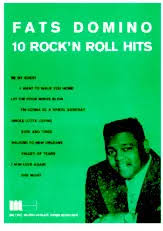
Fats Domino 10 Rock'N Roll Hits Songbook Piano Vocal Guitar Chords
Best Sheet Music download from our Library.
Contents List Download:
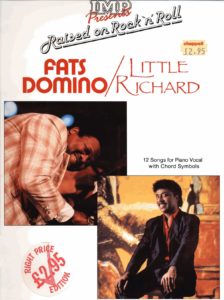
Contents List Download:
Please, subscribe to our Sheet Music Library.
If you are already a subscriber, please, check our NEW SCORES' page every month for new sheet music. THANK YOU!
The Fat Man: The Life and Enduring Legacy of Fats Domino
In the pantheon of rock and roll's founding fathers, few names resonate with the warm, foundational thump of Antoine Dominique Domino Jr., known to the world as Fats Domino. While Elvis Presley brought the hip-swiveling charisma, Chuck Berry the lyrical poetry of teenage life, and Little Richard the unbridled, shrieking chaos, Fats Domino provided the steady, joyous heartbeat. He was the rock of ages, a musical titan whose sound was a direct pipeline from the vibrant, multicultural crucible of New Orleans. With a gentle smile, a booming voice, and a left hand that could move mountains, Fats Domino didn't just play rock and roll; he defined a significant portion of its sonic vocabulary, bridging the gap between the rhythm and blues of the late 1940s and the global phenomenon that would sweep the world in the decades to follow. His story is one of immense talent, quiet consistency, and a sound so distinct and joyful that it remains instantly recognizable nearly three-quarters of a century after his first record.
Biography: From the Ninth Ward to the World
Antoine Domino Jr. was born on February 26, 1928, in a typical Creole cottage in the Lower Ninth Ward of New Orleans, Louisiana. He was the youngest of eight children born to a violin-playing father. The Ninth Ward was a fertile, working-class environment, steeped in the city's rich musical heritage. From an early age, Antoine was surrounded by sound—the street parades, the brass bands, the blues drifting from nearby clubs, and the boogie-woogie piano stylings that filled the air.
His musical initiation began in the family home, taught by his brother-in-law, the jazz guitarist Harrison Verrett. He learned to play by ear, a skill that would define his intuitive and profoundly rhythmic approach to music. By the age of ten, he was already playing piano for small gatherings. The family eventually acquired an old upright piano, and the young Antoine was inseparable from it. He was particularly drawn to the rolling, powerful piano styles of artists like Albert Ammons, Pete Johnson, and Meade Lux Lewis, as well as the sophisticated New Orleans sound of Professor Longhair.
Domino left school after the fourth grade to help support his family, taking on jobs delivering ice and working in a bedspring factory. By night, he was honing his craft, playing at local joints and honky-tonks under the name "Fats," a nickname he acquired for his hearty appetite and physique, which also paid homage to two of his piano heroes, Fats Waller and Fats Pichon. It was in one of these clubs, the Hideaway Club, that his life would change forever.
Browse in the Library:
Or browse in the categories menus & download the Library Catalog PDF:
In 1949, Lew Chudd, the founder of Imperial Records, was on a talent-scouting trip to New Orleans. He was taken to the Hideaway Club by a local DJ to hear a young pianist who was creating a local stir. Chudd was immediately captivated by Domino's powerful presence and unique sound. He signed him to a recording contract on the spot, a partnership that would yield some of the most important recordings in American popular music.
Fats Domino’s first recording session produced "The Fat Man," a song widely considered by many historians to be one of the very first rock and roll records. Based on the blues standard "Junker's Blues," Domino infused it with his signature rolling piano triplets, a pounding backbeat, and his distinctive, slurred vocal delivery, famously uttering the onomatopoeic "wah-wah" into the microphone. The song was a massive hit, reaching number two on the Billboard R&B charts and selling over a million copies, an astonishing feat for a debut.

From that point on, Fats Domino became a hit-making machine. Throughout the 1950s and into the early 1960s, he and his long-time musical partner, bandleader, and co-writer Dave Bartholomew crafted an unbroken string of classics at the legendary J&M Recording Studio on North Rampart Street. With the house band, a crack team of session aces that included the likes of saxophonist Lee Allen, drummer Earl Palmer, and bassist Frank Fields, they created the blueprint for the New Orleans sound. Hits like "Goin' Home," "Going to the River," "Please Don't Leave Me," "Blueberry Hill," "Blue Monday," "I'm Walkin'," and "Walking to New Orleans" followed in rapid succession.
While many of his contemporaries struggled with the cultural shifts and business pressures of the 1960s, Domino adapted gracefully. He continued to have hits, and his music remained popular. He famously turned down an offer from The Beatles to record one of his songs, preferring to stick to his own sound. In 1968, he appeared as a guest on The Tonight Show, where he was introduced by a clearly reverent John Lennon, who credited Domino as one of the true originators.
Fats Domino largely retired from active touring in the 1980s, choosing to remain in the Lower Ninth Ward, living in a large, pink, custom-designed house not far from where he grew up. He became a local landmark, content to live a quiet life, occasionally performing at local festivals and events. His legacy was cemented with his induction into the Rock and Roll Hall of Fame as a member of the inaugural class in 1986.
In 2005, Hurricane Katrina devastated New Orleans, and the Lower Ninth Ward was among the hardest-hit areas. For days, the world feared for the 77-year-old Domino, who had famously chosen to ride out the storm at home with his family. He was eventually rescued by a Coast Guard helicopter, and images of him being airlifted to safety became a powerful symbol of both the destruction and the resilient spirit of his beloved city. He lost his home and his many gold records to the floodwaters but, with the help of friends, fans, and the Tipitina's Foundation, he recovered. He lived out the rest of his life in a suburban New Orleans home until his death from natural causes on October 24, 2017, at the age of 89.
Music Style, Improvisational Licks, and Harmonic Simplicity
Fats Domino’s musical style was a study in powerful simplicity and infectious groove. It was a perfect synthesis of the major strands of New Orleans music: blues, boogie-woogie, and rhythm and blues.
The Piano Style: The Trifecta of Groove
The essence of Domino’s sound can be broken down into three core elements, all centered on his piano playing:
- The Left Hand: This was the engine room. Domino’s left hand was a powerhouse of rhythm, providing a relentless, rolling boogie-woogie bassline. He rarely deviated from a simple, repeating pattern that outlined the chords. This pattern, often a series of octaves or tenths (a stretch that became his signature), walked up and down the keyboard, creating a propulsive, danceable foundation that felt like a full rhythm section in itself.
- The Right Hand Triplets: This is the instantly recognizable "Fats Domino lick." His right hand would play a syncopated, bouncing pattern of eighth-note triplets on the off-beat, typically on a single note or a simple chord. This created a rhythmic counterpoint to the steady left-hand bassline, producing a rolling, tumbling effect that was both melodic and percussive. It was this triplet pattern, more than any other single element, that defined his sound.
- The Glissando: Domino loved to end a phrase or a song with a dramatic, sweeping glissando up the piano keys. It was a gesture of pure joy and showmanship, a sonic exclamation point that perfectly matched his easygoing personality.
Improvisational Licks:
Domino was not a virtuosic improviser in the jazz sense. His "licks" were not long, complex solos but rather short, rhythmic, and melodic motifs he would weave into the fabric of a song. These were often variations on his signature triplet pattern, or simple pentatonic blues runs. His genius lay not in harmonic complexity but in the feel. He could take a simple two or three-note phrase and, through impeccable timing and touch, make it swing with irresistible force. He would often double the vocal melody with his right hand, then break away for a two-bar fill based on those triplets before returning to the groove. The solos were more about rhythmic punctuation than harmonic exploration.
Chord Progressions and Harmony:
Harmonically, Fats Domino’s music was remarkably straightforward, drawing directly from the blues tradition.
- The 12-Bar Blues: A vast majority of his early hits, including "The Fat Man," "Goin' Home," and "Let the Four Winds Blow," are built on the standard 12-bar blues progression (I-IV-V). He rarely deviated from this structure, but his rhythmic drive and vocal delivery made it feel entirely new.
- The "New Orleans" or "Rhumba" Blues: Songs like "Blue Monday" and "I'm Walkin'" utilized a variation of the 12-bar blues with a slightly different feel, often incorporating a I-vi-IV-V progression or a Latin-tinged, rhumba-like rhythm that was popular in New Orleans. This gave the music a sophisticated, danceable shuffle that set it apart from the harder-edged blues of Chicago or the Delta.
- Simple Pop Structures: For his biggest crossover hit, "Blueberry Hill," he used the standard 32-bar AABA pop song format. However, even within this structure, he infused the piano with his signature bluesy triplets and fills, seamlessly blending pop melody with R&B grit.
His harmonic vocabulary was based on dominant 7th chords. The sound of a bluesy, dominant 7th chord ringing out from his piano was the core harmonic color of his entire catalogue. He rarely used complex extensions or alterations, preferring the raw, resonant power of the basic blues harmony.
Cooperation with Other Artists
Fats Domino’s career was defined by a remarkably stable and fruitful long-term partnership rather than a series of one-off collaborations.
- Dave Bartholomew: This was the most crucial collaboration of Domino's life. Bartholomew was a brilliant bandleader, trumpeter, composer, and arranger who acted as Domino's A&R man, co-writer, and producer at Imperial Records. While Domino provided the raw musical ideas and the unique piano and vocal style, Bartholomew was the architect who shaped those ideas into hit records. He wrote or co-wrote the vast majority of Domino's classics, arranged the horn lines, and managed the recording sessions. Their partnership was a perfect symbiosis of raw talent and refined musical craftsmanship.
- The J&M Recording Studio Band: This legendary group of session musicians, led by Bartholomew, was the third pillar of the Domino sound. The rhythm section of Earl Palmer on drums (often credited with inventing the backbeat on record) and Frank Fields on bass provided a swing and power that was unparalleled. The saxophone section, featuring the great Lee Allen and Red Tyler, delivered the bold, honking tenor sax solos and punchy riffs that were integral to hits like "I'm Walkin'" and "The Fat Man." This was not just a backing band; they were co-creators in the studio, and their collective chemistry was a key ingredient in the magic.
- Later Collaborations: In his later years, Domino was honored by numerous artists. He appeared in the documentary The History of Rock 'N' Roll, Vol. 1 and performed with artists like Ray Charles and Jerry Lee Lewis. While he didn't seek out high-profile duets, his influence was so profound that performing with the artists he inspired became a form of tribute in itself.
Influences and Legacy
Influences:
Fats Domino’s musical roots were deep in the soil of New Orleans. His primary influences included:
- Boogie-Woogie Pianists: The driving, eight-to-the-bar left-hand patterns of Albert Ammons, Meade Lux Lewis, and Pete Johnson were the direct antecedent to his own powerful basslines.
- New Orleans Pianists: He was heavily influenced by the intricate, rhythmic, and syncopated style of Professor Longhair, though he streamlined it into a more commercial and accessible sound. He also looked up to early New Orleans piano greats like Fats Pichon.
- Vocalists: His warm, mellow, and slightly slurred vocal style owed a debt to the smooth crooners of the day, particularly Billy Eckstine and Louis Armstrong, whose phrasing and gravelly charm can be heard in Domino's delivery.
- The Blues: The structure and emotional core of his music was the blues, filtered through the specific, festive lens of his hometown.
Legacy:
Fats Domino’s legacy is monumental and multifaceted.
- Pioneer of Rock and Roll: He was one of the primary architects of the genre. "The Fat Man" is a leading contender for the title of "first rock and roll record." He was one of the first black artists to achieve massive crossover success with white audiences, helping to break down racial barriers in the music industry of the 1950s.
- Defining a Regional Sound: More than anyone else, Fats Domino is responsible for bringing the New Orleans sound to the world. His records are the definitive expression of that city's rhythmic, celebratory musical spirit.
- Influence on Countless Musicians: His impact on subsequent generations of musicians is immeasurable. The Beatles (particularly Paul McCartney) adored him. John Lennon recorded a version of "Ain't That a Shame." Elton John built his entire early piano style on Domino's foundation. Dr. John, Robert Plant, and countless others have cited him as a primary influence. His simple, powerful approach showed generations of musicians that a great song and a great groove were more important than technical flash.
- Symbol of Resilience: His survival of Hurricane Katrina and the dignified way he faced the loss of his home and possessions added a poignant final chapter to his life, cementing his status not just as a musical icon but as a symbol of the unbreakable spirit of New Orleans.
Works, Discography, and Most Known Compositions
Fats Domino’s discography is a treasure trove of American popular music. He had 35 Top 40 hits on the Billboard Hot 100, a staggering number for an R&B artist of his era. His most famous works include:
Most Known Compositions and Performances:
- "The Fat Man" (1949): His groundbreaking debut and a foundational document of rock and roll.
- "Ain't That a Shame" (1955): A massive hit that crossed over to the pop charts, famously covered by Pat Boone, though Domino's original version is the definitive one.
- "Blueberry Hill" (1956): His signature song and biggest hit. A cover of a 1940s pop standard, Domino transformed it into a timeless rock and roll classic with his emotive vocal and rolling piano.
- "Blue Monday" (1956): A classic rhythm and blues shuffle with a clever lyric about the work week.
- "I'm Walkin'" (1957): An upbeat, walking bassline-driven hit that showcased his more playful side. It was later famously covered by Ricky Nelson.
- "Whole Lotta Loving" (1958): A high-energy, prototypical rock and roll track.
- "I Want to Walk You Home" (1959): A sweet, doo-wop influenced ballad.
- "Walking to New Orleans" (1960): A beautiful, nostalgic tribute to his hometown and one of his last major hits. It displayed a more mature, sentimental side of his songwriting.
Selected Discography (Studio Albums):
- Carry On Rockin' (1955, later reissued as Rock and Rollin' with Fats Domino)
- Fats Domino – Swings (1959)
- …A Lot of Dominos (1960)
- I Miss You So (1961)
- Let's Play Fats Domino (1962)
- Here Comes Fats Domino (1963)
- Fats Is Back (1968) – His notable comeback album recorded in Los Angeles.
Filmography
While Fats Domino was not a prolific actor, his appearances in early rock and roll films helped solidify his image and bring his music to a wider audience. His most notable film appearances include:
- The Girl Can't Help It (1956): This classic rock and roll movie featured a memorable cameo of Domino performing "Blue Monday" in a nightclub. He also sang the title track. His performance is a highlight of the film, capturing his easygoing stage presence perfectly.
- Jamboree (1957): Also known as Disc Jockey Jamboree, this film featured Domino performing "I'm Walkin'."
- The Big Beat (1958): He appeared in this musical film, performing "I'm in the Mood for Love."
- Shake, Rattle & Rock! (1994): A television movie about the early days of rock and roll, in which he made a cameo appearance.
Fats Domino was far more than just a hit-maker. He was a cultural force, a musical innovator, and a beloved figure whose work provided the soundtrack to a generation's coming of age. His legacy is not just in the records he sold or the charts he topped, but in the indelible groove he carved into the foundation of popular music. When you hear that rolling piano triplet and that warm, unhurried voice, you are hearing the sound of joy itself—a sound that will forever echo from the bayous of New Orleans to the far corners of the world.