
Community Musicians, building a worldwide Community Music.
Scores
for all instruments: 15,000+
(active and growing),
over 231,000 pages.
All genres and levels: Jazz & Blues, Rock & Pop, Classical & Contemporary, Film & Musicals;
books & biographies; methods, études, play-along tracks (MP3) for Jazz & Rock.
Access & benefits: US$15.99 one-time payment, valid for lifetime, full Library access.
Table of Contents
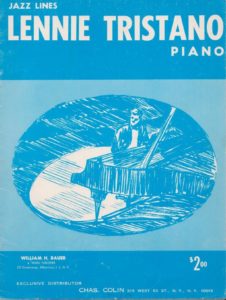
Remembering Lennie Tristano, born on this day in 1919.

Best Sheet Music download from our Library.
Please, subscribe to our Sheet Music Library.
If you are already a subscriber, please, check our NEW SCORES' page every month for new sheet music. THANK YOU!
Lennie Tristano: The Blind Visionary Who Reshaped Jazz
On March 19, 1919, a figure was born who would become one of jazz's most enigmatic and influential innovators. Lennie Tristano, who entered the world in Chicago on this day 106 years ago, remains a paradoxical presence in jazz history—a musician revered by cognoscenti yet relatively unknown to the general public, a blind pianist who saw more clearly than most where jazz could go, and a demanding teacher whose students became some of the most distinctive voices in the music .
Early Life: Forging a Musical Identity in Darkness
Leonard Joseph Tristano was born during the devastating Spanish influenza pandemic, a circumstance that may have contributed to his congenital weak eyesight . A bout with measles at age six exacerbated his condition, and by age nine or ten, glaucoma had rendered him completely blind . Yet from this darkness emerged an extraordinary musical light.
Young Lennie demonstrated remarkable precocity, picking out melodies on the family player piano at just two or three years old . He began formal classical piano lessons at eight, though he would later express ambivalence about their value, suggesting they may have hindered as much as helped his natural development .
From around 1928, Tristano attended the Illinois School for the Blind in Jacksonville for a decade, an experience that proved formative in unexpected ways . During these years, he displayed the instrumental versatility that would later inform his teaching—mastering not only piano but saxophones, trumpet, guitar, clarinet, and drums . At eleven, he had his first professional gigs, playing clarinet in a brothel—an early introduction to the reality of making music for a living .
Tristano pursued formal musical education at Chicago's American Conservatory of Music from 1938 through 1943, earning a bachelor's degree in performance and completing additional graduate studies . His classical training gave him deep familiarity with Bach's counterpoint, which would profoundly influence his approach to jazz improvisation. His aunt Rose assisted by taking notes for him during his university studies, enabling him to navigate the academic environment despite his blindness .
The Chicago Years: First Steps as a Performer and Teacher
The early 1940s found Tristano playing tenor saxophone and piano for various engagements, including stints in a rumba band . He began teaching privately during this period, counting among his first students a sixteen-year-old alto saxophonist named Lee Konitz—the beginning of a lifelong musical relationship . From 1943, he also taught at the Axel Christensen School of Popular Music .
Tristano first garnered press attention in 1944, appearing in Metronome magazine's survey of Chicago's music scene, followed by Down Beat coverage in 1945 . His first recordings came in 1945 with members of Woody Herman's band, tracks that already displayed his signature characteristics—extended harmonies, fleet single-note runs, and sophisticated block chords . He also recorded solo piano pieces that same year .
In 1945, Tristano married Judy Moore, a singer who performed with his piano accompaniment in Chicago's mid-1940s clubs . The marriage would eventually end, but his daughter Carol would later become an important guardian of his legacy, contributing liner notes to posthumous releases .
New York and the Birth of the Tristano School
In 1946, Tristano made the crucial move to New York City, settling initially in Freeport, Long Island . There he formed a trio with bassist Arnold Fishkin and guitarist Billy Bauer, a group that immediately attracted attention for its innovative approach. Critic Barry Ulanov would later describe their recording "Out on a Limb" as heralding a "luminous new era in jazz," praising the long, intertwining lines, studied continuity, and improvised counterpoint that occasionally approached atonality .
That same year, Tristano met Charlie Parker, beginning a mutual admiration that would yield some fascinating if sparse recorded documentation . They played together in bands alongside Dizzy Gillespie and Max Roach for radio broadcasts in 1947 . Parker reportedly appreciated Tristano's originality—the fact that his playing didn't merely copy Parker's own style .
A notable 1947 radio broadcast pitted representatives of "old jazz" against "new jazz," with Tristano, Parker, Gillespie, and others decisively winning the battle of ideas . That same year, readers of Metronome voted Tristano "Musician of the Year," and he contributed two theoretical articles to the magazine: "What's Right With the Beboppers" and "What's Wrong With the Beboppers" .
By 1948, Tristano had added Konitz to his working band, forming a quintet, and soon after added another saxophonist student, Warne Marsh, creating the sextet that would make history .
The Revolutionary 1949 Recordings
The year 1949 stands as perhaps the most significant in Tristano's recorded legacy. In January, he participated in a Metronome All-Stars session with an extraordinary lineup including Parker, Gillespie, Fats Navarro, Miles Davis, J.J. Johnson, Kai Winding, and Shelly Manne . Two tracks from that session, "Overtime" and "Victory Ball," featured Tristano compositions .
More importantly, also in January, Tristano led sessions for the Prestige label featuring Konitz, Bauer, Fishkin, and Manne. Tracks like Konitz's "Subconscious Lee" (named for Konitz's nickname, given by Miles Davis for his effortless improvisational ability) and "Tautology" showcased the Tristano aesthetic in full flower .
Then came the legendary Capitol sessions between March and May 1949. With the sextet now including Marsh alongside Konitz and Bauer, Tristano recorded compositions that would become cornerstones of his legacy: "Crosscurrents," "Wow," and others . These pieces demonstrated what critic Barry Ulanov called "a new luminous era in jazz"—long, contrapuntal lines, harmonic sophistication, and a rhythmic approach distinct from bebop .
On May 16, 1949, Tristano and his musicians recorded two tracks that would secure his place in jazz history: "Intuition" and "Digression" . These were the first documented examples of free group improvisation in jazz—performances with no predetermined harmony, key, time signature, tempo, melody, or rhythm . The musicians were held together only by contrapuntal interaction and a rough plan of when each would enter .
These recordings predated Ornette Coleman's free jazz experiments by nearly a decade, yet they emerged from a different conceptual framework. As Tristano student Lenny Popkin explained, "It's free harmony, but it's harmony. That's where I distinguish between Tristano's free jazz and what was later called free jazz—musicians most often blowing each in his own direction. With Lennie, harmony, melody, and rhythm have equal importance, as does the communion of spirit between musicians. They're playing the same elements as people playing standards" .
Despite their historic importance, the tracks faced delayed release—"Intuition" came out in late 1950, "Digression" not until 1954 . Many musicians found Tristano's music too progressive and emotionally cold, predicting public indifference . Yet Parker and composer Aaron Copland were impressed.
Lennie Tristano - Lullaby of the Leaves (Copenhagen 1965)
Musical Style: The Architecture of Improvisation
Tristano's musical style represents one of the most distinctive and rigorously conceived approaches in jazz. At its core lay a paradox: music of immense intellectual sophistication that aimed for spontaneity and emotional directness .
Harmonic Conception: Tristano extended bebop's harmonic language while simultaneously seeking ways to move beyond chord-based improvisation. His harmonic approach featured extended chords, chromatic substitutions, and a fluid approach to tonality that sometimes approached atonality . Tracks like "C Minor Complex" (from The New Tristano) demonstrate his ability to imply complex harmonic motion through single melodic lines, with critic Stuart Nicholson identifying it as a minor-key contrafact of "You'd Be So Nice to Come Home To" .
Linear Improvisation: Perhaps Tristano's most distinctive contribution was his conception of melodic line. Drawing on Bach's counterpoint, he developed long, architecturally coherent melodic lines that maintained their logic over extended durations . These lines often moved independently of the rhythm section's punctuation, creating a floating quality that distinguished his music from the more phrase-based approach of bebop .
Rhythmic Conception: Tristano favored an evenly stated, unaccented rhythm section accompaniment that provided a flowing backdrop for his linear explorations . He maintained the eighth-note drive of the swing era while incorporating bebop's harmonic sophistication . His later solo recordings, particularly The New Tristano (1960-62), feature remarkable polyrhythmic complexity, with left-hand walking bass lines providing structure while right-hand lines pull against the beat with sophisticated rhythmic displacement .
Emotional Quality: Critics have often described Tristano's music as "cool" or emotionally detached . Yet this characterization misses the passionate quest for pure lyricism that animates his best work . Tracks like "Requiem," his tribute to Charlie Parker, reveal deep blues feeling—a side of Tristano often overlooked . The Penguin Guide to Jazz suggests that ballads like "You Don't Know What Love Is" from The New Tristano "suggest a world of expression which jazz has seldom looked at since" .
The Best Songs and Compositions
Tristano's recorded legacy, though relatively small in quantity, contains numerous essential works:
"Crosscurrents" (1949): This classic composition exemplifies Tristano's intricate harmonic structures and the tight ensemble interplay of his sextet. The melody unfolds in unison between saxophones and piano, showcasing Tristano's virtuosic touch and innovative phrasing .
"Wow" (1949): An experimental masterpiece incorporating elements of free improvisation and dissonant harmonies. The piece opens with a repeated unison figure that gradually fragments into angular, unpredictable lines .
"Intuition" (1949): The historic first recorded free improvisation, demonstrating that collective spontaneity could produce coherent musical structure without predetermined frameworks .
"Subconscious Lee" (1949): Named for Lee Konitz, this contrafact became a jazz standard, its intricate melody and advanced harmonic structure reflecting Tristano's teaching .
"Descent into the Maelstrom" (1953): A stunning solo piano piece inspired by Edgar Allan Poe's story, this atonal improvisation used multitracking and motif development rather than harmonic structure to generate form—anticipating Cecil Taylor and others by years .
"Line Up" and "East Thirty-Second" (1955): These tracks from the Lennie Tristano album featured Tristano improvising over pre-recorded bass and drum tracks, with tape speed manipulation giving his lines astonishing density .
"Turkish Mambo" (1955): A remarkable polyrhythmic exploration interweaving measures in 7/8, 7/4, 5/8, 5/4, and 3/4—a fusion of jazz with Middle Eastern rhythmic concepts .
"Requiem" (1955): Tristano's tribute to Charlie Parker, opening with a Schumann-esque prelude before settling into an emotionally charged blues .
"C Minor Complex" (1962): From The New Tristano, this tour de force features Tristano alone, his left hand walking a single-note bass line while his right hand explores complex melodic territory, shifting between single lines and block chords .
"G Minor Complex" (1962): Another solo masterpiece, based on the changes of "You'd Be So Nice to Come Home To" but transformed through Tristano's harmonic and rhythmic imagination.
Browse in the Library:
Or browse in the categories menus & download the Library Catalog PDF:
Collaborations with Jazz Greats
Though Tristano maintained a relatively insular musical world centered on his students, he collaborated with many of jazz's greatest figures:
Charlie Parker: The mutual admiration between Tristano and Parker produced several recordings, including fascinating 1951 duo recordings made at Tristano's home—the only known recordings of Parker playing "I Can't Believe That You're in Love with Me" and his sole complete version of "All of Me" . These intimate duets capture two giants in conversation.
Dizzy Gillespie, Miles Davis, Fats Navarro: Tristano participated in several all-star sessions featuring these trumpet legends, including the 1947 broadcasts and 1949 Metronome All-Stars dates .
Sarah Vaughan: The great singer joined Tristano and others for a November 1947 session featuring "Everything I Have Is Yours" .
Lee Konitz and Warne Marsh: These saxophonists were Tristano's most important musical disciples. Konitz, who first studied with Tristano at sixteen, became one of the most distinctive alto voices in jazz, maintaining his Tristano-derived linear approach throughout a long career . Marsh developed a similarly distinctive tenor saxophone voice, exploring Tristano's concepts with remarkable depth .
Billy Bauer: The guitarist was Tristano's essential partner in developing contrapuntal interplay, their lines intertwining with Bach-like complexity .
Peter Ind: The bassist became an important Tristano collaborator and documentarian, participating in the overdubbed "Ju-ju" and "Pastime" sessions of 1951—the first overdubbed improvised jazz recordings .
The Teacher: Spreading the Vision
By the mid-1950s, Tristano increasingly focused on teaching, running a school of jazz from 1951 to 1956 and teaching privately thereafter . His teaching was unusually structured and disciplined for jazz education at the time, reflecting his belief that improvisation could be systematically taught .
Tristano's students included not only Konitz and Marsh but also saxophonists Lenny Popkin, Sal Mosca, and countless others who carried his ideas forward . His teaching emphasized ear training, rhythmic precision, and the development of long melodic lines. He encouraged students to sing their improvisations before playing them, internalizing the music before touching their instruments.
His influence extended through his students' students, creating what some have called the "Tristano school"—a lineage of musicians who maintain his focus on linear improvisation, contrapuntal interaction, and emotional directness achieved through technical mastery.
Technological Innovation
Tristano was remarkably forward-thinking in his use of recording technology. In 1951, he converted part of his Manhattan loft (at 317 East 32nd Street, commemorated in his composition "East Thirty-Second") into a recording studio . There he created the first overdubbed improvised jazz recordings—"Ju-ju" and "Pastime"—adding second piano parts to trio tracks .
His 1955 Atlantic album Lennie Tristano contained further experiments: "Line Up" and "East Thirty-Second" used tape speed manipulation, with Tristano improvising over pre-recorded rhythm tracks at slowed speeds, then speeding the tape for final release to achieve extraordinary density . "Turkish Mambo" explored polyrhythmic possibilities through re-recording .
These experiments proved controversial. Critics accused Tristano of cheating, and when The New Tristano appeared in 1962, its cover explicitly stated: "No use is made of multi-tracking, overdubbing, or tape-speeding on any selection" . Yet Tristano's technological explorations anticipated practices that would become commonplace in subsequent decades.
Later Years and Gradual Withdrawal
After the burst of activity in the 1940s and early 1950s, Tristano gradually withdrew from public performance. He played at the first Newport Jazz Festival in 1954, though he generally avoided festivals, considering them too commercial . His last public appearance in the United States came in 1968 .
He continued teaching privately and recording sporadically in his studio. The New Tristano (1962) proved his final major statement, a remarkable solo album that distilled his lifetime of musical investigation into seven tracks . Pianist Alan Broadbent would later call it "the greatest solo jazz piano album bar none" .
Tristano remained critical of jazz's evolution during the 1960s, maintaining that his own modernity derived from knowledge and application of musical fundamentals rather than mere rejection of tradition . When asked about his absence from recording studios, he explained: "A record of mine today would be a big commercial flop, given that I have no intention of prostituting myself" .
Lennie Tristano died in New York City on November 18, 1978, at age 59 .
Filmography and Media Appearances
Tristano's recorded output for film and television is sparse, reflecting his withdrawal from commercial venues. However, his music has found its way into notable contexts:
His performance of "You Go to My Head" was featured in the acclaimed HBO series The Sopranos, introducing his music to a new generation . The track appears on the Lennie Tristano Personal Recordings 1946-1970 box set, which collects previously unreleased live and studio performances .
The 2022 Mosaic/Dot Time box set represents the most comprehensive Tristano release to date, featuring six discs of material spanning his entire career, with extensive notes by his daughter Carol and saxophonist Lenny Popkin .
Legacy and Influence
Assessing Tristano's legacy remains complex. Some critics continue to describe his music as cold and question his impact . Others view him as a crucial bridge between bebop and later developments, a figure whose importance is underappreciated because his work resists easy categorization .
His influence operates on multiple levels:
As Pioneer: Tristano's 1949 free improvisations anticipated Ornette Coleman and the free jazz movement by nearly a decade . His atonal explorations in "Descent into the Maelstrom" (1953) pointed toward Cecil Taylor and others . His overdubbing experiments predicted studio techniques that would become standard.
As Educator: Through students like Konitz, Marsh, and their descendants, Tristano's ideas about linear improvisation, rhythmic precision, and contrapuntal interaction continue to circulate in jazz. His emphasis on systematic improvisation instruction helped lay groundwork for jazz education.
As Alternative Voice: Tristano offered a genuine alternative to bebop's dominant paradigm—a music with bebop's harmonic sophistication but a different rhythmic feel, different priorities, different emotional register . He demonstrated that jazz could develop along multiple paths simultaneously.
As Complete Musician: Tristano embodied the ideal of the musician as complete artist—performer, composer, improviser, teacher, theorist, and technological innovator all in one. His refusal to compromise his vision, even at the cost of commercial success, stands as an example of artistic integrity.
The Penguin Guide to Jazz perhaps best captured his achievement: "Howsoever the conjoining of technique, interpretation and feeling may work for the listener, this is remarkable piano jazz, and the contrasting ballads… suggest a world of expression which jazz has seldom looked at since" .
On what would have been his 106th birthday, Lennie Tristano remains what he always was—a musician's musician, a teacher's teacher, a visionary whose blindness allowed him to see possibilities others missed. His music, small in quantity but immense in implication, continues to reward those willing to enter its carefully constructed world. In an art form often driven by fashion and commerce, Tristano stands as a reminder that the deepest innovations sometimes come from those who turn away from the crowd to follow their own internal light.