Table of Contents
Samuel Barber – Agnus Dei (Piano Solo sheet music)
Search Bach’s best sheet music, books, and transcriptions in the Library:
| Artist or Composer / Score name | Cover or sample |
|---|---|
| Barber – Agnus Dei Op. 11 (full score transcribed for mixed Chorus with Organ or Piano Accompaniment) |  |
| Barber – Samuel Barber The Composer And His Music (1992) by Barbara B. Heyman (Biography) | 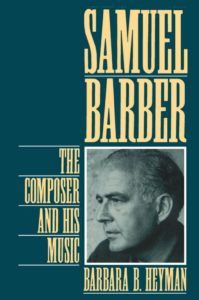 |
| Barber Samuel 3 Songs for voice and piano |  |
| Barber Samuel Barber 65 Songs Piano and High Voice Edition |  |
| Barber Summer Music Full Score For Woodwind Quintet |  |
| Barber Violin Concerto (Violin and Piano sheet music) |  |
| Barber Violin Concerto (Violin part sheet music) |  |
| Barber_Violin_Concerto.mscz.mscz | |
| Barber, Samuel Cello Concerto (Cello Part) |  |
| Barber, Samuel Sonata For Piano, Op.26 | 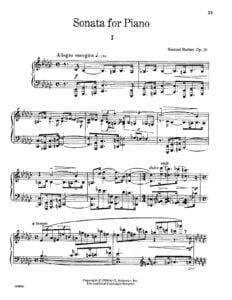 |
| Barber, Samuel – Sure On This Shining Night for Piano and SATB |  |
| Barber, Samuel – Adagio for Strings Op. 11 Agnus Dei (solo piano arr.) |  |
| Barber, Samuel – Four Songs – Nocturne |  |
| Barber, Samuel – Four Songs – A Nun takes the Veil |  |
| Barber, Samuel – Four Songs The Secrets of the Old |  |
| Barber, Samuel – Summer Music |  |
| Barber, Samuel Adagio for Strings full score | Samuel Barber-Adagio for Strings full score |
| Barber, Samuel Adagio For Strings Samuel Barber (Musescore File).mscz | |
| Barber, Samuel Agnus Dei Adagio for strings op. 11 for mixed chorus | |
| Barber, Samuel Nocturne Op. 33 |  |
Please, subscribe to our Sheet Music Library.
If you are already a subscriber, please, check our NEW SCORES’ page every month for new sheet music. THANK YOU!
Best Sheet Music download from our Library.
Community Musicians, building a worldwide Community Music.
Scores
for all instruments: 15,000+
(active and growing),
over 231,000 pages.
All genres and levels: Jazz & Blues, Rock & Pop, Classical & Contemporary, Film & Musicals;
books & biographies; methods, études, play-along tracks (MP3) for Jazz & Rock.
Access & benefits: US$15.99 one-time payment, valid for lifetime, full Library access.
Samuel Barber (1910-1981)
Who was Samuel Barber?
Samuel Barber: The Romantic Soul of American Music
Samuel Osborne Barber II (March 9, 1910 – January 23, 1981) stands as one of the most significant and beloved American composers of the 20th century. In an era defined by rapid stylistic change, atonality, and intellectual experimentation, Barber remained a steadfast voice of lyrical Romanticism. His music, characterized by its poignant melodies, masterful orchestration, and deep emotional resonance, forged a path that was both deeply personal and universally accessible. While his career was marked by critical acclaim and prestigious awards, it also witnessed the fluctuating tides of musical fashion, making his enduring popularity a testament to the sheer power and beauty of his craft.
Biography: A Prodigy's Path
Samuel Barber was born in West Chester, Pennsylvania, into a comfortable and culturally supportive family. His father, a physician, and his mother, a pianist, recognized his extraordinary musical gifts early on. At the age of six, he began composing, and by nine, he was attempting to write an opera. A pivotal moment came in 1924 when, at just 14, he became a founding student of the newly established Curtis Institute of Music in Philadelphia. There, he engaged in a triple-threat curriculum, studying piano, voice, and composition. His composition teachers were Rosario Scalero and the eminent Italian composer Gian Carlo Menotti, who would become Barber's lifelong partner and most important artistic collaborator.
The relationship with Menotti, which began at Curtis, was profound and lasting, both personally and professionally. They lived together for over 40 years, first in a small house in New York and later at "Capricorn," a legendary estate in Mount Kisco, New York. This home became a salon for the great artistic minds of the mid-20th century, fostering a creative environment that was central to Barber's work.
Barber's early career was one of astonishing success. Unlike many composers who struggle for recognition, his music was championed by major conductors and performers from the outset. Arturo Toscanini, the most celebrated conductor of the era, premiered his Adagio for Strings (the string orchestra arrangement of the second movement of his String Quartet, Op. 11) and the Essay for Orchestra No. 1 in 1938 with the NBC Symphony Orchestra. This single performance catapulted the 28-year-old Barber to international fame. The Adagio, with its searing, long-breathed melodic line, became an instant classic and remains his most iconic work.
He continued to produce a stream of masterpieces throughout the 1940s and 50s, including the Violin Concerto (1939), the ballet Medea (1946), the Pulitzer Prize-winning opera Vanessa (1957), and his stunning Piano Concerto (1962), for which he won his second Pulitzer Prize. This period represented the peak of his public acclaim.
However, the 1960s and 70s brought personal and professional challenges. The avant-garde, led by figures like Pierre Boulez and Karlheinz Stockhausen, became the dominant force in academic and critical circles. Barber's lush, tonal, and emotional style was increasingly viewed as anachronistic. This critical neglect, compounded by heavy drinking, depression, and the painful end of his relationship with Menotti in the early 1970s, took a heavy toll on his creativity.
His late works, such as the masterful The Lovers (1971) and the Third Essay for Orchestra (1978), are deeply felt but were composed with increasing difficulty and were met with mixed reviews. Samuel Barber died of cancer in 1981 at the age of 70, a somewhat diminished figure in the eyes of the critical establishment but beloved by audiences and fellow musicians. In the decades since his death, his reputation has undergone a major revival, and he is now securely enshrined as a cornerstone of 20th-century American music.
Music Style, Harmony, and "Improvisational Licks"
Barber's musical style is a sophisticated synthesis of European Romanticism and 20th-century American vitality. His primary allegiance was to melody. A Barber melody is instantly recognizable: it is long, lyrical, arching, and often achingly expressive. This vocal quality is no accident, stemming from his own beautiful baritone voice and his deep understanding of the human voice's capabilities.
Harmony and Chord Progressions
Barber's harmonic language is the bedrock of his expressive power. While firmly rooted in tonality, he expanded it with rich chromaticism, modal inflections, and moments of biting dissonance that always serve the dramatic or emotional arc of the music, never existing for their own sake. His approach is often described as "dissonant tonality"—the harmony may wander through remote keys and employ complex chords, but a tonal center, and the emotional gravity it provides, is almost always felt.
Consider the Adagio for Strings. Its power lies in its deceptively simple harmonic structure. It begins with a slow, stepwise ascent in the first violins over a sustained B-flat minor chord. The harmony moves with a slow, inexorable logic, often using suspensions and chromatic alterations to build unbearable tension. The famous climax is achieved through a sequence of secondary dominants and a poignant Neapolitan sixth chord, creating a moment of profound catharsis before the long, slow resolution back to the tonic. This is not harmonic innovation for its own sake, but harmonic drama of the highest order.
In his Piano Concerto, Op. 38, we see a more modern, muscular side. The first movement's main theme is built on a pentatonic scale, but the accompanying harmony is acerbic and percussive, featuring planing chords and dissonant clusters that owe a debt to Prokofiev and Bartók. Yet, the slow movement, a sweeping Canzone, returns to his lyrical heart, with long, arching melodies over lush, romantic harmonies. The final movement is a virtuosic, motoric Allegro molto that juxtaposes wild, jazzy syncopations with passages of stark, almost atonal, polytonality, before resolving triumphantly in a blaze of C major.
On "Improvisational Licks"
While Barber was a meticulous craftsman who notated every detail of his scores, the quality of "improvisational licks" is a fascinating lens through which to view his music. The term is more readily associated with jazz, but it captures an essential quality of Barber's best work: a feeling of spontaneity, of a melody being spun out in real-time, as if the composer were improvising at the piano or singing a newly discovered tune. This is particularly evident in the soloistic, cadenza-like passages in his concertos. The finale of the Violin Concerto, a perpetual motion moto perpetuo, feels like a single, brilliant, improvised flight of fancy. Similarly, the solo piano writing in his Nocturne (Homage to John Field), Op. 33, has an intimate, rhapsodic quality, as if Barber is gently improvising on a beloved theme. This ability to make highly crafted art sound utterly natural and spontaneous is a hallmark of his genius.
Collaborations with Other Artists
Barber's career was inextricably linked with the performers who inspired and championed his work.
- Gian Carlo Menotti: The most significant collaboration of his life was not just personal but artistic. They were each other's first and most trusted critics. Menotti wrote the libretti for Barber's two major operas, the Pulitzer-winning Vanessa and the chamber opera A Hand of Bridge. Menotti's theatrical instincts were a perfect complement to Barber's musical drama.
- Arturo Toscanini: The legendary conductor's endorsement in 1938 was the making of Barber's international career. While Toscanini famously returned the scores to Barber saying he would not learn new music, he ultimately did, and his performances of the Adagio and First Essay set a standard for their interpretation.
- Vladimir Horowitz and the Clefs: Barber's Piano Sonata, Op. 26 (1949) was commissioned by the League of Composers and Irving Berlin, and its fiendishly difficult final fugue was championed by Vladimir Horowitz, who gave the first performance. The piece remains a cornerstone of 20th-century piano repertoire. His Cello Sonata, Op. 6 (1932) was written for the cellist Raya Garbousova, and his later Cello Concerto, Op. 22 (1945) was commissioned by the Russian-American cellist Gregor Piatigorsky.
- Martha Graham: Barber's ballet score Medea (originally titled The Serpent Heart) was a major collaboration with the pioneering modern dancer and choreographer Martha Graham. The music, later arranged as the suite Medea's Meditation and Dance of Vengeance, perfectly captures the primal Greek tragedy.
- Eleanor Steber and Leontyne Price: His operas and songs were brought to life by the great singers of his day. Soprano Eleanor Steber created the role of Vanessa, and Leontyne Price became a legendary interpreter of Cleopatra in his opera Antony and Cleopatra, which was commissioned for the opening of the new Metropolitan Opera House at Lincoln Center in 1966.
Influences and Legacy
Barber was a musical synthesis, not a revolutionary. His influences were broad and deeply digested. The soaring lyricism of Puccini and the rich chromaticism of Wagner are palpable in his operas. The symphonic structures of Brahms and the orchestral color of Ravel are evident in his orchestral works. The folk-inspired modality and astringency of Bartók and the motoric rhythms of Prokofiev can be heard in his more muscular pieces, like the Piano Concerto. From his fellow Americans, he absorbed a certain open-air spaciousness, reminiscent of Aaron Copland, though Barber's idiom was always more overtly European in its emotional expression.
Barber's legacy is unique. For decades after his death, his music was sometimes dismissed by academics for not being "progressive" enough. However, he never courted fashion; he followed his own muse. His legacy rests on a body of work of consistently high quality that speaks directly to the human heart. He proved that technical mastery and emotional directness are not mutually exclusive. He is a composer's composer for his flawless craft and a listener's composer for his profound beauty. His influence can be heard in later composers who value tonality and lyricism, such as John Corigliano, Jennifer Higdon, and even in the more lyrical moments of film composers like John Williams.
Selected Works
Orchestral
- Adagio for Strings, Op. 11 (1936/38)
- Violin Concerto, Op. 14 (1939)
- Essays for Orchestra (No. 1, Op. 12, 1937; No. 2, Op. 17, 1942; No. 3, Op. 47, 1978)
- Symphony No. 1, Op. 9 (1936, rev. 1943)
- Capricorn Concerto, Op. 21 (1944) (for flute, oboe, trumpet, and strings)
- Medea's Meditation and Dance of Vengeance, Op. 23a (1955)
- Piano Concerto, Op. 38 (1962)
- Cello Concerto, Op. 22 (1945)
Opera
- Vanessa, Op. 32 (1957)
- A Hand of Bridge, Op. 35 (1959) (chamber opera)
- Antony and Cleopatra, Op. 40 (1966, rev. 1975)
Choral
- Dover Beach, Op. 3 (1931) (for voice and string quartet)
- Reincarnations, Op. 16 (1940) (for mixed chorus)
- Agnus Dei (1967) (the composer's own arrangement of the Adagio for Strings for mixed chorus)
Vocal and Piano
- Knoxville: Summer of 1915, Op. 24 (1947) (for soprano and orchestra)
- Hermit Songs, Op. 29 (1953) (song cycle)
- Numerous individual songs, including "The Daisies," "Sure on this Shining Night," and "Rain Has Fallen"
Chamber and Piano
- String Quartet, Op. 11 (1936) (contains the Adagio)
- Cello Sonata, Op. 6 (1932)
- Piano Sonata, Op. 26 (1949)
- Excursions, Op. 20 (1944) (for piano)
- Summer Music, Op. 31 (1956) (for wind quintet)
Filmography
Barber composed no original film scores. However, his pre-existing music has been used to profound effect in cinema, most famously:
- The Elephant Man (1980): David Lynch's use of the Adagio for Strings gives the film much of its tragic, ethereal beauty.
- Platoon (1986): Oliver Stone's use of the Adagio in the film's most devastating moments forever associated the piece with the tragedy and trauma of the Vietnam War, introducing it to a new generation.
Discography (A Brief Guide)
Barber's music has been recorded extensively. Key recordings include:
- Leonard Slatkin / St. Louis Symphony Orchestra (RCA Victor): An essential collection of the major orchestral works, including the symphonies, essays, and concertos.
- Thomas Schippers / New York Philharmonic (various labels): Schippers was a close associate of Barber and led the premiere of Antony and Cleopatra. His recording of the Piano Concerto with John Browning (for whom it was written) is the definitive version.
- Leontyne Price (RCA Victor): Her recordings of scenes from Antony and Cleopatra and the Hermit Songs are legendary.
- Emerson String Quartet (Deutsche Grammophon): A superb recording of the String Quartet and other chamber works.
- John Browning (RCA Victor): The definitive recording of the Piano Concerto under Schippers, as well as the Piano Sonata.
Most Known Compositions and Performances
Without question, Samuel Barber's most famous composition is the Adagio for Strings. Its performance at the funerals of Albert Einstein, Grace Kelly, and Franklin D. Roosevelt, and its use in major films, has cemented its status as America's unofficial elegy. Following closely is his lush and lyrical Violin Concerto, a staple of the virtuoso repertoire. The Piano Concerto, with its formidable technical demands and emotional range, and the song cycle Knoxville: Summer of 1915, a rapturous setting of James Agee's prose, are also cornerstones of his legacy. The operas Vanessa and the revised version of Antony and Cleopatra have seen successful revivals in recent years, affirming his place in the operatic canon.
Samuel Barber's music is a testament to the enduring power of beauty and emotion. In a century of "isms" and manifestos, he simply wrote music that was honest, crafted with impeccable skill, and filled with a profound sense of humanity. That is his ultimate and lasting legacy.