
| Community Musicians, building a worldwide Community Music. | |
| All the music you want to play on one site. Sharing the world’s best Contemporary, jazz, Popular, and classical Sheet Music for all instruments. | |
| Scores: >15,000 (active and growing every day), over 231,000 pages All genres and Categories: Jazz & Blues, Rock & Pop, classical & contemporary, film & musicals’ scores; books & biographies; methods, études, and exercises; play along background tracks (MP3), audios & PDFs for Jazz & Rock Access and benefits: Subscription fee: $15.99 one-time payment, valid for lifetime (secure Payment via Paypal, or Stripe) How to join the Sheet Music Library 🔍 Search in the Library Catalog — FAQs — Join us |
Table of Contents
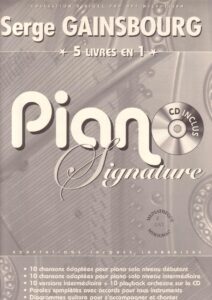
Remembering Serge Gainsbourg, born on this day in 1928.
Best Sheet Music download from our Library.

Please, subscribe to our Sheet Music Library.
If you are already a subscriber, please, check our NEW SCORES’ page every month for new sheet music. THANK YOU!
The Enigmatic and Enduring Genius of Serge Gainsbourg
Today, on April 2nd, 2026, we remember the birth of Serge Gainsbourg, a man who was as much a national monument as a controversial firebrand. If he were alive today, the French poet, singer, composer, provocateur, and cultural lightning rod would be 98 years old. Born Lucien Ginsburg in Paris in 1928 to Russian-Jewish parents who had fled the Bolshevik Revolution, Gainsbourg transcended his origins to become one of the most important and polarizing figures in modern French popular music. His legacy, which encompasses jazz, chanson, rock, reggae, and countless other genres, remains a towering and complex pillar of 20th-century art. To his countrymen, he remains an immortal icon, a man whose genius was matched only by his capacity for scandal and self-destruction.
From Lucien Ginsburg to “Gainsbarre”
Before he was the leering, chain-smoking embodiment of French cool, Serge Gainsbourg was a shy, gangly art student with a passion for painting. Born into a struggling family, he learned piano from his father, a classically trained musician, but it was the smoky, dimly-lit jazz clubs of post-war Paris that truly captivated him. In the 1950s, failing to make a living as a painter, he began working as a bar pianist, adopting the stage name “Serge Gainsbourg” to honor the Russian painter Ilya Repin. It was during these early years, immersed in the world of American jazz and French chanson, that he honed his craft, developing a unique vocal style that was less about power and more about atmosphere.
His career as a recording artist began in the late 1950s with the album Du Chant à la Une! (1958), which featured his first minor hit, “Le Poinçonneur des Lilas,” a darkly comic tale of a Paris Métro ticket puncher driven to madness by the monotony of his job. Over the next decade, Gainsbourg transformed from a traditional chanson singer into a sonic alchemist, exploring a dizzying array of styles. He was a musical chameleon, constantly shedding his skin and reinventing himself long before it was fashionable.
The Gainsbourg Sound: A Harmony of Dissonance
To attempt to categorize Gainsbourg’s music is a fool’s errand; his genius lay precisely in its uncategorizable nature. His artistic output ranged from his early work in jazz, chanson, and yé-yé to later efforts in rock, zouk, funk, reggae, and electronica. His discography is a masterclass in stylistic audacity, a restless journey from the intimate piano-bar recordings of Confidentiel (1963) to the bizarre, proto-industrial funk of Love on the Beat (1984).
However, amidst this chaos, a coherent artistic voice always emerged. Gainsbourg’s music was often built on a foundation of sophisticated, jazz-inflected harmonies, a direct result of his early training and his love for composers like Chopin and Dvořák. He had a unique ear for dissonance and resolution, often pairing unsettling chord progressions with lush, romantic orchestration. His collaborations with arranger Alain Goraguer in the early 1960s yielded some of the most elegant and complex jazz-pop ever recorded, as heard on songs like “Black Trombone” and the album N°4 (1962), which featured a blend of jazz, Latin, and rock and roll influences.
Beyond the harmony, Gainsbourg was a master of rhythm and lyricism. His lyrics were a weapon, filled with puns, double-entendres, alliteration, and complex rhyme schemes that foreshadowed the complexity of rap music by decades. He treated the French language with a playful, iconoclastic irreverence, subverting clichés and inventing new ones. Whether delivering a breathy croon or a half-spoken, world-weary recitative, his voice was a character in itself—the sophisticated Parisian boulevardier, the drunken lout, the lovesick poet, all wrapped in a cloud of Gitane smoke and self-loathing.
The Essential Songs and Compositions
While Gainsbourg wrote over 550 songs for himself and others, a few key works serve as portals to his multifaceted genius. For the uninitiated, his catalogue can be daunting, but these tracks illustrate his evolution and impact:
- “Le Poinçonneur des Lilas” (1958): His first hit, a deceptively cheerful jazz waltz that captures the existential tedium of modern labor, showcasing his early lyrical prowess and deadpan delivery.
- “La Javanaise” (1963): A shimmering masterpiece of melancholic romance. Its iconic piano riff and tender lyrics, written as a gift for singer Juliette Gréco, have made it one of the most covered songs in the French repertoire.
- “Je t’aime… moi non plus” (1969): The song that needs no introduction. Originally a duet with Brigitte Bardot, it was famously re-recorded with his lover Jane Birkin. The song’s breathy, erotic narrative and its simulated climax were scandalous in their day, yet the underlying chord progression and orchestration are undeniably beautiful and haunting. The piece remains the most emblematic symbol of Gainsbourg’s ability to fuse high art with low provocation.
- “Histoire de Melody Nelson” (1971): The undisputed masterpiece, a 28-minute concept album that tells the story of a middle-aged man’s obsession with a teenage girl. With its funky, minimalist bassline, lush orchestral arrangements by Jean-Claude Vannier, and Gainsbourg’s whispered, half-spoken narrative, it is a foundational text for trip-hop, indie rock, and orchestral pop. Artists from Beck to Massive Attack to Pulp have cited it as a primary influence.
- “Aux Armes et cætera” (1979): His most audacious cultural act. Gainsbourg recorded an entire album of reggae in Kingston, Jamaica, including a version of “La Marseillaise” set to a reggae beat. The resulting outrage from French military and right-wing groups only solidified his status as a provocateur and a champion of artistic freedom.
- “Lemon Incest” (1984): A duet with his then-teenage daughter Charlotte. Set to a haunting piano adaptation of Chopin’s Étude Op. 10, No. 3, the song’s title and lyrics (which Charlotte has said were misunderstood) ignited a firestorm of controversy about its alleged celebration of pedophilia. Nonetheless, it stands as a beautifully arranged and deeply unsettling work of art that questions the boundaries of love, family, and art.

A Cinematic Life: Gainsbourg on Screen
Gainsbourg’s talents were not confined to the recording studio. He was a prolific film composer, scoring over 40 films, and a regular actor, appearing in nearly as many. He made his film debut in 1959 in Come Dance with Me! alongside his future muse Brigitte Bardot. He went on to appear in a variety of films, from crime dramas like Le Pacha (1968) to the bizarre political satire Mr. Freedom (1968). He also composed the scores for many of these films, including L’Eau à la Bouche (1960), which gave him his first taste of commercial success.
As a director, he was responsible for four feature-length films: Je t’aime moi non plus (1976), Équateur (1983), Charlotte for Ever (1986), and Stan the Flasher (1990). These films, which he also wrote and scored, are largely autobiographical and explore his recurring themes of obsession, sex, and degradation. While not as commercially successful as his music, they are essential for understanding his worldview.
The Jazz Connection: A Foundation in Improvisation
Gainsbourg’s deep and abiding love for jazz was the bedrock of his musical education. His early piano-bar work required him to master the standards and improvise freely, a skill that gave his pop songs an unexpected sophistication. This connection was most evident in his early albums, which featured some of the finest jazz musicians in France.
The most important collaborator from this period was pianist, arranger, and composer Alain Goraguer, who worked closely with Gainsbourg from his debut until the mid-1960. Goraguer’s lush, yet sophisticated jazz arrangements gave Gainsbourg’s early chansons a unique sonic texture, blending the intimacy of French cabaret with the harmonic complexity of American cool jazz. Tracks like “Black Trombone,” “Coco & Co.,” and “Le Jazz dans le Ravin” perfectly illustrate this period. Later, on the stripped-down album Confidentiel (1963), Gainsbourg worked with guitar virtuoso Elek Bacsik, whose Django-inspired playing gave the album a sparse, modern sound. Even as his music evolved into rock and reggae, the jazz sensibility—the attention to mood, dissonance, and the individual note—never truly left him.
Influences, Legacy, and the Eternal Gainsbourg
Gainsbourg’s influences were as varied as his music. As a lyricist, he was deeply inspired by the writer and jazz musician Boris Vian, whose love of wordplay and satire provided a template for Gainsbourg’s own poetic provocations. Musically, he drew from a wide pool, including the classical music of Chopin, the swing of Cole Porter, and the popular rock of the British Invasion. However, his greatest influence was the act of listening itself; he was a voracious and eclectic consumer of sound, absorbing everything from African highlife to Jamaican dub and recontextualizing it for a French audience.

His own legacy is staggering. Since his death from a heart attack in 1991 at the age of 62, Gainsbourg has transformed from a controversial, chain-smoking lout into one of France’s best-loved national icons. But his influence extends far beyond the borders of France. His music has been sampled by US hip-hop artists like Nas, the Wu-Tang Clan, and De La Soul. The spectral beauty of Histoire de Melody Nelson directly inspired the sound of trip-hop pioneers like Massive Attack and Portishead, as well as indie acts like Beck and Air. His legacy is not just one of sound, but of attitude—a defiant, intellectual, and unapologetically sensual approach to art that continues to resonate with musicians, filmmakers, and provocateurs of all kinds.
Serge Gainsbourg was a true original, an artist who understood that art’s purpose was not to soothe but to unsettle, not to conform but to challenge. On the anniversary of his birth, we don’t just celebrate a singer; we celebrate an entire universe of ideas, sounds, and provocations. He was a poet of the gutter and the boudoir, a brilliant composer and a master of the cheap shot. And for that, France, and the world, will never forget him.
Serge Gainsbourg
6:33 -Le poinçonneur des Lilas 12:00 -La Javanaise 18:48 -Comment te dire adieu 23:18 -Poupée de cire, poupée de son 28:38 -France Gall and Serge Gainsbourg – Les Sucettes 38:40 -Initials BB 44:57 -Je T´aime moi non plus 51:45 -Je suis venu te dire que je m’en vais 58:00 -Marilou Sous La Neige 1:01:11 -L’homme à tête de chou 1:07:34 -Aux armes et caetera 1:13:38 -Ecce homo 1:22:55 -Jane Birkin – Quoi 1:30:20 -Love on the Beat