
Community Musicians, building a worldwide Community Music.
Scores for all instruments: 15,000+
(active and growing), over 231,000 pages.
All genres and levels: Jazz & Blues, Rock & Pop, Classical & Contemporary, Film & Musicals;
books & biographies; methods, études, play-along tracks (MP3) for Jazz & Rock.
Access & benefits: US$15.99 one-time payment, valid for lifetime, full Library access.
Table of Contents
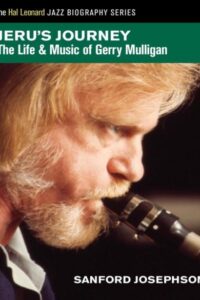
Remembering Gerry Mulligan, born on this day in 1927.
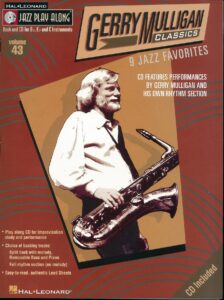
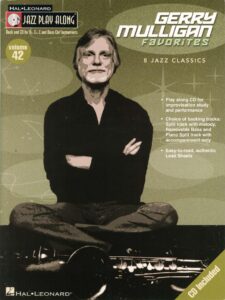
Best Sheet Music download from our Library.
Please, subscribe to our Sheet Music Library.
If you are already a subscriber, please, check our NEW SCORES’ page every month for new sheet music. THANK YOU!
Gerry Mulligan: The Baritone Saxophone’s Poet of Cool
On April 6, 1927, in the Queens Village neighborhood of New York City, a singular voice in American music entered the world. Gerald Joseph Mulligan—known simply as Gerry—grew up to become one of the most distinctive, influential, and beloved figures in jazz history. Though celebrated primarily as the baritone saxophonist who transformed his instrument’s possibilities, Mulligan was also a visionary arranger, a sophisticated composer, and an innovative bandleader whose career spanned five decades. From the landmark “Birth of the Cool” sessions with Miles Davis to the revolutionary piano‑less quartet with Chet Baker, from his powerful Concert Jazz Band to his later orchestral works, Mulligan consistently pushed the boundaries of jazz while remaining deeply rooted in melody and swing. His legacy endures as that of a musician who embodied the very spirit of “cool.”
Early Life and the Making of an Arranger
Gerry Mulligan was the youngest of four sons born to George and Louise Mulligan. His father worked as an engineer, which meant the family moved frequently, but music remained a constant presence. Mulligan first studied piano at age seven before learning the clarinet. It was during his family’s relocation to Philadelphia that his professional path began to crystallize. At just sixteen, the determined young musician approached Johnny Warrington, the director of the WCAU‑CBS radio orchestra, to offer his arrangements. Though still a high school student, his ambition paid off: Warrington began buying his work. This early success led to arranging for Tommy Tucker’s band and, later, for Elliot Lawrence.
The mid‑1940s was a period of intense creative ferment, and the young Mulligan found himself at its epicenter. He played tenor saxophone in a Philadelphia concert that featured the revolutionary sounds of Charlie Parker and Dizzy Gillespie. In a moment that would foreshadow his own future as a mentor, Parker retrieved Mulligan’s sax from the checkroom and insisted he play. Mulligan was nervous, but Parker’s encouragement gave him a crucial shove at an early age. At nineteen, Mulligan was writing and playing for the Gene Krupa Orchestra, and soon after for the Claude Thornhill Orchestra—a gig that would prove pivotal. During his time with Thornhill, he decided to focus exclusively on the baritone saxophone and began a crucial association with the band’s key arranger, Gil Evans.
The Birth of the Cool and a New Musical Vocabulary
Mulligan’s immersion in the late‑1940s New York jazz scene—alongside innovators such as John Lewis, Charles Mingus, Thelonious Monk, and Miles Davis—led to his involvement in one of the most important recording projects in jazz history: the “Birth of the Cool” sessions. The nonet, co‑led by Miles Davis, sought to create a new, more subtle, and orchestral alternative to the high‑energy, complex lines of bebop. The music was delicate and understated, emphasizing intricate arrangements, unusual instrumental textures (including French horn and tuba), and a lighter, more linear approach to improvisation.
Mulligan’s contributions were immense. He wrote or arranged six of the album’s eleven tunes, including enduring classics like “Jeru,” “Rocker,” and “Venus de Milo.” It was Miles Davis who gave Mulligan the nickname “Jeru”—a name he cherished throughout his life. While the music was recorded in New York, its relaxed, linear feel became synonymous with the laid‑back lifestyle of California and became a key component of what the media began to call “West Coast Jazz.” The project marked a new direction in jazz, one that would define Mulligan’s career. His signature sound—an unusual and irresistible blend of intricate counterpoint and open harmonic space—was first showcased there and became his lasting trademark.

The Piano‑less Quartet: An Accidental Revolution
In 1951, seeking better opportunities, Mulligan hitchhiked to California. It was in Los Angeles that he stumbled upon an innovation that would make him a star. He had been booked to play a club, but the piano provided was a small, 66‑key miniature that he found unsuitable for the group he had in mind. So he simply decided not to use it. This happy accident gave birth to the piano‑less quartet—a format that became his most celebrated and influential ensemble.
With the young, lyrical trumpeter Chet Baker, bassist Carson Smith, and drummer Chico Hamilton, the Gerry Mulligan Quartet created a revolutionary sound. Without a piano to comp chords, the rhythm section (bass and drums) was freed to be more interactive, and the front line of saxophone and trumpet was liberated to create spontaneous, conversational counterpoint. Their music had an airy, open quality, full of space, yet it swung with a gentle, irresistible force. Mulligan experienced an almost psychic rapport with Baker, a level of musical telepathy he had never known before and rarely encountered again.
Their informal live recordings at The Haig jazz club in Los Angeles and in a home studio became the basis for their first records, which were major sellers and brought both Mulligan and Baker international acclaim. The group epitomized the “cool” sound, yet their appeal was immediate and widespread. It was a radical concept, and yet it harkened back to the earliest days of jazz, where collective improvisation reigned supreme. This brilliant collaboration was abruptly halted in mid‑1953 when Mulligan was arrested on narcotics charges and sentenced to six months at a sheriff’s honor farm. Upon his release, Baker had launched a successful solo career, and the original quartet was never fully revived, though they would reunite on occasion.
Musical Style and Harmonic Innovation
Gerry Mulligan’s musical style is a study in contrasts: deeply sophisticated yet seemingly effortless, rooted in tradition yet boldly innovative. His approach to the baritone saxophone was revolutionary. Before Mulligan, the baritone was often used as a comedic or rhythmic anchor in big bands, known for its gruff, heavy sound. Mulligan, in contrast, played the instrument with a light, airy, almost breathy tone that was agile and melodic. He transformed the cumbersome horn into a lyrical, singing voice, capable of the same fleet‑footed lines as a tenor or alto saxophone.
His compositional and arranging style was defined by a love for counterpoint. Influenced by the classical counterpoint of Bach and the collective improvisation of Dixieland jazz, Mulligan built his music around interweaving melodic lines. Instead of relying on a piano to fill out the harmony, he used the independent movement of two or more melodic voices—for example, his baritone with a trumpet or trombone—to create harmonic tension and release. This resulted in an open harmonic space where each note carried more weight and clarity. His approach was often described as polyphonic, a return to the contrapuntal roots of jazz in a modern context.
His harmonic language was subtle and advanced. In pieces such as “Golden Notebooks,” Mulligan creates tension not by setting up a key center but rather with melodic activity, rhythmic rest, and his trademark counterpoint. His music is marked by a rich and even orderly quality, where each musician’s line seems busily looking for a pause—a hole in the music that can be filled with an answering phrase. This intricate interplay produced a texture that was both intellectually engaging and deeply satisfying.
Essential Songs and Compositions
Gerry Mulligan was not merely a brilliant improviser; he was a gifted composer whose tunes have become jazz standards. His melodies are often deceptively simple, but they provide the perfect framework for his contrapuntal explorations.
Browse in the Library:
Or browse in the categories menus & download the Library Catalog PDF:
- “Walkin’ Shoes” (1952): One of his most popular and enduring compositions, this piece features a classic AABA structure and perfectly captures the relaxed, swinging essence of the Mulligan‑Baker quartet.
- “Five Brothers” (1949): This tune, dating back to his early days in New York, has become a standard and a favorite among saxophonists for its memorable melody and chord changes.
- “Line for Lyons” (1952): Another cornerstone of the piano‑less quartet’s repertoire, this composition showcases the intuitive interplay and melodic invention of Mulligan and Baker at their finest.
- “Jeru” (1949): Originally written for the “Birth of the Cool” sessions, this tune is a classic of the cool jazz repertoire and carries his cherished nickname.
- “Venus de Milo” (1949): Another Mulligan original from the “Birth of the Cool” album, this piece is notable for its beautiful, lyrical melody and rich, orchestral arrangement.
- “Curtains” (c. 1963): A later composition that shows Mulligan’s continued growth, this piece has classical overtones and a serene, Baroque‑like feeling.
- “Bark for Barksdale” (c. 1950s): A perky, upbeat tune that demonstrates Mulligan’s ability to write joyful, memorable melodies.
- “My Funny Valentine”: While not a Mulligan original, the quartet’s recording of this Rodgers and Hart standard became a massive hit and a defining performance for both Mulligan and Baker—a breathtaking version that is considered one of the definitive recordings of the song.
Major Collaborations and the Concert Jazz Band
While the quartet with Chet Baker was his most famous collaboration, Mulligan’s career was a tapestry of remarkable partnerships.
- Miles Davis: Beyond the “Birth of the Cool,” Mulligan’s relationship with Davis was foundational, with Davis acting as a mentor and catalyst for the cool jazz movement.
- Claude Thornhill and Gil Evans: His tenure with Thornhill, and his studies with arranger Gil Evans, were crucial in developing his orchestral writing and harmonic concepts.
- Bob Brookmeyer: After Baker, Mulligan formed another classic piano‑less quartet, this time with the brilliant valve trombonist Bob Brookmeyer. Their partnership was equally telepathic, with Brookmeyer’s warm, singing tone and inventive counterpoint providing a perfect foil for Mulligan’s baritone.
- Dave Brubeck: In the late 1960s and early 1970s, Mulligan toured regularly as part of the “Gerry Mulligan / Dave Brubeck Quartet,” a pairing of two of the biggest names in cool jazz that resulted in thrilling musical dialogues.
- The Concert Jazz Band (1960‑1964): This was the culmination of Mulligan’s big‑band dreams. A 13‑piece ensemble with a piano‑less rhythm section, the Concert Jazz Band was a powerful and flexible instrument for his writing. The band’s book, initially based on his small‑group repertoire, was arranged by top‑tier writers like Al Cohn and Bill Holman. They recorded five albums for Verve Records and were hailed for their unity, cohesion, and the leader’s brilliant, swinging arrangements.
- “Gerry Mulligan Meets…” Series: In the late 1950s and early 1960s, Verve Records released a series of albums pairing Mulligan with other jazz giants. These include Gerry Mulligan Meets Ben Webster (a classic album from two giants), Gerry Mulligan Meets Johnny Hodges, Gerry Mulligan Meets Stan Getz, and Gerry Mulligan Meets Thelonious Monk—all treasured documents of jazz history.
- Other Collaborators: His list of collaborators reads like a who’s who of 20th‑century music: Louis Armstrong, Count Basie, Lester Young, Duke Ellington, Billie Holiday, Charles Mingus, Ben Webster, Johnny Hodges, Stan Getz, Art Farmer, Zoot Sims, and many more.
Filmography and Theatre Work
Gerry Mulligan also made forays into film and theatre, both as an actor and as a composer.
Acting Roles:
- I Want to Live! (1958) – as a jazz combo member.
- The Rat Race (1960).
- The Subterraneans (1960) – as Reverend Joshua Hoskins.
- Bells Are Ringing (1960) – as Ella’s blind date, a film starring his then‑partner, Judy Holliday.
- Jazz on a Summer’s Day (1960) – a documentary film of the 1958 Newport Jazz Festival.
Film Composer:
- A Thousand Clowns (1965) – wrote the title theme.
- Luv (1967) – wrote the music for the film version of the Broadway comedy.
- La Menace (1977) – a French film for which he composed the music.
- I’m Not Rappaport (1996) – composed the title theme for this film, released the year of his death.
Theatre:
- Happy Birthday (1974): Mulligan collaborated with Judy Holliday on a musical adaptation of Anita Loos’ play, with Mulligan composing the music and Holliday writing the lyrics. The ambitious project had a workshop production but never reached Broadway.
Later Career, Legacy, and Influence
After his initial burst of fame, Mulligan continued to evolve. He reformed the Concert Jazz Band in the late 1970s, explored orchestral works (including a saxophone concerto commissioned for him), and collaborated with Argentine tango master Ástor Piazzolla. His fascination with trains inspired the 1971 album The Age of Steam, a large‑ensemble masterpiece.
Gerry Mulligan’s legacy is monumental. He is arguably the most influential baritone saxophonist in jazz history, single‑handedly transforming the instrument from a novelty into a legitimate and beautiful voice for melodic improvisation. As a composer and arranger, his work for the “Birth of the Cool” nonet and his own groups helped define the sound of modern jazz. His piano‑less quartet concept was a radical innovation that opened up new possibilities for small‑group interaction, influencing countless musicians who sought to create music with more space and contrapuntal freedom.
He was consistently voted number one in jazz polls worldwide and won a record twenty‑nine consecutive DownBeat Readers Poll awards. In 1995, a year before his death, he was awarded the prestigious NEA Jazz Masters fellowship. Upon his passing, his library and personal effects, including a gold‑plated Conn baritone saxophone, were given to the Library of Congress, cementing his place in American cultural history.
Beyond the technical innovations, Mulligan’s lasting contribution was an attitude—a sense of cool. It was an approach to music that was intelligent, unforced, lyrical, and profoundly swinging. He was a musician who made listeners feel as if they were hearing the past, the present, and the future of jazz all in one tune. As we reflect on his life and work, we hear not just a master of the baritone saxophone, but a true American original.
Additional Information
Gerry Mulligan died on January 20, 1996, in Darien, Connecticut, at the age of 68. His influence has not waned. Modern baritone saxophonists—from Nick Brignola to Gary Smulyan to Lauren Sevian—all acknowledge Mulligan as the foundational voice on the instrument. His compositions remain staples in jazz education, and his recordings continue to sell and inspire new generations of listeners. The piano‑less quartet format, once an accident, is now a standard chamber jazz configuration, used by groups ranging from the Modern Jazz Quartet (in certain configurations) to contemporary trios and duos.
Mulligan also left behind a modest but revealing body of writings and liner notes, demonstrating a sharp, self‑effacing wit. He once described his own music as “a kind of ordered anarchy”—a perfect summary of the balance between structure and freedom that defined his art. In 1999, three years after his death, the Gerry Mulligan Collection opened at the Library of Congress, offering scholars and fans access to his scores, manuscripts, photographs, and instruments. That collection ensures that the man who turned the big, low‑growling baritone saxophone into an instrument of lyric poetry will never be forgotten.
On what would have been his birthday, the jazz world continues to celebrate Gerry Mulligan not only as a musician of rare skill but as an enduring symbol of innovation, elegance, and the enduring power of cool.
Gerry Mulligan – “Jeru’”(1962) (Full Album)
Personnel: Bass – Ben Tucker Congas – Alec Dorsey Drums – Dave Bailey Piano – Tommy Flanagan Saxophone – Gerry Mulligan
Track List:
A1 Capricious 0:00 A2 Here I’ll Stay 5:47 A3 Inside Impromptu 10:47 A4 You’ve Come Home 16:20 B1 Get Out Of Town 22:00 B2 Blue Boy 26:12 B3 Lonely Town 30:51
Released: 1962 Recorded: June 30, 1962 Studio: Nola Penthouse Studio, NYC