Community Musicians, building a worldwide Community Music.
Scores
for all instruments: 15,000+
(active and growing),
over 231,000 pages.
All genres and levels: Jazz & Blues, Rock & Pop, Classical & Contemporary, Film & Musicals;
books & biographies; methods, études, play-along tracks (MP3) for Jazz & Rock.
Access & benefits: US$15.99 one-time payment, valid for lifetime, full Library access.
Table of Contents
Morricone Once Upon a Time in America (piano solo) sheet music, Noten, partitura, spartiti, 楽譜, 乐谱
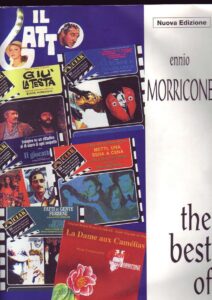
Best Sheet Music download from our Library.

Please, subscribe to our Sheet Music Library.
If you are already a subscriber, please, check our NEW SCORES' page every month for new sheet music. THANK YOU!
Search your favorite sheet music in the Sheet Music Catalog
Echoes of a Lost Time: How Morricone’s Score Defines Once Upon a Time in America
In the pantheon of cinema, few partnerships have been as fruitful and profound as that of director Sergio Leone and composer Ennio Morricone. From the dust-choked plains of The Good, the Bad and the Ugly to the rain-slicked streets of Once Upon a Time in the West, their collaboration redefined the sonic landscape of film. But their final, and perhaps greatest, union was for Leone’s 1984 swan song, Once Upon a Time in America. It is a film about memory, guilt, friendship, and the brutal passage of time. And Morricone did not just score the film; he composed its soul, creating a work so integral that it feels less like accompaniment and more like the very air the characters breathe.
What makes this score so extraordinary begins with its genesis. Unlike almost any other film in history, Morricone wrote the complete score before a single frame was shot. Leone, a master of visual storytelling, would then play Morricone’s themes on set, using the music to guide the actors’ performances and his own directorial eye. This reversed the traditional filmmaking process, elevating the music from a supporting element to a foundational blueprint for the entire picture.
The Architecture of Melancholy
Once Upon a Time in America is not a gangster film about shootouts and power grabs; it is a five-act opera about regret. Morricone’s music, therefore, is not action-driven. It is hauntingly, almost unbearably, nostalgic. The core of the score rests on two monumental themes.
First, there is "Deborah’s Theme." It is the sound of an impossible dream. Woven around a tender, aching melody carried by a solo flute and later swelling into a full string arrangement, the theme represents the ethereal beauty of the girl next door (Deborah) and the pure, innocent love that the protagonist, Noodles, can never truly possess. It is a waltz for a paradise lost, dripping with a sadness that pre-empts the tragedy to come. When we hear it, we are not in the present; we are in the amber glow of a memory that hurts to hold.
Then, there is the film’s main signature, "Cockeye’s Song." Named for the character who carries a harmonica (a nod to Once Upon a Time in the West), this theme is the engine of the film’s time-jumping narrative. Its haunting, repetitive pan-flute melody is deceptively simple, but it functions as a musical representation of obsession. It’s the sound of a man trapped in a single, unresolved moment from his past. The melody circles back on itself, just as Noodles’ mind circles back to the opium den and the betrayal that shattered his life. It is not a tune of action, but of anticipation—the agonizing wait for a phone to ring, for a secret to be revealed, for a lifetime to be undone.
Dissonance and Innocence
Morricone’s genius also lies in his use of dissonance and unexpected textures. The cue "Poverty" is a jarring, almost avant-garde piece that blends twangy electric guitars, plucked strings, and discordant voices. It perfectly captures the gritty, desperate energy of the Lower East Side ghetto where the young protagonists learn to survive. It is ugly, beautiful, and vital.
In stark contrast is the children’s theme, a playful, plucked melody that accompanies the young gang’s exploits. The most heartbreaking use of this innocence comes with "Amapola (Parte Seconda)." As the adolescent Noodles watches the adult Deborah perform on a theater stage, the diegetic, slightly schmaltzy song "Amapola" slowly transforms into Morricone’s own non-diegetic theme. The camera pushes in on the young boy’s face, and for a single, perfect moment, we see all his desire, inadequacy, and future tragedy reflected back. The music bridges the gap between the cheap reality and his grand, impossible fantasy.
The Final, Silent Gasp
The true power of Morricone’s score is only fully realized in the film’s infamous, ambiguous final sequence. After a lifetime of guilt, Noodles lies in an opium den, smiling enigmatically. As the camera slowly pushes in, the sound of a garbage truck’s crushing blades gives way to the sublime, ascending choir of "Eatimi." The music swells into a heavenly, almost religious crescendo, then suddenly cuts to silence.
What follows is a reprise of the childhood theme, but it’s distorted, slowed down, and exhausted. The partying boys in the moving van are now spectral figures from a half-remembered dream. The music doesn’t provide answers; it provides the emotional texture of a man choosing to live forever in his most precious memory, rather than face a reality he destroyed.
At that moment, Morricone does not tell us what happened. He tells us how it feels. He confirms that time is the ultimate gangster, stealing everything, leaving only the echoes of a melody.
A Legacy Beyond Film
Morricone’s score for Once Upon a Time in America is not merely a collection of beautiful themes. It is a masterclass in narrative psychology. It is a symphony of regret, a tone poem for a broken clock. The music is so potent that it often overwhelms the image, existing in the memory as vividly as De Niro’s tired eyes or the slow dance of dust motes in a speakeasy.
While the Academy Awards famously ignored the film upon its release (nominating Morricone for the inferior The Mission instead), time has corrected the record. The score stands as the composer’s own personal favorite and, for many listeners, the definitive statement of his career. It is the sound of a perfect marriage between a director who saw life as a tragic epic and a composer who knew that every epic, no matter how grand, ends in a quiet, lonely whisper. Listen to it with your eyes closed, and you have already seen the whole film. You have already lived a lifetime.