Community Musicians, building a worldwide Community Music.
Scores
for all instruments: 15,000+
(active and growing),
over 231,000 pages.
All genres and levels: Jazz & Blues, Rock & Pop, Classical & Contemporary, Film & Musicals;
books & biographies; methods, études, play-along tracks (MP3) for Jazz & Rock.
Access & benefits:US$15.99 one-time payment, valid for lifetime, full Library access.
Roy Orbison wasn’t your typical rock and roll star. Long before the term “singer-songwriter” was commonplace, he was crafting intricate, emotionally devastating mini-symphonies that owed as much to opera and bolero as they did to the rockabilly roots of his Texas youth. Born on this day, April 23, 1936, he was a true original — an unlikely pop icon whose soaring, operatic voice and dark, introspective ballads carved out a unique and enduring place in musical history. From the dusty oil fields of West Texas to the tragic heights of fame and heartbreak, Orbison’s story is one of extraordinary talent, unimaginable personal loss, and a final, triumphant return to the spotlight.
A Small-Town Boy with a Big Voice
Roy Kelton Orbison was born in Vernon, Texas, the second of three sons to Orbie Lee, an oil-field driller, and Nadine, a nurse. His childhood was steeped in music; for his sixth birthday, he wanted a harmonica, but his father gave him a guitar, a pivotal moment that ignited a lifelong passion. He wrote his first song, "A Vow of Love," at the age of eight. The family later moved to the tiny town of Wink (population 1,000), where Roy was surrounded by a rich musical stew of country, western swing, and the sounds of neighbouring Mexican radio stations.
By 13, he had formed his first band, The Wink Westerners, which played a mix of country standards and pop hits on local radio. The group evolved into rockabilly act The Teen Kings, and while briefly attending North Texas State College, Orbison and his bandmates recorded a catchy, loping track called “Ooby Dooby.” The song caught the ear of legendary Sun Records producer Sam Phillips, who signed the young Orbison in 1956, hoping he might fill the void left by a rising star named Elvis Presley.
Crafting the Orbison Sound
What truly set Orbison apart was his singular musical style. Though he shared the same rockabilly roots as Sun labelmates Carl Perkins and Johnny Cash, he quickly moved beyond them, pioneering an entirely different brand of music. His songs abandoned the standard verse-chorus-verse structure, often building without a clear chorus to a shattering, operatic climax. With his frequent collaborators Joe Melson and Bill Dees, and under the sympathetic production of Fred Foster, Orbison created lush, symphonic soundscapes where he famously used violins in a rock context and his own multi-octave voice became the lead instrument, effortlessly moving from a tender, vulnerable croon to a powerful, controlled wail. This unique approach earned him nicknames like “the Caruso of Rock” and “the Big O”.
The Golden Years: A String of Heartbreak Hits
Orbison’s true breakthrough came after he signed with Monument Records in Nashville. In 1960, he recorded a song he had offered to both Elvis Presley and the Everly Brothers — both of whom turned it down. That song was "Only the Lonely," and its soaring, dramatic arrangement established a new sound in rock and roll, soaring to No. 2 on the Billboard charts and No. 1 in the UK. It launched a run of unforgettable hits, many of which he wrote or co-wrote, that explored the depths of loneliness and longing: the paranoia-fueled crescendo of “Running Scared” (1961), the tear-stained “Crying” (1961), the dreamlike epic “In Dreams” (1963), and the definitive kiss-off anthem “It’s Over” (1964).
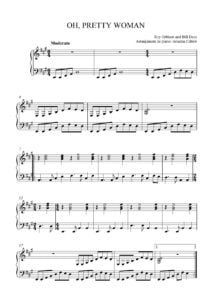
At the height of Beatlemania in 1963, he was invited to tour the UK as the opening act for The Beatles, who openly idolized him. Such was his power that on the first night, a motionless, black-clad Orbison performed fourteen encores before the Fab Four could even take the stage. In 1964, he co-wrote and recorded his signature song, the iconic "Oh, Pretty Woman," which became a global No. 1 and cemented his status as a legend. During this golden period, 22 of his singles reached the Billboard Top 40, and six peaked in the top five.
If you are already a subscriber, please, check our NEW SCORES' page every month for new sheet music. THANK YOU!
A Shadow of Sorrow: Personal Tragedies
Just as his career reached its zenith, Orbison’s life was struck by a series of almost unimaginable personal tragedies. In 1966, his first wife, Claudette Frady, the subject of many of his youthful songs, was killed in a motorcycle accident; Roy was riding just ahead of her when it happened. Devastated, he found it difficult to write but continued to tour relentlessly.
Two years later, while he was on tour in England, a fire swept through his Nashville-area home, killing his two eldest sons, Roy DeWayne (10) and Anthony King (6). The compounded grief was a blow from which he never fully recovered, and it was reflected in music that seemed to carry an even heavier, more profound sense of loss. In 1969, he married a young German woman, Barbara Wellhonen, who became a stabilizing force in his life, and they later had two sons.
The Quiet Legend and a Stunning Return
Throughout the 1970s, his career faltered as musical tastes changed, but his audience remained loyal, especially in Europe. A resurgence began in the 1980s, spurred by a new generation of artists who revered him, including Linda Ronstadt, whose cover of “Blue Bayou” became a smash, and Don McLean, who covered “Crying.” In 1980, a duet with Emmylou Harris, “That Lovin’ You Feeling Again,” won a Grammy Award. David Lynch’s haunting use of “In Dreams” in the 1986 film *Blue Velvet* introduced Orbison’s music to a disquieting new context while reaffirming its timeless power.
The pinnacle of his comeback, however, was the formation of the supergroup "The Traveling Wilburys" in 1988, alongside George Harrison, Bob Dylan, Tom Petty, and Jeff Lynne. Billed as half-brothers from a fictional traveling family, the group’s debut album was a joyous, collaborative triumph that topped the charts and reminded the world of the singular power of Orbison’s voice alongside his illustrious peers.
A Career Cut Short and a Posthumous Triumph
With his career soaring again, Orbison completed work on a new solo album, *Mystery Girl*, produced by Lynne. But on December 6, 1988, at the age of 52, he suffered a fatal heart attack at his mother’s home in Hendersonville, Tennessee, just weeks before its release. His death sent a shockwave through the music world, leaving his comeback story heartbreakingly incomplete.
Yet, his music continued to break new ground. *Mystery Girl* was released posthumously and became his most successful studio album, spawning the global hit single “You Got It,” which became his first Top 10 hit in nearly 25 years. The Traveling Wilburys’ poignant video for “End of the Line” featured a guitar rocking in an empty chair, a silent tribute to their absent friend.
Honours and a Timeless Legacy
Orbison’s status as a giant of popular music is enshrined in a long list of honours. He was inducted into the Rock and Roll Hall of Fame in 1987 by a reverential Bruce Springsteen and into the Songwriters Hall of Fame in 1989. He was the recipient of six Grammy Awards, including the Lifetime Achievement Award in 1998, having won Grammys in pop, rock, and country categories. In 2010, he was posthumously awarded the 2,400th star on the Hollywood Walk of Fame. *Rolling Stone* magazine ranked him No. 37 on its list of the "Greatest Artists of All Time" and No. 13 on its list of the "100 Greatest Singers of All Time". His music remains culturally omnipresent, from film soundtracks to the Royal Philharmonic Orchestra’s 2017 album adding new orchestral arrangements to his original vocal.
Roy Orbison's legacy is not defined solely by chart positions or awards, but by the profound emotional resonance of his music. He gave voice to heartache, vulnerability, and longing at a time when rock and roll prized bravado, creating a body of work that remains deeply intimate and universally understood. His was a career marked by glittering highs and unthinkable lows, a testament to the enduring power of a voice that could, in the space of three breathtaking minutes, convey the very heart of human sorrow and the ecstasy of love. Though he left the stage far too soon, the mysterious, bespectacled man in black continues to whisper and wail in the dark, ensuring that for generations to come, he will never be forgotten.